The 50+ Reviews Threshold: Minimum Volume for AI Citation Consideration
Discover why 50+ reviews is the critical threshold for AI citation. Learn how review volume impacts LLM recommendations and brand visibility across ChatGPT, Perplexity, and Google AI Overviews.
Published on Jan 3, 2026.Last modified on Jan 3, 2026 at 3:24 am
Review volume is the foundational metric that determines whether your business gets cited by AI systems at all. When large language models and AI citation engines scan the web for information about your company, they’re not just looking for any mention—they’re evaluating the consistency and prevalence of your presence across multiple platforms. A single glowing review might impress a human customer, but AI systems require repetition and scale to build confidence in your credibility. The more reviews you accumulate across trusted platforms, the stronger the signal you send to AI algorithms that your business is legitimate, reliable, and worth recommending. This is why minimum review thresholds have become a critical factor in AI visibility and citation likelihood.
The 50+ Reviews Threshold Explained
The 50+ reviews threshold represents a critical inflection point where AI systems begin to treat your business as a credible citation source. According to research from Semrush, repetition across multiple platforms builds confidence in AI systems, and reaching 50 reviews signals that your business has achieved meaningful market validation. Below this threshold, AI systems may overlook your business entirely or deprioritize it in favor of competitors with stronger review signals. At 50+ reviews, you cross into a zone where AI citation algorithms recognize your business as having sufficient social proof to warrant inclusion in responses. The impact becomes even more pronounced as you climb higher—businesses with 100+ reviews see dramatically different treatment from AI systems compared to those with 20-30 reviews.
Review Volume Range
AI Citation Likelihood
Competitive Position
Conversion Impact
0-20 reviews
Very Low
Disadvantaged
Minimal
21-49 reviews
Low
Competitive Gap
Limited
50-99 reviews
Moderate
Competitive
Measurable
100-199 reviews
High
Strong Advantage
Significant
200+ reviews
Very High
Market Leader
Substantial
Ready to Monitor Your AI Visibility?
Track how AI chatbots mention your brand across ChatGPT, Perplexity, and other platforms.
Large language models assess review volume through multi-factor evaluation mechanisms that go beyond simple counting. When an LLM encounters your business during a search or citation task, it analyzes the distribution of reviews across platforms, the recency of those reviews, and the consistency of sentiment to determine trustworthiness. AI systems use sophisticated algorithms to detect patterns—they’re looking for whether reviews are concentrated on a single platform (potentially suspicious) or distributed across multiple authoritative sources (more credible). The technical assessment also considers review velocity, meaning how quickly you’re accumulating new reviews, as this signals ongoing customer engagement. According to Yext’s research on 6.8M AI citations, 86% come from brand-managed sources, indicating that AI systems can distinguish between organic and managed review sources. This means that reaching 50+ reviews through legitimate customer feedback carries significantly more weight than artificially inflated numbers.
Review Platforms That Matter Most to AI
Not all review platforms carry equal weight in AI citation algorithms. The platforms that AI systems prioritize most heavily include:
Google Reviews - The most influential platform for local AI citations and general business credibility
Trustpilot - Highly trusted by AI systems for comprehensive review data and verified customer feedback
Capterra & G2 - Essential for SaaS and software companies seeking AI visibility in product recommendations
Industry-Specific Platforms - Yelp for restaurants/services, Zillow for real estate, AppStore for apps
LinkedIn Recommendations - Increasingly important for B2B credibility and professional services
Amazon Reviews - Critical for e-commerce businesses and product-based companies
The concentration of your 50+ reviews across these platforms matters significantly. AI systems weight reviews from established, verified platforms much more heavily than from obscure or unverified sources. Spreading your review volume strategically across 3-4 major platforms is more effective than concentrating all reviews in a single location.
Stay Updated on AI Visibility Trends
Get the latest insights on AI mentions, brand monitoring, and optimization strategies.
The Quality vs. Quantity Paradox
While reaching 50+ reviews is essential for AI citation, the quality-quantity paradox reveals an important nuance: not all reviews are created equal. Digitaloft’s research emphasizes that the quality of mentions matters, meaning that five detailed, specific reviews with high ratings carry more weight than fifty generic one-star reviews. AI systems use natural language processing to evaluate review content, looking for specificity, authenticity, and relevance rather than just counting raw numbers. A business with 45 detailed, positive reviews might actually outrank a competitor with 75 generic or negative reviews in AI citation algorithms. However, this doesn’t diminish the importance of reaching 50+—it simply means that your strategy should focus on both volume and quality simultaneously. The sweet spot is achieving 50+ reviews while maintaining an average rating of 4.0 stars or higher and ensuring that reviews contain substantive feedback about your products or services.
Building to 50+ Reviews: Strategic Approach
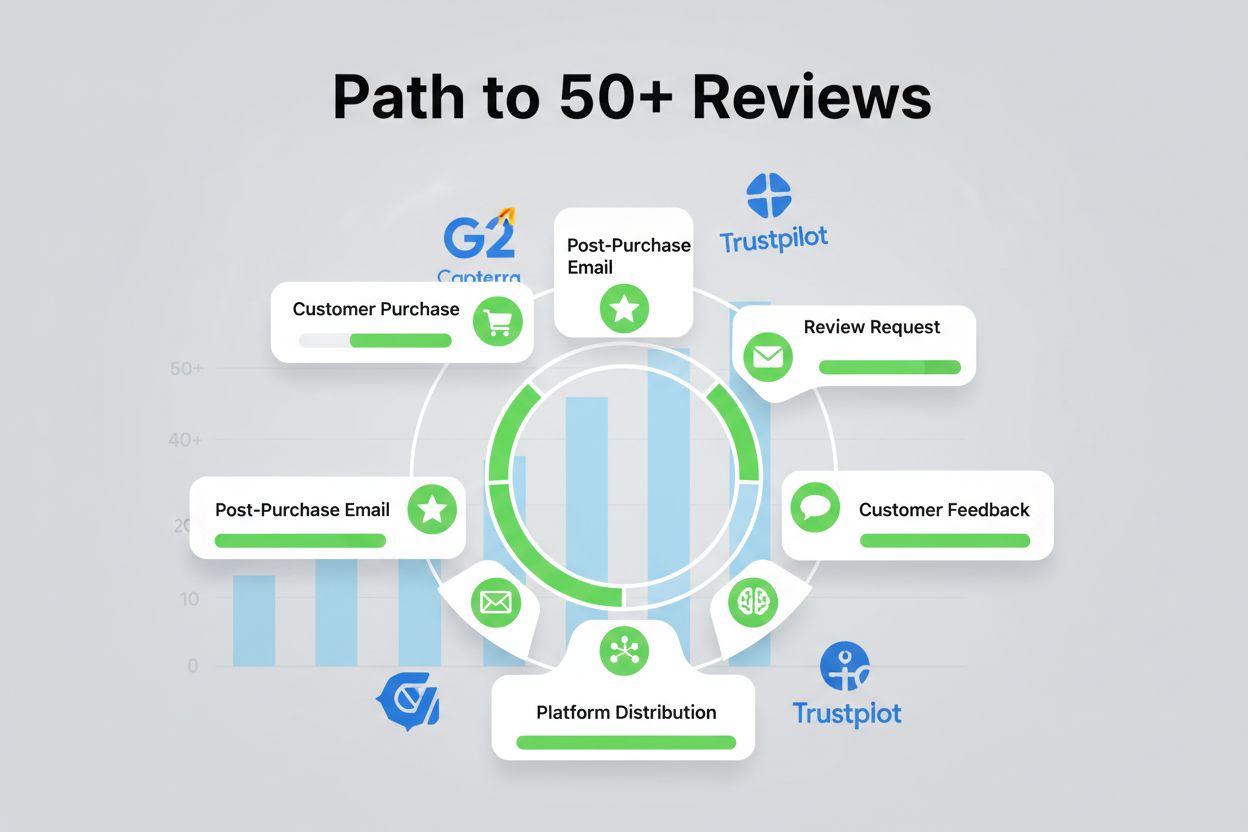
Reaching 50+ reviews requires a systematic, multi-channel strategy rather than hoping customers will naturally leave feedback. Here’s a structured approach to build your review volume strategically:
Audit your current review presence across all major platforms and identify gaps where you’re underrepresented
Implement post-purchase email campaigns that encourage satisfied customers to leave reviews within 24-48 hours of their experience
Create platform-specific review requests tailored to each platform’s audience and review style
Train your team to identify promoters during customer interactions and direct them to review platforms
Develop incentive programs (compliant with platform guidelines) that reward customers for leaving detailed reviews
Monitor competitor review strategies to understand which platforms and messaging resonate in your industry
Establish a review response protocol to engage with all reviews, both positive and negative, demonstrating active management
Leverage multiple touchpoints—SMS, in-app notifications, QR codes, and direct links—to reduce friction in the review process
This systematic approach typically accelerates the path to 50+ reviews by 3-6 months compared to passive strategies.
The Competitive Advantage of 50+ Reviews
Businesses that cross the 50+ review threshold gain measurable competitive advantages in AI visibility and customer conversion. Research from Roketto demonstrates that companies with strong review signals see 67% more AI responses when customers search for solutions in their category, and these AI-driven referrals convert at 4.4x higher rates than cold traffic. This isn’t coincidental—AI systems are programmed to recommend businesses with strong social proof signals, and 50+ reviews represents the minimum credibility threshold that triggers this preferential treatment. The competitive gap widens further when you consider that many businesses in your industry likely have fewer than 50 reviews, meaning you’re automatically positioned ahead of the majority of your competition. Additionally, reaching this threshold creates a virtuous cycle: higher AI visibility leads to more customer interactions, which generates more reviews, which further improves AI visibility. Companies that achieve and maintain 50+ reviews across multiple platforms report 2-3x higher organic discovery rates compared to their pre-threshold performance.
Monitoring and Maintaining Review Momentum
Reaching 50+ reviews is not a finish line—it’s the beginning of an ongoing optimization process. Review momentum is a critical metric that AI systems monitor continuously, meaning that your review velocity (new reviews per month) matters as much as your total count. A business that accumulated 50 reviews over two years and then stopped generating new feedback will gradually lose competitive advantage to competitors who maintain steady review growth. Effective monitoring requires tracking several key metrics: total review count across all platforms, average rating trends, review sentiment analysis, response rate to customer feedback, and review velocity. Many businesses make the mistake of celebrating reaching 50 reviews and then deprioritizing their review generation strategy, only to watch their competitive position erode as competitors continue building. The most successful businesses treat review management as an ongoing operational priority, not a one-time project. This means maintaining your post-purchase email campaigns, continuing to train staff on review requests, and regularly analyzing which platforms and messaging strategies drive the highest-quality feedback. Quarterly reviews of your review strategy ensure you’re adapting to platform algorithm changes and customer behavior shifts.
AmICited’s Role in Review Volume Monitoring
Managing review volume across multiple platforms and tracking the metrics that matter to AI systems can quickly become overwhelming without the right tools. AmICited provides a centralized platform for monitoring your review volume, tracking progress toward and beyond the 50+ threshold, and understanding how your review metrics translate into AI citation visibility. Rather than manually checking Google Reviews, Trustpilot, Capterra, and industry-specific platforms separately, AmICited aggregates this data into actionable dashboards that show your review velocity, competitive positioning, and AI citation impact. The platform helps you identify which review platforms are driving the most AI citations in your industry, where your review gaps exist, and which customer segments are most likely to leave detailed feedback. By connecting your review volume data directly to AI citation outcomes, AmICited transforms review management from a guessing game into a data-driven strategy. If you’re serious about achieving and maintaining the 50+ review threshold that AI systems require, having visibility into how your review efforts translate into actual AI citations is essential—and that’s exactly what AmICited delivers.
Frequently asked questions
What exactly is the 50+ reviews threshold?
The 50+ reviews threshold is the critical inflection point where AI systems begin treating your business as a credible citation source. Below this threshold, AI systems may overlook your business entirely or deprioritize it in favor of competitors with stronger review signals. At 50+ reviews, you cross into a zone where AI citation algorithms recognize your business as having sufficient social proof to warrant inclusion in responses.
Why is 50 reviews the magic number for AI citation?
Research shows that 50% correct data is the minimum threshold needed for AI models to consistently recover strong performance. This principle extends to review volume—50 reviews represents the point where AI systems have enough data to confidently assess your business credibility. Below this number, the signal is too weak; above it, the confidence increases exponentially.
Do all review platforms count equally toward the 50+ threshold?
No, not all platforms carry equal weight. Google Reviews, Trustpilot, Capterra, and G2 are weighted most heavily by AI systems. Spreading your 50+ reviews strategically across 3-4 major platforms is more effective than concentrating all reviews in a single location. Industry-specific platforms also carry significant weight depending on your business type.
How long does it take to reach 50+ reviews?
With a systematic review generation strategy, most businesses can reach 50+ reviews within 3-6 months. This timeline depends on your customer volume, industry, and how aggressively you implement review request campaigns. Passive strategies without dedicated effort typically take 12-24 months or longer.
What happens if reviews drop below 50?
If your review count drops below 50 (which is rare unless reviews are removed), your AI citation visibility will decline. However, the bigger concern is review velocity—AI systems monitor how quickly you're accumulating new reviews. Stagnant review counts signal declining customer engagement, which negatively impacts AI recommendations.
Can fake or low-quality reviews help reach the threshold?
Absolutely not. AI systems use sophisticated natural language processing to detect fake, generic, or low-quality reviews. Fake reviews can actually harm your credibility more than having fewer authentic reviews. Focus on generating genuine customer feedback with specific details about your products or services.
How does AmICited help monitor review volume impact on AI citations?
AmICited aggregates your review data across all major platforms and connects it directly to your AI citation outcomes. Rather than manually checking multiple review sites, you get a centralized dashboard showing your review velocity, competitive positioning, and exactly how your review metrics translate into actual AI citations.
What's the next milestone after reaching 50+ reviews?
After reaching 50+ reviews, focus on maintaining steady review velocity (new reviews per month) and climbing toward 100+ reviews, which represents a significant competitive advantage. The next milestone is achieving 100+ reviews with an average rating of 4.5+ stars, which positions you as a market leader in AI citation visibility.
Monitor Your AI Citations Across All Platforms
Track how your review volume translates into AI citations with AmICited. Get real-time insights into your brand visibility across ChatGPT, Perplexity, Google AI Overviews, and more.
How much do reviews actually matter for AI recommendations? Seeing mixed signals
Community discussion on how customer reviews impact AI recommendations. Marketers and business owners share data on review quantity, quality, and platform influ...
Learn the optimal content depth, structure, and detail requirements for getting cited by ChatGPT, Perplexity, and Google AI. Discover what makes content citatio...
Learn what AI citation thresholds are, how they work across ChatGPT, Perplexity, and Google AI Overviews, and strategies to meet them for better AI visibility.
12 min read
Cookie Consent We use cookies to enhance your browsing experience and analyze our traffic. See our privacy policy.