

How to Fix Low AI Visibility for Your Brand
Learn proven strategies to improve your brand's visibility in AI search engines like ChatGPT, Perplexity, and Gemini. Discover content optimization, entity cons...
8 min read
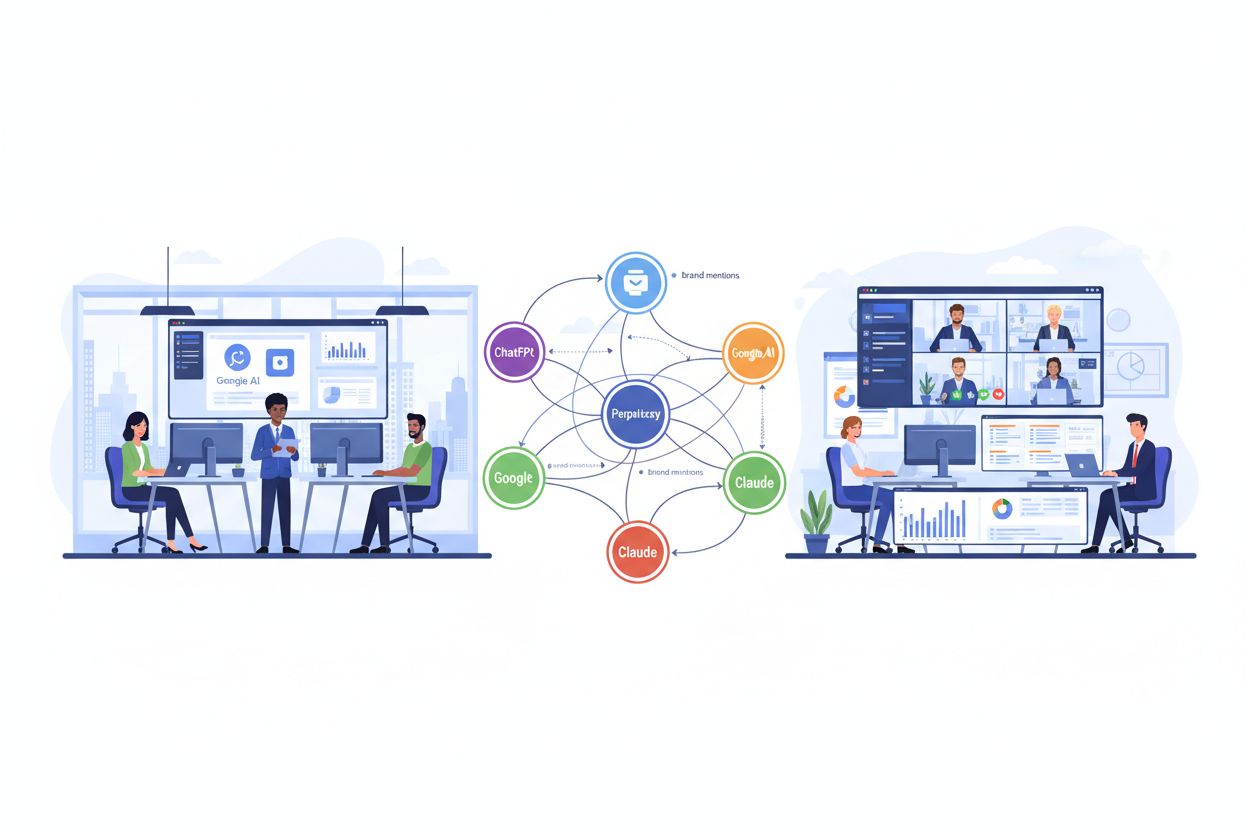
Compare agency vs in-house AI visibility monitoring. Explore costs, timelines, expertise requirements, and hybrid approaches to help you choose the right strategy for your brand.
AI visibility refers to how frequently and in what context your brand appears in responses generated by large language models (LLMs) like ChatGPT, Perplexity, Google AI Overviews, and Claude. Unlike traditional search engine optimization, which focuses on ranking in Google’s search results, AI visibility monitoring tracks whether your brand is cited, mentioned, or recommended when users ask AI systems questions related to your industry. This distinction matters because AI-generated answers now influence purchasing decisions, brand perception, and customer trust—often before users ever click through to traditional search results.
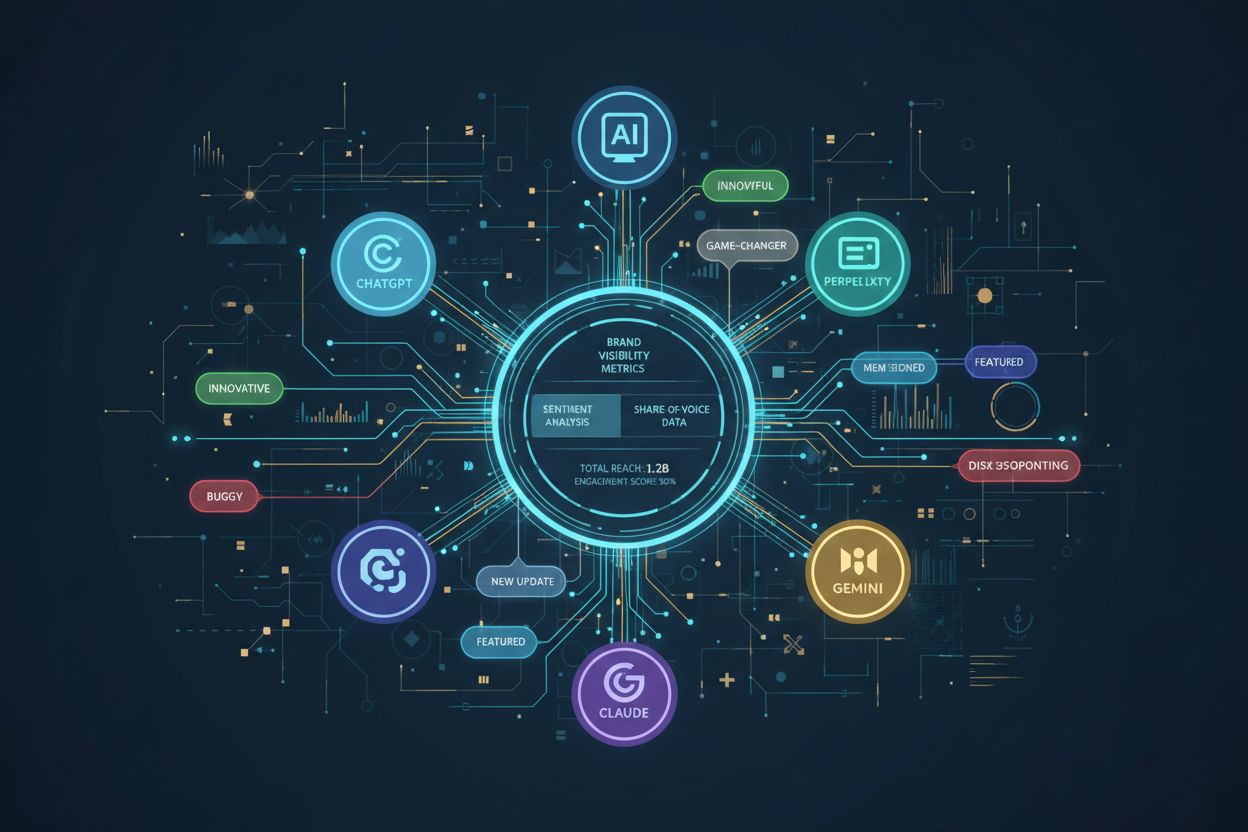
Building an internal AI visibility team gives your organization complete control over monitoring strategy, data handling, and optimization decisions. Your team becomes deeply familiar with your brand’s unique positioning, competitive landscape, and business objectives, enabling highly customized monitoring and rapid response to changes in AI-generated answers. However, this approach requires significant investment: you’ll need to hire specialists (AI analysts, data scientists, content strategists), invest in monitoring tools and infrastructure, and allocate time for ongoing training as AI platforms evolve.
Key advantages of in-house AI visibility:
Key challenges of in-house AI visibility:
Marketing agencies and specialized AI visibility firms offer a fundamentally different approach: they bring pre-built expertise, established processes, and access to advanced monitoring tools without requiring you to build internal capabilities. Agencies excel at rapid deployment, having already solved common implementation challenges for multiple clients. They can quickly identify which AI platforms matter most for your industry, set up comprehensive monitoring, and provide strategic recommendations based on cross-industry insights.
The trade-off is reduced control over day-to-day operations and data handling. You’re also dependent on the agency’s priorities and resource allocation, which can sometimes conflict with your urgent needs. Additionally, agencies may have less intimate knowledge of your brand’s nuances compared to an internal team, potentially missing context-specific optimization opportunities.
The financial implications of choosing between in-house and agency AI visibility are substantial. Building an in-house team typically requires $80,000-$150,000 annually per specialist, plus tool subscriptions ($5,000-$20,000/year), infrastructure costs, and training expenses. For a small team of 2-3 people, you’re looking at $200,000-$500,000+ annually before seeing meaningful results.
Agency retainers typically range from $5,000-$50,000 monthly depending on scope, with most mid-market brands spending $15,000-$30,000 monthly. While this seems expensive, it often includes strategy, implementation, and ongoing optimization—services you’d need to build internally.
| Cost Factor | In-House (Annual) | Agency (Annual) | Hybrid (Annual) |
|---|---|---|---|
| Personnel | $200,000-$500,000 | $0 | $100,000-$250,000 |
| Tools & Software | $5,000-$20,000 | Included | $5,000-$15,000 |
| Infrastructure | $10,000-$30,000 | Included | $5,000-$15,000 |
| Training & Development | $5,000-$15,000 | Included | $2,000-$5,000 |
| Total Year 1 | $220,000-$565,000 | $60,000-$600,000 | $112,000-$285,000 |
| Ongoing (Year 2+) | $200,000-$500,000 | $60,000-$600,000 | $100,000-$250,000 |
Effective AI visibility monitoring requires a specific skill set that’s still relatively rare in the job market. In-house teams typically need: an AI visibility specialist or analyst (who understands LLM behavior and monitoring tools), a content strategist (who can optimize content for AI citation), and ideally a data analyst (who can interpret trends and create actionable insights). Finding professionals with deep expertise in this emerging field is challenging—most are either transitioning from SEO or coming from AI-focused companies.
Agencies solve this problem by assembling teams with diverse backgrounds: former SEO professionals, data scientists, content strategists, and AI researchers. This diversity of expertise means they’ve encountered more use cases and can apply lessons from one industry to another. However, you lose the benefit of having team members who are fully dedicated to your brand’s success.
If you need AI visibility monitoring operational quickly, agencies have a clear advantage. Most agencies can have basic monitoring running within 2-4 weeks: they’ll audit your current AI visibility, set up tracking across major platforms, and deliver initial insights. Full implementation with optimization recommendations typically takes 4-8 weeks.
In-house teams face a longer timeline. Recruiting qualified candidates takes 4-8 weeks, onboarding and training takes another 4-6 weeks, and setting up monitoring infrastructure takes 2-4 weeks. By the time your in-house team is fully operational, 12-28 weeks may have passed. For companies in competitive markets where every week of visibility matters, this delay can be costly.
Data handling is a critical consideration, especially for regulated industries like healthcare, finance, and legal services. In-house teams maintain complete control over where data is stored, who accesses it, and how it’s processed. You can implement custom security protocols, ensure compliance with GDPR, HIPAA, or other regulations, and maintain full audit trails.
Agencies handle data differently depending on their infrastructure. Enterprise-grade agencies (like Profound) offer SOC2 compliance, role-based access controls, and transparent data handling practices. However, you’re trusting a third party with sensitive information about your brand’s visibility and competitive positioning. Hybrid approaches often address this by keeping sensitive data in-house while outsourcing monitoring and analysis.
In-house teams face scalability challenges. Adding new brands, expanding to new markets, or increasing monitoring frequency requires hiring additional staff or stretching existing resources. Conversely, reducing scope means managing layoffs or reassigning team members. This inflexibility can be problematic in fast-growing companies or those with seasonal variations in marketing needs.
Agencies scale effortlessly. Need to monitor 50 new prompts next month? They adjust your plan. Expanding to 5 new markets? They add regional tracking. This flexibility is particularly valuable for agencies managing multiple clients, franchises with varying needs, or companies experiencing rapid growth. The trade-off is that you’re dependent on the agency’s capacity and willingness to scale with you.
The AI visibility tool landscape includes several strong options, each with different strengths. SE Visible (from SE Ranking) offers comprehensive multi-platform tracking with excellent sentiment analysis and competitor benchmarking—ideal for brands wanting a dedicated, user-friendly solution. Profound serves enterprise clients with advanced features like CDN integration and real-time traffic attribution. Ahrefs Brand Radar integrates AI visibility into the broader Ahrefs SEO platform, making it ideal for teams already using Ahrefs. Peec AI provides affordable, straightforward monitoring with smart prompt suggestions. Semrush offers AI visibility as part of its broader SEO toolkit. Otterly AI specializes in geographic audits and technical optimization recommendations. ZipTie excels at granular, URL-level analysis. Clearscope combines AI visibility tracking with content optimization and creation tools.
| Tool | Best For | Starting Price | Key Strength |
|---|---|---|---|
| SE Visible | Dedicated AI monitoring | $189/month | User-friendly, comprehensive tracking |
| Profound | Enterprise needs | $82.50/month | Advanced analytics, CDN integration |
| Ahrefs Brand Radar | Existing Ahrefs users | $199/month add-on | Integrated with SEO data |
| Peec AI | Budget-conscious teams | €89/month | Affordable, smart suggestions |
| Semrush | SEO + AI monitoring | $99/month | Integrated platform |
| Otterly AI | Geographic focus | $29/month | Technical audits, local optimization |
| ZipTie | Deep analysis | $58.65/month | URL-level granularity |
| Clearscope | Content creators | $129/month | Content optimization + monitoring |
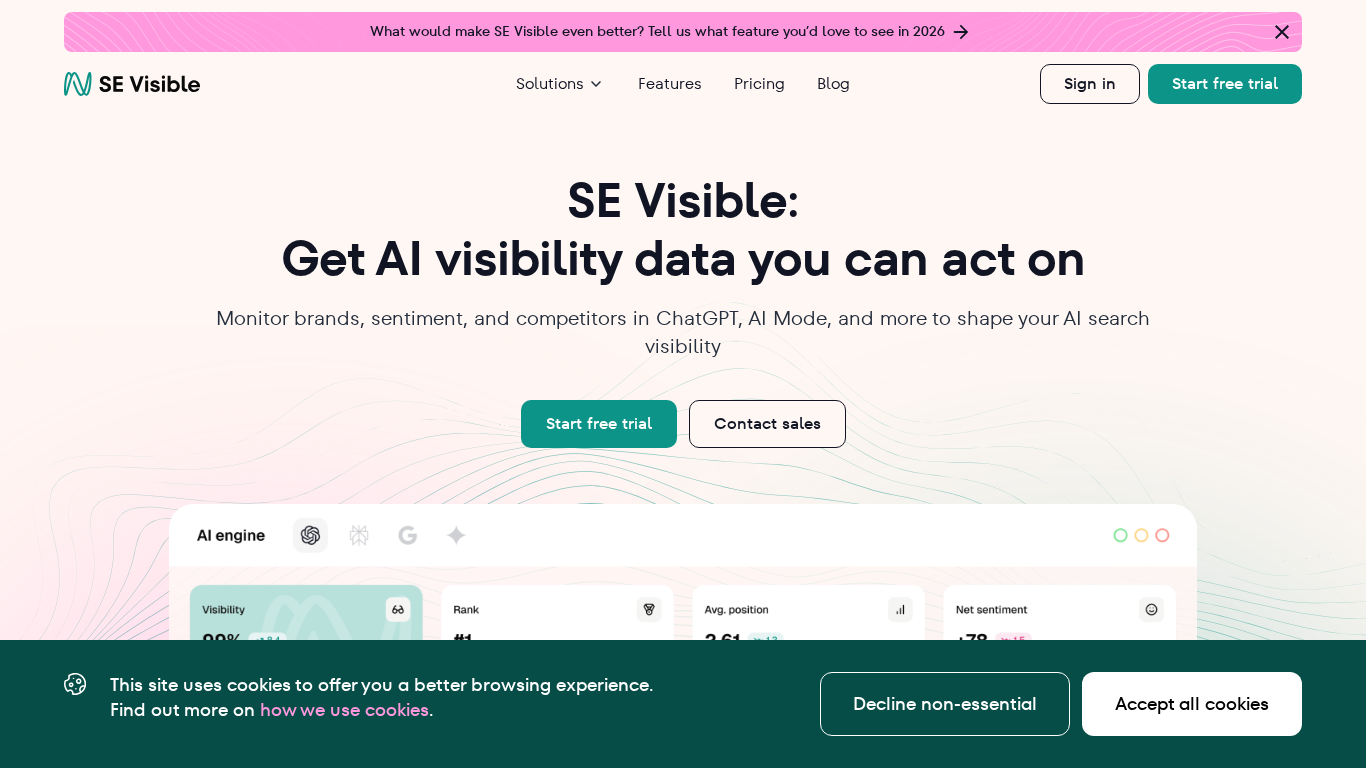
SE Visible stands out as a purpose-built AI visibility platform offering clean dashboards, multi-platform tracking, and strong sentiment analysis. It’s particularly effective for brands wanting a dedicated solution without the complexity of enterprise platforms.
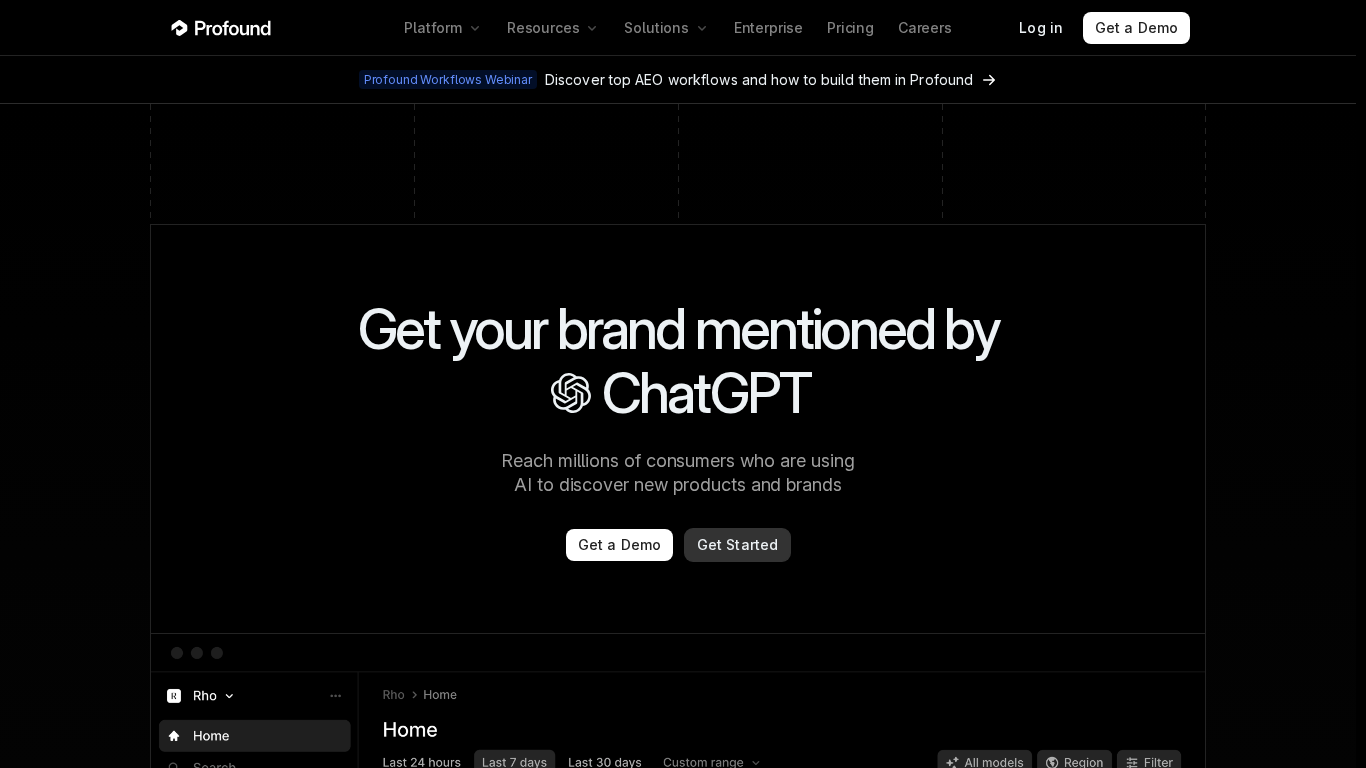
Profound caters to enterprise clients with advanced features including CDN integration, real-time traffic attribution, and comprehensive competitive intelligence. It’s ideal for large organizations with complex monitoring needs.
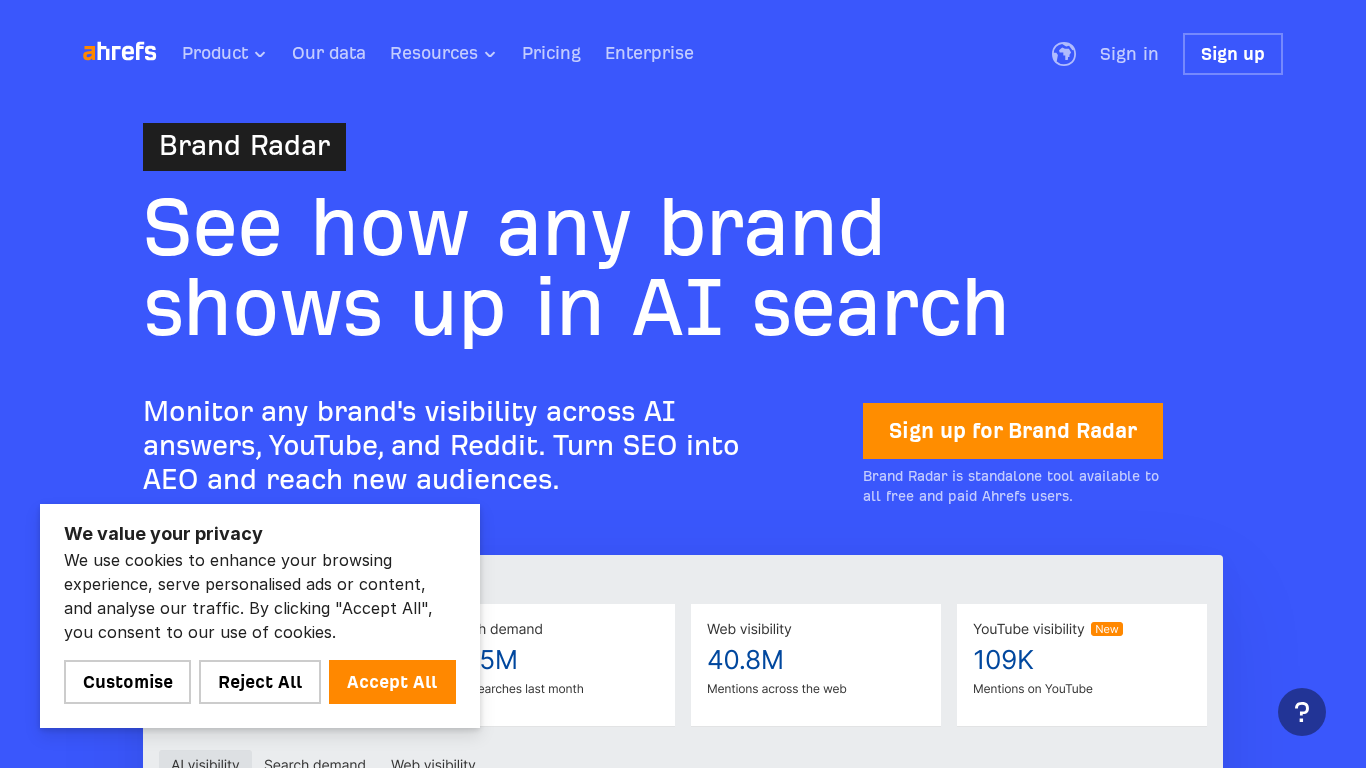
Ahrefs Brand Radar integrates AI visibility tracking into the broader Ahrefs platform, making it ideal for teams already using Ahrefs for SEO. The integration allows you to see how SEO and AI visibility correlate.
The most successful companies don’t choose between in-house and agency—they blend both approaches strategically. A typical hybrid model might involve: outsourcing continuous monitoring and reporting to an agency (leveraging their tools and expertise), while maintaining an in-house content strategist who interprets findings and drives optimization. Another variation: agencies handle initial setup and strategy, then hand off ongoing monitoring to an in-house team. Or: in-house teams focus on proprietary, high-value optimization while agencies handle routine monitoring and competitive intelligence.
Hybrid models work because they balance speed with control, expertise with customization, and cost with capability. You get the agency’s rapid deployment and diverse expertise without losing control over strategic decisions. You maintain in-house knowledge without bearing the full cost of building a complete team. This approach is particularly effective for mid-market companies and enterprises with complex needs.
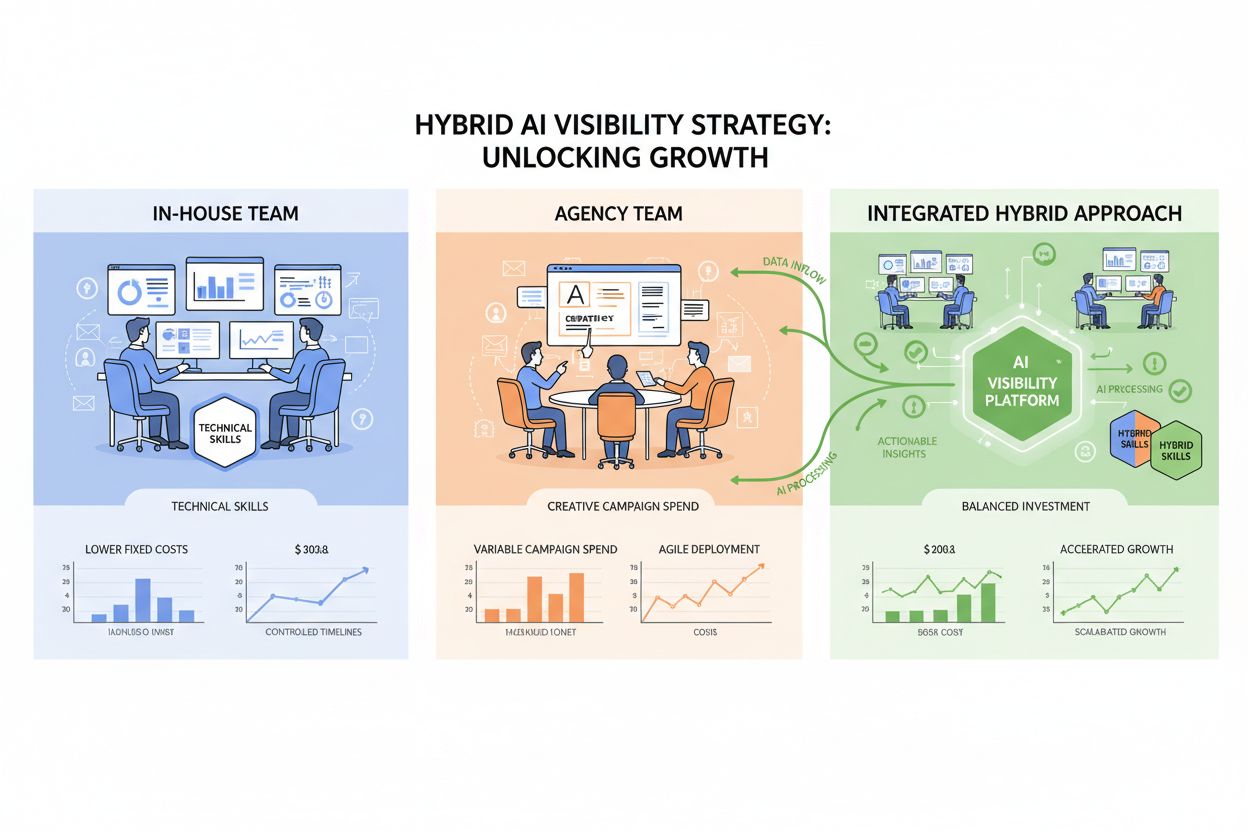
Choosing between in-house, agency, and hybrid approaches requires evaluating several factors:
Budget constraints: If you have $200,000+ annually, in-house becomes viable. Below $100,000, agencies are more cost-effective. Between $100,000-$200,000, hybrid models shine.
Timeline urgency: Need results in weeks? Choose agency. Can wait 3-6 months? In-house is feasible. Need quick wins plus long-term capability? Hybrid.
Expertise availability: Can you recruit AI visibility specialists in your market? In-house is realistic. Struggling to find talent? Agency is necessary.
Data sensitivity: Handling regulated data? In-house offers more control. Comfortable with third-party data handling? Agencies work fine.
Competitive intensity: In highly competitive markets, speed matters—favor agencies or hybrid. In less competitive niches, in-house teams can build deeper advantages.
Growth trajectory: Rapidly scaling? Agencies’ flexibility is valuable. Stable, predictable growth? In-house investment pays off.
Strategic importance: Is AI visibility core to your competitive advantage? In-house investment is justified. Is it important but not core? Agencies suffice.
Regardless of which approach you choose, successful implementation requires attention to change management, team alignment, and success metrics. If building in-house, invest in training—AI visibility is evolving rapidly, and your team needs continuous learning. If hiring an agency, establish clear communication protocols, define success metrics upfront, and schedule regular strategy reviews. For hybrid models, ensure seamless handoffs between in-house and agency teams, with clear ownership of different responsibilities.
Define success metrics before implementation: Are you tracking visibility score improvements, sentiment changes, citation frequency, or traffic attribution? Different metrics require different tools and approaches. Establish baseline measurements, set realistic improvement targets, and review progress monthly. Most importantly, remember that AI visibility is a long-term game—expect 3-6 months before seeing significant improvements, and plan your approach accordingly.
Most brands see initial insights within 2-4 weeks of starting monitoring. Meaningful improvements in visibility typically take 3-6 months, depending on your starting position and the competitiveness of your market. Agencies often deliver faster initial results due to their experience, while in-house teams may take longer to ramp up but can achieve deeper optimization over time.
Yes, this is a common and effective approach. Agencies can establish baseline monitoring, develop initial strategies, and train your team on best practices. After 6-12 months, you can transition to in-house management with the foundation already in place. This reduces the risk of building in-house from scratch.
Traditional SEO focuses on ranking in search engine results pages (SERPs). AI visibility focuses on being cited or mentioned in AI-generated answers. While they're related—authoritative content ranks well in both—the optimization strategies differ. AI visibility requires different content structures, entity optimization, and citation strategies.
Start with the 3-4 platforms where your target audience spends time: ChatGPT, Google AI Overviews, Perplexity, and Claude cover most use cases. As your program matures, expand to Gemini, Copilot, and others. Most brands find that 80% of their AI visibility comes from these major platforms.
It's increasingly important for B2B companies, professional services, e-commerce, and any business where customers research solutions online. If your customers use AI tools to research before buying, AI visibility matters. For highly niche or local businesses, it may be less critical, but the trend is toward universal importance.
AmICited.com specializes in AI visibility monitoring for brands, offering comprehensive tracking across multiple LLM platforms with strong sentiment analysis and competitive benchmarking. It's particularly strong for brands wanting a dedicated, user-friendly solution without the complexity of enterprise platforms. The choice depends on your specific needs, budget, and integration requirements.
ROI varies by industry and implementation approach. Brands typically see 15-40% increases in qualified traffic from AI sources within 6 months of optimization. The real value comes from being cited in high-intent queries where customers are actively researching solutions. Agencies often demonstrate ROI faster, while in-house teams build longer-term competitive advantages.
Make informed decisions about your AI visibility strategy. AmICited.com helps you track how your brand appears across ChatGPT, Perplexity, Google AI Overviews, and other AI platforms.
Learn proven strategies to improve your brand's visibility in AI search engines like ChatGPT, Perplexity, and Gemini. Discover content optimization, entity cons...
Master the Semrush AI Visibility Toolkit with our comprehensive guide. Learn how to monitor brand visibility in AI search, analyze competitors, and optimize for...
Learn what AI visibility reporting is, how it works, and why it's essential for monitoring your brand's presence in ChatGPT, Perplexity, Google AI Overviews, an...