
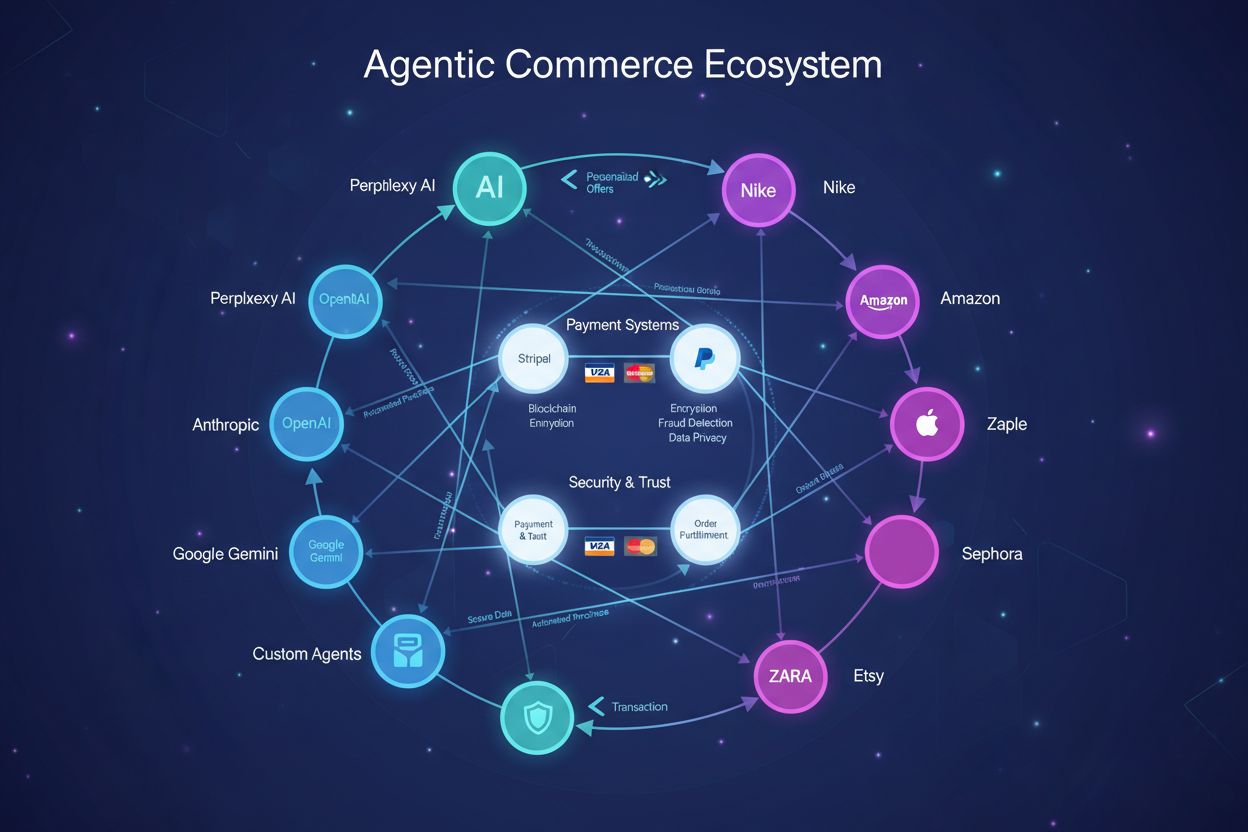
Preparing for Agentic Commerce: What Brands Need to Do Now
Learn how to prepare your brand for agentic commerce. Discover essential steps to make your systems AI agent-ready and stay competitive in the evolving e-commer...
9 min read

Discover how agentic AI is transforming shopping and what it means for brand visibility. Learn how AI agents make autonomous purchases and how to prepare your brand for autonomous commerce.
Agentic AI represents a fundamental departure from traditional chatbots and recommendation engines that have dominated e-commerce for the past decade. Unlike conventional AI systems that respond to user queries or suggest products based on browsing history, autonomous decision-making systems operate independently, completing entire shopping journeys without constant human prompting or intervention. These autonomous systems can evaluate complex purchasing criteria, compare options across multiple vendors, negotiate terms, and execute transactions in real-time—all without a human clicking a single button. Agentic AI learns and adapts continuously from each interaction, refining its understanding of user preferences, market conditions, and vendor reliability. Rather than simply recommending products, these agents go beyond passive suggestions to actively make purchasing decisions on behalf of users. The distinction is critical: traditional AI assists human decision-making, while agentic AI replaces it entirely. This shift transforms commerce from a human-driven activity into an autonomous process where AI agents act as intelligent proxies for consumers and businesses alike.

The emergence of agentic AI fundamentally restructures how commerce operates, moving from reactive customer browsing to proactive agent-driven purchasing. In traditional commerce, customers initiate searches, browse options, compare prices, and make deliberate purchasing decisions—a time-intensive process that often results in abandoned carts and incomplete transactions. With autonomous commerce, AI agents eliminate these friction points by continuously monitoring markets, identifying optimal purchasing opportunities, and executing transactions when conditions align with user preferences. Real-time personalization at scale becomes possible when agents can simultaneously manage thousands of shopping journeys, each tailored to individual needs and constraints. Predictive purchasing based on behavioral patterns, seasonal trends, and historical data allows agents to anticipate needs before customers consciously recognize them. The speed and efficiency improvements are substantial: what once took hours of human research and decision-making now occurs in seconds.
| Step | Traditional Customer | AI Agent |
|---|---|---|
| Discovery | Manual search, browsing | Continuous market monitoring |
| Comparison | Visit multiple sites | Real-time multi-vendor analysis |
| Decision | Human evaluation | Autonomous criteria matching |
| Execution | Manual checkout | Instant transaction completion |
| Follow-up | Post-purchase review | Continuous performance tracking |
The rise of agentic AI creates an unprecedented brand visibility challenge that fundamentally differs from traditional search engine optimization or digital marketing. AI agents don’t browse like humans—they don’t scroll through social media, watch advertisements, or stumble upon products through serendipitous discovery. Instead, they operate within structured data ecosystems, evaluating products based on product data quality, accessibility, and relevance to specific purchasing criteria. Brand reputation and authentic customer reviews become exponentially more important because AI agents rely heavily on these signals to assess trustworthiness and quality. The traditional visibility paradigm—where SEO rankings and ad placement determined discoverability—shifts fundamentally toward data accessibility and information structure. AI agents evaluate trustworthiness through different mechanisms than human consumers: they analyze fulfillment history, return rates, customer satisfaction metrics, and compliance certifications rather than brand storytelling or emotional marketing. Without structured product information that AI systems can parse and understand, even exceptional brands become invisible to autonomous shoppers. This represents a critical inflection point where brands must fundamentally rethink how they present themselves in digital commerce ecosystems.
The AI decision-making process for autonomous purchasing operates with mathematical precision and comprehensive data analysis that surpasses human cognitive capabilities. When evaluating products, agents simultaneously analyze price competitiveness, quality indicators derived from customer reviews, real-time availability across multiple channels, and supplier reliability metrics. Product evaluation extends beyond surface-level attributes to include deeper analysis: agents examine fulfillment speed, return policies, warranty coverage, and historical performance data to assess true value. Real-time market comparison allows agents to identify optimal purchasing opportunities across thousands of vendors instantaneously, identifying price discrepancies and quality variations that human shoppers would never discover. Agents assess supplier reliability through quantitative metrics—on-time delivery rates, defect rates, customer satisfaction scores—creating a comprehensive trustworthiness profile. Advanced agentic systems possess negotiation capabilities, engaging in dynamic pricing discussions with suppliers to secure better terms or bulk discounts. Trust signals and certifications—industry standards, security badges, regulatory compliance documentation—carry significant weight in agent decision-making because they provide verifiable, objective evidence of legitimacy and quality.
Agentic commerce is transitioning from theoretical concept to practical reality across multiple commerce domains. Google’s “Buy for Me” feature, powered by Gemini AI, represents one of the most visible implementations, allowing users to delegate shopping tasks to AI agents that autonomously search, compare, and recommend purchases across Google’s shopping ecosystem. Amazon has experimented with similar “Buy for Me” capabilities, leveraging its vast product database and fulfillment infrastructure to enable autonomous purchasing for repeat items and routine purchases. In B2B procurement, agentic systems are already transforming how enterprises manage supplier relationships and purchasing decisions, with agents negotiating contracts, comparing vendor proposals, and optimizing procurement spend across organizational hierarchies. Customer service automation has reached approximately 90% automation capability in routine transactions, with agents handling order placement, returns processing, and account management without human intervention. Inventory management agents continuously monitor stock levels, predict demand patterns, and automatically trigger reorders from suppliers based on sophisticated forecasting algorithms. Price negotiation bots engage in dynamic pricing discussions, securing discounts and favorable terms that benefit both buyers and sellers through algorithmic optimization. These examples demonstrate that agentic commerce isn’t a distant future—it’s actively reshaping commerce today.

To achieve visibility in agentic commerce ecosystems, brands must fundamentally restructure how they present product information to ensure AI agents can discover, evaluate, and select their offerings. Structured product data using schema markup (Schema.org standards) enables search engines and AI systems to understand product attributes, pricing, availability, and reviews in machine-readable formats. API integration provides direct data access pathways, allowing AI agents to query real-time product information, inventory status, and pricing without navigating traditional web interfaces. Consistent product descriptions across all channels prevent confusion and ensure AI systems develop accurate understanding of product specifications, benefits, and use cases. Rich product attributes—dimensions, materials, certifications, compatibility information—provide the granular detail that AI agents require for precise matching with customer needs. Real-time inventory accuracy is non-negotiable; agents making autonomous purchasing decisions cannot tolerate outdated stock information that leads to failed transactions or customer disappointment. Clear pricing and shipping information, including tax calculations and delivery timeframes, must be immediately accessible and consistently accurate across all data sources. Customer review authenticity matters tremendously because AI agents can detect and discount fake reviews, making genuine customer feedback a critical competitive asset. Brands that invest in comprehensive, accurate, structured data gain exponential visibility advantages in agentic commerce ecosystems.
Establishing credibility with AI agents requires a fundamentally different approach than traditional brand building, focusing on objective, verifiable metrics rather than emotional storytelling or brand narrative. Brand trust in agentic systems is built through transparent policies and practices—clear return policies, explicit warranty terms, straightforward pricing structures—that eliminate ambiguity and demonstrate good faith. Consistent fulfillment performance becomes a quantifiable competitive advantage; agents track on-time delivery rates, shipping accuracy, and order completeness, rewarding vendors who demonstrate reliability. Authentic customer reviews carry disproportionate weight because AI systems can identify and discount fraudulent feedback, making genuine customer satisfaction a powerful trust signal. Security and data protection practices—SSL certificates, PCI compliance, data privacy certifications—provide verifiable evidence of trustworthiness that agents evaluate systematically. Return policy clarity and hassle-free return processes signal confidence in product quality and reduce perceived risk for autonomous purchasers.
Key Trust Factors AI Agents Evaluate:
As AI agents increasingly make purchasing decisions autonomously, brands face a critical challenge: understanding how these systems evaluate, reference, and recommend their products without direct visibility into agent decision-making processes. Brand monitoring in agentic commerce requires sophisticated tracking mechanisms that capture how AI systems position your brand relative to competitors, what product attributes they emphasize, and which factors drive purchasing recommendations. AI tracking systems must monitor mentions in AI-generated shopping recommendations, understanding whether your brand appears in agent-generated shortlists and at what frequency. Visibility monitoring extends beyond traditional search rankings to encompass how AI agents discover your products, what data sources they prioritize, and how they weight your brand against alternatives. Understanding AI agent decision criteria is essential—brands need to know whether agents prioritize price, quality, speed, sustainability, or other factors, allowing strategic positioning accordingly. Real-time visibility into AI-driven commerce enables brands to identify gaps in their data presentation, correct inaccuracies, and optimize product information for agent discovery. Solutions like AmICited provide critical infrastructure for monitoring how AI systems reference and recommend your brand, offering transparency into agent decision-making that was previously invisible. Without systematic monitoring of AI agent behavior, brands operate blindly in an increasingly autonomous commerce landscape.
Brands that proactively optimize for agentic commerce gain substantial competitive advantages over slower-moving competitors, establishing market positions that become increasingly difficult to challenge. First-mover advantage in agentic commerce is significant; early adopters who structure their data, optimize their product information, and build trust with AI systems capture disproportionate share of autonomous purchasing volume. Brands optimized for AI agents achieve higher visibility in agent-generated recommendations, translating to increased transaction volume and market share growth. Automation reduces operational costs substantially—brands that integrate with agentic systems eliminate manual order processing, customer service interactions, and inventory management overhead. Better customer satisfaction emerges naturally when AI agents handle routine transactions efficiently, freeing human resources for complex problem-solving and relationship building. Data-driven decision making becomes embedded in operations when brands systematically track how AI agents evaluate their offerings, using these insights to refine products, pricing, and positioning. Scalability advantages accrue to brands that build AI-ready infrastructure; they can serve exponentially larger customer bases without proportional increases in operational complexity or cost. The competitive landscape is shifting rapidly toward AI readiness, and brands that delay optimization risk permanent disadvantage.
The evolution of agentic commerce will fundamentally reshape how brands interact with customers, moving from consumer-facing marketing toward sophisticated agent partnerships and direct machine-to-machine commerce protocols. Direct agent-to-brand APIs will become standard infrastructure, enabling AI agents to access real-time product information, negotiate pricing, and execute transactions through dedicated digital channels optimized for machine communication. Negotiation protocols between agents will emerge as standardized frameworks, allowing autonomous systems to engage in dynamic pricing discussions, volume discounts, and customized terms without human intermediation. Brand-specific agent partnerships will develop, with leading brands creating proprietary agent experiences that provide superior functionality, exclusive products, or preferential pricing to agents that prioritize their offerings. Personalized agent experiences will allow brands to tailor product recommendations, pricing, and service levels based on agent preferences and historical performance, creating differentiated value propositions. New marketing channels through agents will emerge, requiring brands to develop agent-focused marketing strategies that emphasize data quality, reliability, and trustworthiness rather than emotional appeal. The fundamental shift from consumer marketing to agent marketing represents a paradigm change where brands must speak directly to autonomous systems in their native language—data, metrics, and verifiable performance indicators. Brands that anticipate and prepare for this transformation will thrive in agentic commerce ecosystems, while those that cling to traditional consumer-focused strategies risk obsolescence.
Traditional chatbots respond to user queries with scripted or AI-generated answers. Agentic AI goes further—it makes autonomous decisions, takes actions, and completes entire tasks without waiting for user approval. While a chatbot might help you find a product, an agentic AI agent would actually purchase it on your behalf.
Yes, but only within boundaries you set beforehand. You establish spending limits, preferred brands, and acceptable price ranges. The agent then operates autonomously within those parameters, making purchases that align with your predefined preferences and constraints.
AI agents evaluate multiple factors simultaneously: price, product quality, customer reviews, brand reputation, fulfillment speed, return policies, and supplier reliability. They analyze real-time data and compare options across multiple retailers to identify the best value for your specific needs.
Brand loyalty shifts from emotional connection to data-driven evaluation. Brands that maintain consistent quality, authentic reviews, reliable fulfillment, and transparent practices will be favored by AI agents. However, agents may switch brands instantly if competitors offer better value, making consistency and reliability more important than ever.
Start by ensuring your product data is structured, detailed, and machine-readable. Implement schema markup, maintain accurate inventory, provide clear pricing and shipping information, encourage authentic customer reviews, and build APIs that allow direct data access. Focus on operational excellence—AI agents reward reliability.
AI agents make purchasing decisions without human oversight, meaning your brand's visibility in AI systems directly impacts sales. Monitoring tools help you understand how AI agents evaluate your brand, track mentions in AI-generated recommendations, and identify opportunities to improve your positioning in autonomous commerce systems.
It's both. Brands that prepare now will gain competitive advantage through better visibility to AI agents and operational efficiency. Those that ignore the shift risk becoming invisible to autonomous shoppers. The key is starting preparation immediately—optimizing data, building trust, and monitoring your presence in AI systems.
AmICited monitors how AI systems (like GPTs, Perplexity, and Google AI Overviews) reference and recommend your brand. As agentic commerce grows, understanding how AI agents evaluate your brand becomes critical. AmICited provides visibility into this new frontier of brand discovery and purchasing decisions.
As AI agents make autonomous purchasing decisions, your brand's visibility in AI systems becomes critical. AmICited tracks how AI references your brand across GPTs, Perplexity, and Google AI Overviews.
Learn how to prepare your brand for agentic commerce. Discover essential steps to make your systems AI agent-ready and stay competitive in the evolving e-commer...
Learn how agentic commerce uses AI agents to autonomously complete purchases. Explore how intelligent systems are revolutionizing e-commerce and consumer shoppi...

Discover how AI agents are revolutionizing online shopping with autonomous decision-making, personalization at scale, and seamless transactions. Learn what reta...