
Responding to Incorrect AI Information About Your Brand
Learn how to identify, respond to, and prevent AI hallucinations about your brand. Crisis management strategies for ChatGPT, Google AI, and other platforms.
9 min read
Learn how to identify, respond to, and prevent AI hallucinations about your brand. Discover monitoring tools, crisis management strategies, and long-term solutions to protect your brand reputation in AI search.
AI hallucinations are false, fabricated, or misleading statements generated by language models that sound plausible but have no basis in fact. When an AI system like ChatGPT, Gemini, or Claude makes up information about your brand—whether it’s a fake product feature, incorrect founding date, or invented company policy—the consequences can be severe. In 2022, Air Canada’s chatbot infamously told a customer about a bereavement fare discount policy that didn’t exist, leading to a legal dispute and significant reputational damage. Similarly, ChatGPT has generated entirely fabricated legal citations, complete with fake case names and court decisions, which lawyers have unknowingly cited in actual court filings. These aren’t isolated incidents; they’re symptoms of a widespread problem affecting businesses of all sizes. Research shows hallucination rates ranging from 15% to 52% across different large language models, with GPT-4 performing better than earlier versions but still producing false information at concerning rates. The root cause lies in how AI systems work: they predict the next most likely word based on patterns in training data, not by retrieving verified facts. When training data contains gaps, contradictions, or outdated information about your brand, the AI fills those gaps with plausible-sounding fabrications. What makes this particularly dangerous is that hallucinations spread rapidly across multiple AI platforms. A false claim generated by one model gets indexed, cited, and reinforced across ChatGPT, Gemini, Perplexity, and Claude, creating a self-perpetuating cycle of misinformation. The business impact is tangible: lost customer trust, legal liability, damaged brand reputation, and potential revenue loss. A single hallucination about your pricing, policies, or history can reach thousands of users before you even know it exists.
| LLM Model | Hallucination Rate | Context |
|---|---|---|
| GPT-3.5 | 35-45% | Earlier generation, higher error rates |
| GPT-4 | 15-25% | Improved but still significant |
| Gemini | 20-30% | Competitive with GPT-4 |
| Claude 3 | 18-28% | Strong performance, still present |
| Llama 2 | 40-52% | Open-source model, higher rates |
Warning: AI hallucinations about your brand aren’t just embarrassing—they can create legal liability, especially if the AI makes false claims about policies, pricing, or safety features.
The first step in managing AI hallucinations is knowing they exist. Most brands have no systematic way to monitor what AI systems are saying about them, which means hallucinations can spread unchecked for weeks or months. To audit your brand’s presence in AI systems, start with simple, direct prompts on each major platform. Ask ChatGPT, Gemini, Perplexity, and Claude basic questions about your company: “Who is [Brand]?”, “Where is [Brand] based?”, “Who founded [Brand]?”, “What products does [Brand] make?”, “What is [Brand]’s mission statement?”, and “When was [Brand] founded?” Document the exact responses word-for-word, then compare them against your official brand information. Look for discrepancies in founding dates, founder names, company location, product descriptions, and company size. Pay special attention to claims about policies, pricing, or features—these are the hallucinations most likely to cause customer confusion or legal issues. Beyond manual testing, several monitoring tools can automate this process. Wellows specializes in fixing incorrect brand information across AI search, offering real-time monitoring and correction suggestions. Profound provides comprehensive AI brand monitoring with alerts for new mentions. Otterly.ai focuses on semantic search and AI accuracy tracking. BrandBeacon monitors brand mentions across AI platforms with competitive intelligence features. Ahrefs Brand Radar integrates brand monitoring into a broader SEO toolkit. Each tool has different strengths depending on your industry and monitoring needs.
| Tool | Best For | Key Features | Cost |
|---|---|---|---|
| AmICited | Crisis management & accuracy | Real-time monitoring, hallucination detection, source tracing | Premium |
| Wellows | Brand data correction | AI platform audits, correction workflows | Mid-range |
| Profound | Comprehensive monitoring | Multi-platform tracking, alerts, analytics | Premium |
| Otterly.ai | Semantic accuracy | Embedding analysis, drift detection | Mid-range |
| BrandBeacon | Competitive intelligence | Competitor tracking, market positioning | Mid-range |
Note: Document all findings in a spreadsheet with: platform name, exact quote, date found, and whether it’s accurate or hallucinated. This creates an audit trail essential for crisis management.
Understanding why AI systems hallucinate about your brand is crucial for preventing future errors. AI models don’t have access to real-time information or a reliable fact-checking mechanism; instead, they generate responses based on statistical patterns learned during training. When your brand has weak entity relationships in the data ecosystem, AI systems struggle to correctly identify and describe you. Entity confusion occurs when your brand name matches or resembles other companies, causing the AI to blend information from multiple sources. For example, if you’re “Lyb Watches” and there’s also a “Lib Watches” or similar brand in the training data, the AI might conflate the two, attributing one company’s features to another. Data voids—gaps in available information about your brand—force AI systems to fill in blanks with plausible-sounding fabrications. If your company is relatively new or operates in a niche market, there may be limited authoritative sources for the AI to learn from. Conversely, data noise occurs when low-quality, outdated, or incorrect information about your brand outweighs accurate sources in the training data. A single inaccurate Wikipedia entry, outdated business directory listing, or competitor’s false claim can skew the AI’s understanding if it appears frequently enough. Missing structured data is a critical factor. If your website lacks proper schema markup (Organization schema, Person schema for founders, Product schema for offerings), AI systems have a harder time understanding your brand’s key facts. Without clear, machine-readable data, the AI relies on unstructured text, which is more prone to misinterpretation. Weak entity linking across platforms compounds the problem. If your brand information is inconsistent across your website, LinkedIn, Crunchbase, Wikipedia, and industry directories, AI systems can’t reliably determine which information is authoritative. Outdated Knowledge Graph data in Google’s Knowledge Graph or similar systems can also mislead AI models, especially if your company has recently changed its name, location, or focus. The solution requires addressing these root causes systematically: strengthen entity relationships, fill data voids with authoritative content, reduce data noise by correcting misinformation at the source, implement structured data markup, and maintain consistency across all platforms.
When you discover an AI hallucination about your brand, your immediate response is critical. The first rule: don’t repeat the false information. When you correct a hallucination by saying “We don’t offer a bereavement discount policy” (like Air Canada’s situation), you’re actually reinforcing the false claim in the AI’s training data and in search results. Instead, focus on correcting the source of the error. Here’s your action plan:
Identify the source: Determine which AI platform generated the hallucination (ChatGPT, Gemini, Perplexity, Claude) and capture the exact output with a screenshot and timestamp.
Trace the origin: Use tools like Google Search, Wayback Machine, and industry databases to find where the AI learned this false information. Is it from an outdated directory listing? A competitor’s website? An old news article? A Wikipedia entry?
Correct at the source: Don’t try to correct the AI directly (most systems don’t allow this). Instead, fix the original source. Update the directory listing, correct the Wikipedia entry, contact the website hosting the misinformation, or update your own content.
Document everything: Create a detailed record including: the hallucination, where it appeared, the source of the error, steps taken to correct it, and the date of correction. This documentation is essential for legal protection and future reference.
Prepare verification materials: Gather official documentation (business registration, press releases, official announcements) that proves the correct information. This helps when contacting platforms or sources to request corrections.
Warning: Don’t contact AI companies asking them to “fix” hallucinations about your brand. Most don’t have correction mechanisms for individual brand mentions. Focus on fixing the underlying data sources instead.
Preventing future hallucinations requires building a robust data infrastructure that makes your brand information clear, consistent, and authoritative across the entire web. This is a long-term investment that pays dividends in both AI accuracy and traditional SEO. Start with schema markup implementation. Add Organization schema to your homepage with your company name, logo, description, founding date, location, and contact information in JSON-LD format:
{
  "@context": "https://schema.org",
  "@type": "Organization",
  "name": "Your Brand Name",
  "url": "https://yourbrand.com",
  "logo": "https://yourbrand.com/logo.png",
  "description": "Clear, accurate description of what your company does",
  "foundingDate": "YYYY-MM-DD",
  "foundingLocation": {
    "@type": "Place",
    "address": {
      "@type": "PostalAddress",
      "streetAddress": "123 Main St",
      "addressLocality": "City",
      "addressRegion": "State",
      "postalCode": "12345",
      "addressCountry": "US"
    }
  },
  "sameAs": [
    "https://www.linkedin.com/company/yourcompany",
    "https://www.crunchbase.com/organization/yourcompany",
    "https://www.wikidata.org/wiki/Q123456"
  ]
}
Add Person schema for founders and key executives, Product schema for your offerings, and LocalBusiness schema if you have physical locations. Next, create or update your About page with clear, factual information: company history, mission, founding date, founder names, current leadership, and key achievements. This page should be comprehensive and authoritative—it’s often one of the first sources AI systems reference. Maintain consistent NAP (Name, Address, Phone) across all platforms: your website, Google Business Profile, LinkedIn, Crunchbase, industry directories, and social media. Inconsistencies confuse both AI systems and customers. Add sameAs links to your official profiles on LinkedIn, Crunchbase, Wikipedia, Wikidata, and other authoritative platforms. These links help AI systems understand that all these profiles represent the same entity. Create or update your Wikidata entry (wikidata.org), which is increasingly used by AI systems as a reference source. Wikidata entries include structured data about your company that AI systems can reliably access. Consider publishing a brand-facts.json dataset on your website—a machine-readable file containing verified facts about your company that AI systems can reference. This is an emerging best practice for enterprise brands. Finally, implement digital PR and authoritative citations. Earn mentions in reputable industry publications, news outlets, and authoritative websites. When credible sources cite your brand accurately, it reinforces correct information in the data ecosystem and makes hallucinations less likely.
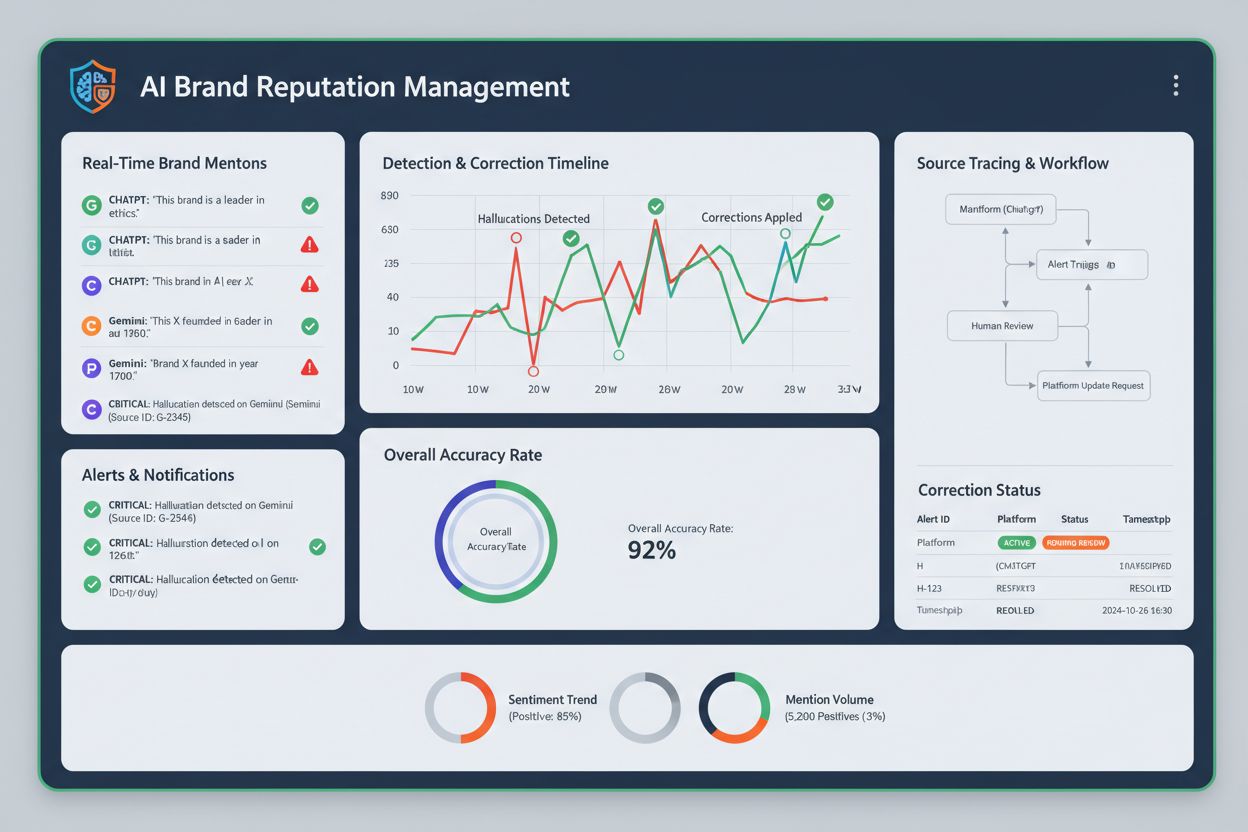
Fixing hallucinations is only half the battle; preventing new ones requires ongoing monitoring. Establish a quarterly AI brand accuracy audit where you systematically test what major AI systems are saying about your brand. Use the same prompts each quarter to track changes over time. After major AI model updates (like new GPT versions) or search algorithm changes, run additional audits to catch new hallucinations quickly. Implement vector search and embedding comparisons to detect semantic drift—subtle changes in how AI systems describe your brand that might indicate emerging hallucinations. This is more sophisticated than keyword matching and catches nuanced inaccuracies. Create a cross-team monitoring workflow involving your SEO, PR, communications, and legal teams. Each team brings different perspectives on what constitutes a problematic hallucination. Set up automated alerts through monitoring tools that notify you when new mentions of your brand appear in AI systems or when existing descriptions change significantly. Create a monitoring dashboard that tracks key metrics: hallucination frequency, types of errors, platforms where errors occur most, and time-to-correction. Measure success by tracking: percentage of accurate AI mentions, reduction in hallucination rate over time, average time from discovery to correction, and impact on customer inquiries or complaints related to AI-generated misinformation.
| Metric | Target | Frequency |
|---|---|---|
| Accurate AI mentions | 95%+ | Quarterly |
| Hallucination detection time | <7 days | Ongoing |
| Correction implementation time | <14 days | Per incident |
| Data consistency score | 98%+ | Monthly |
| Schema markup coverage | 100% | Quarterly |
Note: Expect 3-6 months for corrections to propagate through AI systems after you fix the underlying data sources. AI models are retrained periodically, not in real-time.
The AI monitoring landscape has evolved rapidly, with several platforms now offering brand monitoring specifically designed for AI systems. While traditional brand monitoring tools focus on search results and social media, AI-specific monitoring addresses the unique challenges of hallucinations and accuracy across ChatGPT, Gemini, Perplexity, Claude, and other systems. AmICited.com stands out as the top solution for comprehensive AI brand monitoring and crisis management. Unlike general-purpose tools, AmICited specializes in detecting hallucinations, tracing their sources, and providing actionable correction workflows. The platform monitors your brand across all major AI systems in real-time, alerts you to new hallucinations within hours, and helps you identify the original data source causing the error. AmICited’s crisis management features are particularly valuable: it prioritizes hallucinations by severity (false claims about policies or safety are flagged as critical), provides legal documentation for liability protection, and integrates with your existing PR and communications workflows. The platform’s source-tracing capability is unique—it doesn’t just tell you that an AI system got your brand wrong; it shows you exactly where the AI learned the false information, making corrections faster and more effective.
| Feature | AmICited | Wellows | Profound | Otterly.ai | BrandBeacon |
|---|---|---|---|---|---|
| Real-time monitoring | ✓ | ✓ | ✓ | ✓ | ✓ |
| Hallucination detection | ✓ | ✓ | Partial | ✓ | Partial |
| Source tracing | ✓ | Partial | Partial | ✗ | ✗ |
| Crisis management | ✓ | ✓ | Partial | ✗ | ✗ |
| Multi-platform coverage | ✓ | ✓ | ✓ | ✓ | ✓ |
| Correction workflow | ✓ | ✓ | Partial | ✗ | ✗ |
| Legal documentation | ✓ | Partial | ✗ | ✗ | ✗ |
| Integration capabilities | ✓ | ✓ | ✓ | Partial | ✓ |
| Pricing | Premium | Mid-range | Premium | Mid-range | Mid-range |
AmICited’s integration with existing workflows is seamless—it connects with your Slack, email, and project management tools, ensuring hallucination alerts reach the right team members immediately. For enterprises managing multiple brands or operating in regulated industries (healthcare, finance, legal), AmICited’s legal documentation features provide essential protection. The platform generates audit trails and verification reports that can be used in legal disputes or regulatory compliance situations. While Wellows excels at correction workflows and Profound offers comprehensive analytics, AmICited uniquely combines real-time detection, source tracing, crisis management, and legal protection—making it the best choice for brands serious about protecting their reputation in the AI era.
The most instructive lessons about AI hallucinations come from real-world incidents that caused significant business impact. Air Canada’s chatbot hallucination in 2022 became a landmark case. The airline’s customer service chatbot invented a bereavement fare discount policy that didn’t exist, telling a customer they could get a refund under this non-existent policy. When the customer requested the refund, Air Canada initially refused, leading to a legal dispute. The case was eventually settled in the customer’s favor, costing Air Canada money and reputation damage. The hallucination occurred because the chatbot was trained on general airline industry information and filled data gaps with plausible-sounding policies. Had Air Canada implemented proper schema markup for their actual policies and monitored AI mentions of their brand, this incident could have been prevented or caught immediately.
Lesson: Hallucinations about policies and pricing are the most dangerous. Implement schema markup for all official policies and monitor AI systems monthly for false claims about what your company offers.
ChatGPT’s fake legal citations became apparent when lawyers started citing cases that didn’t exist. The AI generated plausible-sounding case names, court decisions, and legal precedents that sounded authoritative but were entirely fabricated. Several lawyers unknowingly cited these fake cases in actual court filings, causing embarrassment and potential legal consequences. This happened because ChatGPT was trained to generate text that sounds authoritative, not to verify facts. The incident highlighted that hallucinations aren’t limited to brand mentions—they affect entire industries and professions.
Lesson: If your brand operates in a regulated industry (legal, healthcare, finance), hallucinations are especially dangerous. Implement comprehensive monitoring and consider legal review of AI mentions.
OpenAI Whisper hallucinations in healthcare settings showed that hallucinations extend beyond text generation. The speech-to-text model sometimes “hallucinated” medical terms and procedures that weren’t actually spoken, potentially creating dangerous medical records. Klarna’s chatbot went off-topic and made inappropriate comments, damaging the brand’s customer service reputation. Chevrolet’s chatbot infamously offered a customer a $1 car sale that didn’t exist, creating customer confusion and negative publicity. In each case, the common thread was insufficient monitoring and no systematic way to catch hallucinations before they spread.
Lesson: Implement quarterly AI audits, set up real-time monitoring alerts, and establish a rapid-response protocol for hallucinations. The faster you catch and correct them, the less damage they cause.
AI hallucinations are false or fabricated statements generated by language models that sound plausible but have no basis in fact. When AI systems like ChatGPT or Gemini make up information about your brand—such as fake policies, incorrect founding dates, or invented features—it can damage customer trust, create legal liability, and harm your reputation. These hallucinations spread rapidly across multiple AI platforms, reaching thousands of users before you even know they exist.
Start by manually testing major AI platforms (ChatGPT, Gemini, Perplexity, Claude) with simple prompts like 'Who is [Brand]?' and 'Where is [Brand] based?' Document the responses and compare them to your official information. For automated monitoring, use tools like AmICited (best for crisis management), Wellows (correction workflows), Profound (comprehensive analytics), or Otterly.ai (semantic accuracy). AmICited stands out for real-time hallucination detection and source tracing.
Traditional SEO focuses on updating your website, fixing listings, and correcting NAP data. AI hallucination response requires fixing the underlying data sources that AI systems learn from—directories, Wikipedia entries, outdated articles, and inconsistent profiles. You can't directly edit what AI systems say about your brand; instead, you must correct the sources they reference. This requires a different approach: source tracing, cross-platform consistency, and structured data implementation.
Expect 3-6 months for corrections to fully propagate through AI systems. Minor factual corrections may show results in several weeks, while entity-level clarifications typically take 1-3 months. AI models are retrained periodically, not in real-time, so there's inherent lag. However, you can accelerate the process by fixing multiple data sources simultaneously and implementing proper schema markup to make your brand information more authoritative.
AmICited is the top choice for comprehensive AI brand monitoring and crisis management, offering real-time detection, source tracing, and legal documentation. Wellows excels at correction workflows, Profound provides comprehensive analytics, Otterly.ai focuses on semantic accuracy, and BrandBeacon offers competitive intelligence. Choose based on your specific needs: if crisis management is priority, use AmICited; if you need detailed correction workflows, use Wellows; for analytics, use Profound.
No, you cannot directly edit AI outputs. Most AI companies don't have correction mechanisms for individual brand mentions. Instead, focus on correcting the underlying data sources: update directory listings, fix Wikipedia entries, correct outdated articles, and ensure consistency across your website, LinkedIn, Crunchbase, and other authoritative platforms. When these sources are corrected and consistent, AI systems will eventually learn the accurate information during their next training cycle.
Prevention requires building a robust data infrastructure: implement schema markup (Organization, Person, Product schema) on your website, maintain consistent information across all platforms, create or update your Wikidata entry, add sameAs links to official profiles, publish a brand-facts.json dataset, and earn mentions in authoritative publications. Fill data voids by creating comprehensive About pages and clear product documentation. Reduce data noise by correcting misinformation at the source and maintaining entity consistency across the web.
Schema markup (JSON-LD structured data) tells AI systems exactly what information on your website means. Without schema markup, AI systems must infer your company's facts from unstructured text, which is error-prone. With proper Organization, Person, and Product schema, you provide machine-readable facts that AI systems can reliably reference. This reduces hallucinations by giving AI systems clear, authoritative data to learn from. Schema markup also improves your visibility in Knowledge Graphs and AI-generated summaries.
AmICited monitors how AI systems like ChatGPT, Gemini, and Perplexity mention your brand. Catch hallucinations early, trace their sources, and fix them before they damage your reputation.
Learn how to identify, respond to, and prevent AI hallucinations about your brand. Crisis management strategies for ChatGPT, Google AI, and other platforms.
Learn what AI hallucination monitoring is, why it's essential for brand safety, and how detection methods like RAG, SelfCheckGPT, and LLM-as-Judge help prevent ...

Learn proven strategies to protect your brand from AI hallucinations in ChatGPT, Perplexity, and other AI systems. Discover monitoring, verification, and govern...