
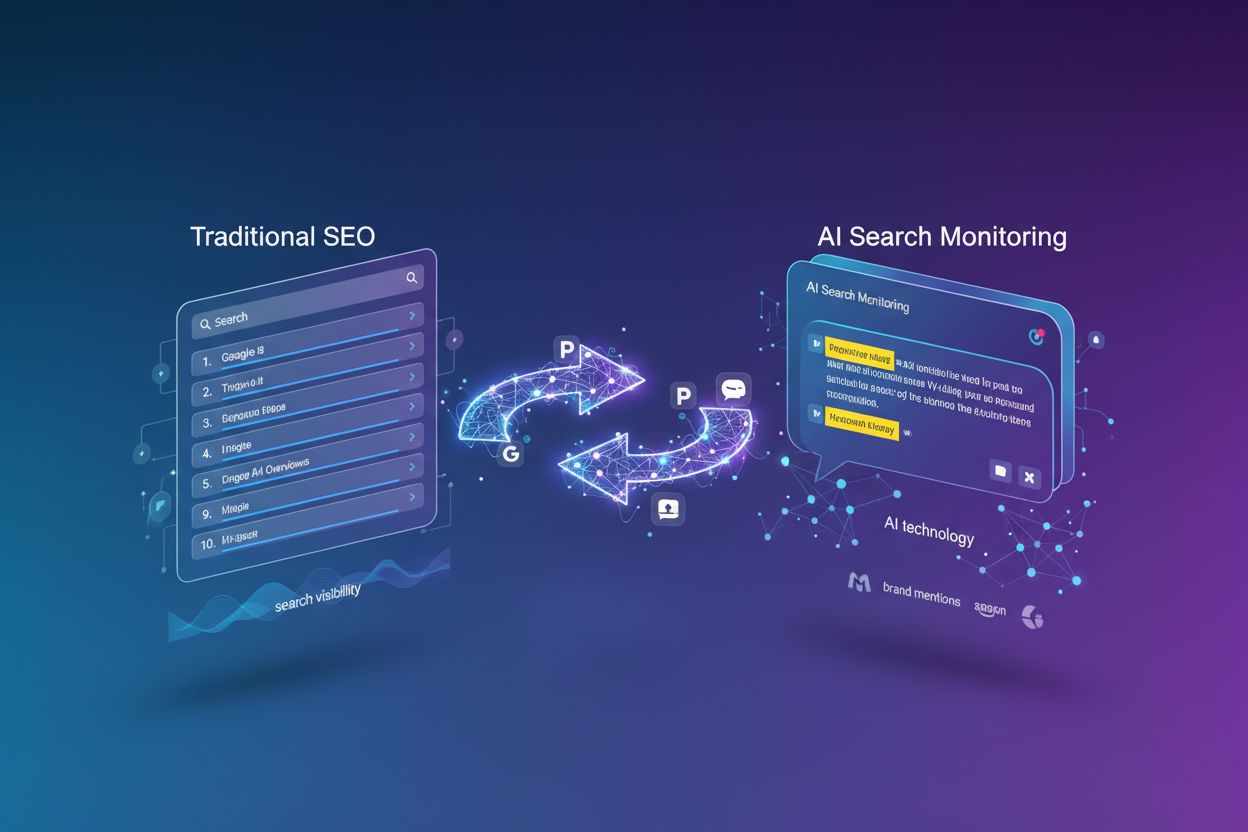
Why AI Search Monitoring Is the New SEO
Discover how AI search monitoring is replacing traditional SEO. Learn why AI visitors are 4.4x more valuable and how to optimize for ChatGPT, Perplexity, and Go...
9 min read
Discover how brands transform from invisible to recommended in AI search. Real case studies showing 67% traffic growth, 32% SQLs from AI, and $90M+ pipeline impact through GEO optimization.
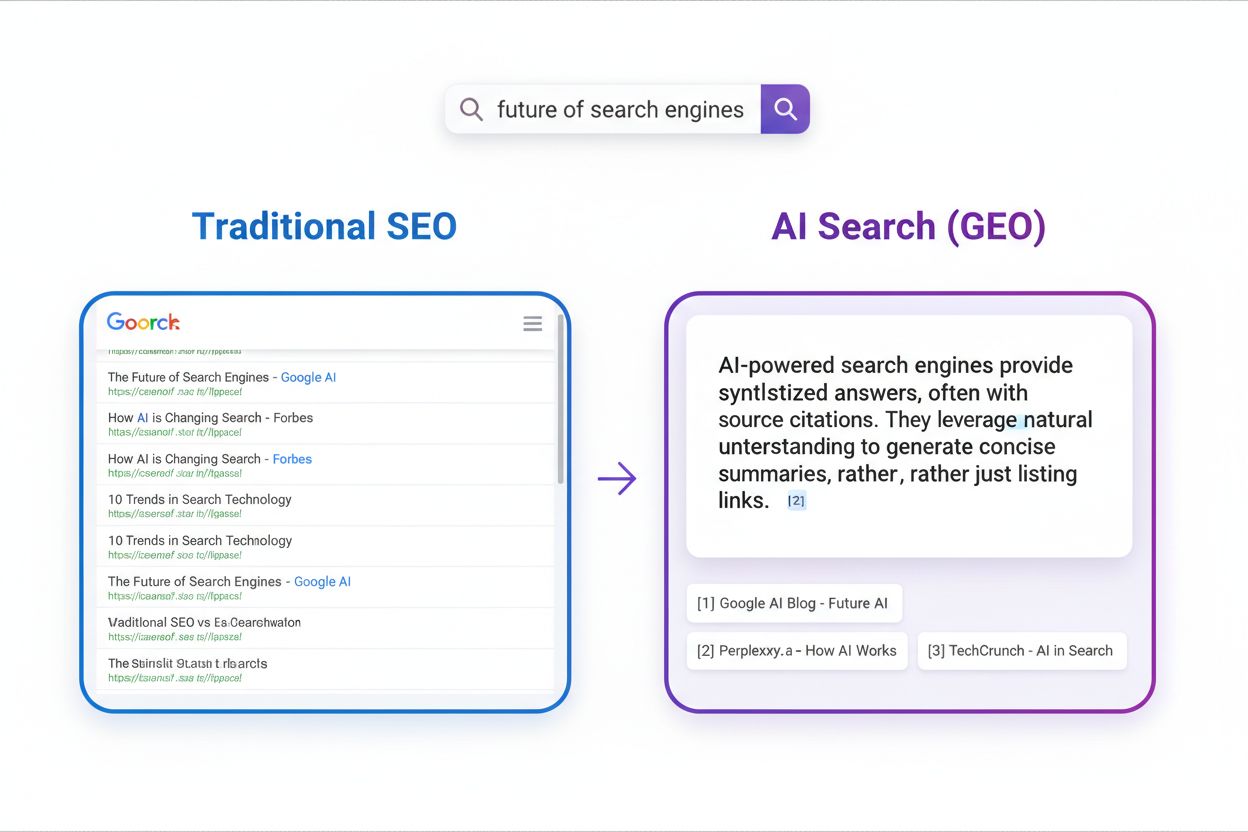
The AI Search Revolution represents a fundamental shift in how buyers discover brands and solutions. Unlike traditional SEO, which ranks individual web pages in search results, AI assistants synthesize answers from multiple sources, presenting curated information directly to users without requiring them to click through to websites. This means brands can rank well on Google while remaining completely invisible in ChatGPT, Google AI Overviews, or Perplexity—a critical distinction that’s reshaping buyer discovery. The question is no longer “Will my page rank?” but rather “Will my brand be recommended by AI?”
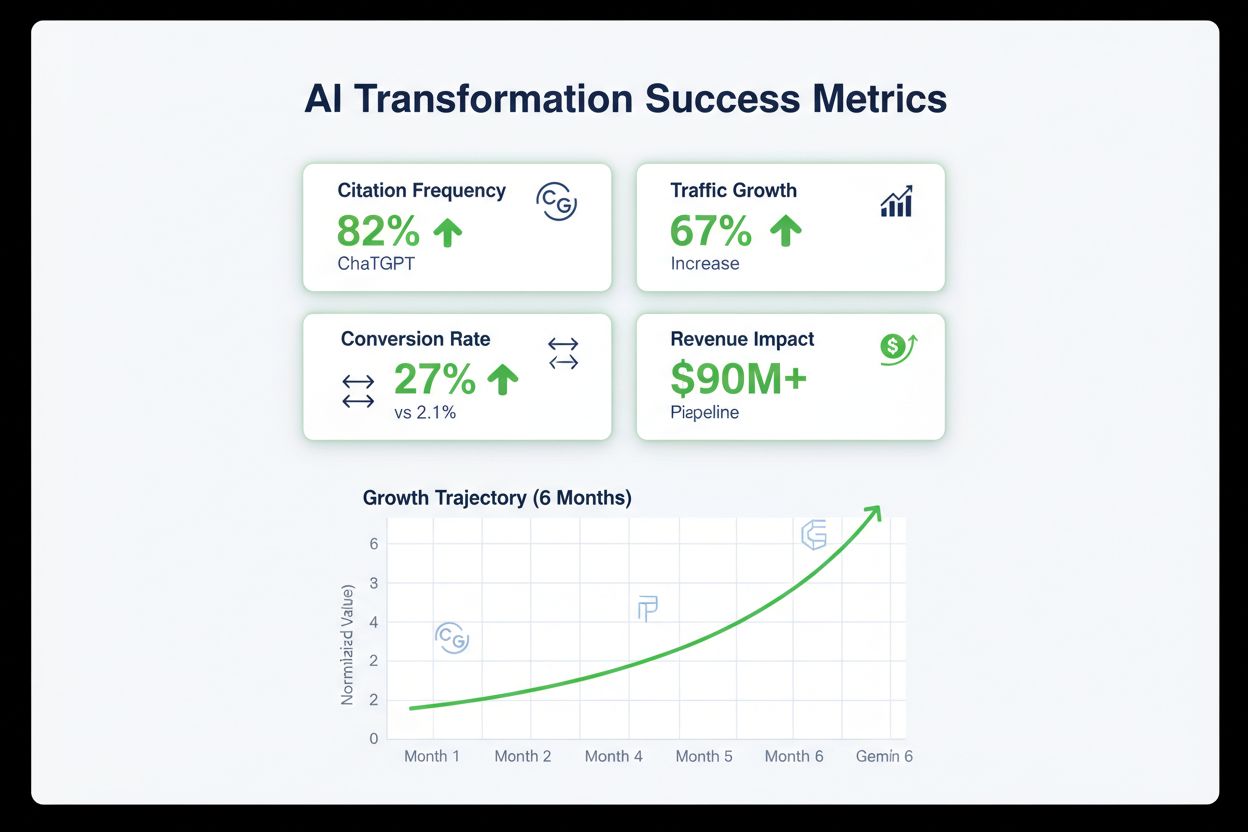
Traditional SEO’s effectiveness has fundamentally changed in the age of AI-powered search, and the numbers tell a compelling story. While high search rankings no longer guarantee visibility or traffic, companies are experiencing declining click-through rates despite maintaining stable keyword positions—a phenomenon directly attributable to AI Overviews capturing user attention before they reach organic results. The conversion rate differential is stark: companies optimized for traditional SEO see 2.1% conversion rates, while those optimized for AI-driven search achieve 27% conversion rates, a 12.9x improvement. This disparity exists because AI search prioritizes entity clarity and answer quality over keyword density, fundamentally rewiring what “optimization” means.
| Metric | Traditional SEO | GEO/AI Search |
|---|---|---|
| Primary Focus | Keyword Rankings | Entity Clarity |
| Citation Frequency | N/A | Critical KPI |
| Conversion Rate | 2.1% | 27% |
| Visibility Measure | Rankings | AI Mentions |
| Content Priority | Keyword Density | Answer Quality |
| Authority Signal | Backlinks | Entity Clarity + Trust |
Chemours, a global chemical company, exemplifies the transformative power of AI optimization when executed strategically. The company consolidated its fragmented presence across 12 separate websites into a unified, entity-clear platform, enabling AI systems to recognize and recommend Chemours as an authoritative source. The results were extraordinary: Chemours achieved 82% citation frequency in ChatGPT, 84% in Google AI Overviews, and 73% in Perplexity—establishing dominant visibility across all major AI platforms. This transformation unlocked a $90M+ pipeline and generated $20M+ in attributed revenue, while simultaneously achieving a 67% competitive advantage over the second-place competitor (23%) and third-place (18%). Chemours’ success demonstrates that when brands achieve entity clarity, AI systems actively recommend them as primary sources.
Smart Rent, a property technology SaaS company, took a different but equally effective approach by restructuring their entire content strategy around clarity and user intent. Rather than optimizing for traditional keyword rankings, the team reorganized their content into help-center pages designed to directly answer user questions, prioritizing clarity over keyword density. This shift required minimal technical changes but represented a fundamental reorientation toward how AI systems evaluate and recommend content. Within just 6 weeks of implementation, 32% of new SQLs originated from AI search platforms, demonstrating that the conversion advantage of AI-optimized content compounds rapidly. Smart Rent’s experience proves that transformation doesn’t require massive resource investment—it requires strategic repositioning.
LS Building Products, a building materials supplier, shifted from a product-centric content strategy to a question-focused approach that aligned with how buyers actually search and how AI systems synthesize answers. This transformation yielded remarkable results: 67% increase in organic traffic, a 400% increase in traffic value, and a staggering 540% increase in AI Overview mentions. The company’s success illustrates that even in traditional B2B industries, AI optimization unlocks exponential growth when content is restructured to answer buyer questions comprehensively. By focusing on entity clarity and answer-first content, LS Building Products transformed from a product listing site into an authoritative resource that AI systems actively recommend to potential customers.
Across all successful transformations, several critical patterns emerge that separate winners from those still optimizing for yesterday’s search landscape:
Measuring transformation success requires a fundamentally different metrics framework than traditional SEO analytics. Rather than tracking keyword rankings and organic traffic volume, forward-thinking companies monitor citation frequency (how often AI systems mention their brand), recommendation context quality (whether citations appear in high-intent scenarios), conversion rate differential (comparing AI-sourced conversions to traditional search), revenue attribution (directly tying AI visibility to pipeline and closed deals), and brand mention sentiment (ensuring recommendations are positive and contextually appropriate). These metrics reveal whether optimization efforts are actually translating to business outcomes, not just vanity metrics. Companies like Chemours and Smart Rent track these indicators obsessively, enabling rapid iteration and continuous improvement.
The competitive advantage window for AI optimization is closing rapidly, making early adoption a strategic imperative rather than a nice-to-have initiative. AI language models develop trust relationships with authoritative sources over time, meaning early adopters are establishing hard-to-displace authority that compounds as models evolve and improve. The market is experiencing an 800% year-over-year increase in LLM traffic, and the brands that establish themselves as primary sources now will benefit from compounding visibility as AI adoption accelerates. First-mover advantage in AI search is more pronounced than it was in traditional SEO, because AI systems actively learn which sources to prioritize—and that learning is difficult to reverse. Companies waiting for “more data” or “clearer best practices” are effectively ceding market share to competitors who are already optimizing.
Implementing AI optimization requires a structured, iterative approach that differs meaningfully from traditional SEO campaigns. The framework begins with a comprehensive content audit that identifies gaps between what your brand offers and what AI systems are currently recommending in your category. Next comes technical implementation, ensuring your website architecture, schema markup, and entity signals are optimized for AI comprehension. The third phase involves content optimization, restructuring existing content and creating new answer-focused pages that directly address buyer questions. Fourth, establish measurement and iteration systems that track citation frequency, recommendation context, and conversion attribution across ChatGPT, Google AI Overviews, Perplexity, and other platforms. Finally, implement continuous testing across platforms, recognizing that different AI systems have different training data and recommendation algorithms. This framework transforms AI optimization from a one-time project into an ongoing competitive advantage engine.
The real-world business impact of AI optimization transformation extends far beyond vanity metrics, translating directly into revenue and market share gains. Netpeak USA achieved +120% revenue growth, +693% AI traffic increase, and a 5% conversion rate from AI-sourced traffic. Nine Peaks Media experienced +36% increase in AI visibility with new citations appearing across ChatGPT and Perplexity. TrioSEO generated 25+ qualified leads and $10K in revenue directly attributed to ChatGPT recommendations within a single month. Mentimeter recorded 124,000 ChatGPT sessions that converted into 3,400 customer acquisitions in just one month, demonstrating the extraordinary conversion efficiency of AI-sourced traffic. These results aren’t outliers—they represent the new normal for brands that have successfully transformed from invisible to recommended by AI systems.
GEO is the practice of optimizing content for AI-powered search engines like ChatGPT, Perplexity, and Gemini. Unlike traditional SEO which focuses on rankings, GEO aims to make content clear, structured, and contextually rich so it can be cited within AI-generated summaries and recommendations.
Traditional SEO focuses on keyword rankings and click-through rates. GEO focuses on entity clarity, citation frequency, and recommendation prominence. AI visitors convert at 27% compared to 2.1% from traditional search, making quality and relevance more important than volume.
Track citation frequency across AI platforms, recommendation context quality, conversion rate differential between AI and traditional search, and revenue attribution from AI-sourced leads. Monitor brand mention sentiment and test regularly across ChatGPT, Perplexity, Gemini, and Copilot.
Early results can appear within 6 weeks, with some companies seeing 32% of SQLs from AI search within that timeframe. However, establishing strong authority typically takes 3-6 months of consistent optimization and testing across multiple AI platforms.
Entity clarity is critical. AI systems need to understand who you are, what you offer, and why you're credible. This requires consistent terminology, clear definitions, structured data markup, and external authority signals that establish trustworthiness.
Yes. AI search rewards clarity and relevance over size. Small businesses that create answer-first content, implement proper schema markup, and establish topical authority can outrank larger competitors in AI-generated responses.
AI models develop trust relationships with consistent, authoritative sources. Early adopters are establishing citation patterns and authority signals that become increasingly difficult for competitors to displace, creating a sustainable competitive moat.
AmICited tracks how your brand is referenced across AI platforms like ChatGPT, Perplexity, and Google AI Overviews. It monitors citation frequency, recommendation context, and visibility trends, helping you measure and optimize your AI search presence.
See how your brand appears in AI-generated answers. Track citations across ChatGPT, Perplexity, Gemini, and more with AmICited's AI monitoring platform.
Discover how AI search monitoring is replacing traditional SEO. Learn why AI visitors are 4.4x more valuable and how to optimize for ChatGPT, Perplexity, and Go...
Master AI search optimization with proven tactics to outrank competitors in ChatGPT, Perplexity, and Google AI Overviews. Learn brand visibility strategies that...

Learn how to audit your website for AI search readiness. Step-by-step guide to optimize for ChatGPT, Perplexity, and AI Overviews with technical SEO and content...