

How Much Is AI Search Traffic Worth? Value Metrics and ROI Analysis
Discover AI search traffic value: 4.4x higher conversions than organic search. Learn ChatGPT, Perplexity, and Google AI Overviews ROI metrics for 2025.
9 min read
Discover why AI search visitors convert 4.4x better than traditional organic traffic. Learn the ROI metrics that matter and how to capture high-value AI traffic.
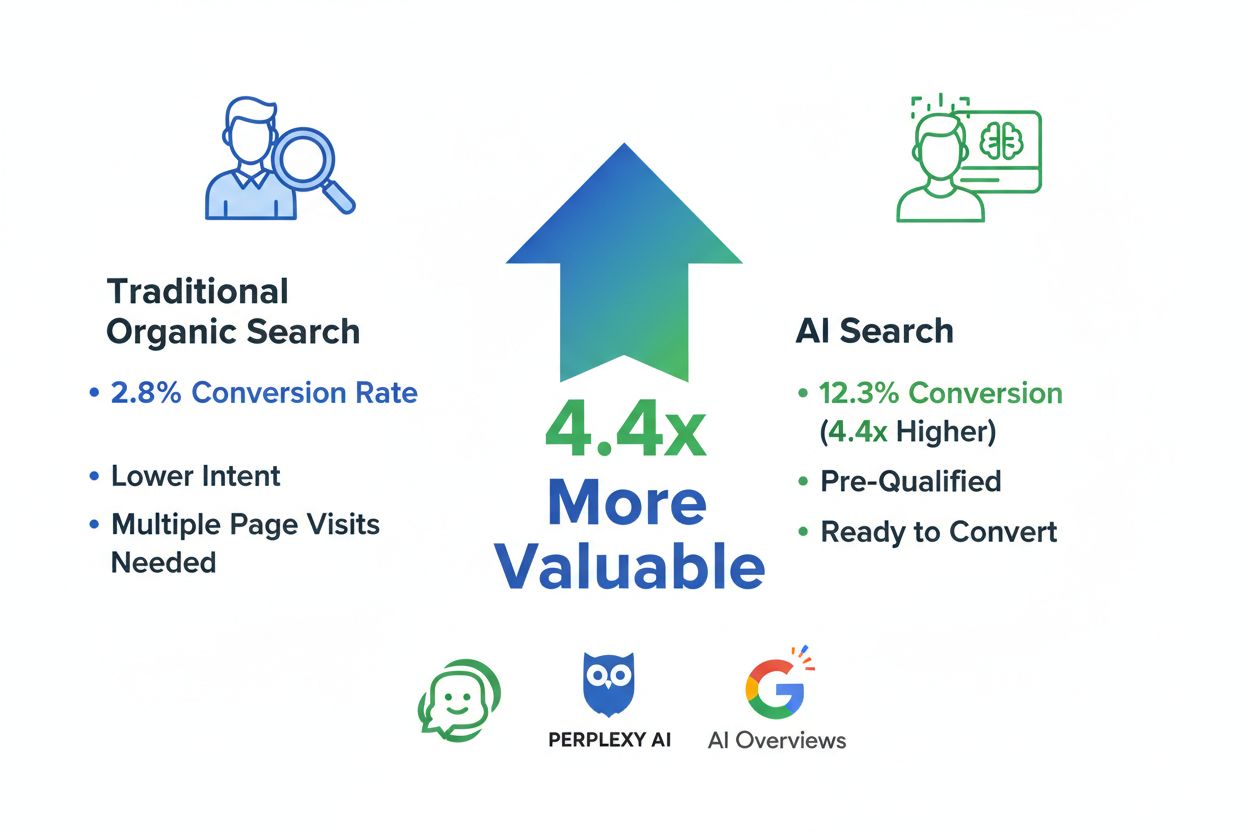
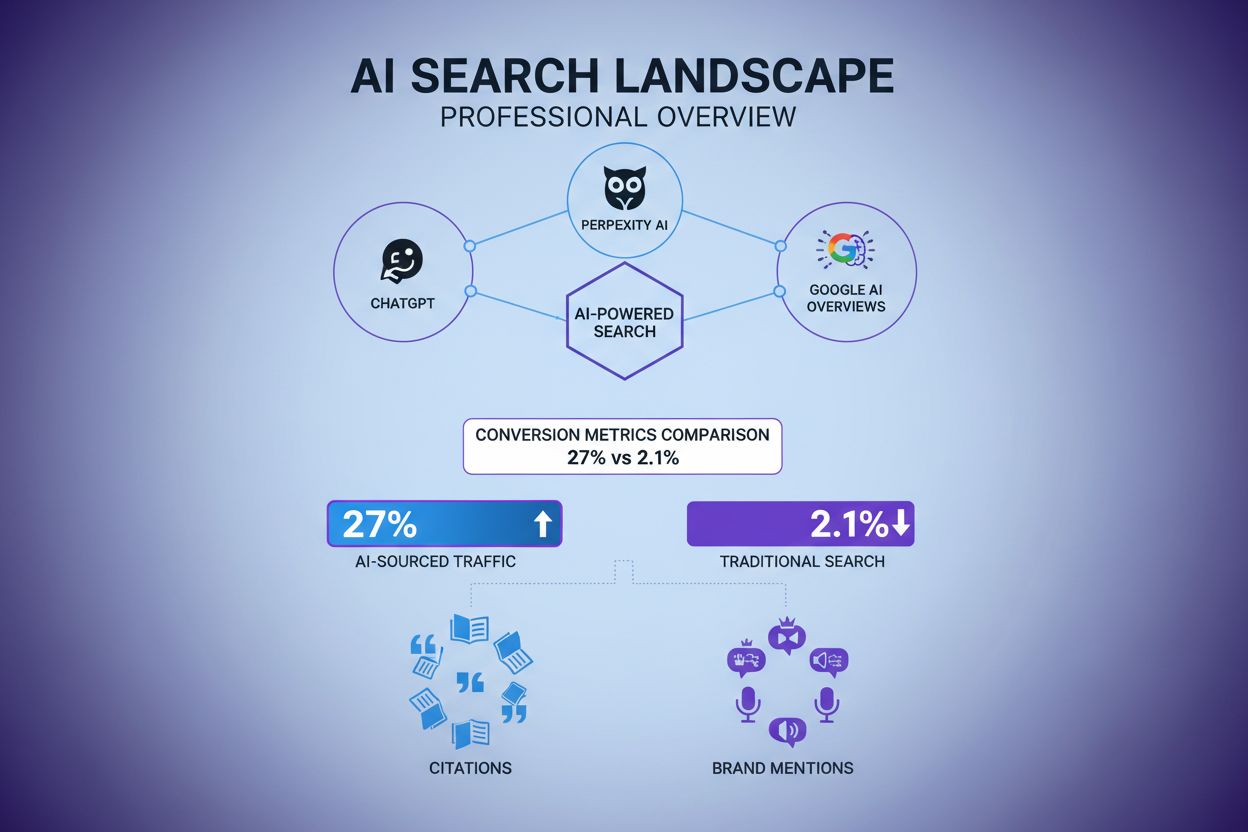
According to Semrush’s comprehensive AI search study, the average AI search visitor is worth 4.4 times more than the average traditional organic search visitor, based on conversion rates. This isn’t a marginal improvement—it’s a fundamental shift in how visitor quality should be measured. Ahrefs reports even more dramatic results, with AI search visitors converting at 23 times higher rates than traditional organic search for their platform, and their data shows that just 0.5% of traffic from AI sources drove 12.1% of their total signups. Yet most marketers continue optimizing for traffic volume and keyword rankings, completely missing the value revolution happening in AI-powered search.
For two decades, the marketing measurement hierarchy was straightforward: keyword rankings drove organic traffic, organic traffic drove leads, and leads drove revenue. But this framework collapses when applied to AI search. Traditional metrics like bounce rate, pages per session, and click-through rate fail to capture what actually matters: visitor intent and conversion probability. When AI Overviews appear in Google search results, click-through rates for informational queries drop by more than half—from 1.41% to 0.64%—yet the visitors who do click through are dramatically more qualified. Zero-click searches now account for nearly 60% of all Google searches in the US and EU, meaning traditional traffic volume metrics increasingly measure the wrong thing. The real story isn’t in the clicks; it’s in the conversions that happen when pre-informed visitors arrive at your site.
| Traditional Metric | What It Misses |
|---|---|
| Organic Traffic Volume | AI visitors convert 4.4x better despite lower volume |
| Keyword Rankings | AI cites positions 21+ as often as top 3 |
| Bounce Rate | AI visitors bounce less because they’re pre-qualified |
| Click-Through Rate | AI Overviews reduce CTR 34-46% but increase conversion |
| Pages Per Session | AI visitors convert faster with fewer page visits |
The reason AI search visitors convert so dramatically better is elegantly simple: they arrive pre-informed and pre-qualified. When someone asks ChatGPT “What’s the best marketing automation platform for B2B SaaS?” they’re not browsing—they’re seeking a specific answer. The AI synthesizes information from multiple sources, evaluates options, and delivers a recommendation. By the time your brand is mentioned in that response, the user has already learned about your value proposition, compared you against alternatives, and received what feels like a trusted, word-of-mouth recommendation. This pre-qualification effect is compounded by the persuasive power of AI recommendations. Unlike traditional search results that present 10 blue links, AI responses feel personal and authoritative. When an LLM says “Company X is the best solution for Y use case,” that carries emotional weight and credibility that a search ranking never could. The visitor doesn’t arrive at your site to research—they arrive ready to evaluate whether to buy.
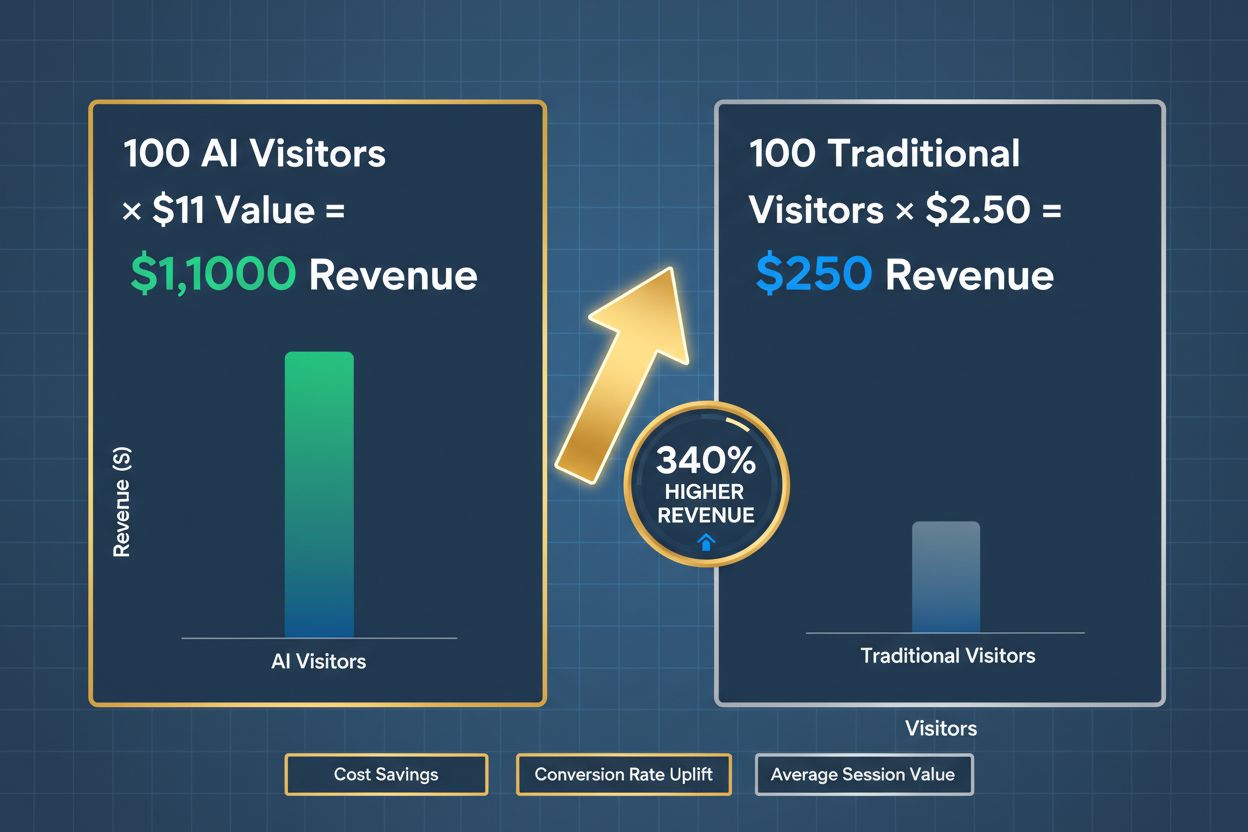
Understanding the financial impact requires simple arithmetic. If your traditional organic visitor is worth $2.50 in revenue (calculated as total organic revenue divided by organic visitors), then your AI visitor is worth $2.50 × 4.4 = $11.00. This means 100 AI visitors generate $1,100 in revenue compared to $250 from 100 traditional visitors. The Ahrefs case study makes this concrete: they received 0.5% of their traffic from AI sources but those visitors drove 12.1% of their signups. Scaling this across your business, even modest gains in AI traffic create outsized revenue impact. Companies implementing GEO strategies report 300-500% ROI within 6-12 months. The math is compelling: if you’re currently getting 10 AI visitors per month and converting them at 4.4x your traditional rate, you’re leaving significant revenue on the table by not optimizing for AI visibility. The opportunity isn’t in getting more traffic—it’s in getting the right traffic.
One of the most counterintuitive findings from recent AI search research is that you don’t need to rank in the top 3 positions to gain AI visibility. Semrush’s analysis of ChatGPT citations reveals that approximately 90% of cited pages rank in traditional organic search positions 21 or lower. This fundamentally changes the optimization playbook. Why do LLMs cite lower-ranking content? First, they have access to a vastly larger pool of content than traditional search engines—they’re not limited to the top 10 results. Second, LLMs can understand nuanced user intent in ways traditional search engines cannot. They can recognize that a specific user asking a specific question might benefit from content that ranks poorly for the general keyword but perfectly answers their particular use case. Third, AI systems prioritize content quality and relevance to the specific query over overall page authority. A deeply researched, well-structured answer to a niche question will be cited over a generic overview that ranks higher. This means your path to AI visibility doesn’t require dethroning competitors from top rankings—it requires creating content so specifically valuable and well-structured that AI systems recognize it as the best answer for particular queries.
The scale of AI search adoption is accelerating faster than most marketers realize. ChatGPT now processes over 2.5 billion queries daily with 800 million weekly active users. Perplexity AI recorded 153 million website visits in May 2025, up 191.9% from a year earlier. Google’s AI Overviews now appear in 57% of search engine results pages as of June 2025, compared to just 25% in August 2024. Most strikingly, AI-referred traffic grew 527% year-over-year between January and May 2025. These aren’t distant future trends—they’re current realities reshaping competitive dynamics right now. Gen Z adoption patterns are particularly telling: 34% of Gen Z users now use AI chatbots for search, and 57% turn to AI tools when Google doesn’t deliver expected results. This demographic will define search behavior for decades, and they’re already comfortable with AI-mediated discovery. The window for early-mover advantage is closing rapidly.
History shows that early adopters of platform transitions build lasting competitive advantages. Brands that optimized for mobile-first indexing when it was still novel gained lasting visibility advantages. Companies that mastered social media as an acquisition channel built sustainable moats that persist today. AI search represents the same inflection point—but moving faster. The brands establishing strong AI visibility now will benefit from compounding effects as these platforms mature. LLMs learn by finding patterns in vast amounts of online content. By shaping these patterns today through consistent, high-quality, well-structured content, your brand can be presented more frequently and favorably for years to come. Competitors who wait until AI search dominates will face an uphill battle against brands that already have established authority and citation patterns. The competitive advantage window is measured in months, not years.
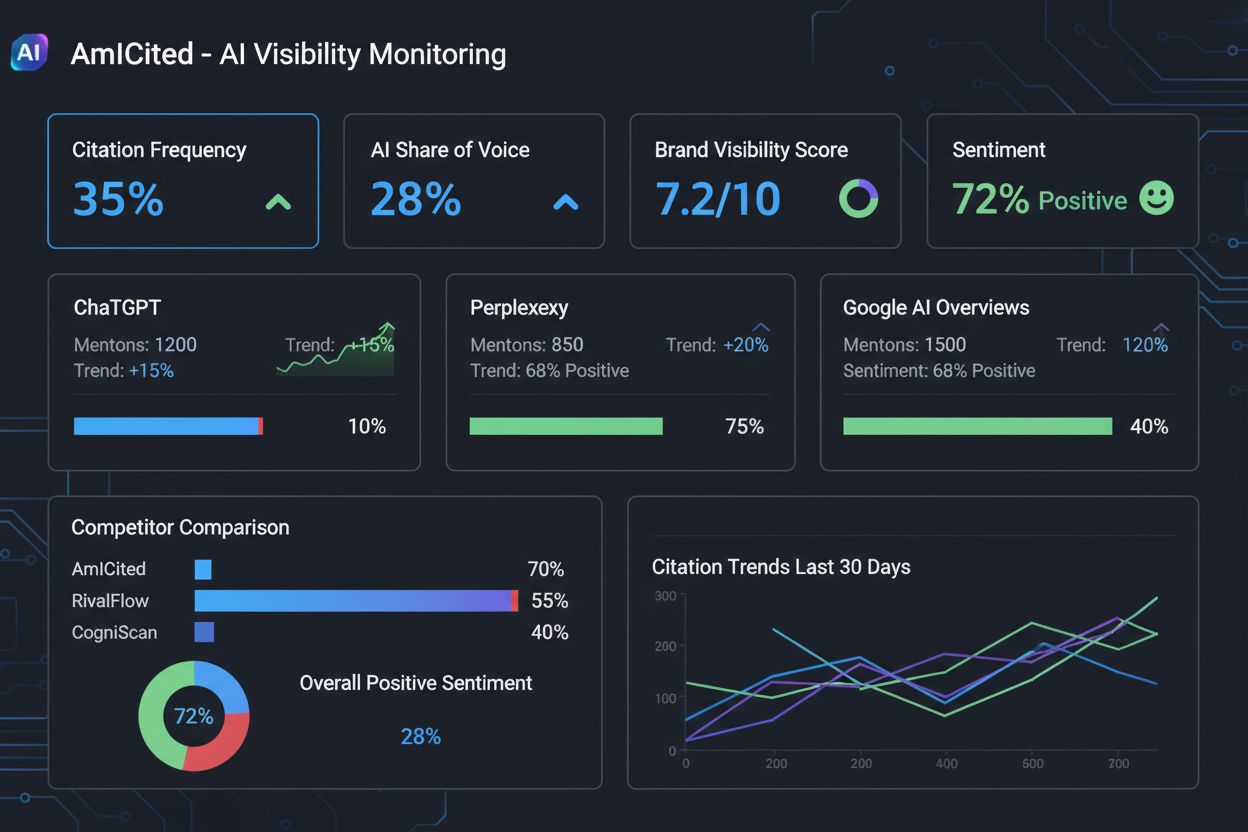
Traditional SEO gave us a clear metrics hierarchy: rankings, traffic, and conversions. GEO requires a fundamentally different measurement framework built around citations rather than clicks. Five metrics now matter more than traditional rankings:
Citation Frequency: How often your brand appears in AI-generated responses across platforms. Aim for 30%+ of AI responses for your core category queries.
Brand Visibility Score: A composite metric combining citation frequency, citation placement, link presence, and sentiment weight. Track weekly for consistent upward trajectory.
AI Share of Voice: Your brand’s percentage of total citations in your category compared to competitors. Aim to exceed your traditional market share by 10-20%.
Sentiment Analysis: Whether AI systems describe your brand positively, neutrally, or negatively. Target 70%+ positive sentiment across platforms.
LLM Conversion Rate: The conversion rate of visitors from AI platforms compared to traditional search. Your AI conversion rate should be 2-3x your traditional organic rate.
These metrics replace the traditional SEO trinity because they measure what actually drives revenue in the AI search era.
This is where AmICited.com becomes essential. While most analytics platforms remain blind to AI mentions, AmICited provides complete visibility into how AI systems reference your brand across ChatGPT, Perplexity, Google AI Overviews, and emerging platforms. The platform automatically tracks citation frequency, identifies which of your pages are being cited, analyzes sentiment in AI responses, and shows your competitive positioning. Rather than manually querying AI systems weekly, AmICited’s monitoring infrastructure continuously tracks your AI visibility, alerting you when your brand appears in new contexts or when sentiment shifts. The competitive intelligence features show exactly which content your competitors are getting cited for, revealing gaps in your own strategy. Most importantly, AmICited connects visibility metrics to business outcomes—you can see not just that you’re being cited, but how those citations drive traffic and conversions. In a world where 89% of B2B buyers use AI during their purchasing journey, having visibility into that journey is no longer optional.
The risk of ignoring AI search optimization is substantial and accelerating. Gartner predicts traditional search engine volume will drop 25% by 2026 due to users shifting to AI-powered answer engines. By 2028, that decline could reach 50%. When AI Overviews appear for a query, independent research shows click-through rate reductions ranging from 34% to 46%. Publishers are already reporting traffic losses of 20-40% as AI summaries appear above their content. The compounding effect is severe: as more users adopt AI search, your organic traffic declines while your competitors who optimized for AI visibility capture the high-intent traffic. The brands that will thrive aren’t those clinging to traditional SEO exclusively, nor those abandoning proven strategies entirely. Winners will be businesses that recognize AI search as an additional layer of discovery—complementary to traditional search, not simply replacing it—and systematically optimize for both.
You don’t need to overhaul your entire strategy to start capturing AI visitor value. Begin with these actionable steps:
Audit your current AI visibility across ChatGPT, Perplexity, Claude, and Google AI Overviews using your core category keywords. Document which of your pages are being cited and in what context.
Identify your most-cited content and analyze what makes it citation-worthy. Is it the structure? The comprehensiveness? The specific data points? Double down on these elements.
Optimize for AI-friendly formatting by adding clear introductory answer blocks (40-60 words), implementing proper heading hierarchy, using bullet points and tables, and ensuring content is scannable.
Create FAQ sections targeting how your ideal customers actually ask AI systems questions. These match the conversational query patterns that LLMs process.
Implement schema markup to make your content machine-readable. LLMs favor content they can easily parse and understand.
The foundation of LLM optimization overlaps substantially with traditional SEO—quality content, proper structure, and technical excellence still matter. But AI search requires specific enhancements: clearer answers, better formatting, more specific targeting of niche use cases, and consistent brand messaging across all channels. The brands that will dominate aren’t those choosing between traditional SEO and AI optimization—they’re those doing both, simultaneously, with intention.
According to Semrush research, AI search visitors convert at 4.4 times the rate of traditional organic search visitors. This means if your traditional organic visitor is worth $2.50 in revenue, your AI visitor is worth $11.00. This higher conversion rate occurs because AI visitors arrive pre-informed, having already compared options and received a trusted recommendation from the AI system.
AI visitors convert better because they arrive pre-qualified. When someone asks ChatGPT or Perplexity a specific question and your brand is mentioned in the response, they've already learned about your value proposition, compared alternatives, and received what feels like a trusted recommendation. They're not browsing—they're ready to evaluate whether to buy.
No. Research shows that approximately 90% of pages cited by ChatGPT rank in positions 21 or lower in traditional Google search. LLMs cite content based on relevance to specific queries and content quality, not overall domain authority. This means you can gain AI visibility without dethroning competitors from top rankings.
Unlike traditional SEO which takes 6-12 months, AI visibility improvements can appear within weeks, especially on platforms like Perplexity that conduct real-time web searches. However, building sustainable citation authority requires 3-6 months of consistent optimization. Early adopters of GEO strategies have 3x higher AI visibility than late movers.
Five key GEO metrics matter: Citation Frequency (how often you appear in AI responses), Brand Visibility Score (composite metric of citation quality), AI Share of Voice (your citations vs. competitors), Sentiment Analysis (how positively you're portrayed), and LLM Conversion Rate (conversion rate from AI traffic). These replace traditional SEO metrics like rankings and bounce rate.
Currently, AI-referred traffic represents 2-6% of total organic traffic for most websites, but it's growing at 40%+ per month. More importantly, this traffic converts 4.4x better than traditional organic traffic. Even small gains in AI traffic can significantly impact revenue. By 2028, AI search could drive equal or greater traffic volume than traditional search.
A citation includes a link to your content as a source—the AI explicitly credits your website. A mention references your brand name without a link. Both have value, but citations drive trackable traffic and stronger attribution. AmICited tracks both metrics separately so you can understand your complete AI visibility picture.
Yes. Traditional SEO foundations remain important because many of the factors that help you rank in Google also improve your AI visibility. However, AI search requires specific enhancements: clearer answer blocks, better formatting, more specific targeting of niche use cases, and consistent brand messaging. The winning strategy is doing both traditional SEO and AI optimization simultaneously.
Track how ChatGPT, Perplexity, and Google AI Overviews mention your brand. Get real-time insights into your AI search visibility and competitive positioning.
Discover AI search traffic value: 4.4x higher conversions than organic search. Learn ChatGPT, Perplexity, and Google AI Overviews ROI metrics for 2025.
AI search visitors convert 5x better than Google organic traffic. Learn why ChatGPT, Perplexity, and Claude drive higher-quality conversions despite lower volum...
Complete GEO audit checklist with 25 optimization factors for ChatGPT, Perplexity, and Google AI Overviews. Improve your AI search visibility with our comprehen...