
AI Visibility Futures
Explore AI Visibility Futures - forward-looking analysis of emerging trends in AI-driven brand discovery. Learn how brands will be discovered by AI systems and ...
12 min read
Discover how AI search is reshaping SEO. Learn the key differences between AI platforms like ChatGPT and traditional Google search, and how to optimize your content for both.
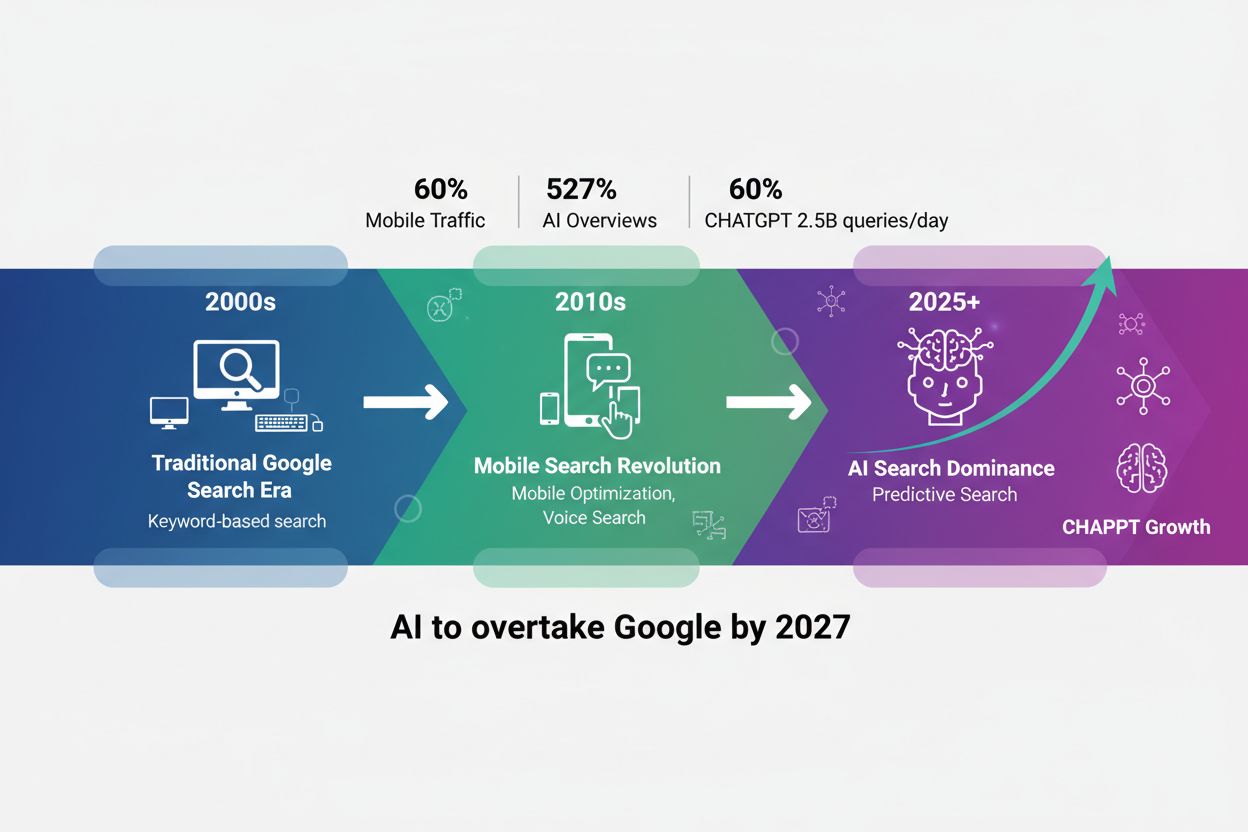
The way people search for information is undergoing a seismic transformation. For over two decades, Google’s blue links dominated how users discovered content online. Today, that paradigm is shifting dramatically toward AI-powered conversational interfaces that synthesize answers before users ever click a link. Between January and May 2025, AI-referred sessions jumped from 17,076 to 107,100 across major websites—a staggering 527% increase in just five months. This isn’t a distant future scenario; it’s happening right now in your analytics. ChatGPT alone grew from 600 visits per month in early 2024 to over 22,000 visits per month by May 2025. Meanwhile, Google AI Overviews now appear in 60.32% of U.S. searches, fundamentally changing how search results are presented. The question is no longer whether AI search will matter—it’s whether your SEO strategy accounts for this reality.
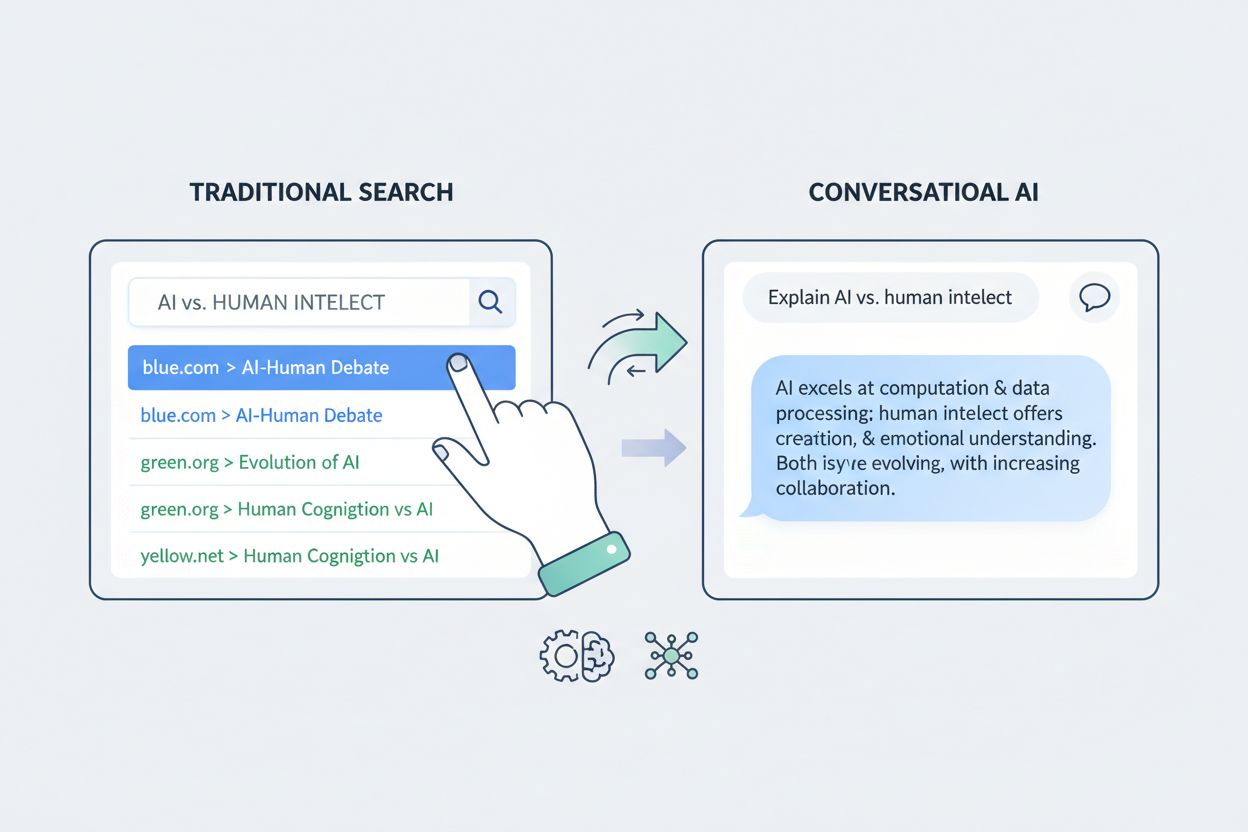
While both AI search and traditional search aim to answer user questions, they operate on fundamentally different principles. Traditional search engines like Google rely on a complex ranking algorithm that considers backlinks, domain authority, keyword relevance, and hundreds of other factors to determine which pages deserve the top positions. The goal is to surface entire webpages that users can click through and explore. AI search systems, by contrast, use large language models trained on vast amounts of internet content to generate synthesized answers that directly address user queries. Instead of ranking pages, they extract relevant information from multiple sources and present it as a cohesive response within a chat interface.
| Factor | Traditional Search (Google) | AI Search (ChatGPT, Perplexity, Google AI Overviews) |
|---|---|---|
| Primary Goal | Rank and surface webpages | Generate synthesized answers |
| Ranking Factors | Backlinks, domain authority, keywords, page experience | Content quality, semantic clarity, relevance, trustworthiness |
| Citation Importance | Links are critical ranking signals | Citations are helpful but not required for visibility |
| Content Discovery | Crawls and indexes pages regularly | Learns from training data; may cite pages ranking 21+ in traditional search |
| User Experience | Click-based; users visit multiple sites | Conversational; answers provided directly in interface |
| Speed of Indexing | Days to weeks for new content | Immediate surfacing if content is relevant and accessible |
| Multimodal Support | Limited; primarily text and images | Strong; can process and reference text, images, video, audio |
This distinction matters enormously for your strategy. A page ranking in position 15 on Google might never receive clicks, but that same page could be cited frequently in AI responses if it contains clear, well-structured information that answers specific questions. Conversely, a page ranking in position 1 might lose significant traffic if an AI Overview answers the query completely before users scroll to organic results.
The financial implications of this shift are profound. According to Semrush’s research, the average AI search visitor is worth 4.4 times more than the average traditional organic search visitor, based on conversion rates. This dramatic difference exists because AI search visitors arrive at your site already informed, already having compared options, and already primed to make a decision. When a user asks ChatGPT “What are the best project management tools for remote teams?” and the AI mentions your product alongside competitors, that user has already received a personal recommendation from a trusted source. By the time they click to your website, they’re significantly further along in the buyer’s journey than someone who clicked a traditional search result.
McKinsey estimates that AI search could impact $750 billion in revenue by 2028, with half of consumers already using AI-powered search tools today. For digital marketing and SEO-related topics specifically, research suggests that AI search could drive more visitors than traditional search by early 2028. This isn’t just about traffic volume—it’s about traffic quality. The visitors you gain from AI citations tend to convert better, stay longer, and generate higher lifetime value. Early adopters who optimize for AI visibility now will capture disproportionate market share as this transition accelerates.
The AI search landscape is rapidly diversifying beyond a single dominant player. ChatGPT remains the clear leader, receiving approximately 2.5 billion queries per day and growing at a pace that could see it surpass Google’s search volume by 2027. ChatGPT’s weekly active users grew 8x from October 2023 to April 2025, reaching over 800 million users. The platform’s conversational interface and ability to maintain context across multiple turns makes it particularly effective for complex, consultative queries.
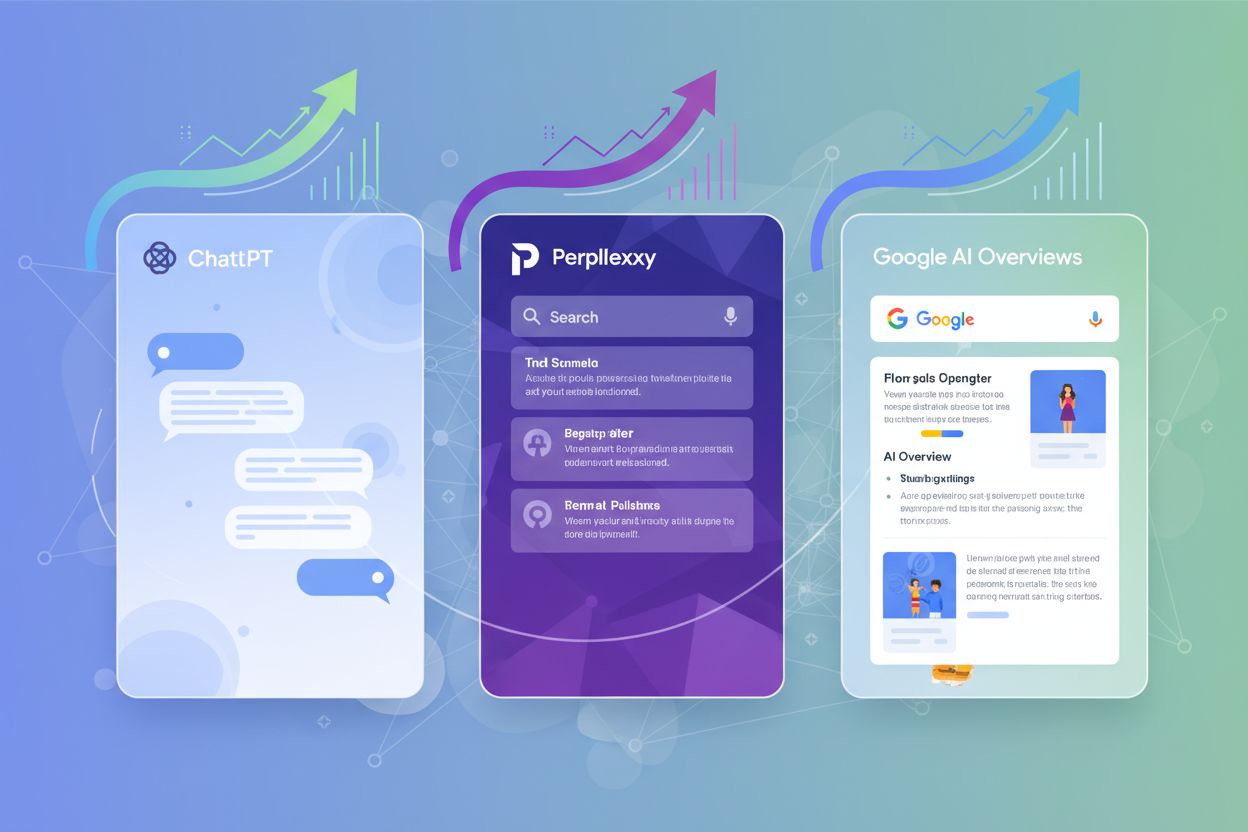
Google AI Overviews represent Google’s response to this threat. Rather than ceding search to competitors, Google integrated AI-generated summaries directly into its search results. These summaries appear above traditional organic results and synthesize information from multiple sources. Google has also launched AI Mode, which provides a ChatGPT-like experience and completely replaces the traditional search results page for users who opt in. If AI Mode becomes the default experience, the transition to AI-dominant search could happen much faster than current projections.
Perplexity has emerged as a strong third player, particularly in finance and professional services. The platform emphasizes source transparency and real-time information, making it attractive to users who want both synthesized answers and clear citations. Microsoft Copilot and Google Gemini round out the major players, each with their own user bases and optimization requirements.
AI search adoption isn’t uniform across industries. Certain sectors are experiencing dramatically higher AI traffic penetration because their users ask the types of questions that AI systems excel at answering—consultative, trust-heavy, context-dependent queries.
These five industries account for 55% of all LLM-sourced sessions across major websites. Why? Because users in these sectors ask questions like “What should I ask a lawyer before signing this contract?” or “Is this medication safe with my specific conditions?” or “How do I structure payroll for my small business?” These are exactly the types of nuanced, personalized questions that AI systems are designed to answer comprehensively. If your business operates in one of these industries, AI search optimization should be a top priority.
Understanding what content AI systems prefer to cite is crucial for visibility. Research reveals that Quora is the most commonly cited website in Google AI Overviews, followed closely by Reddit. This might seem counterintuitive—why would AI prefer community Q&A sites over authoritative brand websites? The answer lies in content structure and specificity. Quora and Reddit contain thousands of niche, specific answers to detailed questions that aren’t addressed elsewhere on the web. When someone asks “What’s the best way to train a dog with separation anxiety if you work full-time?” they’re more likely to find a detailed, personal answer on Reddit than on a generic dog training website.
However, the picture is more nuanced. While Quora and Reddit dominate on a per-domain basis, 50% of all ChatGPT links point to business and service websites. This means your company website has strong potential to be cited in AI responses—but only if you create the right type of content. High-authority domains like Travel + Leisure, Good Housekeeping, NerdWallet, LinkedIn, YouTube, and the New York Times also rank highly in AI citations, suggesting that a combination of authority, clarity, and relevance drives AI visibility.
Optimizing for AI search requires a different approach than traditional SEO, though the two strategies complement each other. Here are the key tactics:
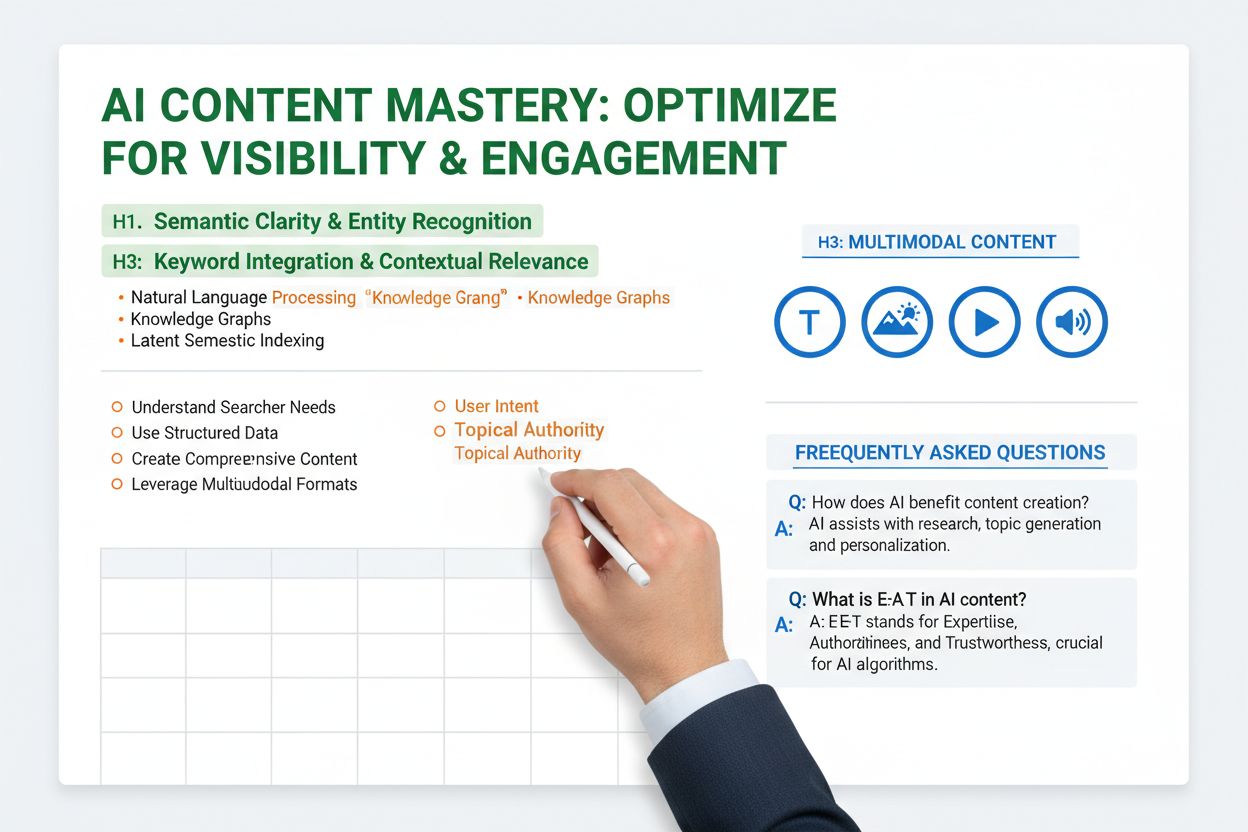
Structure your content for extraction. AI systems need to be able to easily identify and extract relevant information from your pages. Use clear H1, H2, and H3 heading hierarchies. Break up long paragraphs into scannable sections. Create FAQ sections that directly answer common questions. Use bullet points and numbered lists to present information in easily digestible chunks.
Prioritize semantic clarity over keyword density. Instead of stuffing keywords, focus on clearly explaining concepts and defining terms. Use natural language that matches how people actually ask questions. Include related entities and concepts that help AI systems understand the full context of your content.
Create multimodal content. AI systems can process text, images, video, and audio. Content that combines multiple formats gives AI more ways to interpret and present your information. A blog post with embedded videos, infographics, and clear text performs better than text alone.
Publish comparison guides and detailed examples. AI systems frequently cite content that helps users understand differences between options or see real-world applications. Create guides comparing your solution to competitors. Provide detailed case studies and examples that illustrate your points.
Ensure your website is crawlable. Many AI systems don’t execute JavaScript, so avoid hiding important content behind interactive elements. Make sure your site structure is logical and your content is accessible to crawlers. Use semantic HTML and structured data markup to help AI systems understand your content.
Maintain consistent brand messaging. Use the same terminology and phrasing across your website and other properties. When AI systems see consistent messaging about your brand across multiple sources, they develop more confidence in citing you.
You can’t optimize what you don’t measure. Traditional SEO metrics like rankings and organic traffic are no longer sufficient in an AI-driven search landscape. You need new KPIs that capture your visibility in AI systems.
Manual prompt testing is the most straightforward approach. Regularly test prompts in ChatGPT, Perplexity, and Google AI Overviews that relate to your business. Search for your brand name, your products, and relevant industry topics. Note whether and how your brand appears in the responses. Track changes over time.
Monitor brand mentions and citations across high-authority websites where AI systems source information. Tools like Google Alerts can help, but more sophisticated solutions provide deeper insights into where your brand is mentioned and in what context.
Implement UTM parameters for AI traffic sources. As of June 2025, you can use utm_source=chatgpt to track traffic coming from ChatGPT in Google Analytics 4. This helps you understand the volume and quality of AI-referred traffic.
Track sentiment and portrayal. It’s not enough to know you’re cited—you need to know how you’re portrayed. Are you mentioned favorably? Are there negative mentions you need to address? This is where specialized AI visibility monitoring tools become invaluable.
AmICited.com provides automated monitoring of your brand mentions and citations across ChatGPT, Perplexity, Google AI Overviews, and other AI platforms. Rather than manually testing prompts, AmICited tracks how AI systems reference your brand across hundreds of relevant queries, giving you a comprehensive view of your AI visibility and how it changes over time. This is essential for understanding your true presence in the AI search landscape.
Traditional SEO isn’t dead—it’s evolving. The most successful strategy going forward combines optimization for both traditional search and AI search. Here’s why: many of the factors that help you rank in Google also help you get cited in AI systems. Quality content, clear structure, and topical authority benefit both. However, the emphasis shifts. In traditional SEO, you’re competing for position 1. In AI search, you’re competing to be the answer the model chooses to cite.
The timeline matters. For digital marketing and SEO-related topics, AI search could surpass traditional search by early 2028. For other industries, the transition may take longer. But the direction is clear: AI-driven discovery is accelerating faster than anyone predicted. Early adopters who begin optimizing for AI visibility now will establish themselves as trusted sources before the competition catches up. By the time AI search becomes the dominant discovery channel in your industry, you’ll already have the visibility and authority that took years to build.
The competitive advantage belongs to those who act now. Your competitors are likely still focused entirely on traditional SEO. By diversifying your strategy to include AI optimization, you’re positioning your brand to capture disproportionate visibility in the search landscape of 2027 and beyond.
No, traditional SEO remains important as a foundation, but it's evolving. Many factors that help you rank in Google also help you get cited in AI systems. However, you now need to optimize for both traditional search and AI visibility simultaneously.
According to recent data, AI search could surpass traditional search for digital marketing topics by early 2028. ChatGPT is on pace to overtake Google's query volume by 2027, though this timeline could accelerate if Google makes AI Mode the default experience.
Google AI Overviews appear within Google's search results and synthesize answers from multiple sources. ChatGPT search is a standalone conversational interface. Both compress the marketing funnel but work differently - Google Overviews still show some links, while ChatGPT may not.
AI search visitors are more qualified because they've already received synthesized information and compared options within the AI interface. By the time they click to your site, they're further along in the decision journey and more likely to convert.
Legal, Finance, Health, SMB, and Insurance see the highest AI traffic. These industries benefit from consultative, trust-heavy queries that AI systems excel at answering. However, all industries should begin optimizing now.
You can manually test prompts in ChatGPT, Perplexity, and Google AI Overviews. Use GA4 with UTM parameters to track traffic from AI sources. Tools like AmICited.com monitor your brand mentions and citations across AI platforms automatically.
Structured, semantic content with clear headings, FAQ sections, and direct answers. Content that's easy for AI to extract and reuse performs better. Quora and Reddit rank highly because they contain niche, specific answers to detailed questions.
No. Traditional SEO and AI optimization should work together. The same quality content that ranks well in Google often gets cited in AI systems. Focus on creating genuinely helpful, well-structured content that serves both audiences.
AI search is reshaping how customers find your brand. AmICited tracks your mentions and citations across ChatGPT, Perplexity, Google AI Overviews, and other AI platforms - giving you visibility into the future of search.
Explore AI Visibility Futures - forward-looking analysis of emerging trends in AI-driven brand discovery. Learn how brands will be discovered by AI systems and ...
Comprehensive guide to the 25 best AI visibility tools in 2026. Compare features, pricing, and capabilities of Profound, Am I Cited, Peec AI, Otterly, Semrush A...

Discover the real business costs of ignoring AI search monitoring. Learn how brands lose visibility, market share, and customer discovery when they don't track ...