

Conversational Commerce
Learn what conversational commerce is, how AI chatbots and messaging apps transform e-commerce, market statistics, implementation best practices, and future tre...
10 min read

Discover how AI shopping and conversational commerce are transforming retail. Learn about chat-based shopping trends, real-world success stories, and how to implement AI-powered commerce for your brand.
The e-commerce landscape is undergoing a fundamental transformation as conversational commerce replaces the static, one-size-fits-all approach of traditional online shopping. While conventional e-commerce relies on customers navigating product catalogs independently, conversational commerce enables real-time, personalized interactions through chat, messaging apps, and voice assistants. This shift represents a move from one-to-many broadcasting to one-to-one personalization at scale, where AI understands individual customer needs and preferences instantly. According to recent industry data, 73% of marketers plan to increase conversational commerce investments by 25-50% in the coming year, signaling widespread recognition of this channel’s potential. Additionally, 74% of marketing leaders plan to incorporate conversational ads into their 2025 strategies, demonstrating that brands across sectors are prioritizing direct, intimate customer conversations over traditional display advertising.

At the heart of conversational commerce lies sophisticated AI-powered chatbot technology that leverages Natural Language Processing (NLP) to understand customer intent with remarkable accuracy. These intelligent systems operate across multiple platforms—including WhatsApp, Facebook Messenger, Instagram Direct Messages, Amazon Alexa, and Google Assistant—creating seamless shopping experiences wherever customers prefer to communicate. The technology captures zero-party data directly from customer conversations, allowing brands to understand preferences, purchase history, and behavioral patterns without relying solely on cookies or third-party tracking. Modern conversational AI systems continuously learn from each interaction, refining their product recommendations and response accuracy through machine learning algorithms that identify patterns across thousands of customer conversations. Unlike traditional chatbots that follow rigid decision trees, contemporary LLM-powered assistants can understand context, nuance, and complex queries, enabling natural conversations that feel less like talking to a machine and more like consulting a knowledgeable sales associate. The technology also enables real-time inventory checks, price comparisons, and personalized product suggestions based on browsing history, purchase patterns, and explicitly stated preferences. This comprehensive approach to understanding customer needs creates a foundation for truly personalized shopping experiences that drive engagement and conversion.
| Aspect | Traditional E-Commerce | Conversational Commerce |
|---|---|---|
| Customer Journey | Multi-step, browsing | Natural conversation |
| Personalization | Generic recommendations | AI-powered, contextual |
| Data Collection | Passive tracking | Active conversation |
| Response Time | Delayed | Real-time |
| Platforms | Websites, apps | Chat apps, messaging |
| Customer Effort | High friction | Low friction |
The advantages of implementing conversational commerce extend far beyond simple customer convenience, offering measurable business impact across multiple dimensions:
• One-to-one personalization at scale – AI systems deliver individualized product recommendations and shopping experiences to millions of customers simultaneously, something impossible with human-only customer service teams.
• Higher engagement in private channels – Customers interact more frequently and openly in direct messaging environments compared to public social media, leading to deeper relationships and increased lifetime value.
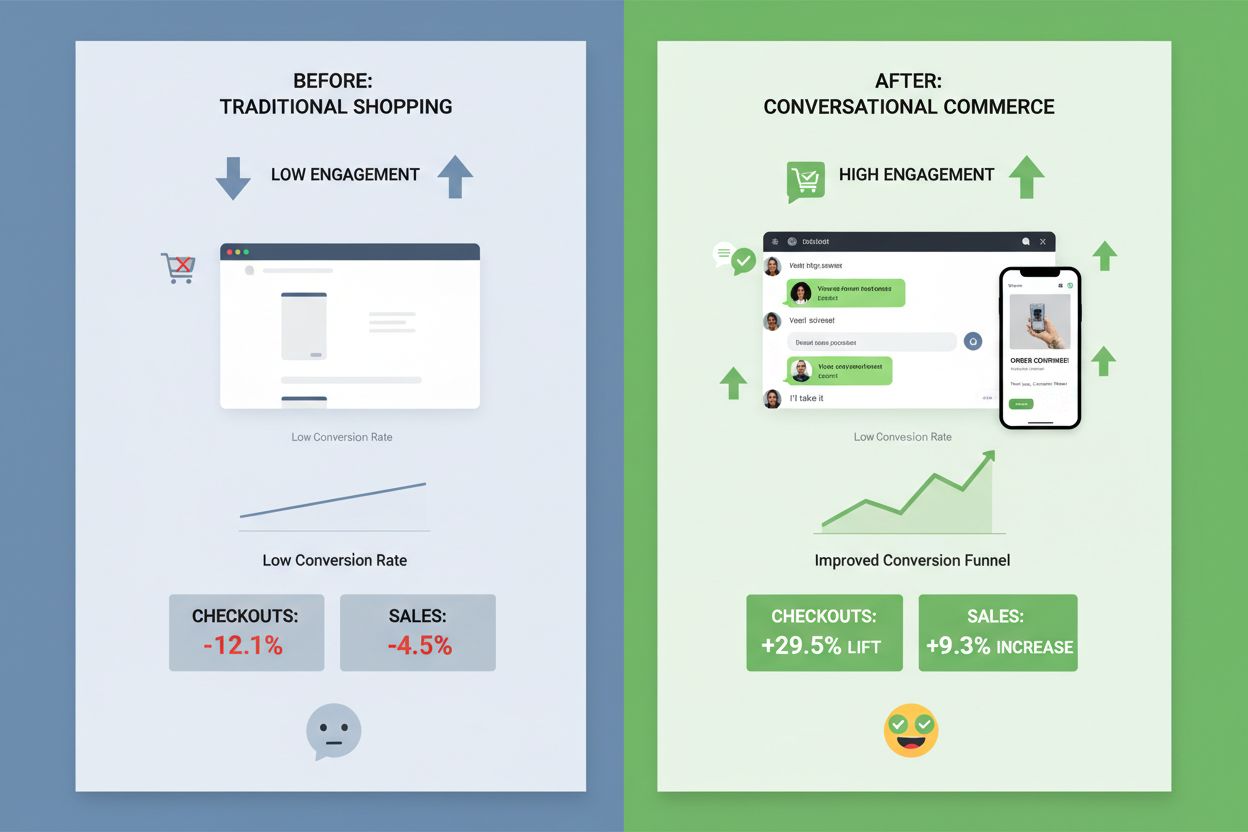
• Proven conversion lift – Hunkemöller, a leading European lingerie retailer, achieved a +29.5% lift in initiated checkouts and +9.3% lift in overall sales after implementing AI-powered conversational shopping.
• Zero-party data collection and optimization – Direct customer conversations provide explicit preference data that enables continuous AI model improvement and increasingly accurate personalization.
• 24/7 availability and cost efficiency – AI agents handle customer inquiries around the clock without the overhead of maintaining large customer service teams, reducing operational costs while improving response times.
• Behavioral insights and predictive analytics – Conversational data reveals shopping patterns, seasonal preferences, and customer lifecycle trends that inform inventory planning, marketing strategies, and product development decisions.
Hunkemöller, a prominent European intimate apparel brand, demonstrates the transformative potential of conversational commerce through its strategic implementation of AI-powered shopping assistants. The brand deployed AI categorization technology that understood customer style preferences, body type considerations, and comfort priorities, enabling the system to recommend products with unprecedented relevance. The results were striking: +29.5% lift in initiated checkouts and +9.3% lift in completed sales within the first implementation period. Beyond raw metrics, the conversational data revealed fascinating behavioral insights—women predominantly purchased cozy, comfortable items for personal use, while men shopped for higher-value gift items, often seeking guidance on sizing and style appropriateness. Marley Spoon, a meal subscription service, successfully leveraged conversational commerce to reactivate churned customers by engaging them in personalized conversations about their dietary preferences, schedule changes, and previous satisfaction issues. These case studies illustrate that conversational commerce isn’t merely a novelty channel but a proven mechanism for driving measurable business results across different retail categories and customer segments.
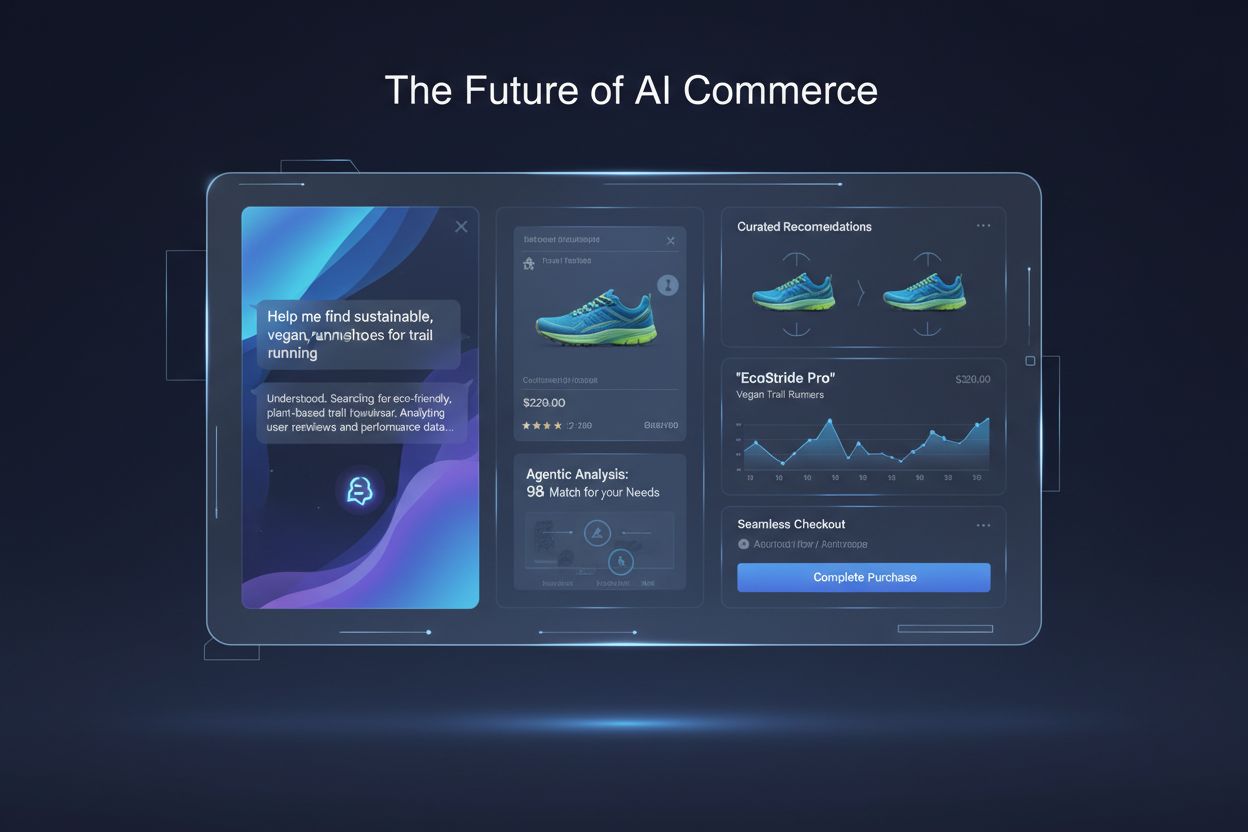
The distinction between assistive AI and agentic AI is crucial for understanding the future of conversational commerce. While assistive AI helps humans make better decisions, agentic AI operates autonomously to complete tasks, make recommendations, and even execute transactions without constant human oversight. In shopping contexts, AI agents handle product discovery by understanding vague customer requests and surfacing relevant items, generate personalized recommendations based on behavioral patterns, and guide customers through checkout processes with minimal friction. Beyond customer-facing interactions, AI agents dramatically enhance backend operations—automatically writing compelling product descriptions, categorizing inventory with precision, and generating SEO-optimized meta titles and descriptions that improve discoverability. These systems employ predictive capabilities to anticipate customer needs, suggesting complementary products or alerting customers to relevant sales before they even search. The availability advantage is substantial: AI agents provide 24/7 customer support without fatigue or inconsistency, handling peak shopping periods and time-zone differences effortlessly. Research indicates that commerce professionals using AI tools save an average of 6.4 hours per week, time previously spent on manual product management, customer inquiries, and data entry tasks that AI now handles with greater accuracy and consistency.
The infrastructure supporting conversational commerce spans multiple platforms, each with distinct advantages and user bases. WhatsApp, Facebook Messenger, and Instagram Direct Messages collectively reach billions of users who already spend significant time in these applications, making them natural shopping destinations. Voice assistants like Amazon Alexa and Google Assistant enable hands-free shopping for customers managing multiple tasks simultaneously, particularly appealing for reorders and routine purchases. Emerging platforms like TikTok Shop and Instagram Checkout integrate commerce directly into social discovery experiences, allowing customers to purchase without leaving the app where they discovered products. SMS and text-based assistants provide a direct, high-engagement channel with open rates exceeding 98%, making them ideal for time-sensitive offers and order updates. The most sophisticated brands implement cross-platform integration, ensuring consistent customer experiences and unified data regardless of which channel customers prefer. With 5 billion monthly active users across major social platforms, the potential audience for conversational commerce is virtually limitless, yet success requires understanding which channels align with specific customer segments and product categories.
Modern consumers increasingly expect personalized, real-time interactions that acknowledge their individual preferences and purchase history, rejecting generic product recommendations and one-size-fits-all marketing messages. The shift from passive browsing to active conversation reflects changing consumer psychology—customers want to ask questions, receive immediate answers, and feel heard by brands rather than simply scrolling through product listings. Mobile-first preferences dominate consumer behavior, with the majority of shopping research and purchases occurring on smartphones, making chat-based commerce naturally aligned with how customers already interact with technology. Consumers demand 24/7 availability, expecting to shop and receive support at any hour, a requirement that human-only customer service teams cannot meet. The preference for natural language interaction over navigating complex menus or forms reflects broader frustration with clunky digital experiences—customers want to communicate as they would with a friend, not decode technical interfaces. Gen Alpha consumers, who have never known a world without AI, expect intelligent, anticipatory service as a baseline rather than a premium feature. Research reveals that 68% of customers refuse to use a chatbot again after a poor experience, emphasizing the critical importance of implementation quality. Additionally, 79% of consumers are influenced by user-generated content and peer recommendations, suggesting that conversational commerce platforms should facilitate social proof and community engagement alongside individual transactions.
Despite significant potential, conversational commerce implementation presents substantial challenges that require thoughtful strategy and investment. Data privacy and security remain paramount concerns, as conversational commerce systems collect intimate customer information including preferences, purchase history, and behavioral patterns that demand robust protection against breaches and misuse. Building and maintaining customer trust requires transparency about data usage, clear opt-in mechanisms, and demonstrated commitment to customer privacy—particularly important given that 68% of customers say AI advances make trustworthiness more important than ever. Ensuring accurate product information within conversational systems demands continuous catalog synchronization, as outdated pricing, availability, or specifications damage credibility and create operational friction. Handling complex queries remains challenging for AI systems, particularly when customers have nuanced needs, special requests, or situations requiring human judgment and empathy. System integration across legacy e-commerce platforms, inventory management systems, and CRM tools requires significant technical investment and ongoing maintenance. Training AI models to understand industry-specific terminology, regional variations, and cultural nuances demands substantial data and expertise. Transparency about AI use is increasingly important, as customers want to know when they’re interacting with machines versus humans, and deception damages long-term trust. Ethical considerations around algorithmic bias, fair pricing, and manipulation require careful governance to ensure conversational commerce enhances rather than exploits customer relationships.
The trajectory of conversational commerce points toward increasingly sophisticated and autonomous shopping experiences that anticipate customer needs before explicit requests. Fully automated shopping assistants will handle end-to-end customer journeys—from discovery through post-purchase support—with minimal human intervention, freeing customer service teams to focus on complex issues requiring empathy and judgment. Consumer insights derived from zero-party data will become competitive advantages, enabling brands to understand preferences, values, and behaviors with unprecedented granularity and accuracy. AR and VR integration will enable virtual try-ons within conversational interfaces, allowing customers to visualize products in their own spaces or on their own bodies before purchasing. Predictive shopping will evolve beyond recommendations to proactive outreach—AI systems suggesting replenishment items, seasonal products, or complementary purchases at optimal moments in customer lifecycles. Subscription-based experiences will leverage conversational commerce to deliver personalized curation, making subscriptions feel like personalized shopping services rather than static product bundles. Live shopping with AI hosts will combine entertainment, education, and commerce, creating engaging experiences that blur lines between content consumption and purchasing. Voice commerce expansion will accelerate as voice recognition accuracy improves and smart speakers become ubiquitous in homes and vehicles. Emotional AI and empathy will enable systems to recognize customer frustration, disappointment, or excitement, responding with appropriate tone and support that feels genuinely human-centered.
Organizations ready to implement conversational commerce should begin by identifying and prioritizing the platforms where their target customers already spend time, rather than forcing customers to adopt new channels. Define clear use cases aligned with business objectives—whether driving sales, improving customer service, reactivating lapsed customers, or gathering market insights—ensuring that conversational commerce investments address specific business challenges. Invest heavily in product data and catalog enrichment, as AI systems can only recommend and describe products effectively when underlying data is accurate, complete, and well-organized. Select platforms and tools that integrate seamlessly with existing systems, avoiding solutions that create data silos or require manual workarounds. Test and iterate continuously, starting with limited rollouts to specific customer segments or product categories, measuring performance against clear metrics before scaling. Establish success metrics aligned with business objectives—whether conversion rate, average order value, customer satisfaction, or operational efficiency—and monitor performance rigorously. Train your team on conversational commerce best practices, ensuring that human team members understand when and how to intervene in AI conversations and how to escalate complex issues appropriately. Plan for scale from the beginning, architecting systems that can handle growth without degradation in performance or customer experience. As conversational commerce becomes increasingly central to retail strategy, platforms like AmICited.com play a vital role in monitoring how AI systems cite sources, maintain accuracy, and represent brands authentically within conversational interfaces—ensuring that the AI shopping revolution builds customer trust rather than eroding it.
Conversational commerce is a marketing and sales approach that uses chat apps, voice assistants, and AI-powered messaging to deliver personalized, real-time shopping experiences. It simplifies product discovery, boosts engagement, and drives conversions by enabling two-way interactions with customers across platforms like WhatsApp, Facebook Messenger, Instagram Direct, and voice assistants.
AI improves shopping through personalization, speed, and accuracy. AI-powered systems understand customer intent through natural language processing, provide instant product recommendations based on preferences and behavior, handle 24/7 customer inquiries without human intervention, and continuously learn from interactions to improve future recommendations and experiences.
Major platforms supporting conversational commerce include WhatsApp, Facebook Messenger, Instagram Direct Messages, Amazon Alexa, Google Assistant, TikTok Shop, Instagram Checkout, and SMS-based shopping assistants. Each platform offers unique advantages and reaches different customer segments, with successful brands implementing cross-platform integration for consistent experiences.
Brands collect zero-party data directly from customer conversations—information customers willingly share about preferences, needs, and purchase history. This data is more accurate and privacy-compliant than third-party tracking, enabling better personalization while building customer trust through transparent data practices and clear consent mechanisms.
Real-world results demonstrate significant conversion improvements. Hunkemöller achieved a +29.5% lift in initiated checkouts and +9.3% lift in overall sales using conversational commerce. Benefits include reduced friction in the purchase journey, higher engagement in private messaging channels, improved customer satisfaction, and increased customer lifetime value through personalized experiences.
Start by identifying platforms where your target customers already spend time. Define clear use cases aligned with business objectives, invest in product data quality and catalog enrichment, select tools that integrate with existing systems, test with limited rollouts, establish success metrics, and train your team on best practices before scaling implementation.
Security and privacy are paramount in conversational commerce. Reputable platforms implement encryption, secure data storage, and compliance with privacy regulations like GDPR. Brands should be transparent about data usage, implement clear opt-in mechanisms, and demonstrate commitment to customer privacy—critical since 68% of customers say AI advances make trustworthiness more important.
The future includes fully automated shopping assistants, AR/VR integration for virtual try-ons, predictive shopping that anticipates needs, subscription-based personalized curation, live shopping with AI hosts, expanded voice commerce, and emotional AI that responds with appropriate empathy. These advances will create seamless, anticipatory shopping experiences that feel genuinely human-centered.
Track mentions of your products and brand across AI shopping assistants, chatbots, and conversational commerce platforms with AmICited
Learn what conversational commerce is, how AI chatbots and messaging apps transform e-commerce, market statistics, implementation best practices, and future tre...
Learn how to optimize your products for ChatGPT shopping and AI commerce. Master product feeds, visibility strategies, and stay ahead in conversational commerce...

Learn what conversational commerce and AI are, how they work together, their benefits for businesses and customers, and best practices for implementation in you...