

AI Traffic Conversion Rates: Why Quality Exceeds Quantity
Discover why AI traffic converts 23x better than organic search. Learn how to optimize for AI platforms and measure real ROI from AI-driven visitors.
10 min read
Learn why AI traffic converts 4-5x better than Google. Discover quality metrics that matter, platform-specific conversion rates, and strategies to optimize AI visitor quality.
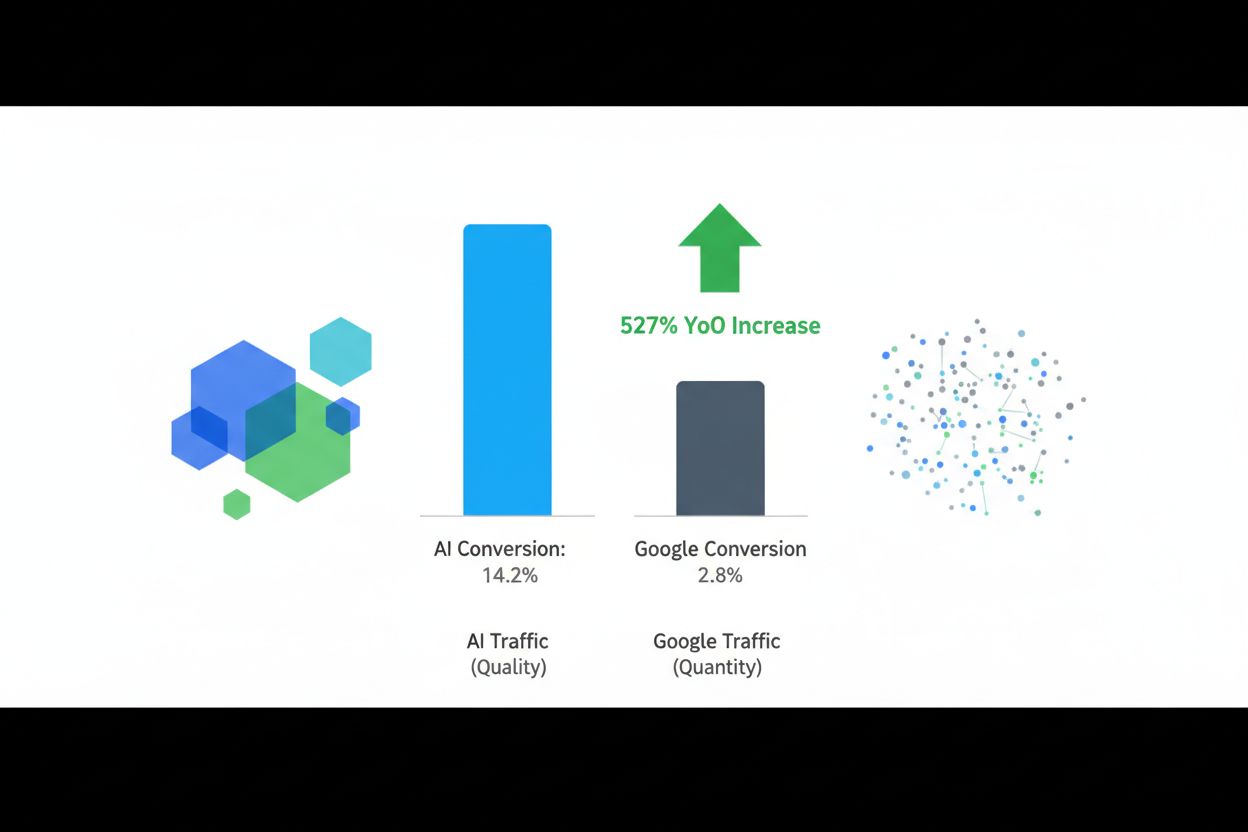
The rise of AI-powered search platforms presents a fascinating contradiction that challenges traditional digital marketing wisdom: while AI traffic represents less than 1% of total web traffic, it converts at 14.2%—a staggering 4-5 times higher than Google’s 2.8% conversion rate. This paradox has left many marketers confused about where to allocate resources, especially when AI traffic is growing at an explosive 527% year-over-year rate. The question isn’t whether AI traffic matters—the data clearly shows it does—but rather how to properly value and optimize for a traffic source that defies conventional volume-based metrics.
To truly understand the value of AI traffic, we must move beyond surface-level metrics and examine how AI visitors actually behave on websites. While AI traffic does exhibit a 4.1% higher bounce rate compared to Google visitors, this apparent weakness masks a more nuanced reality. AI visitors spend an average of 86 seconds on site, demonstrating meaningful engagement despite higher initial bounce rates. The following table reveals the complete behavioral picture:
| Metric | AI Traffic | Google Traffic |
|---|---|---|
| Bounce Rate | 45.2% | 41.1% |
| Pages Per Visit | 2.3 | 2.8 |
| Session Duration | 86 seconds | 94 seconds |
| Conversion Rate | 14.2% | 2.8% |
This data shows that while AI visitors may leave more quickly initially, those who stay convert at dramatically higher rates, suggesting a more qualified visitor pool overall.
The superior conversion performance of AI traffic stems from the fundamental nature of how AI platforms deliver visitors to websites. When users interact with Claude, ChatGPT, or Perplexity, they’re typically seeking specific answers or solutions—and the AI’s recommendation to visit your site carries implicit endorsement and relevance. This creates a highly qualified visitor who arrives with clear intent and contextual understanding of your offering. The 14.2% conversion rate isn’t anomalous; it reflects visitors who have already been pre-qualified by AI systems that understand their needs. Unlike traditional search where users may click through multiple results speculatively, AI-referred visitors represent a more deliberate, purpose-driven traffic source that naturally converts at higher rates.
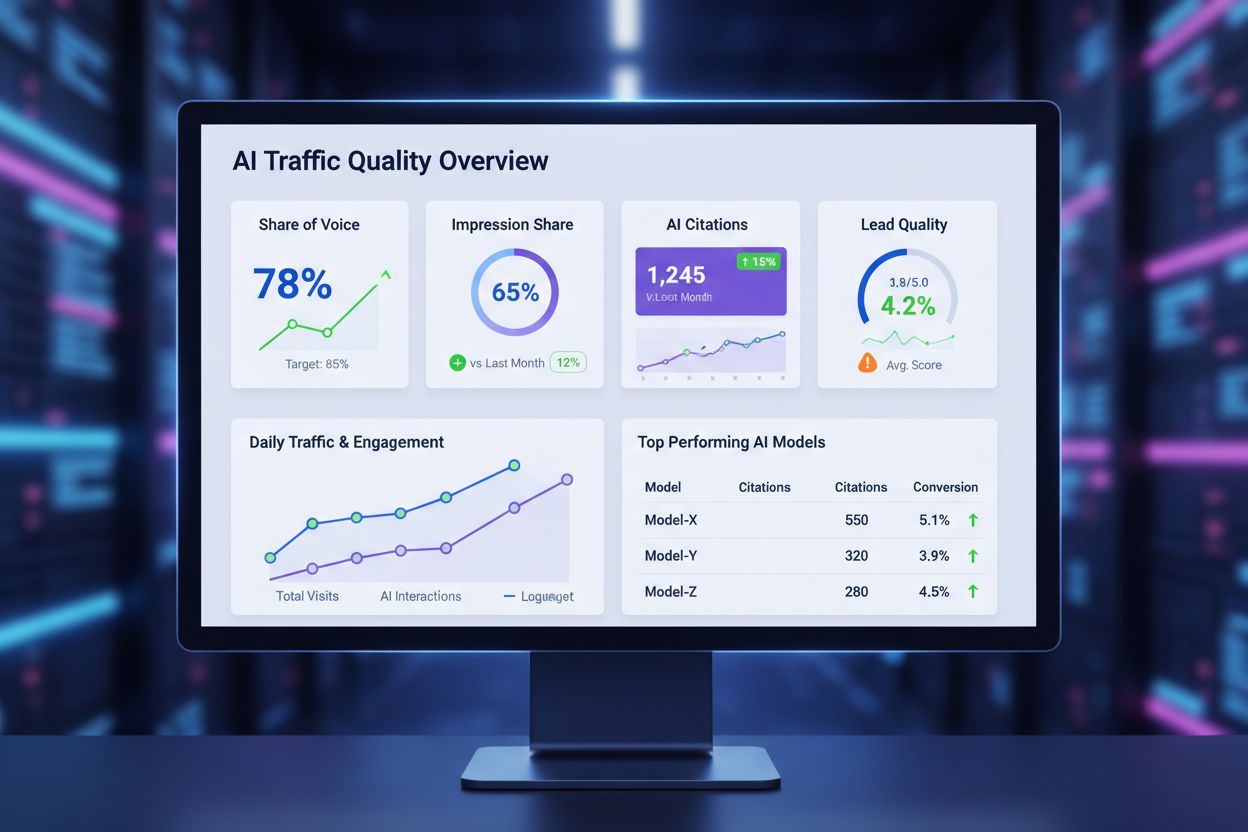
Traditional conversion metrics alone fail to capture the true value of AI traffic in today’s zero-click environment. To properly evaluate AI traffic quality, marketers must expand their measurement framework beyond simple click-through rates and implement a more sophisticated tracking approach. The following metrics provide a comprehensive view of AI traffic performance:
These metrics collectively paint a picture of quality that raw traffic volume cannot capture.
Not all AI platforms deliver equal conversion results, and understanding these differences is critical for optimization. Claude leads the conversion performance with 16.8%, reflecting its user base’s focus on detailed, research-intensive queries. ChatGPT follows closely at 14.2%, benefiting from its massive user base and integration into daily workflows across industries. Perplexity converts at 12.4%, still significantly outperforming Google but attracting a slightly different user demographic focused on real-time information and research. These variations suggest that the quality of AI-referred traffic depends not just on the visitor’s intent, but on the specific platform’s user behavior patterns, recommendation algorithms, and integration with your industry vertical. Savvy marketers are already optimizing content strategies to appeal to each platform’s unique characteristics.
The emergence of AI-powered search has accelerated a trend that was already reshaping digital marketing: the zero-click search. When an AI platform provides a comprehensive answer directly in its interface—citing your content but not requiring a click—traditional attribution models completely miss the value you’ve created. This zero-click environment means that clicks are no longer the primary measure of AI traffic value, and many marketers are significantly underestimating their AI-driven impact. The shift requires abandoning click-centric measurement in favor of citation-based tracking, where being mentioned in an AI response carries measurable business value even without a subsequent click. Organizations that fail to adapt their measurement frameworks will continue to undervalue AI traffic and make suboptimal resource allocation decisions.
Optimizing for AI traffic quality requires a fundamentally different approach than traditional SEO, one that prioritizes relevance, comprehensiveness, and direct answer provision. Rather than competing for keyword rankings, successful AI traffic strategies focus on becoming the most cited, trusted source for specific topics and solutions. The following actionable steps form the foundation of a quality-first AI optimization strategy:
These steps shift focus from volume metrics to quality indicators that actually drive business results.
The trajectory of AI traffic growth suggests a significant inflection point in the near future. Current projections indicate that AI traffic conversion rates will reach parity with Google’s sometime between late 2027 and early 2028, assuming continued growth rates and platform maturation. This timeline may seem distant, but it represents a critical planning horizon for marketing strategy. By the time AI traffic reaches Google-equivalent conversion performance, the competitive landscape will have shifted dramatically, with early adopters having established dominant citation positions. Organizations that wait until AI traffic reaches 5-10% of total volume before optimizing will find themselves competing in a saturated market against entrenched competitors. The window for establishing AI authority is now, while competition remains relatively light and citation opportunities are abundant.
Despite the impressive growth and conversion performance of AI traffic, Google still drives approximately 90% of total web traffic, making it impossible to abandon traditional search optimization. The optimal strategy isn’t choosing between AI and Google—it’s recognizing that both channels serve different functions in the customer journey. Google traffic remains the volume engine, driving awareness and consideration at scale, while AI traffic increasingly serves as the conversion accelerator for high-intent visitors. Content optimized for AI citations often performs better in Google search as well, since both systems reward comprehensive, authoritative, well-structured information. The most successful organizations are implementing integrated strategies that optimize for both channels simultaneously, recognizing that a visitor might discover your brand through Google, research it through ChatGPT, and convert through a direct AI recommendation.
Tracking where and how often your content appears in AI-generated responses requires a different toolkit than traditional analytics. While Google Analytics captures clicks, AI citation monitoring demands dedicated attention to platforms like Perplexity, which provides transparency into citation sources, combined with manual monitoring of ChatGPT and Claude responses for relevant queries. Several emerging tools now offer AI citation tracking capabilities, allowing marketers to monitor citation velocity, identify which content pieces generate the most AI recommendations, and track competitive citation share. Setting up regular monitoring processes—whether through automated tools or weekly manual audits of key queries—provides the visibility needed to understand your AI traffic quality and identify optimization opportunities. This citation data becomes increasingly valuable as a leading indicator of future traffic and conversion performance, offering insights into how AI systems perceive your content authority before those perceptions translate into visitor volume.
AI traffic conversion refers to the percentage of visitors from AI-powered platforms (ChatGPT, Perplexity, Claude, etc.) who complete a desired action on your website. Unlike traditional search traffic, AI-referred visitors typically arrive with higher intent and contextual understanding, resulting in significantly higher conversion rates—averaging 14.2% compared to Google's 2.8%.
AI visitors arrive with pre-qualified intent because they've already been recommended by AI systems that understand their needs. When an AI assistant suggests visiting your site, it carries implicit endorsement and relevance. This creates a more deliberate, purpose-driven traffic source compared to speculative Google search clicks, naturally resulting in higher conversion rates.
Track metrics beyond simple click-through rates: Share of Voice (your citation percentage vs competitors), Impression Share (how often your content appears in AI responses), AI Citations (raw mentions across platforms), Lead Quality (sales team feedback on AI-referred leads), and Multi-channel Attribution (how AI traffic influences conversions across other channels).
Claude leads with 16.8% conversion rate, followed by ChatGPT at 14.2%, and Perplexity at 12.4%. These variations reflect each platform's user base characteristics and recommendation algorithms. Understanding platform-specific performance helps you tailor content strategies to appeal to each platform's unique audience and maximize conversion potential.
Currently, AI traffic represents less than 1% of total web traffic but is growing at 527% year-over-year. While Google still drives 90% of conversions today, projections suggest AI could reach conversion parity with Google by late 2027-early 2028. The optimal strategy is integrating both channels rather than choosing between them.
Focus on becoming the most cited source for your topics: use clear headers and direct answers that AI systems can easily extract, develop comprehensive content clusters around core topics, optimize for multiple AI platforms' preferences, implement citation tracking, and emphasize E-E-A-T signals (Experience, Expertise, Authoritativeness, Trustworthiness) through author credentials and original research.
No. Google still drives approximately 90% of total web traffic and remains the volume engine for awareness and consideration. AI traffic increasingly serves as the conversion accelerator for high-intent visitors. The most successful strategy integrates both channels, recognizing that visitors often discover your brand through Google, research it through AI, and convert through AI recommendations.
Perplexity provides transparency into citation sources, while ChatGPT and Claude require manual monitoring of relevant queries. Emerging tools now offer AI citation tracking capabilities. Set up regular monitoring processes—whether automated or weekly manual audits—to track citation velocity, identify which content generates the most AI recommendations, and monitor competitive citation share.
AmICited monitors how AI platforms reference your brand across ChatGPT, Perplexity, Google AI Overviews, and more. Get real-time insights into your AI traffic quality and conversion potential.
Discover why AI traffic converts 23x better than organic search. Learn how to optimize for AI platforms and measure real ROI from AI-driven visitors.

Discover AI traffic conversion rates across ChatGPT, Claude, and Perplexity. Learn why AI visitors convert 5-23x better than Google organic search and how to op...
AI search visitors convert 5x better than Google organic traffic. Learn why ChatGPT, Perplexity, and Claude drive higher-quality conversions despite lower volum...