


The 4.4x Value of AI Search Visitors: Why Quality Beats Quantity
Discover why AI search visitors convert 4.4x better than traditional organic traffic. Learn the ROI metrics that matter and how to capture high-value AI traffic...
9 min read
Why does AI traffic convert 4-5x better than Google despite being under 1% of total volume? The behavioral data, the intent signal, and the platform-by-platform breakdown explained.
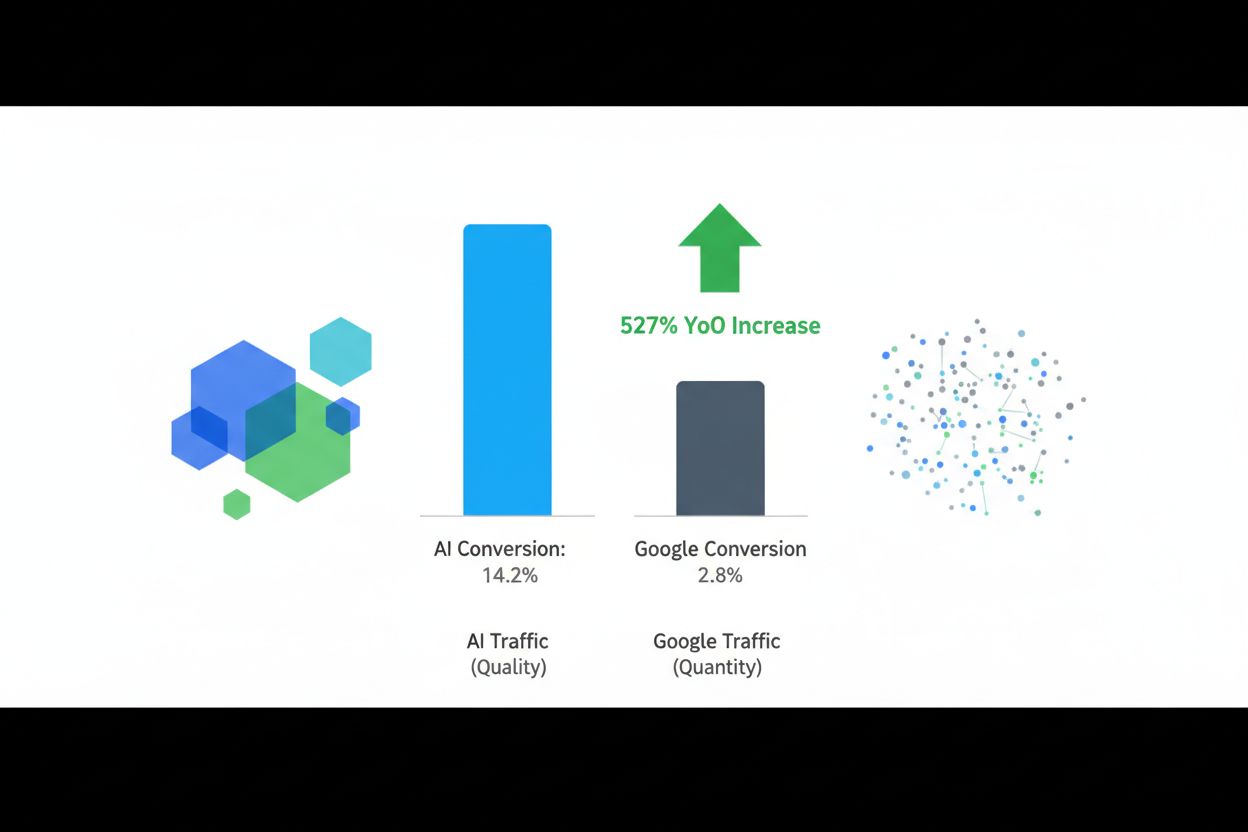
The rise of AI-powered search platforms presents a fascinating contradiction that challenges traditional digital marketing wisdom: while AI traffic represents less than 1% of total web traffic, it converts at 14.2%—a staggering 4-5 times higher than Google’s 2.8% conversion rate. This paradox has left many marketers confused about where to allocate resources, especially when AI traffic is growing at an explosive 527% year-over-year rate. This article unpacks why that gap exists—the behavioral data, the intent signal, and the platform-level differences behind it. If you’re looking for the step-by-step playbook to track and act on this data, see our guide to measuring and optimizing AI traffic conversion rates .
To understand why AI traffic converts so well, we need to look past surface-level metrics and examine how AI visitors actually behave once they land on a site. While AI traffic does exhibit a 4.1% higher bounce rate compared to Google visitors, this apparent weakness masks a more nuanced reality. AI visitors spend an average of 86 seconds on site, demonstrating meaningful engagement despite higher initial bounce rates. The table below lays out the full behavioral picture:
| Metric | AI Traffic | Google Traffic |
|---|---|---|
| Bounce Rate | 45.2% | 41.1% |
| Pages Per Visit | 2.3 | 2.8 |
| Session Duration | 86 seconds | 94 seconds |
| Conversion Rate | 14.2% | 2.8% |
Read those rows together and a pattern emerges: AI visitors browse fewer pages and leave faster on average, yet the ones who stay convert at nearly five times Google’s rate. That’s not a weaker visitor pool—it’s a more decisive one. They aren’t wandering through your site trying to figure out if you’re relevant; the AI already answered that question before they clicked.

Track how AI chatbots mention your brand across ChatGPT, Perplexity, and other platforms.
The superior conversion performance of AI traffic stems from the fundamental nature of how AI platforms deliver visitors to websites. When users interact with Claude, ChatGPT, or Perplexity, they’re typically seeking specific answers or solutions—and the AI’s recommendation to visit your site carries implicit endorsement and relevance. This creates a highly qualified visitor who arrives with clear intent and contextual understanding of your offering. The 14.2% conversion rate isn’t anomalous; it reflects visitors who have already been pre-qualified by AI systems that understand their needs. Unlike traditional search, where users may click through multiple results speculatively, AI-referred visitors represent a more deliberate, purpose-driven traffic source that converts at consistently higher rates because the filtering work has already happened upstream, inside the conversation, before the click ever occurs.
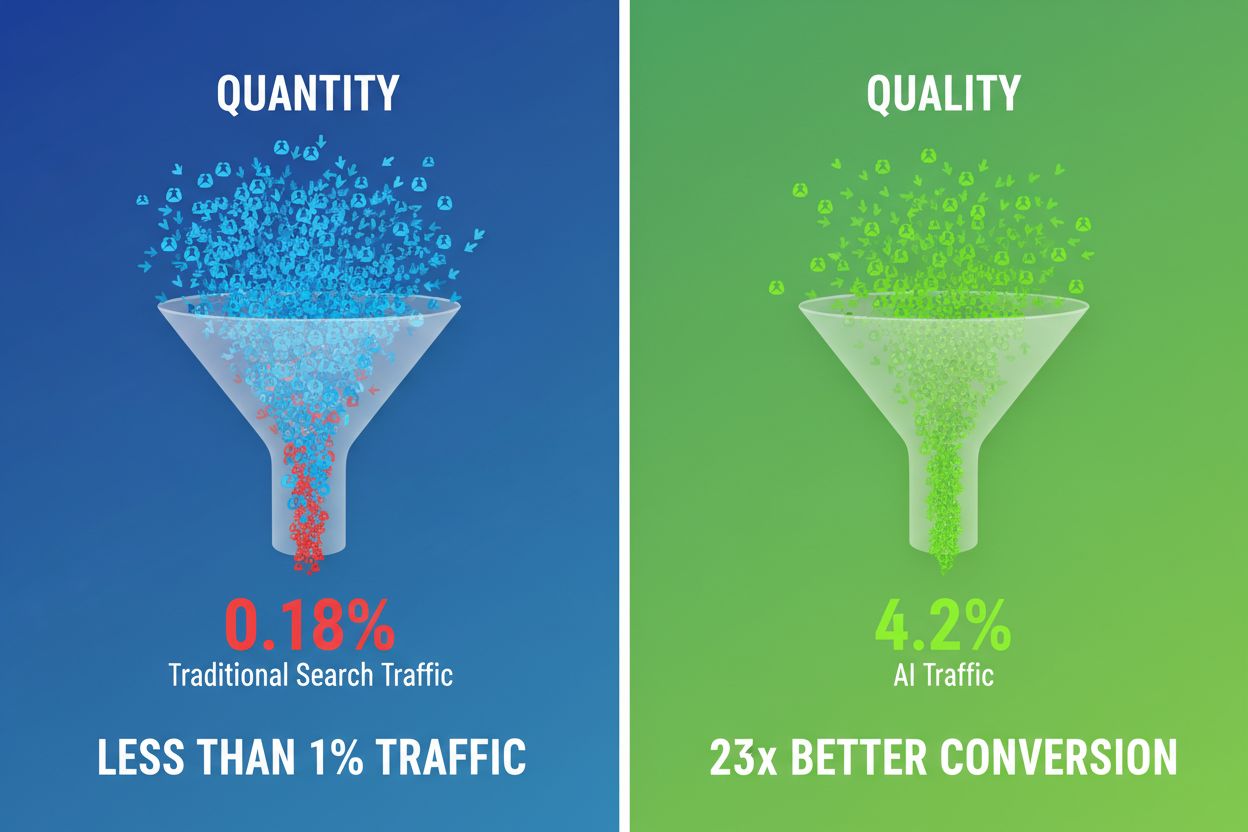
Not all AI platforms deliver equal conversion results, and the differences are informative in their own right. Claude leads the conversion performance with 16.8%—Claude’s average conversion rate—reflecting its user base’s focus on detailed, research-intensive queries. ChatGPT follows closely at 14.2%, benefiting from its massive user base and integration into daily workflows across industries. Perplexity converts at 12.4%, still significantly outperforming Google but attracting a slightly different user demographic focused on real-time information and research. These variations suggest that the quality of AI-referred traffic depends not just on visitor intent in the abstract, but on the specific platform’s user behavior patterns and recommendation algorithms—context that’s critical for tailoring content to each audience, a topic our practical optimization guide covers in depth.
Get the latest insights on AI mentions, brand monitoring, and optimization strategies.
The emergence of AI-powered search has accelerated a trend that was already reshaping digital marketing: zero-click search. When an AI platform provides a comprehensive answer directly in its interface—citing your content but not requiring a click—traditional attribution models completely miss the value you’ve created. This means clicks are no longer the primary measure of AI traffic value, and many marketers are significantly underestimating their AI-driven impact. The behavioral and conversion data above only capture the visitors who do click through; an unknown, and likely substantial, share of AI-driven brand influence never shows up in a session at all. Organizations need to measure that value in today’s zero-click environment through citation-based tracking, not just click-based analytics, or they’ll continue undervaluing this channel.
The trajectory of AI traffic growth suggests a significant inflection point is coming, though not immediately. Current projections indicate that AI traffic conversion rates will reach parity with Google’s sometime between late 2027 and early 2028, assuming continued growth rates and platform maturation. This timeline may seem distant, but it represents a critical planning horizon for marketing strategy. By the time AI traffic reaches Google-equivalent conversion performance, the competitive landscape will have shifted dramatically, with early adopters having established dominant citation positions. Organizations that wait until AI traffic reaches 5-10% of total volume before paying attention will find themselves competing in a saturated market against entrenched competitors.
Despite the impressive conversion performance of AI traffic, Google still drives approximately 90% of total web traffic, making it impossible—and unnecessary—to abandon traditional search. The paradox this article opened with isn’t really an either/or choice; it’s a description of two channels serving different functions in the customer journey. Google traffic remains the volume engine, driving awareness and consideration at scale, while AI traffic increasingly serves as the conversion accelerator for high-intent visitors who have already done their research. A visitor might discover your brand through Google, evaluate it through a conversation with ChatGPT, and convert through a direct AI recommendation—three touchpoints, one journey. Understanding why each channel behaves the way it does is the foundation for valuing them correctly; putting that understanding into a tracking and optimization system is the next step, covered in our companion guide on turning AI traffic data into action .
Viktor Zeman is a co-owner of QualityUnit. Even after 20 years of leading the company, he remains primarily a software engineer, specializing in AI, programmatic SEO, and backend development. He has contributed to numerous projects, including LiveAgent, PostAffiliatePro, FlowHunt, UrlsLab, and many others.

AmICited monitors how AI platforms reference your brand across ChatGPT, Perplexity, Google AI Overviews, and more. Get real-time insights into your AI traffic quality and conversion potential.
Discover why AI search visitors convert 4.4x better than traditional organic traffic. Learn the ROI metrics that matter and how to capture high-value AI traffic...

Community discussion on the value of AI search traffic compared to organic search. Real conversion data from marketers measuring AI-referred visitor quality.
AI search visitors convert 5x better than Google organic traffic. Learn why ChatGPT, Perplexity, and Claude drive higher-quality conversions despite lower volum...
Cookie Consent
We use cookies to enhance your browsing experience and analyze our traffic. See our privacy policy.