
AI Traffic Conversion: Understanding Quality Over Quantity
Learn why AI traffic converts 4-5x better than Google. Discover quality metrics that matter, platform-specific conversion rates, and strategies to optimize AI v...
7 min read

Discover why AI traffic converts 23x better than organic search. Learn how to optimize for AI platforms and measure real ROI from AI-driven visitors.
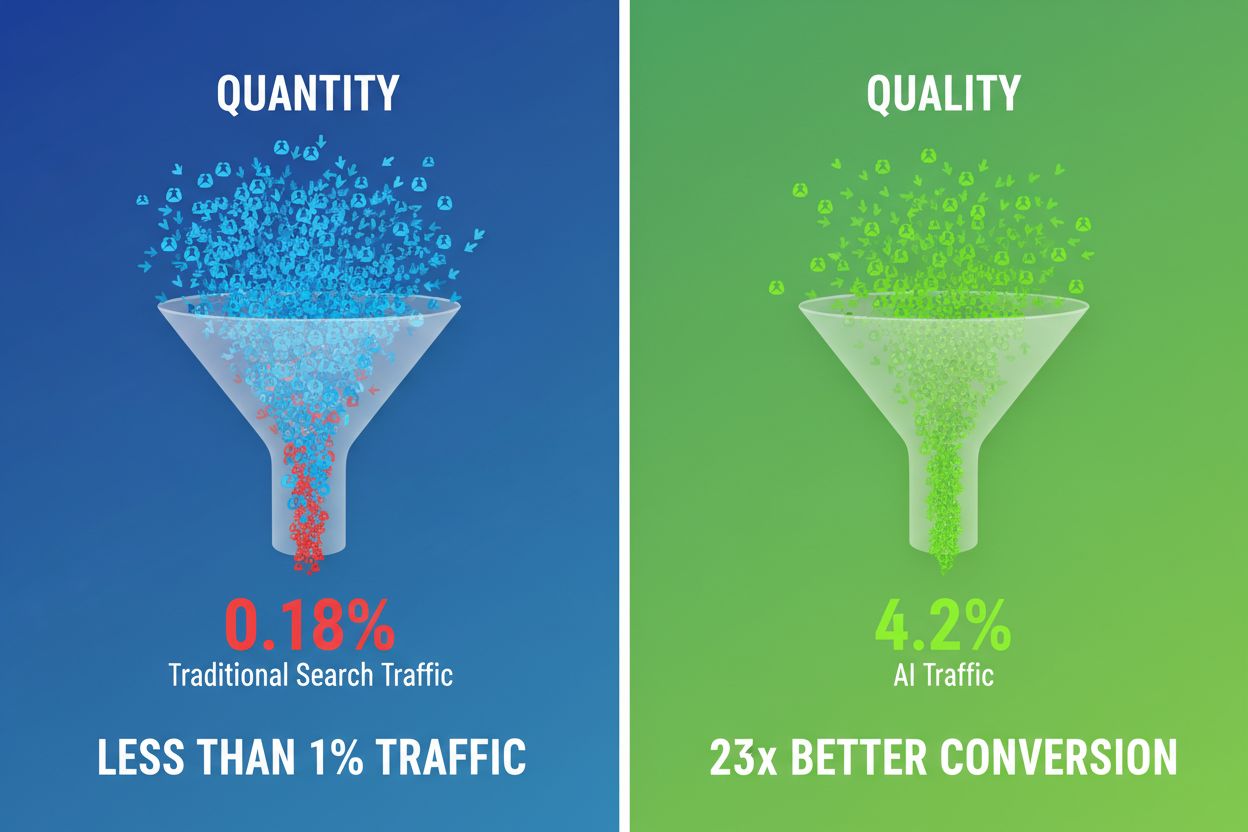
While AI traffic currently represents less than 1% of total website traffic, it’s quietly revolutionizing conversion metrics across the digital landscape. According to Ahrefs data, AI-sourced visitors convert at rates 23x higher than traditional organic search traffic—a staggering differential that challenges everything marketers thought they knew about traffic quality. This paradox reveals a fundamental truth: in the age of AI, the volume of visitors matters far less than their intent, engagement level, and readiness to convert. The implications are profound: a website receiving 100 AI visitors could generate more conversions than 2,300 organic search visitors. As AI platforms continue their explosive growth trajectory, understanding and optimizing for this high-intent traffic source has shifted from optional to essential for forward-thinking businesses.
AI visitors exhibit fundamentally different behavioral patterns compared to traditional search engine users, driven by the conversational nature of AI platforms and the specificity of queries they facilitate. These visitors arrive with highly refined search intent, having already filtered through multiple layers of AI-generated context and recommendations before clicking through to your site. They tend to be more engaged, spending significantly more time on pages and exploring deeper into your content ecosystem. Research shows that AI visitors view 50% more pages per session than their traditional search counterparts, indicating a higher propensity for comprehensive product research and decision-making. The demographic profile also differs notably: AI platform users skew toward early adopters, tech-savvy professionals, and decision-makers actively seeking solutions. This combination of refined intent, extended engagement, and higher-value demographics creates the perfect storm for conversion optimization.
| Metric | AI Traffic | Traditional Search | Difference |
|---|---|---|---|
| Conversion Rate | 4.2% | 0.18% | 23x higher |
| Pages Per Session | 5.8 | 3.9 | 50% more |
| Average Session Duration | 4m 32s | 2m 15s | 101% longer |
| Bounce Rate | 28% | 62% | 54% lower |
| Return Visitor Rate | 34% | 12% | 183% higher |
The exceptional conversion performance of AI traffic stems from multiple interconnected factors that create an ideal environment for customer acquisition. When users arrive at your site through AI platforms, they’ve already undergone a sophisticated filtering process that traditional search engines don’t provide. The AI has pre-qualified them based on relevance, authority, and contextual fit—essentially performing the first stage of your sales funnel before they ever click. This pre-qualification effect, combined with the intentional nature of AI-driven discovery, produces measurably superior results:
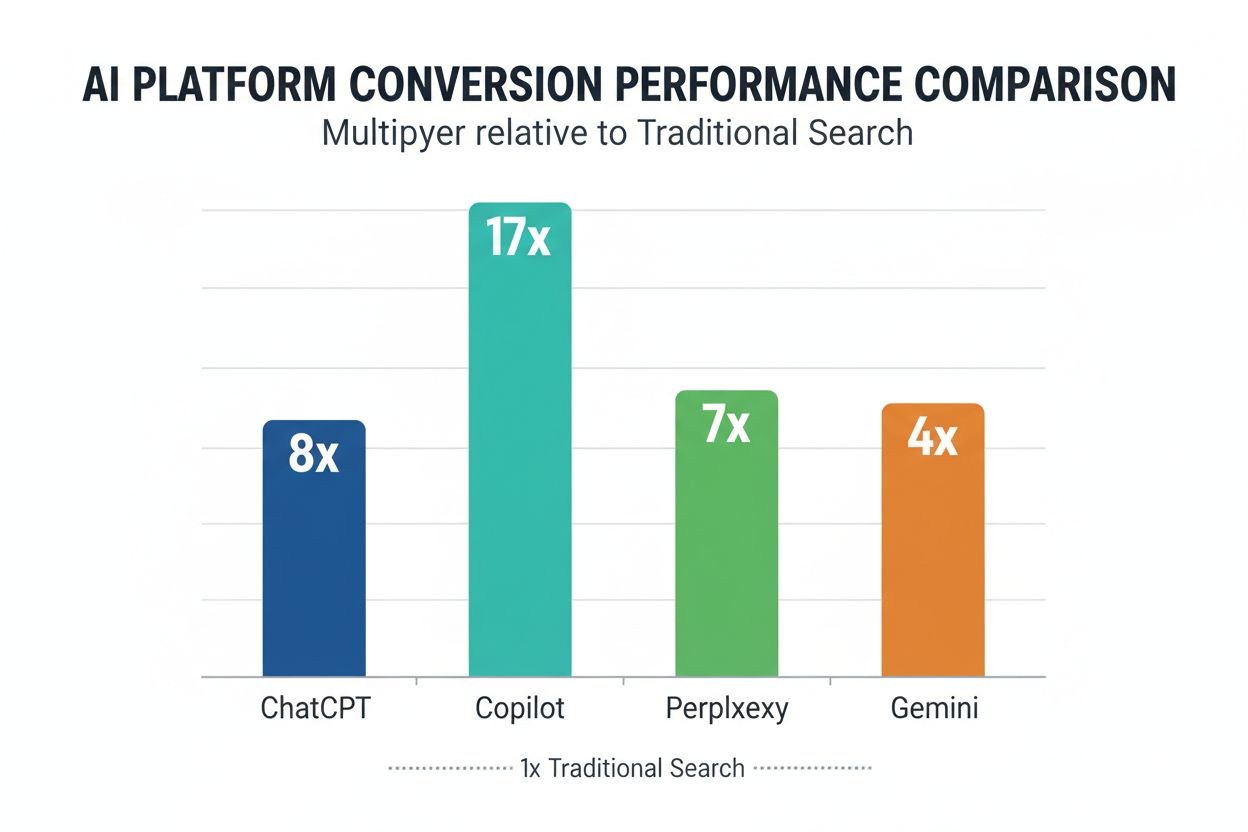
Different AI platforms demonstrate distinct conversion characteristics, reflecting their unique user bases, recommendation algorithms, and integration approaches. Microsoft Copilot, leveraging its integration with Windows and Microsoft 365, captures enterprise users and professionals already embedded in productivity workflows—a demographic with high purchase intent. Perplexity’s research-focused positioning attracts users conducting deep investigative searches, while ChatGPT’s massive user base provides volume alongside quality. Gemini’s integration with Google’s ecosystem creates interesting hybrid dynamics. Understanding these platform-specific nuances allows marketers to tailor their optimization strategies accordingly.
| AI Platform | Conversion Rate vs. Direct | Conversion Rate vs. Search | User Base Focus | Primary Strength |
|---|---|---|---|---|
| Copilot | 17x higher | 12x higher | Enterprise/Professional | Workflow integration |
| Perplexity | 7x higher | 5x higher | Researchers/Analysts | Research-driven queries |
| ChatGPT | 8x higher | 6x higher | General/Broad | Scale and accessibility |
| Gemini | 4x higher (direct), 3x higher (search) | 2.5x higher | Google ecosystem users | Search integration |
The variance across platforms reflects both the quality of recommendations and the intent levels of each platform’s user base. Copilot’s enterprise focus and workflow integration produce the highest conversion multiples, while Gemini’s broader positioning shows more moderate but still impressive gains. These differences suggest that optimization strategies should be platform-aware, with content and positioning tailored to each platform’s unique audience characteristics and recommendation mechanisms.
The financial case for prioritizing AI traffic optimization becomes increasingly compelling when you model the trajectory of conversion rate improvements and traffic growth. Currently, while Google sends 345x more traffic than all AI platforms combined, the conversion rate differential creates a fascinating inflection point in the ROI equation. A website receiving 10,000 monthly organic visitors converting at 0.18% generates 18 conversions, while just 100 AI visitors converting at 4.2% generate 4.2 conversions—nearly a quarter of the revenue from 1% of the traffic. As AI traffic continues its 155.6% year-over-year growth rate, the crossover point where AI traffic becomes your primary conversion driver approaches rapidly. Industry analysts project that by late 2027 to early 2028, AI-driven conversions could match or exceed Google search conversions for many verticals, fundamentally reshaping marketing budget allocation. The ROI calculation becomes even more favorable when factoring in customer acquisition costs: AI traffic often requires less paid promotion than search engine marketing while delivering superior conversion performance. For forward-thinking organizations, the question isn’t whether to optimize for AI traffic, but how quickly they can build competitive advantage before the market saturates. Early movers in AI traffic optimization are capturing disproportionate value, establishing brand authority and conversion infrastructure that will compound as the channel scales.
Traditional web analytics metrics—pageviews, bounce rate, time on site—provide incomplete pictures of AI traffic performance and can actually mislead optimization efforts. The unique characteristics of AI-driven visitors demand a new framework of key performance indicators specifically designed to capture conversion quality and platform-specific dynamics. Organizations must evolve beyond vanity metrics to focus on indicators that directly correlate with revenue and strategic business outcomes. The most forward-thinking brands are already implementing these AI-specific KPIs:
These metrics shift focus from traffic volume to conversion quality and business impact, enabling data-driven optimization that compounds over time.
Capturing and converting AI traffic requires a fundamentally different approach than traditional SEO, one that accounts for how AI systems discover, evaluate, and recommend content. The first critical element is content freshness: AI systems prioritize recently updated content, with research showing that AI cites content that is 25.7% fresher than what traditional search engines rank. This means implementing a content refresh cadence that keeps your most important pages current, signaling to AI systems that your information remains authoritative and reliable. Beyond freshness, schema markup implementation becomes essential—structured data helps AI systems understand your content’s context, relevance, and credibility, increasing the likelihood of recommendations. Building brand authority signals through consistent messaging, expert positioning, and third-party validation creates the trust foundation that AI systems use when evaluating recommendation worthiness. Technical optimization should focus on E-E-A-T signals (Experience, Expertise, Authoritativeness, Trustworthiness), which AI systems weight heavily in their recommendation algorithms. Content strategy should emphasize direct answer optimization—structuring information to directly address the specific questions AI systems are trained to answer. Additionally, implementing AI-friendly content formats such as clear hierarchies, concise summaries, and explicit problem-solution frameworks makes your content more likely to be extracted and recommended. Finally, monitoring and responding to AI citations allows you to identify which content resonates with AI systems and double down on those topics, creating a virtuous cycle of increasing recommendations and traffic.
While AI traffic’s superior conversion rates might suggest a wholesale shift in marketing strategy, the reality demands a more nuanced integration approach that leverages both channels simultaneously. Google still sends 345x more traffic than all AI platforms combined, making traditional SEO optimization non-negotiable for most organizations. The integration challenge lies in optimizing for both channels without creating conflicting strategies or diluting resources across incompatible approaches. Fortunately, the fundamentals overlap significantly: both channels reward fresh, authoritative, well-structured content that directly addresses user intent. The divergence emerges in emphasis and execution: traditional SEO prioritizes keyword optimization, backlink profiles, and technical performance metrics, while AI optimization emphasizes content freshness, E-E-A-T signals, and direct answer formatting. The most effective strategy treats these as complementary rather than competitive channels, with a unified content foundation that serves both audiences while allowing platform-specific optimization layers. This means maintaining your traditional SEO infrastructure—keyword research, link building, technical optimization—while adding AI-specific enhancements like content refresh cycles and schema markup. Organizations that successfully integrate both channels create a resilient traffic ecosystem where declining performance in one channel can be offset by growth in another, while the combined conversion power of both channels dramatically exceeds either alone.
The conversion advantage of AI traffic manifests differently across industries, reflecting varying user behaviors, purchase complexity, and decision-making processes. In e-commerce, AI traffic shows exceptional performance for high-consideration purchases where customers benefit from AI-curated product recommendations and comparative analysis—luxury goods, electronics, and specialized equipment see conversion rates 25-30x higher than traditional search. B2B and SaaS companies experience particularly strong AI traffic performance because their buyers actively use AI tools for solution research and vendor evaluation; these visitors arrive pre-educated about your value proposition and competitive positioning. Local service businesses see moderate but growing AI traffic benefits as platforms like Perplexity increasingly provide location-specific recommendations, with conversion rates 8-12x higher than organic search for service-area queries. Financial services benefit from AI traffic’s trust transfer effect, as recommendations from authoritative AI systems carry significant weight in investment and banking decisions, producing conversion rates 15-20x higher than traditional channels. Healthcare and wellness organizations see strong AI traffic performance for informational queries but must navigate compliance considerations around medical claims and recommendations. The common thread across all industries: AI traffic converts best when your business solves specific, well-defined problems that AI systems can clearly articulate and recommend, and when your content directly addresses the questions AI systems are trained to answer.
The trajectory of AI traffic growth and conversion performance suggests a fundamental reshaping of digital marketing economics over the next 18-24 months. Current projections indicate that AI-driven conversions could match Google search conversions by late 2027 to early 2028, a timeline that may seem distant but requires immediate strategic preparation. The 52% of sites already converting AI traffic represent early movers establishing competitive advantages that will compound as the channel scales; the remaining 48% face increasing pressure to catch up. However, only 16% of brands currently track AI performance, creating a massive information asymmetry where sophisticated marketers gain disproportionate advantage. The strategic imperative is clear: organizations must begin building AI traffic optimization capabilities now, before the channel becomes saturated and competitive advantages erode. This preparation involves auditing current content for AI-friendliness, implementing fresh content cycles, establishing AI-specific KPI tracking, and building organizational expertise in platform-specific optimization. The brands that treat AI traffic as a strategic priority rather than an experimental channel will capture outsized value as the market evolves. The future of digital marketing isn’t about choosing between AI and traditional channels—it’s about mastering the integration of both, with AI traffic’s superior conversion rates increasingly driving the financial performance of sophisticated digital strategies.
AI traffic conversion rate refers to the percentage of visitors from AI platforms (ChatGPT, Perplexity, Copilot, Gemini) who complete a desired action on your website. Current data shows AI traffic converts at 4.2% on average, compared to 0.18% for traditional search—a 23x difference that reflects the higher intent and pre-qualification of AI-sourced visitors.
AI visitors arrive further along in the decision-making journey, having already researched options and narrowed choices through AI conversations. They only click when genuinely interested in taking action, resulting in pre-qualified, high-intent traffic. Additionally, AI users tend to be early adopters and professionals with purchasing authority, creating a demographic advantage.
ChatGPT dominates AI referral traffic, accounting for over 80% of all AI-driven visits to websites. However, Copilot shows the highest conversion rates at 17x traditional search, while Perplexity converts at 7x and Gemini at 4x. Platform choice depends on your target audience and industry vertical.
Move beyond traditional metrics like pageviews and bounce rate. Track AI-specific KPIs including: AI conversion rate by platform, customer lifetime value of AI-sourced customers, citation frequency in AI responses, AI traffic attribution windows, and platform-specific ROI. Only 16% of brands currently track AI performance, creating a competitive advantage opportunity.
Industry analysis suggests AI-driven conversions could match or exceed Google search conversions by late 2027 to early 2028. This timeline creates an 18-24 month window for strategic positioning before the market saturates. Early movers establishing AI visibility now will have compound advantages that are difficult for competitors to overcome.
No. Google still sends 345x more traffic than all AI platforms combined, making traditional SEO non-negotiable. The winning strategy integrates both channels: maintain your SEO foundation while adding AI-specific optimizations like content freshness cycles, schema markup, and E-E-A-T signals. Both channels serve different purposes in the customer journey.
Focus on: implementing regular content refresh cycles (AI cites content 25.7% fresher than traditional search), adding comprehensive schema markup, building E-E-A-T signals, structuring content with direct answers first, and monitoring AI citations to identify high-performing topics. These changes benefit both AI platforms and traditional search.
AI platforms currently drive less than 1% of total website traffic, but this represents a 155.6% year-over-year growth rate. While volume remains small, the conversion quality is exceptional—52% of websites already convert AI traffic, and the channel is growing faster than any other traffic source including social and direct.
Track how AI platforms cite your brand and measure the real ROI of AI traffic with AmICited's AI monitoring platform
Learn why AI traffic converts 4-5x better than Google. Discover quality metrics that matter, platform-specific conversion rates, and strategies to optimize AI v...

AI search visitors convert 5x better than Google organic traffic. Learn why ChatGPT, Perplexity, and Claude drive higher-quality conversions despite lower volum...
Discover AI search traffic value: 4.4x higher conversions than organic search. Learn ChatGPT, Perplexity, and Google AI Overviews ROI metrics for 2025.