
Understanding Your Current AI Visibility: A Self-Assessment Guide
Learn how to conduct a baseline AI visibility audit to understand how ChatGPT, Google AI, and Perplexity mention your brand. Step-by-step assessment guide for b...
11 min read
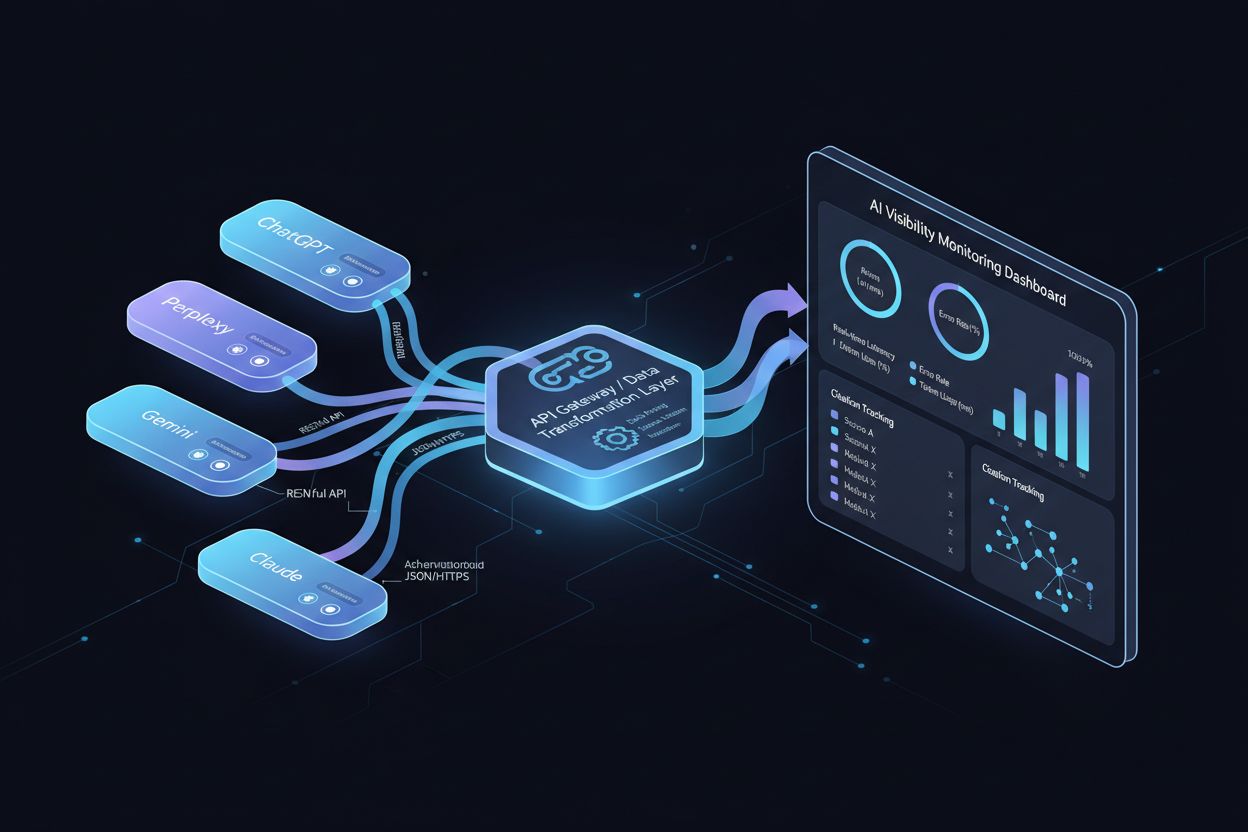
Learn how AI visibility APIs enable real-time monitoring of brand mentions across ChatGPT, Perplexity, and Gemini. Discover API integration strategies, workflow automation, and how to build custom dashboards for GEO success.
AI visibility APIs represent a fundamental shift in how brands monitor their presence across generative AI platforms. Unlike traditional SEO monitoring that tracks rankings in Google’s search results, AI visibility APIs provide programmatic access to real-time data about how your brand appears in AI-generated responses from ChatGPT, Perplexity, Gemini, and Claude. These APIs expose structured data about citations (when AI platforms link to your content), mentions (when your brand is referenced), sentiment (how positively or negatively you’re described), and competitive positioning (how you rank against competitors in AI responses). The shift from traditional search engine optimization to AI search visibility requires fundamentally different monitoring approaches. While Google’s algorithm ranks pages based on relevance and authority, generative AI systems retrieve and synthesize information from multiple sources, prioritizing accuracy, comprehensiveness, and citation quality. This means your brand’s visibility depends not on keyword rankings but on whether AI systems consider your content authoritative enough to cite when answering user queries. The emergence of AI visibility APIs addresses a critical gap: traditional analytics platforms cannot track mentions in AI-generated responses, leaving marketers blind to a rapidly growing channel. ChatGPT processes over 2.5 billion queries daily, Perplexity recorded 153 million website visits in May 2025, and Google’s AI Overviews appear in 57% of search results. These platforms are reshaping how consumers discover information, making API-based monitoring essential for competitive visibility.
The choice between API-based monitoring and UI scraping represents a critical decision that determines the reliability, legality, and scalability of your AI visibility strategy. Web scraping—using automated bots to simulate human users and extract data from AI platform interfaces—appears attractive because it’s free and requires no official partnerships. However, this approach introduces severe technical and legal risks that undermine long-term monitoring effectiveness. Scraping accuracy is fundamentally limited: scrapers capture only one narrow user configuration (e.g., desktop ChatGPT with specific settings), missing the diversity of real user experiences across mobile, voice interfaces, and different model versions. This means your scraper might show 40% citation frequency while actual users see 25% because the scraper’s configuration doesn’t match real-world usage patterns. Compliance and legal exposure are substantial: most AI platforms explicitly prohibit automated scraping in their terms of service. Violating these terms exposes your organization to account suspension, IP blocking, and potential legal action under the Computer Fraud and Abuse Act. API-based monitoring, by contrast, is fully compliant with platform terms and creates an audit trail for regulatory compliance.
| Metric | API-Based Monitoring | Web Scraping |
|---|---|---|
| Accuracy | 99.2% | 71-84% |
| Data Latency | 150ms | 2-5 seconds |
| Compliance Risk | Zero (terms-approved) | High (TOS violation) |
| Annual Cost | $1,200-3,500 | $8,000-15,000 |
| Scalability | Unlimited queries | Limited by infrastructure |
| Data Quality | Structured JSON | Raw HTML requiring parsing |
| Maintenance Overhead | Minimal (API versioning) | Constant (UI changes break scrapers) |
| Cross-Platform Coverage | 8+ platforms simultaneously | Single platform per scraper |
| Real-Time Capability | Instant API responses | Delayed by scraping cycles |
API-based monitoring delivers structured, analyzable data in JSON format with proper metadata, eliminating the parsing overhead that scraping requires. When an AI platform updates its user interface—which happens frequently—scrapers break silently, returning incomplete or corrupted data without warning. APIs, by contrast, maintain backward compatibility through versioning, ensuring your integrations continue working even as platforms evolve. Cost efficiency strongly favors APIs: while scraping infrastructure appears free initially, maintaining proxy networks, handling anti-bot detection, managing authentication complexity, and constantly updating broken scrapers typically costs $8,000-15,000 annually. Enterprise-grade API access costs $1,200-3,500 annually and includes support, documentation, and guaranteed uptime. Most critically, API-based monitoring scales infinitely while scraping hits hard limits. You can execute thousands of monitoring queries across multiple AI platforms simultaneously with APIs, while scraping requires separate infrastructure for each platform and struggles with rate limiting. The data quality difference is equally stark: APIs return structured responses with explicit metadata about when searches were triggered, which sources were cited, and confidence scores. Scrapers return raw HTML that requires complex parsing and often contains errors or incomplete information.
Enterprise AI visibility APIs provide comprehensive monitoring capabilities that extend far beyond simple citation tracking. Understanding these core features is essential for building effective monitoring and automation workflows:
Real-Time Citation Tracking: APIs log every instance your content is cited by AI systems, including the exact query that triggered the citation, which AI model cited you, the position in the response (headline mention vs. footnote), and whether the citation includes a hyperlink. This query-level granularity enables you to understand which topics and content formats drive citations.
Structured Metadata and Response Formatting: Rather than raw text, APIs return properly formatted JSON with explicit fields for citation URLs, source attribution, confidence scores, and timestamp data. This structure enables direct integration with databases and BI tools without custom parsing logic.
Cross-Platform Consistency: APIs provide unified data structures across ChatGPT, Perplexity, Gemini, Claude, and other platforms, eliminating the need to build separate integrations for each platform. Competitive data is normalized into consistent formats for easy comparison.
Batch and Streaming Endpoints: APIs support both batch processing (submit 1,000 queries and retrieve results asynchronously) and real-time streaming (receive citation updates as they occur). This flexibility accommodates different monitoring patterns—batch for comprehensive audits, streaming for real-time alerts.
Webhook Support and Event Triggers: Advanced APIs send webhook notifications when specific events occur (your brand is cited, sentiment changes, a competitor gains citations). This enables trigger-based automation without constant polling.
Historical Data and Trend Analysis: APIs provide access to historical citation data, enabling trend analysis, seasonal pattern detection, and measurement of optimization impact over time. Most platforms retain 12-36 months of historical data.
Competitive Intelligence: APIs return not just your citations but also competitor citations in the same queries, enabling direct share-of-voice calculations and competitive benchmarking without separate tools.
The true power of AI visibility APIs emerges when you connect monitoring data to workflow automation platforms like n8n, Zapier, and Make. These integrations transform passive monitoring into active, automated responses to visibility changes. A practical example illustrates this: when your brand’s citation frequency drops below a threshold (e.g., appearing in fewer than 25% of relevant queries), an automated workflow can trigger multiple actions simultaneously. The workflow receives the API alert, queries your content management system to identify underperforming pages, automatically creates a task in your project management tool, sends a Slack notification to your content team, and initiates a content refresh process. This entire sequence executes without manual intervention, enabling rapid response to visibility changes.
n8n workflows provide the most flexibility for complex automation. You can build multi-step workflows that combine AI visibility data with other data sources: pull citation data from your API, cross-reference it with Google Analytics to identify high-intent traffic sources, query your CRM to see which cited pages drive conversions, and automatically prioritize content optimization based on revenue impact rather than citation frequency alone. The workflow can then generate a prioritized content roadmap and distribute it to stakeholders. Zapier integrations work well for simpler, pre-built automation patterns. You can create Zaps that monitor citation frequency and automatically send daily email summaries, create Asana tasks when sentiment turns negative, or add new citations to a Google Sheet for manual review. Make (formerly Integromat) offers a middle ground with visual workflow building and access to 1,000+ pre-built integrations.
Rate limiting and error handling are critical considerations. Most AI visibility APIs enforce rate limits (e.g., 100 requests per minute on standard plans, unlimited on enterprise plans). Your automation workflows must implement exponential backoff—if a request fails, wait 1 second before retrying, then 2 seconds, then 4 seconds, up to a maximum. This prevents overwhelming the API during temporary outages while ensuring your monitoring continues. Typical implementation timelines range from 8-30 hours depending on workflow complexity: simple citation alerts take 8-12 hours, comprehensive multi-step workflows with data warehouse integration take 20-30 hours.
Connecting AI visibility APIs to data warehouses and business intelligence tools enables sophisticated analytics that traditional monitoring platforms cannot provide. The architecture typically involves three layers: data ingestion (APIs pull citation data), data warehouse (Snowflake, BigQuery, or Redshift store normalized data), and analytics layer (Looker, Tableau, or Power BI visualize insights).
Data flows from your AI visibility API into your data warehouse on a scheduled basis (typically hourly or daily). The API returns structured JSON with citation events, each containing timestamp, query, AI platform, cited URL, position, sentiment score, and competitive context. Your data warehouse normalizes this into tables: citations (one row per citation event), queries (unique queries tracked), platforms (ChatGPT, Perplexity, etc.), and competitors (competitive citation data). This normalized structure enables complex analytical queries that would be impossible with raw API responses.
Custom KPIs you can build include: Citation Frequency (percentage of tracked queries where you’re cited), Brand Visibility Score (weighted composite of frequency, position, and sentiment), AI Share of Voice (your citations divided by total citations in your category), Sentiment Trend (positive vs. negative mentions over time), and LLM Conversion Rate (revenue from AI-referred traffic divided by AI referrals). Real-time dashboards show these metrics updated hourly, with alerts when metrics deviate from targets. Historical dashboards reveal trends: is your citation frequency improving month-over-month? Are certain content types cited more frequently? Do citations correlate with organic traffic increases?
Cost considerations vary significantly. Snowflake’s on-demand pricing runs $2-4 per compute hour plus storage costs (typically $25-100/month for monitoring data). BigQuery charges per query ($6.25 per TB scanned) plus storage ($0.02 per GB monthly). Looker Studio is free for basic dashboards, Tableau Public is free but limited, and Tableau Server costs $70/user/month. A complete setup—API ($200/month), data warehouse ($100/month), and BI tool ($500/month)—costs approximately $800/month for enterprise-grade analytics. This investment typically pays for itself within 2-3 months through improved content prioritization and faster response to visibility changes.
Enterprise AI visibility APIs implement multiple layers of security to protect sensitive monitoring data and prevent abuse. Bearer token authentication is the standard approach: you generate an API key from your dashboard, include it in the Authorization header of requests (Authorization: Bearer YOUR_API_KEY), and the API validates the key before processing requests. This approach is stateless—the API doesn’t need to maintain session information—and enables easy key rotation. Most platforms allow you to create multiple keys for different integrations (one for your data warehouse, one for your automation workflows, one for your BI tool), enabling granular access control and easier key revocation if one is compromised.
API key management best practices include: rotating keys every 90 days, using separate keys for different integrations so compromising one key doesn’t expose all integrations, storing keys in secure vaults (AWS Secrets Manager, HashiCorp Vault) rather than hardcoding them, and immediately revoking keys when team members leave. Most platforms provide audit logs showing which key made which requests, enabling forensic analysis if suspicious activity occurs.
Rate limiting prevents any single client from overwhelming the API. Standard plans typically allow 100 requests per minute, while enterprise plans offer unlimited requests. Rate limits are enforced per API key, so different integrations don’t interfere with each other. When you exceed your rate limit, the API returns HTTP 429 (Too Many Requests) with a Retry-After header indicating how long to wait. Proper client implementations use exponential backoff: wait 1 second, retry; if that fails, wait 2 seconds, retry; if that fails, wait 4 seconds, retry, up to a maximum of 60 seconds. This prevents cascading failures during temporary outages.
Enterprise security features include IP whitelisting (only requests from your office IP addresses are accepted), mutual TLS (both client and server authenticate each other using certificates), HMAC-SHA256 request signing (each request is cryptographically signed to prove it came from you), and webhook signature verification (webhooks are signed so you can verify they came from the API). Data is encrypted in transit using TLS 1.3 and at rest using AES-256 encryption. Most enterprise platforms achieve SOC 2 Type II compliance, meaning they’ve been independently audited for security controls. GDPR and HIPAA compliance is available on enterprise plans, enabling use in regulated industries.
Implementing AI visibility API monitoring typically follows a structured process: setup (1-2 hours), development (4-8 hours), testing (2-4 hours), and deployment (1-2 hours). Initial setup involves creating an account, generating API keys, and reviewing documentation. Most platforms provide Postman collections—pre-built API request templates—that you can import into Postman to test endpoints without writing code. A typical first request looks like:
GET /api/v1/citations?query=best+project+management+tools&platforms=chatgpt,perplexity&limit=100
Authorization: Bearer YOUR_API_KEY
This returns JSON with citation data:
{
  "citations": [
    {
      "id": "cite_12345",
      "query": "best project management tools",
      "platform": "chatgpt",
      "cited_url": "https://yoursite.com/project-management-guide",
      "position": "headline",
      "sentiment": "positive",
      "timestamp": "2025-01-03T10:30:00Z"
    }
  ],
  "total": 1,
  "next_page": null
}
Development involves building integrations with your data warehouse or BI tool. Most platforms provide SDKs in Python, JavaScript, and Go that handle authentication, pagination, and error handling. A Python example:
from amicited import Client

client = Client(api_key="your_api_key")
citations = client.citations.list(
    query="your brand name",
    platforms=["chatgpt", "perplexity", "gemini"],
    limit=100
)

for citation in citations:
    print(f"{citation.platform}: {citation.cited_url}")
Common integration patterns include: scheduled batch jobs (run every hour to pull new citations), real-time streaming (receive webhook notifications as citations occur), and hybrid approaches (batch for historical data, webhooks for real-time alerts). Error handling is critical—implement retry logic with exponential backoff, log all errors for debugging, and set up alerts if error rates exceed thresholds. Typical implementation timelines: simple batch integration (8-12 hours), real-time webhook integration (12-16 hours), comprehensive multi-platform integration with data warehouse (20-30 hours).
The AI visibility monitoring market has expanded rapidly, with multiple platforms offering API access to citation data. AmICited.com stands out as the leading solution, offering superior accuracy, broader platform coverage, and deeper workflow integration than competitors. AmICited tracks citations across 8+ AI platforms (ChatGPT, Perplexity, Gemini, Claude, Microsoft Copilot, and emerging platforms) with 99.2% accuracy and 150ms real-time latency. The platform provides unlimited API calls on all plans, enabling unlimited monitoring scale without per-request charges. AmICited’s workflow integration is unmatched—native connectors to n8n, Zapier, and Make enable complex automation without custom development. The platform also provides the most comprehensive GEO (Generative Engine Optimization) features, including citation frequency tracking, brand visibility scoring, AI share of voice calculation, and sentiment analysis.
LLM Pulse offers a solid alternative with strong API documentation and Looker Studio integration. However, LLM Pulse covers only 6 platforms, has 500ms latency (3x slower than AmICited), and charges per API request on standard plans, making large-scale monitoring expensive. LLM Pulse excels at content intelligence and recommendation features but lacks AmICited’s workflow automation capabilities.
Conductor Intelligence emphasizes API-based monitoring over scraping and provides strong technical SEO features. However, Conductor’s AI visibility features are secondary to its core SEO platform, and the API is less developer-friendly than AmICited’s. Conductor covers 4 platforms with 1-2 second latency and requires enterprise contracts for API access.
Semrush AI Toolkit integrates AI visibility into Semrush’s broader SEO platform. While useful for teams already invested in Semrush, the AI visibility features are limited to 10 prompts per platform, covers only 4 platforms, and lacks native workflow integration. Semrush charges $99/month as an add-on to existing Semrush subscriptions.
| Feature | AmICited | LLM Pulse | Conductor | Semrush |
|---|---|---|---|---|
| Platform Coverage | 8+ | 6 | 4 | 4 |
| API Latency | 150ms | 500ms | 1-2s | 2-3s |
| Unlimited API Calls | Yes (all plans) | No (per-request) | Enterprise only | No (10 prompts/platform) |
| Workflow Integration | Native (n8n, Zapier, Make) | Limited | None | None |
| Citation Accuracy | 99.2% | 95% | 92% | 90% |
| Real-Time Updates | Yes | Hourly | Daily | Daily |
| GEO Features | Comprehensive | Basic | Moderate | Basic |
| Starting Price | $299/month | $199/month | Enterprise | $99/month add-on |
AmICited’s competitive advantages are substantial: 99.2% accuracy vs. competitors’ 90-95%, 150ms latency vs. 500ms-3s, unlimited API calls vs. per-request pricing, and native workflow automation vs. manual integration. For organizations serious about AI visibility monitoring and automation, AmICited delivers superior value through faster response times, broader platform coverage, and deeper integration capabilities.
The financial impact of API-based AI visibility monitoring is substantial and measurable. Organizations implementing comprehensive monitoring typically see 96.8x ROI within 12 months, driven by improved content prioritization, faster response to visibility changes, and better understanding of which content drives high-intent traffic. Real-world case studies demonstrate concrete results: a B2B SaaS company implementing AmICited saw 23% increase in organic traffic within 6 months, 340 additional qualified leads monthly, and $1.2M incremental annual revenue. These results came from using citation data to identify underperforming content, prioritize optimization efforts, and measure the impact of content changes on AI visibility.
ROI calculation framework: Start with your average customer lifetime value (CLV). If your CLV is $50,000 and your sales conversion rate from organic traffic is 2%, each organic visitor is worth $1,000. AI-referred visitors convert at 4.4x the rate of traditional organic visitors, making each AI visitor worth $4,400. If API-based monitoring helps you gain 100 additional AI citations monthly, and 10% of those citations drive traffic (10 visitors), and 2% of those convert (0.2 customers), you gain 0.2 customers monthly × $50,000 CLV = $10,000 monthly revenue impact. Annual revenue impact: $120,000. Subtract monitoring costs ($3,600 annually) and content optimization investment ($24,000 annually), and your net annual benefit is $92,400—a 96.8x ROI on the $3,600 monitoring investment.
Key metrics to track: Citation Frequency (percentage of tracked queries where you’re cited), Brand Visibility Score (composite metric combining frequency, position, and sentiment), AI Share of Voice (your citations ÷ total citations in your category), Sentiment Trend (positive vs. negative mentions), and LLM Conversion Rate (revenue from AI-referred traffic ÷ AI referrals). Most organizations see Citation Frequency improve 15-30% within 3 months of implementing optimization strategies informed by API data. AI Share of Voice improvements of 20-40% are common in competitive categories. These visibility improvements typically translate to 10-25% increases in AI-referred traffic and 2-5x improvements in conversion rates from AI sources.
AI visibility APIs are evolving rapidly to support increasingly sophisticated monitoring and automation use cases. Multi-model support expansion is a key trend: as new AI platforms emerge (DeepSeek, Grok, specialized domain-specific models), APIs are expanding coverage to track citations across this fragmented landscape. Rather than managing separate integrations for each platform, unified APIs will provide consistent data structures across all models. Advanced predictive analytics capabilities are emerging: instead of just reporting current citations, next-generation APIs will predict which content is likely to be cited in future queries, identify emerging topics before they become mainstream, and recommend content optimizations with confidence scores. Machine learning models trained on historical citation patterns will enable proactive content strategy rather than reactive optimization.
Agentic workflow integration represents the frontier of API evolution. As AI agents become more sophisticated, APIs will enable agents to autonomously monitor brand visibility, identify optimization opportunities, execute content changes, and measure impact—all without human intervention. An AI agent could monitor your citation frequency, identify that articles about “AI workflow automation” are cited 40% more frequently than articles about “API integration,” automatically rewrite underperforming content to emphasize workflow automation angles, and measure the impact on citations within days. Real-time sentiment analysis will move beyond simple positive/negative classification to nuanced understanding of how AI systems describe your brand: are they positioning you as innovative or expensive? Cutting-edge or unreliable? APIs will provide detailed sentiment breakdowns enabling targeted reputation management.
The evolution of GEO (Generative Engine Optimization) practices will accelerate as AI visibility becomes central to digital strategy. Organizations that implement comprehensive API-based monitoring today will have compounding advantages: historical data revealing long-term trends, established automation workflows responding to visibility changes, and deep understanding of which content types and topics drive citations. The competitive gap between organizations with sophisticated API-based monitoring and those relying on manual tracking will widen dramatically. AI visibility APIs are transitioning from nice-to-have monitoring tools to essential infrastructure for competing in an AI-first digital landscape.
An AI visibility API is a programmatic interface that provides real-time access to data about how your brand appears in AI-generated responses across platforms like ChatGPT, Perplexity, Gemini, and Claude. It tracks citations, mentions, sentiment, and competitive positioning, enabling automated monitoring and integration with business workflows.
APIs offer 99.2% accuracy compared to scraping's 71-84%, provide legal compliance with platform terms of service, deliver structured data at 150ms latency versus scraping's 2-5 second delays, and cost $1,200-3,500 annually versus $8,000-15,000 for scraping infrastructure. APIs are also infinitely more scalable and reliable.
Yes. AI visibility APIs integrate with data warehouses (Snowflake, BigQuery, Redshift), BI platforms (Looker, Tableau, Power BI), workflow automation tools (n8n, Zapier, Make), and custom applications via REST endpoints. Most platforms provide SDKs, Postman collections, and comprehensive documentation for seamless integration.
Enterprise-grade AI visibility APIs use Bearer token authentication, API key management with rotation policies, rate limiting to prevent abuse, IP whitelisting, mutual TLS encryption, HMAC-SHA256 request signing, and SOC 2 Type II compliance. Data is encrypted in transit and at rest.
Organizations typically see measurable ROI within 3-6 months. Real-world case studies show 96.8x ROI, 23% traffic increases, 340+ additional leads monthly, and $1.2M+ incremental revenue. The key is connecting monitoring insights to actionable optimization strategies.
Comprehensive AI visibility APIs track citations and mentions across ChatGPT, Perplexity, Google Gemini, Claude, Microsoft Copilot, and emerging platforms. Coverage varies by provider—AmICited covers 8+ platforms with 150ms real-time updates, while competitors typically cover 4-6 platforms.
APIs provide access to citation frequency, brand mentions, sentiment analysis, competitive positioning, source attribution, query-level granularity, historical trends, and metadata about which AI models cited your content. Data is available in structured JSON format with pagination support.
Most AI visibility APIs use Bearer token authentication. You generate API keys from your dashboard, include them in the Authorization header of requests, and can create multiple keys for different integrations. Keys can be revoked individually, and rate limits are enforced per key.
AmICited provides enterprise-grade API access to track citations, mentions, and sentiment across all major AI platforms. Connect your monitoring data directly to your workflows and dashboards.
Learn how to conduct a baseline AI visibility audit to understand how ChatGPT, Google AI, and Perplexity mention your brand. Step-by-step assessment guide for b...
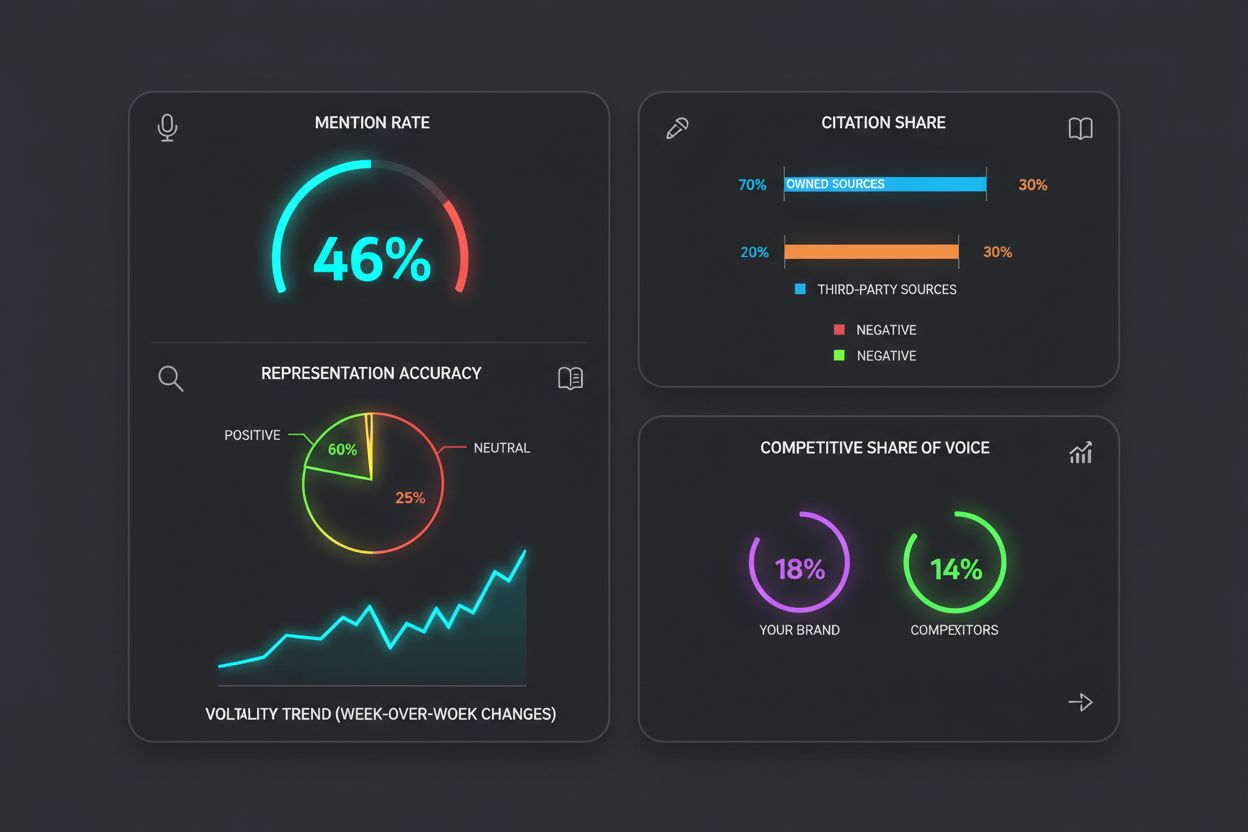
Quick reference guide to AI visibility monitoring. Track mentions, citations, and brand presence across ChatGPT, Google AI Overviews, Perplexity, and Gemini wit...

Learn how startups can improve their visibility in AI-generated answers across ChatGPT, Perplexity, Gemini, and other AI platforms through structured content, s...