

Am I Cited vs Profound: Enterprise AI Visibility Showdown
Compare AmICited and Profound for enterprise AI visibility monitoring. Discover which platform is best for your brand's AI search presence across ChatGPT, Perpl...
12 min read
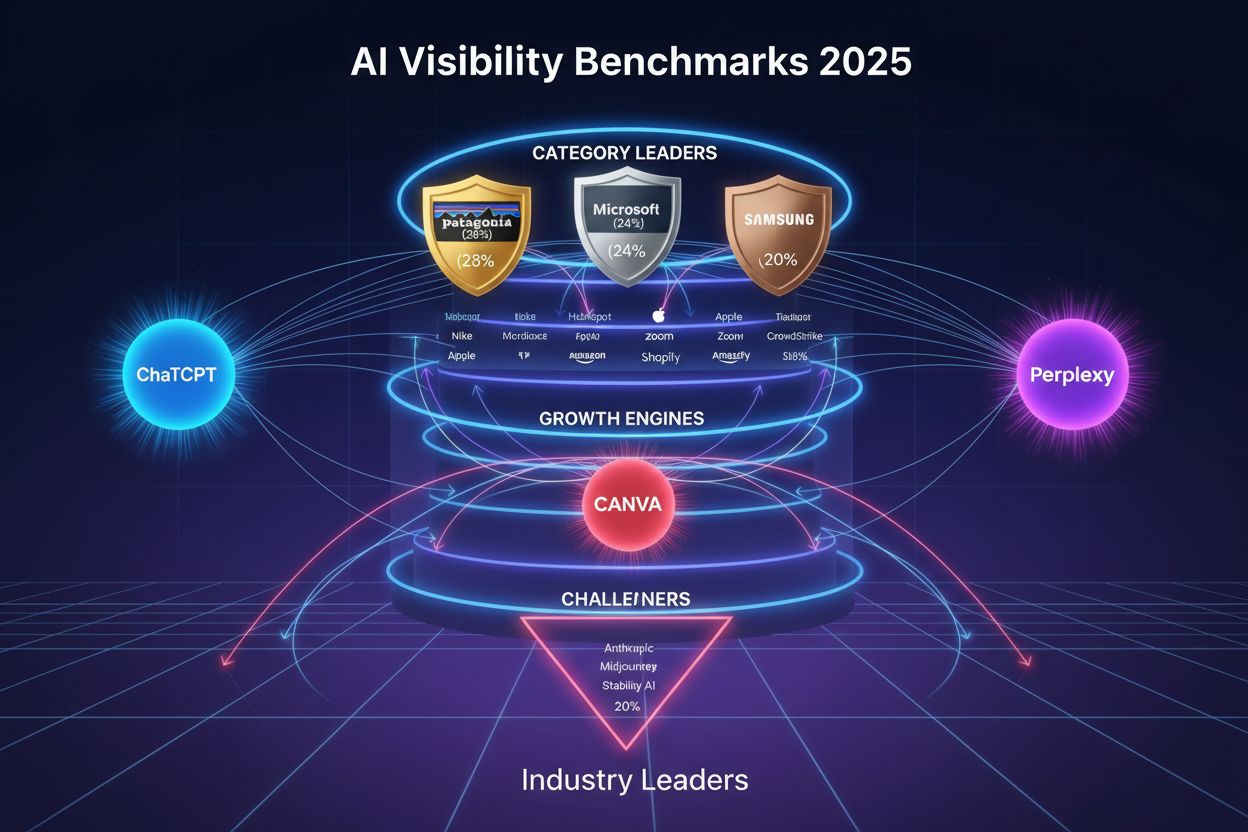
Discover which brands are winning AI visibility benchmarks. Analyze industry leaders across ChatGPT, Perplexity, and Google AI with data-driven insights and competitive benchmarks.
AI visibility represents a fundamental shift in how brands achieve discoverability in the digital landscape. Unlike traditional search, where users navigate to Google and type queries, 37% of product discovery queries now start directly in AI interfaces like ChatGPT, Google AI Overviews, and Perplexity. This seismic change means that traditional SEO metrics no longer fully capture a brand’s true market presence. When an AI system cites your brand in response to a user query, it’s not just a ranking—it’s a trusted recommendation from a technology that 400 million people interact with weekly. The stakes are higher because AI citations carry implicit endorsement; being mentioned by ChatGPT signals authority in ways that a search ranking alone cannot. Industry leaders are already recognizing this shift, with forward-thinking brands investing heavily in AI visibility benchmarks to understand their competitive position in this new ecosystem. The question is no longer “Are we ranking?” but rather “Are we being cited by the AI systems that matter most to our audience?”
AI visibility benchmarks measure how frequently and prominently brands appear in responses generated by major AI systems. The Semrush AI Visibility Index methodology analyzes 2,500+ real prompts across multiple industries to create a comprehensive picture of brand performance. These benchmarks track five critical dimensions:
| Metric | Definition | Why It Matters |
|---|---|---|
| Share of Voice (SOV) | Percentage of total citations a brand receives vs. competitors | Shows competitive dominance in AI responses |
| Citation Frequency | How often a brand is mentioned across all analyzed prompts | Indicates consistent visibility and authority |
| Sentiment Analysis | Tone and context of how brands are mentioned (positive, neutral, negative) | Reveals brand perception quality, not just quantity |
| Source Diversity | Number of unique domains cited alongside your brand | Demonstrates ecosystem strength and partnerships |
| Temporal Consistency | Stability of citations over time (weekly/monthly tracking) | Shows sustainable visibility vs. temporary spikes |
These metrics work together to create a holistic view of AI visibility performance. A brand might have high citation frequency but poor sentiment, or strong source diversity but inconsistent temporal patterns. The Semrush methodology captures these nuances by analyzing real user prompts rather than theoretical queries, ensuring that benchmark data reflects actual AI behavior. This approach reveals which brands are truly winning in AI interfaces and which are merely appearing without meaningful impact.
The 2025 AI Visibility Awards recognized exceptional performance across four major industries, with winners emerging in three distinct categories:
Business & Professional Services:
Consumer Electronics:
Digital Technology & Software:
Fashion & Apparel:
Each category represents a different competitive position. Category Leaders demonstrate sustained dominance with stable, high citation frequency and positive sentiment across all major AI platforms. Growth Engines show the fastest trajectory improvements, often by aligning content strategy with AI citation patterns. Challengers represent emerging brands that have cracked the code on niche visibility, dominating specific query types even if overall SOV remains lower. What unites all winners is their strategic approach to AI visibility—they don’t treat it as accidental but as a deliberate competitive advantage.
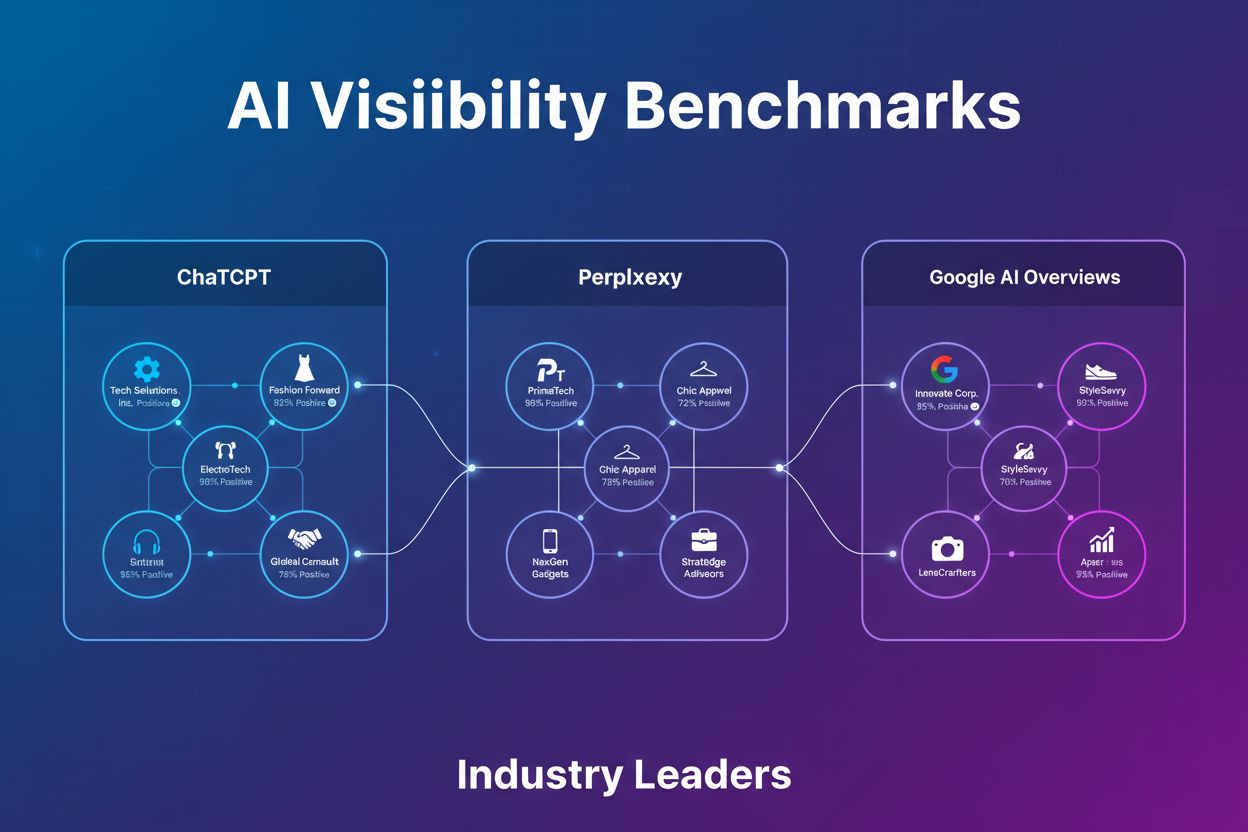
Analysis of 2025 benchmark data reveals four critical patterns that separate winners from the rest of the market. First, category leaders demonstrate remarkable stability, with volatility under 20% month-over-month, suggesting that AI visibility, once established, is defensible through consistent content quality and authority signals. Second, niche domination emerges as a viable strategy—brands like Patagonia don’t compete for every query but dominate specific segments (ethical fashion, sustainability) where they’ve built unquestionable authority. This pattern suggests that brands don’t need universal AI visibility; they need concentrated strength in their core market segments.
Third, challenger success is real but requires specific conditions: rapid growth typically correlates with either (1) entering emerging categories where no clear leader exists, or (2) creating novel content formats that AI systems cite preferentially. Logitech’s growth in gaming visibility, for example, coincided with their investment in gaming-specific product lines and community engagement—content that AI systems actively cite when responding to gaming queries. Fourth, vertical differences matter significantly—consumer electronics shows higher volatility than professional services, suggesting that fashion and tech categories experience faster AI citation cycles, while B2B categories reward consistency and depth.
These patterns matter because they inform strategy. If your category shows high volatility, you need more frequent content updates and real-time monitoring. If your category rewards niche dominance, you should concentrate resources rather than spreading thin. If you’re a challenger in a stable market, you need differentiation, not just incremental improvements.
Different AI platforms cite brands with dramatically different frequencies and patterns. Research analyzing 680 million citations across platforms reveals significant divergence in how ChatGPT, Google AI Overviews, and Perplexity recommend brands. ChatGPT tends toward established, well-documented brands with strong training data representation. Google AI Overviews prioritize brands that appear in Google’s own search index, creating a reinforcement loop for SEO leaders. Perplexity, designed for research and discovery, shows the highest diversity in citations, often surfacing emerging brands and niche players that other platforms overlook.
| Platform | Citation Behavior | TLD Preference | Best For |
|---|---|---|---|
| ChatGPT | Favors established brands, high-volume content | .com (85%) | Brand authority, thought leadership |
| Google AI Overviews | Mirrors search rankings, news-heavy | .com (82%) | SEO-aligned content, news coverage |
| Perplexity | Diverse sources, emerging brands | .com (75%), .edu (12%) | Niche expertise, research content |
Across all platforms, .com domains dominate at approximately 80% of citations, but the remaining 20% reveals important opportunities. Educational institutions (.edu) perform exceptionally well on Perplexity for research-oriented queries, while news domains (.news, .org) gain traction on Google AI Overviews. The strategic implication is clear: a one-size-fits-all AI visibility strategy fails. Brands competing primarily on ChatGPT should focus on authoritative, comprehensive content that demonstrates expertise. Brands targeting Google AI Overviews should align their AI strategy with SEO fundamentals. Brands seeking Perplexity visibility should invest in original research, data, and niche expertise that differentiates them from mainstream competitors. Understanding these platform-specific patterns allows brands to allocate resources strategically rather than spreading efforts equally across all AI systems.
The business implications of AI visibility benchmarks extend far beyond vanity metrics. Market leadership in AI interfaces directly correlates with consumer behavior shifts—when ChatGPT recommends your brand, users perceive it as a trusted third-party endorsement rather than marketing. This perception gap is enormous: a citation in AI carries more weight than a paid search ad or even a high search ranking, because users trust AI systems to provide objective recommendations. With 400 million+ ChatGPT weekly users and AI traffic projected to overtake Google by late 2027, the brands winning AI visibility benchmarks today are positioning themselves as market leaders for the next decade.
The competitive advantage is measurable. Brands in the top quartile of AI visibility benchmarks report higher brand consideration, improved conversion rates, and stronger customer acquisition efficiency compared to competitors with lower visibility. However, there’s a significant 45% confidence gap among marketers—nearly half of marketing leaders lack confidence in their AI visibility strategy, creating an opportunity for early movers. Most award-winning brands in the 2025 benchmarks actively use AI visibility monitoring tools, suggesting that visibility isn’t accidental but the result of deliberate measurement and optimization. The ROI potential is substantial: brands that improve their AI visibility by just 10 percentage points in Share of Voice typically see 15-25% increases in qualified traffic from AI-driven discovery. For organizations with significant market share at stake, this translates to millions in incremental revenue. The question isn’t whether to invest in AI visibility benchmarks, but how quickly you can implement a strategy before competitors establish dominance in your category.
Award-winning brands employ seven core strategies that consistently drive AI visibility improvements:
• Build Topical Authority: Create comprehensive content clusters around core topics rather than scattered individual articles. AI systems cite brands that demonstrate deep expertise across related subtopics. Patagonia’s dominance in ethical fashion stems from interconnected content on sustainability, supply chain transparency, and environmental impact—topics that reinforce each other in AI responses.
• Invest in Earned Media: Press coverage, industry awards, and third-party mentions signal authority to AI systems. Brands with strong earned media profiles appear more frequently in AI citations because training data includes news sources and authoritative publications.
• Activate User Advocacy: Customer testimonials, case studies, and user-generated content create citation opportunities. When customers discuss your brand publicly, AI systems incorporate those mentions into responses, expanding your citation footprint.
• Implement Schema Markup: Structured data helps AI systems understand your content context, improving citation accuracy and frequency. Brands using comprehensive schema markup see 20-30% higher citation rates than competitors without it.
• Diversify Content Formats: AI systems cite blogs, whitepapers, videos, podcasts, and interactive tools differently. A multi-format content strategy ensures visibility across different query types and AI platforms.
• Establish Refresh Cycles: AI systems favor fresh, updated content. Brands implementing 2-3 day refresh cycles for core content see significantly higher citation consistency than those updating quarterly.
• Optimize for Conversational Queries: Write content that answers the questions AI systems actually receive. This means moving beyond keyword optimization to natural language patterns, question-answer formats, and comprehensive explanations that AI systems can cite directly.
These strategies work because they address how AI systems actually evaluate and cite sources. They’re not about gaming algorithms but about creating the kind of authoritative, comprehensive, user-focused content that AI systems are designed to recommend.
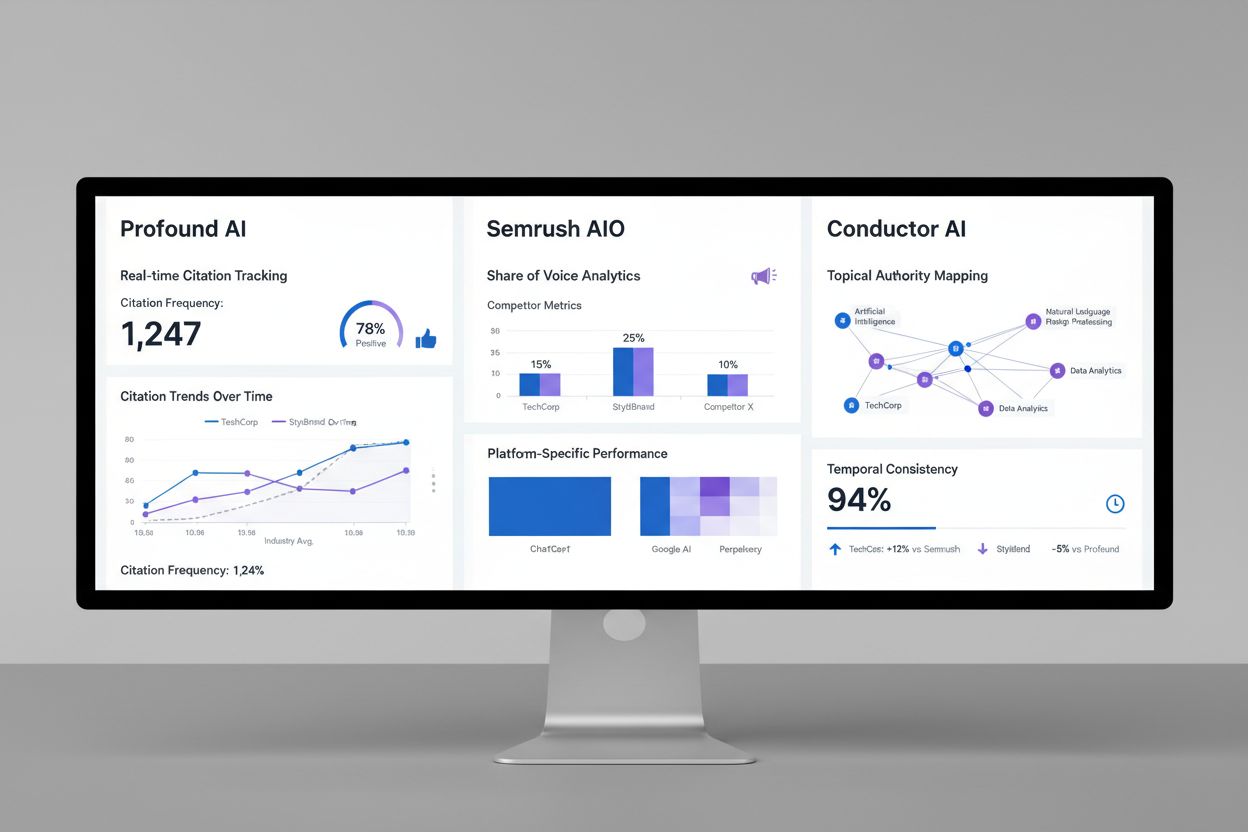
Tracking AI visibility requires specialized tools designed for this new paradigm. Several platforms have emerged as leaders in this space, each with distinct strengths:
| Tool | Best For | Key Features | Pricing Model |
|---|---|---|---|
| AmICited.com | Comprehensive AI monitoring | Real-time ChatGPT/Perplexity tracking, sentiment analysis, competitor benchmarking | Subscription |
| Profound | Citation pattern analysis | 680M+ citation database, platform-specific insights, historical tracking | Enterprise |
| Semrush AIO | Integrated SEO + AI visibility | AI Visibility Index, award benchmarks, content optimization | Subscription |
| Conductor | Enterprise-scale monitoring | Multi-platform tracking, custom dashboards, API access | Enterprise |
| Hall | Emerging brand tracking | Real-time monitoring, niche query focus, growth tracking | Subscription |
AmICited.com stands out as the top product for dedicated AI visibility monitoring, offering real-time tracking of how your brand appears across ChatGPT and Perplexity with sentiment analysis and competitive benchmarking. For brands seeking an alternative platform with strong community features, FlowHunt.io provides collaborative tracking and peer benchmarking capabilities. Semrush AIO integrates AI visibility with traditional SEO metrics, making it ideal for organizations wanting a unified platform. Profound excels for enterprises needing deep citation pattern analysis and historical data. The choice depends on your organization’s needs: startups and mid-market brands typically start with AmICited.com or Semrush AIO, while enterprises often implement Profound or Conductor for comprehensive, custom tracking. Most award-winning brands use multiple tools, combining real-time monitoring (AmICited.com) with deeper analysis (Profound) and SEO integration (Semrush) to create a comprehensive AI visibility intelligence system.
The AI visibility landscape is evolving rapidly, with four major trends reshaping how benchmarks will function in 2026 and beyond. Multimodal AI will expand benchmarking beyond text citations to include image, video, and audio recommendations. Brands will need to optimize across multiple content formats, not just written content. Personalization will increase dramatically—AI systems will cite brands differently based on user context, location, and preferences, making aggregate benchmarks less meaningful and requiring more granular, segment-specific tracking. Real-time integration will become standard, with AI systems pulling live data from brand websites and social platforms, shifting the benchmark focus from historical content to current, dynamic information. Voice search and conversational interfaces will drive new citation patterns, as voice-optimized content and natural language responses become primary discovery mechanisms.
To prepare for these trends, brands should: (1) invest in multimodal content creation now, building video and audio libraries alongside written content; (2) implement real-time data feeds and APIs that allow AI systems to access current information directly; (3) develop segment-specific content strategies rather than relying on universal messaging; (4) optimize for voice search patterns and conversational queries; (5) establish continuous monitoring rather than quarterly benchmarking cycles. Organizations that begin these preparations now will maintain competitive advantage as benchmarking methodologies evolve. Those waiting for trends to fully materialize will find themselves playing catch-up in a landscape where AI visibility is even more critical to market success.
Implementing AI visibility benchmarking in your organization requires a structured, phased approach. Step 1: Select Your Monitoring Tool based on your organization’s size and needs. Most brands start with AmICited.com for real-time monitoring, then layer in Semrush AIO for integrated SEO insights. Step 2: Establish Your Baseline by tracking current AI visibility across your brand and top three competitors for 2-4 weeks. This baseline reveals your starting position and competitive gaps. Step 3: Set Realistic Benchmarks based on your category, company size, and competitive position. Category leaders should target 25-35% Share of Voice; growth engines should aim for 10-15% annual improvement; challengers should focus on 5-10% SOV in niche segments.
Step 4: Track Competitors Continuously using quarterly benchmarking updates to monitor competitive movements and identify emerging threats. Step 5: Implement Optimization based on the seven strategies outlined above, prioritizing topical authority and earned media for immediate impact. Step 6: Measure ROI by correlating AI visibility improvements with traffic, leads, and revenue metrics. Most brands see measurable ROI within 90 days of implementing optimization strategies. The implementation roadmap typically spans 6-12 months: months 1-2 for tool selection and baseline establishment, months 3-4 for initial optimization, months 5-6 for performance measurement and strategy refinement, and months 7-12 for scaling successful tactics and expanding to new content areas. Organizations that treat AI visibility benchmarking as an ongoing discipline rather than a one-time project build sustainable competitive advantage. The brands winning AI visibility benchmarks today aren’t those with the largest budgets but those with the most disciplined, data-driven approach to understanding and optimizing their presence in AI systems.
AI visibility benchmarks measure how frequently and prominently brands appear in responses generated by major AI systems like ChatGPT, Google AI Overviews, and Perplexity. They track metrics including Share of Voice, citation frequency, sentiment analysis, source diversity, and temporal consistency to provide a comprehensive view of brand performance in AI-driven discovery.
With 37% of product discovery queries now starting in AI interfaces and AI traffic projected to overtake Google by late 2027, AI visibility directly impacts consumer behavior and market leadership. AI citations carry implicit endorsement and trust that traditional search rankings cannot match, making them critical for competitive advantage.
Research analyzing 680 million citations reveals significant divergence: ChatGPT favors established, well-documented brands with strong training data representation; Google AI Overviews prioritize brands appearing in Google's search index; Perplexity shows the highest diversity, often surfacing emerging brands and niche players. Each platform requires platform-specific optimization strategies.
Top performers focus on seven core strategies: building topical authority through comprehensive content clusters, investing in earned media coverage, activating user advocacy, implementing schema markup, diversifying content formats, establishing aggressive refresh cycles (2-3 days for core content), and optimizing for conversational query patterns.
Most organizations should establish quarterly benchmarking cycles to monitor competitive movements and identify emerging threats. However, real-time monitoring through tools like AmICited.com provides daily insights into visibility changes, allowing for faster optimization responses and more agile strategy adjustments.
AmICited.com leads the market for dedicated AI visibility monitoring with real-time ChatGPT and Perplexity tracking. For integrated SEO + AI insights, Semrush AIO is excellent. For enterprise-scale analysis, Profound provides deep citation pattern analysis. Most organizations use multiple tools to create comprehensive AI visibility intelligence systems.
Yes. The 2025 AI Visibility Awards demonstrate that challenger brands can achieve breakthrough visibility through differentiated positioning, concentrated topical authority in specific niches, authentic user advocacy, strategic earned media, and comprehensive content addressing specific user problems. Niche domination often outperforms generalist strategies.
Brands that improve their AI visibility by just 10 percentage points in Share of Voice typically see 15-25% increases in qualified traffic from AI-driven discovery. For organizations with significant market share at stake, this translates to millions in incremental revenue, with most brands seeing measurable ROI within 90 days of implementing optimization strategies.
Monitor how your brand appears in ChatGPT, Perplexity, and Google AI Overviews. Get real-time insights into your AI visibility benchmarks and competitive position.
Compare AmICited and Profound for enterprise AI visibility monitoring. Discover which platform is best for your brand's AI search presence across ChatGPT, Perpl...
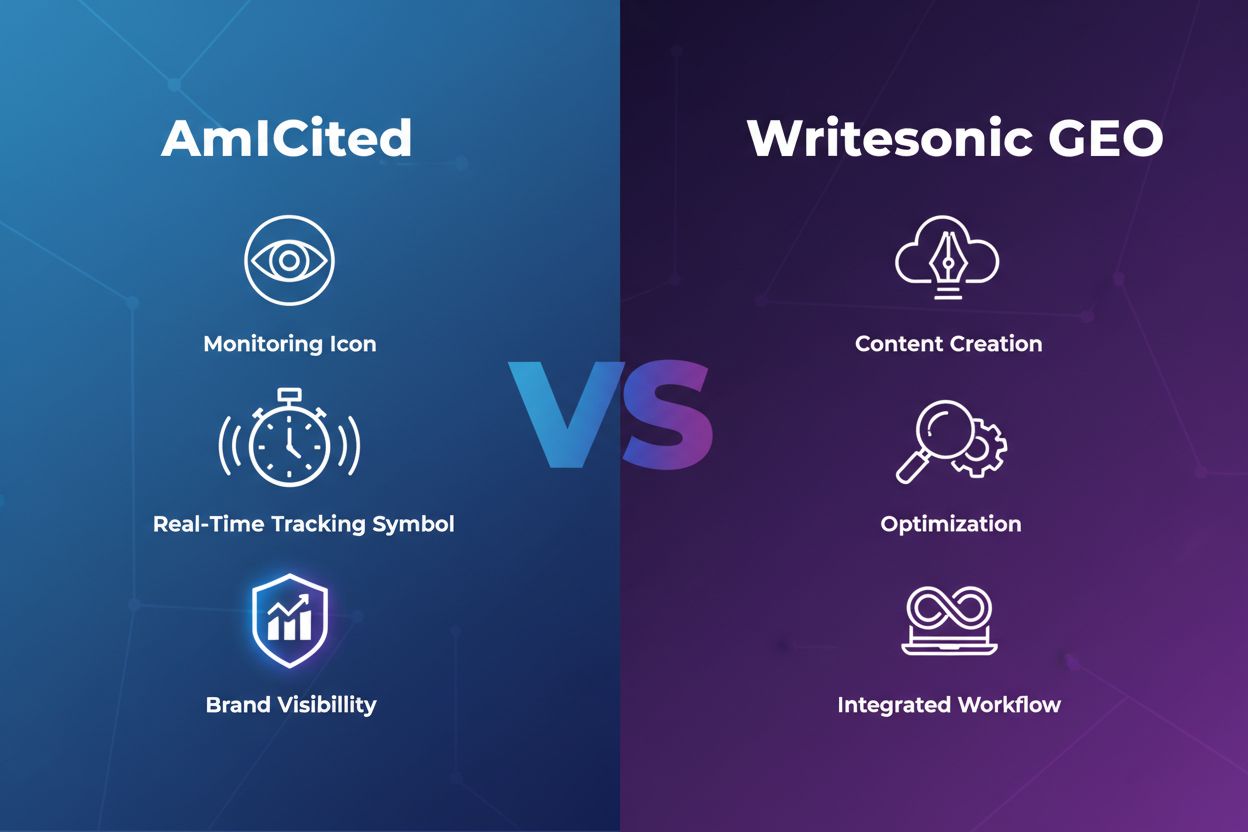
Compare AmICited AI monitoring with Writesonic GEO. Understand the differences between pure monitoring and integrated optimization for AI search visibility.
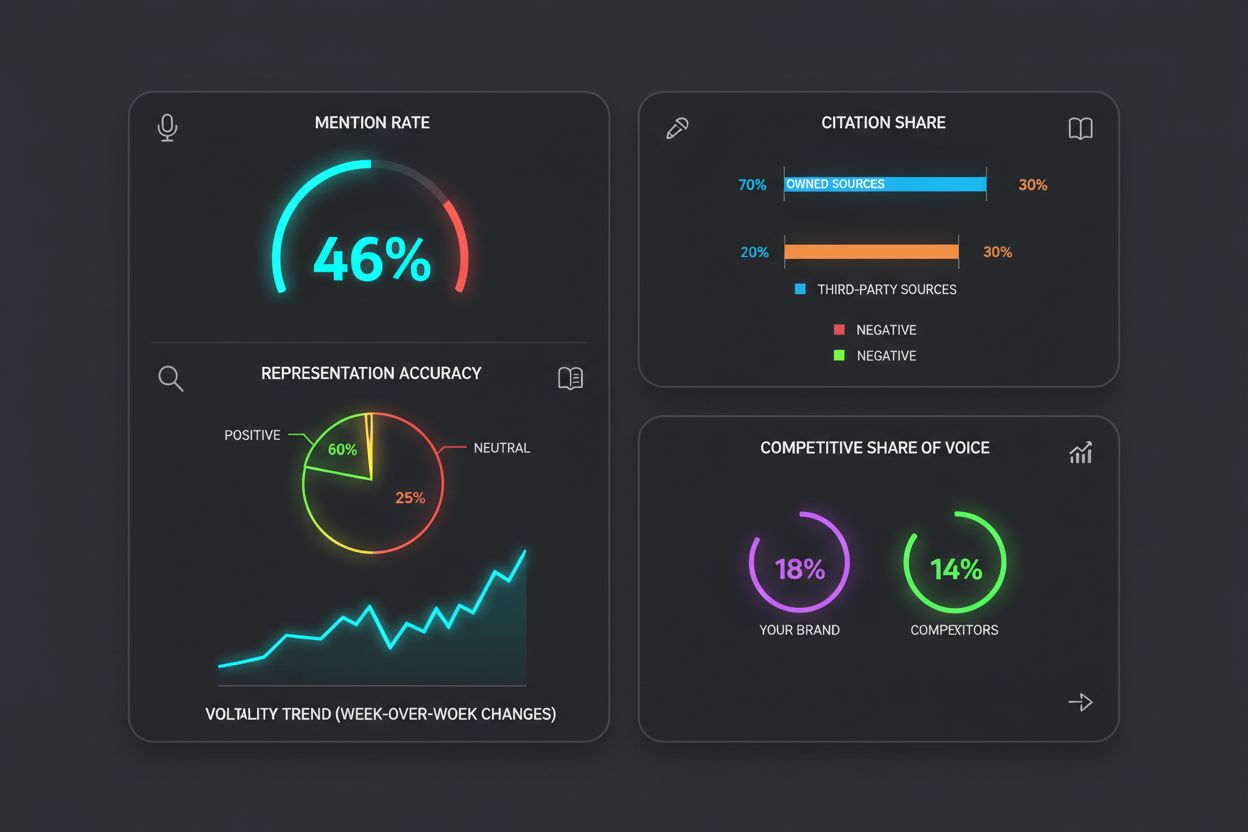
Quick reference guide to AI visibility monitoring. Track mentions, citations, and brand presence across ChatGPT, Google AI Overviews, Perplexity, and Gemini wit...