
Semrush AI Visibility Toolkit: Complete Guide
Master the Semrush AI Visibility Toolkit with our comprehensive guide. Learn how to monitor brand visibility in AI search, analyze competitors, and optimize for...
9 min read
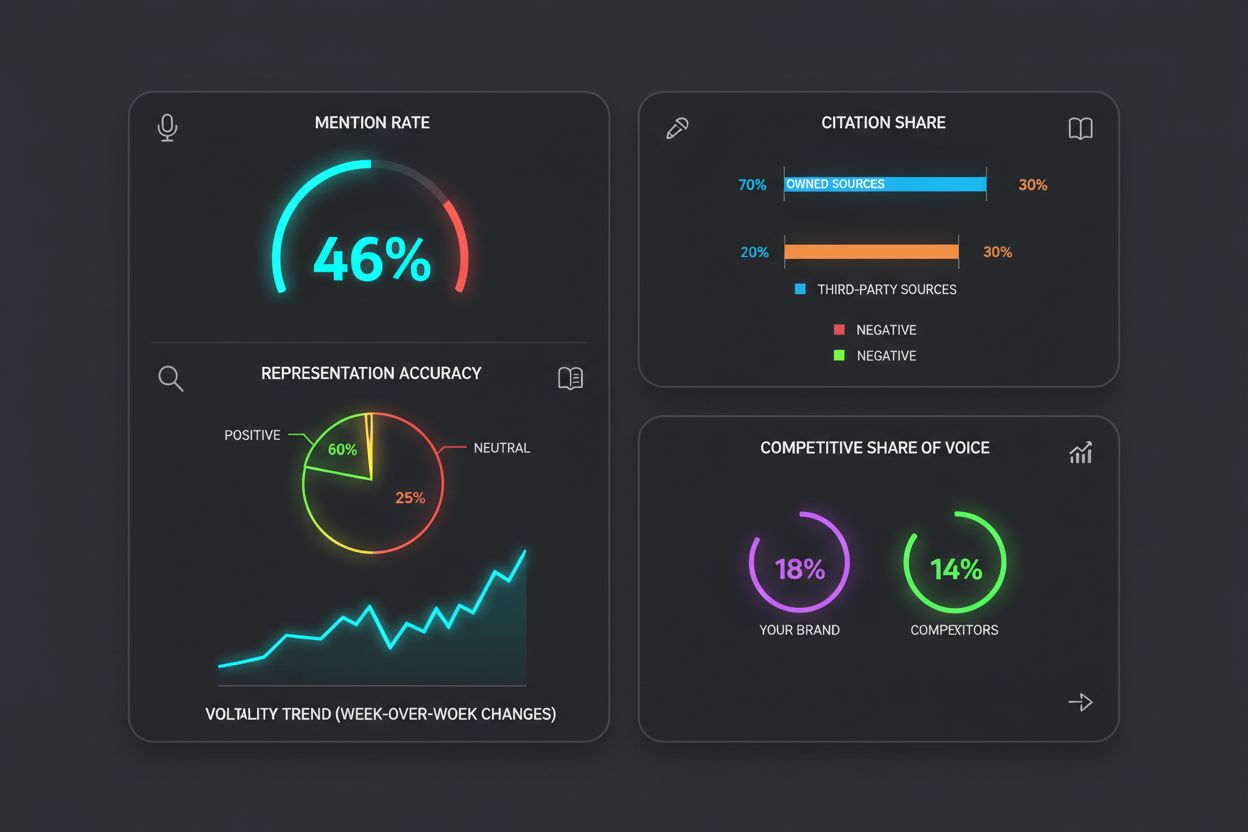
Quick reference guide to AI visibility monitoring. Track mentions, citations, and brand presence across ChatGPT, Google AI Overviews, Perplexity, and Gemini with this one-page checklist.
AI visibility represents your brand’s presence and prominence within AI-generated responses, search summaries, and large language model outputs—a fundamental shift from traditional AI search optimization. As 71.5% of U.S. consumers now use AI tools for search, the landscape has fundamentally changed from optimizing for human readers to optimizing for AI systems that synthesize and cite information. Unlike traditional SEO where your goal is ranking position, AI visibility focuses on whether your content appears in AI-generated answers, how accurately it’s represented, and whether your brand mentions and citations drive meaningful traffic. This new paradigm requires monitoring not just Google rankings, but your presence across ChatGPT, Perplexity, Claude, and other AI platforms that increasingly mediate how users discover information.
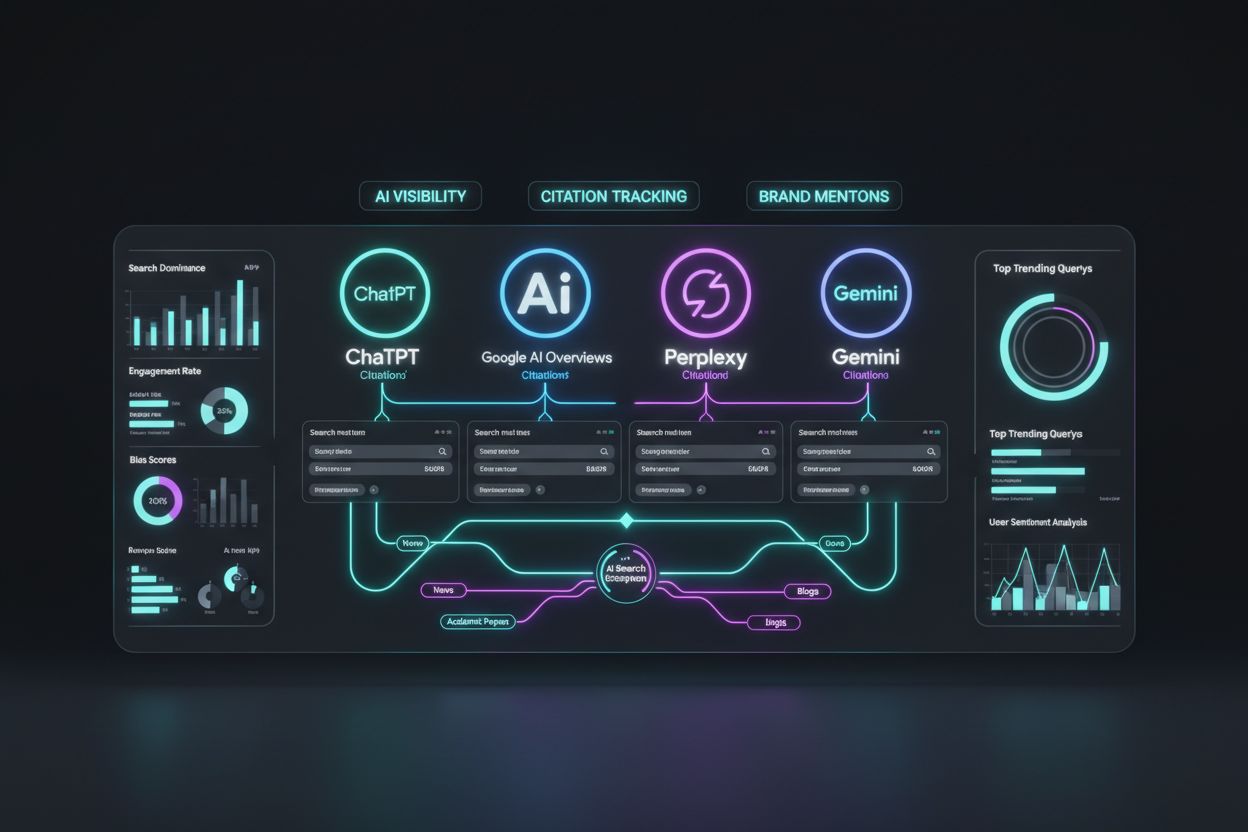
Understanding the right metrics is essential for measuring your AI visibility success, as each metric reveals different aspects of your brand’s performance in AI-driven search. Mention rate tracks how frequently your brand or content appears in AI responses across platforms, providing a baseline understanding of your visibility footprint. Representation accuracy measures whether AI systems cite your content correctly and in context, ensuring your brand message isn’t distorted or misrepresented. Citation share reveals what percentage of total citations in your industry come from your content, indicating your competitive standing in AI-generated answers. Share of voice compares your citation frequency against competitors, showing whether you’re gaining or losing ground in AI visibility. Finally, drift and volatility measure how stable your metrics are over time—high volatility suggests your content may be trending in and out of AI responses unpredictably. These five metrics form the foundation of any comprehensive AI visibility strategy, allowing you to track progress and identify optimization opportunities.
| Metric | Definition | Why It Matters | Example |
|---|---|---|---|
| Mention Rate | Percentage of AI responses that include your brand or content | Establishes baseline visibility and reach across AI platforms | Your brand appears in 23% of AI responses about your industry topic |
| Representation Accuracy | How correctly AI systems cite and contextualize your content | Ensures your message isn’t distorted or taken out of context | ChatGPT accurately attributes your methodology 87% of the time |
| Citation Share | Your citations as a percentage of all citations in your category | Shows competitive positioning and authority recognition | Your content receives 12% of all citations in your industry |
| Share of Voice | Your citation frequency compared to top 5 competitors combined | Reveals whether you’re gaining or losing competitive ground | You capture 18% of voice vs. competitor average of 14% |
| Drift & Volatility | Month-over-month fluctuations in your AI visibility metrics | Identifies unstable performance and trending patterns | Your mention rate fluctuates between 18-28%, indicating volatility |
The AI visibility monitoring landscape has rapidly evolved into three distinct categories, each serving different organizational needs and budgets. Enterprise suites like SE Ranking and Nightwatch offer comprehensive monitoring across multiple AI platforms with advanced analytics, starting at $99-$299/month but requiring significant setup and training. SEO platform add-ons such as Writesonic GEO and Rankscale AI integrate AI visibility tracking into existing SEO workflows, making them ideal for teams already using tools like Semrush or Ahrefs, typically costing $50-$150/month as add-ons. AI-native trackers like Profound AI and Otterly AI are purpose-built specifically for monitoring AI visibility, offering streamlined interfaces and faster implementation, usually starting at $79-$199/month. AmICited.com stands out as the top comprehensive solution, combining enterprise-grade monitoring capabilities with intuitive dashboards specifically designed for marketing teams, offering real-time tracking across all major AI platforms with transparent pricing and no hidden fees. When evaluating tools, consider your team’s technical expertise, the number of keywords you need to monitor, and whether you need integration with existing analytics platforms. The right tool depends on your specific use case: choose enterprise suites if you need white-label reporting and advanced customization, platform add-ons if you’re already invested in an SEO ecosystem, or AI-native trackers if you want simplicity and speed.
| Tool Category | Best For | Starting Price | Key Features |
|---|---|---|---|
| Enterprise Suites (SE Ranking, Nightwatch) | Large teams, white-label needs, advanced analytics | $99-$299/month | Multi-platform monitoring, custom dashboards, API access, team collaboration |
| SEO Platform Add-ons (Writesonic GEO, Rankscale AI) | Teams using existing SEO tools, integrated workflows | $50-$150/month | Seamless integration, familiar interface, combined SEO + AI metrics |
| AI-Native Trackers (Profound AI, Otterly AI) | Quick implementation, focused AI monitoring, SMBs | $79-$199/month | Simple setup, AI-specific metrics, real-time alerts, affordable pricing |
| AmICited.com (Top Solution) | Marketing teams wanting comprehensive AI visibility | Transparent pricing | Real-time multi-platform tracking, intuitive dashboards, no hidden fees, marketing-focused |
Establishing a solid baseline is the critical first step that enables you to measure progress and identify which optimization tactics actually work. Create a comprehensive prompt pack by developing 15-20 variations of questions your target audience asks, including different phrasings, intent types, and long-tail variations—for example, if you’re a productivity software company, test “best project management tools,” “how to organize team workflows,” and “what’s the difference between Asana and Monday.com.” Test across all major platforms by running each prompt through ChatGPT, Perplexity, Claude, Google AI Overviews, and Bing Copilot, documenting which sources appear, how they’re cited, and whether your brand is mentioned. Document your baseline results in a spreadsheet tracking mention rate, citation share, representation accuracy, and any gaps where competitors appear but you don’t—this becomes your benchmark for measuring future improvements. Analyze the gaps by researching why certain competitors appear in AI responses for specific queries while you don’t, looking for patterns in content depth, freshness, E-E-A-T signals, or structured data implementation. Set realistic targets based on your industry and competitive landscape—if your top competitor has 25% citation share, a realistic 6-month goal might be 15-18%, not 40%. This baseline process typically takes 4-6 hours but provides invaluable data that guides your entire AI visibility strategy.
Optimizing for AI visibility requires a fundamentally different approach than traditional SEO, focusing on how AI systems evaluate, understand, and cite your content. Strengthen E-E-A-T signals by adding author credentials, publication dates, expert quotes, and citations to authoritative sources—AI systems like ChatGPT and Perplexity heavily weight these signals when deciding whether to cite your content, and research shows that content with clear expertise indicators appears in AI responses 3-4x more frequently. Implement structured data markup (Schema.org) for your key content types, including Article, FAQPage, and NewsArticle schemas, which help AI systems better understand your content’s context and relevance. Create clear, direct answers to common questions in your industry by using FAQ sections, definition boxes, and concise summaries at the beginning of articles—AI systems often extract these directly into their responses, increasing citation likelihood. Optimize for multiple query angles by creating content that addresses the same topic from different perspectives (how-to, comparison, definition, case study), since different AI platforms may cite different content types for the same topic. Improve technical SEO fundamentals including site speed, mobile responsiveness, and crawlability, as AI systems still rely on traditional SEO signals to discover and evaluate content. Update existing high-value content rather than creating new pages, since established content with backlinks and traffic history is more likely to be cited by AI systems than brand-new pages.
AI visibility monitoring only delivers value when integrated into your broader analytics and content strategy, creating feedback loops that drive continuous improvement. Connect AI visibility data to Google Analytics 4 by implementing UTM parameters on links in your optimized content and creating custom segments for “AI-referred traffic,” allowing you to measure whether AI citations actually drive conversions (remember: users clicking from AI answers convert at 4.4x higher rates than average). Conduct weekly reviews of your AI visibility metrics, looking for trends in mention rate, citation share, and representation accuracy—this cadence is fast enough to catch emerging opportunities but slow enough to avoid noise from daily fluctuations. Perform competitive analysis monthly by tracking how your share of voice is changing relative to your top 3-5 competitors, identifying which topics they’re winning and which represent opportunities for you. Update your content calendar based on AI visibility data, prioritizing topics where you have citation gaps or low representation accuracy, and scheduling content updates for pieces that appear in AI responses but with inaccurate representation. Create feedback loops where your content team, SEO team, and marketing team review AI visibility data together, discussing why certain content performs well and how to replicate that success. Test and iterate by implementing one optimization tactic at a time, measuring its impact over 2-4 weeks before scaling, ensuring you understand what actually moves your metrics. This continuous improvement mindset transforms AI visibility from a one-time audit into a strategic advantage that compounds over time.
Choosing the right AI visibility tool requires evaluating your specific needs against each platform’s capabilities, and the best approach is systematic rather than reactive. Define your evaluation criteria by listing your must-haves (e.g., “must monitor ChatGPT and Perplexity,” “must integrate with GA4,” “must support 100+ keywords”) and nice-to-haves (e.g., “white-label dashboards,” “API access,” “competitor tracking”), then score each tool on how well it meets these criteria. Consider your team’s technical capacity—if your team lacks technical expertise, choose a tool with excellent onboarding and customer support like AmICited.com rather than a complex enterprise platform requiring significant setup. Calculate total cost of ownership by factoring in not just monthly subscription cost but also implementation time, training, and integration work—a $99/month tool that requires 40 hours of setup may be more expensive than a $199/month tool with 2-hour onboarding. Start with a free trial or freemium version to test the tool with your actual keywords and use cases before committing, ensuring the interface matches how your team works and the data quality meets your standards. Evaluate reporting and export capabilities to ensure you can extract data in formats your team needs (CSV, API, custom dashboards) and integrate it into your existing reporting workflows. Review customer support quality by testing their support channels before purchasing—email response time, knowledge base quality, and community forums matter significantly when you’re implementing a new tool. Most importantly, remember that the best tool is the one your team will actually use consistently; a simpler tool that gets daily attention beats a powerful tool that sits unused.
Traditional SEO focuses on ranking position in search results, while AI visibility measures whether your brand appears in AI-generated answers and how accurately it's represented. AI visibility is about citations and mentions in conversational responses from ChatGPT, Perplexity, and Google AI Overviews, rather than click-through rates from search rankings.
Establish a baseline with weekly monitoring for the first month, then transition to bi-weekly or monthly reviews depending on your industry volatility. For high-priority keywords or competitive markets, daily monitoring is recommended. Use automated tools like AmICited.com for continuous tracking without manual effort.
Start with the four core platforms: ChatGPT, Google AI Overviews, Perplexity, and Gemini. These represent the majority of AI-driven search traffic. As your strategy matures, expand to Claude, Bing Copilot, and emerging platforms. Each platform has different citation patterns and audience demographics.
Yes, you can start with manual testing using a spreadsheet to track mentions and citations across platforms. Create 15-20 test prompts, run them through each AI platform, and document results. This approach works for small-scale monitoring but becomes impractical at scale. Invest in tools like AmICited.com once you're tracking 50+ keywords.
Track your five key metrics: mention rate, representation accuracy, citation share, share of voice, and drift/volatility. Set baseline measurements, implement optimizations, and re-test after 2-4 weeks. Connect AI visibility data to Google Analytics to measure whether citations drive actual traffic and conversions (benchmark: 4.4x higher conversion rate).
Mention rate is the foundation—it shows whether your brand appears in AI responses at all. However, all five metrics matter: mention rate establishes baseline visibility, representation accuracy ensures correct messaging, citation share shows competitive positioning, share of voice reveals trends, and drift/volatility identifies stability. Track all five for a complete picture.
AI systems prioritize citations from authoritative sources, making AI visibility a direct signal of brand authority. When your content is cited frequently in AI responses, it reinforces your expertise and trustworthiness. This creates a virtuous cycle: strong E-E-A-T signals lead to more citations, which further establish authority in your industry.
No, maintain both strategies. Traditional SEO still drives significant traffic through blue links, while AI visibility is emerging as a complementary channel. A dual-focus approach ensures you capture traffic from both traditional search results and AI-generated answers. The brands winning in 2025 are those optimizing for both simultaneously.
Get real-time insights into how your brand appears across ChatGPT, Perplexity, Google AI Overviews, and Gemini. Track citations, mentions, and competitive positioning with AmICited's comprehensive monitoring platform.
Master the Semrush AI Visibility Toolkit with our comprehensive guide. Learn how to monitor brand visibility in AI search, analyze competitors, and optimize for...

Learn how to build a strong personal brand for AI visibility. Discover strategies to get cited by ChatGPT, Perplexity, Gemini, and Claude through content optimi...
Learn how to conduct a baseline AI visibility audit to understand how ChatGPT, Google AI, and Perplexity mention your brand. Step-by-step assessment guide for b...