
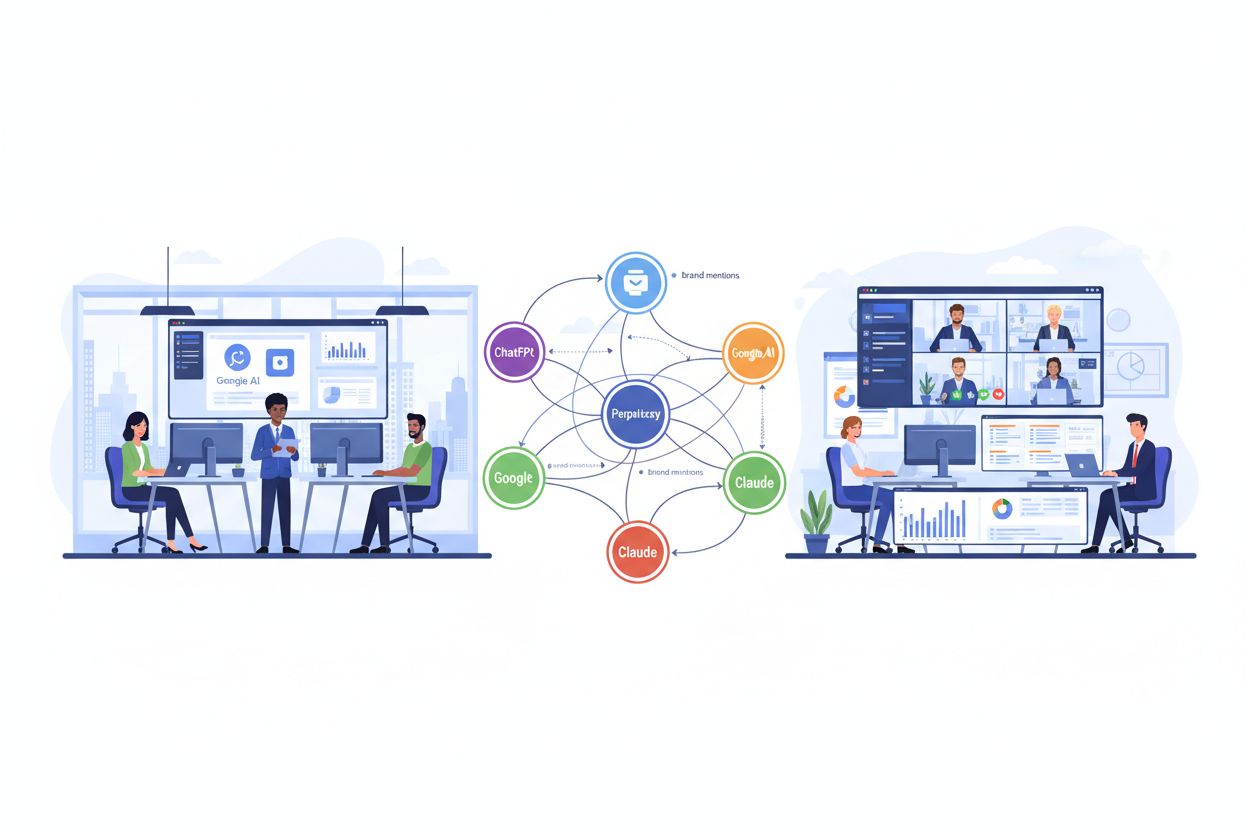
Agency vs In-House AI Visibility: Pros, Cons, and Decision Factors
Compare agency vs in-house AI visibility monitoring. Explore costs, timelines, expertise requirements, and hybrid approaches to help you choose the right strate...
9 min read

Complete guide for marketing agencies to understand, implement, and offer AI visibility services to clients. Learn monitoring strategies, tools, and ROI measurement.
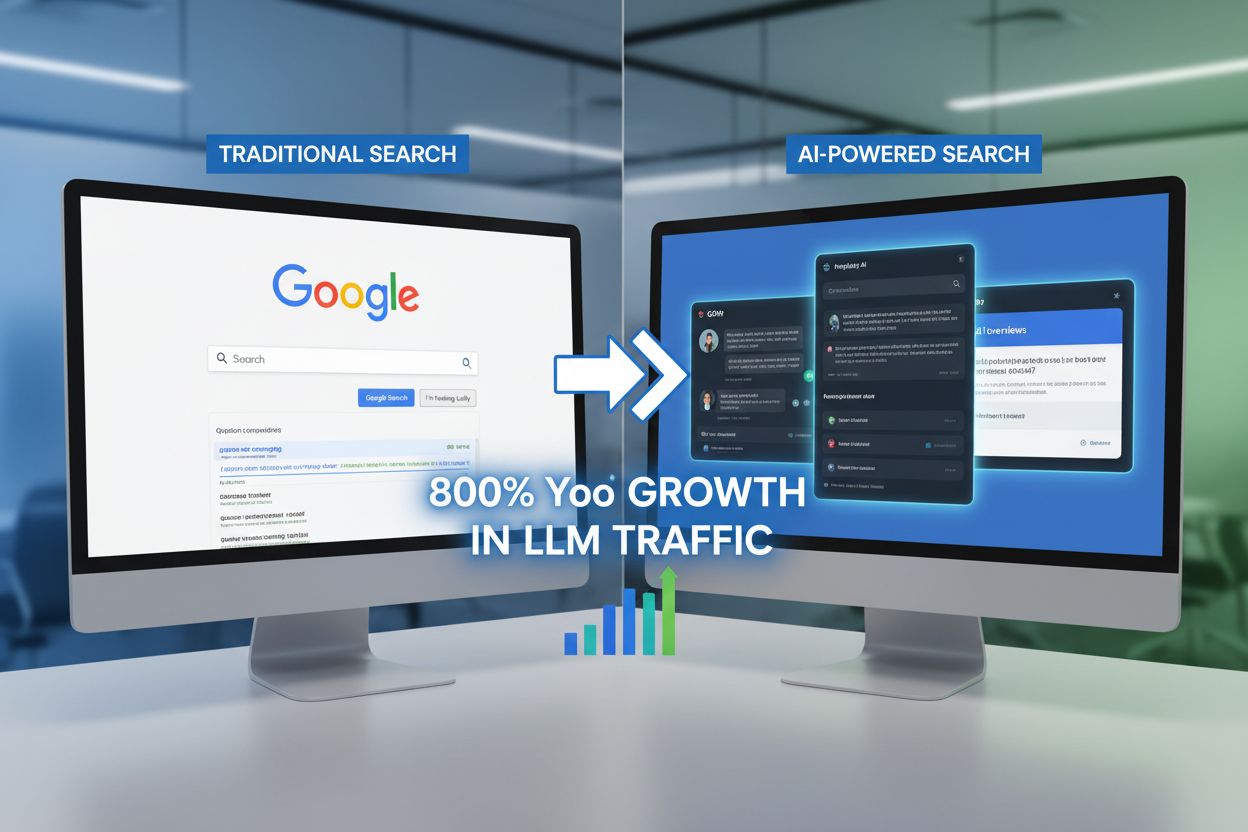
The marketing landscape is undergoing a seismic shift as artificial intelligence fundamentally changes how consumers discover information. While traditional SEO has dominated agency service offerings for decades, the rise of AI-powered search engines and large language models (LLMs) is creating an entirely new visibility frontier that agencies cannot afford to ignore. LLM traffic has surged 800% year-over-year, with platforms like ChatGPT, Perplexity, and Google’s AI Overviews now serving as primary information sources for millions of users—bypassing traditional search results entirely. For marketing agencies, offering AI visibility services isn’t just a competitive differentiator; it’s becoming an essential service to ensure clients maintain brand presence and capture share of voice in this rapidly evolving search ecosystem.
AI visibility services represent a new category of marketing intelligence tools designed to monitor, track, and optimize brand presence across generative AI platforms and answer engines. Unlike traditional SEO, which focuses on ranking for specific keywords in Google’s organic results, AI visibility services track whether and how your brand appears when users query AI chatbots and search engines with natural language questions. These services monitor brand mentions, citations, and sentiment across multiple platforms including ChatGPT, Perplexity, Google AI Overviews, Google’s AI Mode, Gemini, and Microsoft Copilot—essentially creating a comprehensive map of your brand’s presence in the AI-powered search landscape. The core metrics tracked include the frequency and quality of brand mentions, citation accuracy and consistency, sentiment analysis of how the brand is discussed, and competitive positioning relative to other brands in AI-generated responses.
| AI Platform | User Base | Citation Tracking | Sentiment Analysis | Best For |
|---|---|---|---|---|
| ChatGPT | 200M+ monthly users | Yes | Yes | General brand awareness |
| Perplexity | Growing research-focused audience | Yes | Yes | Research-oriented queries |
| Google AI Overviews | Billions of Google users | Yes | Limited | Mainstream visibility |
| Gemini | Google ecosystem users | Yes | Yes | Integrated search experience |
| Microsoft Copilot | Enterprise and consumer users | Yes | Yes | B2B and productivity focus |
To effectively manage AI visibility, agencies must help clients understand and monitor a specific set of performance indicators that differ from traditional SEO metrics. These metrics provide actionable insights into how AI systems are representing and recommending your brand:
The market for AI visibility tools is rapidly maturing, with several platforms offering distinct advantages for agencies managing multiple client accounts. Semrush has extended its platform to include AI visibility tracking, leveraging its existing SEO infrastructure to monitor brand presence across ChatGPT, Perplexity, and Google AI Overviews, making it ideal for agencies already invested in the Semrush ecosystem. Profound specializes in AI visibility with dedicated features for tracking citations and sentiment across multiple platforms, offering competitive benchmarking that helps agencies demonstrate clear ROI to clients. Peec AI focuses on citation accuracy and brand representation in AI responses, with particular strength in identifying and correcting inaccurate information about brands in AI systems. OtterlyAI provides an intuitive dashboard for monitoring brand mentions across AI platforms with strong sentiment analysis capabilities, making it accessible for agencies new to AI visibility services.
For agencies seeking a comprehensive solution, AmICited.com stands out as a purpose-built platform specifically designed for tracking brand citations and visibility across AI systems. AmICited combines advanced citation tracking with competitive benchmarking, allowing agencies to monitor not just whether their clients are mentioned, but how accurately and in what context. The platform’s strength lies in its ability to identify citation gaps—instances where brands should be mentioned but aren’t—and provide actionable recommendations for improving AI visibility. Other notable tools include Hall (focused on brand monitoring and reputation), Nimt.ai (specializing in generative engine optimization), AthenaHQ (offering integrated AI visibility with content optimization), and Scrunch AI (providing AI-powered content analysis for visibility improvement).
| Tool | Best For | Key Strength | Pricing Model | Learning Curve |
|---|---|---|---|---|
| Semrush | Existing Semrush users | Integrated SEO + AI visibility | Enterprise/SaaS | Low |
| Profound | Competitive benchmarking | Multi-platform tracking | SaaS | Medium |
| Peec AI | Citation accuracy | Detailed citation analysis | SaaS | Medium |
| OtterlyAI | Ease of use | User-friendly dashboard | SaaS | Low |
| AmICited | Citation tracking & gaps | Comprehensive citation intelligence | SaaS | Low |
| Hall | Reputation management | Brand monitoring | SaaS | Low |
| Nimt.ai | GEO optimization | Content optimization | SaaS | High |

Implementing AI visibility services requires a structured approach that mirrors traditional SEO onboarding but with specific focus on AI platforms. Follow these steps to establish a comprehensive AI visibility program:
Improving AI visibility requires a different approach than traditional SEO, focusing on how AI systems extract, evaluate, and present information. Content optimization for AI involves creating comprehensive, well-structured content that clearly answers the questions AI systems are trained to respond to—this means prioritizing detailed explanations, data-backed claims, and clear entity relationships over keyword density. Citation building becomes critical in the AI era, as brands need to ensure they’re mentioned as authoritative sources across high-quality websites, research publications, and industry resources that AI systems use for training and response generation. Digital PR and earned media take on new importance because mentions in reputable publications directly influence how AI systems perceive and cite your brand—a mention in a major publication carries significant weight in AI visibility. Entity SEO focuses on ensuring your brand’s knowledge graph information is accurate and comprehensive, which AI systems reference when generating responses about your company. Finally, topical authority—establishing your brand as a comprehensive resource across a specific subject area—signals to AI systems that your content should be cited as a primary source, dramatically improving visibility and citation frequency.
Demonstrating the value of AI visibility services to clients requires clear metrics that connect improved AI visibility to business outcomes. Track improvements in visibility scores and share of voice over time, showing clients how their competitive position is strengthening across AI platforms—these metrics should improve month-over-month as optimization efforts take effect. Measure traffic attribution from AI sources by implementing UTM parameters and monitoring referral traffic from ChatGPT, Perplexity, and other AI platforms through Google Analytics, helping clients understand the direct business impact of improved AI visibility. Monitor citation quality and accuracy, not just quantity, by tracking whether AI systems are citing your client’s brand correctly and linking to their website—high-quality citations drive more valuable traffic than simple mentions. Set realistic expectations by educating clients that AI visibility improvements typically take 2-3 months to show measurable results, as AI systems update their training data and response patterns on different schedules. Finally, create custom dashboards that translate technical metrics into business language, showing clients how improved AI visibility correlates with increased brand awareness, website traffic, and lead generation—this storytelling is essential for justifying continued investment and expanding the service to additional clients.
AI visibility services monitor and track how your brand appears across AI-powered platforms like ChatGPT, Perplexity, Google AI Overviews, and Gemini. These services track brand mentions, citations, sentiment, and competitive positioning in AI-generated responses, helping agencies understand and optimize their clients' presence in the AI search ecosystem.
LLM traffic has grown 800% year-over-year, making AI visibility critical for clients. Agencies that offer these services gain a competitive advantage, can command premium pricing, and provide clients with essential insights into how they appear in the fastest-growing search channel. It's becoming as important as traditional SEO.
Key metrics include visibility score (overall brand presence), Share of Voice (competitive positioning), citation tracking (how often and accurately brands are cited), sentiment analysis (how AI systems discuss the brand), position tracking (where brands appear in responses), and AEO performance (how well content is optimized for AI systems).
Top tools include Semrush (for existing users), Profound (for competitive benchmarking), Peec AI (for citation accuracy), OtterlyAI (for ease of use), AmICited (for comprehensive citation tracking), and Hall (for reputation management). The best choice depends on your agency's existing tech stack and client needs.
Typically, agencies should expect 2-3 months to see measurable improvements in AI visibility metrics. This timeline reflects how AI systems update their training data and response patterns. Setting realistic client expectations is crucial for long-term satisfaction and retention.
Measure ROI by tracking improvements in visibility scores and Share of Voice, monitoring referral traffic from AI platforms through Google Analytics, analyzing citation quality and accuracy, and correlating improved AI visibility with increased brand awareness and lead generation. Create custom dashboards that translate technical metrics into business outcomes.
Traditional SEO focuses on ranking for keywords in Google's organic results, while AI visibility tracks brand mentions and citations in AI-generated responses. AI visibility requires different optimization strategies focused on content comprehensiveness, entity relationships, and citation building rather than keyword optimization.
Yes, many AI visibility platforms offer white-label or reseller options, allowing agencies to offer these services under their own brand. This is an excellent way to expand service offerings without building proprietary technology. Check with specific platforms about their partnership and reseller programs.
AmICited helps marketing agencies track how their clients appear across ChatGPT, Perplexity, Google AI Overviews, and other AI platforms. Get comprehensive citation tracking and competitive benchmarking to offer premium AI visibility services.
Compare agency vs in-house AI visibility monitoring. Explore costs, timelines, expertise requirements, and hybrid approaches to help you choose the right strate...

Learn proven strategies to improve your brand's visibility in AI search engines like ChatGPT, Perplexity, and Gemini. Discover content optimization, entity cons...
Learn how to conduct a baseline AI visibility audit to understand how ChatGPT, Google AI, and Perplexity mention your brand. Step-by-step assessment guide for b...