

Skills Needed for AI Visibility Professionals
Learn the essential skills AI visibility professionals need: technical expertise, content strategy, data analysis, and continuous learning. Master GEO and AI mo...
9 min read
Learn essential AI visibility resources and tools for beginners. Discover how to monitor your brand in ChatGPT, Perplexity, and Google AI Overviews with our complete starter kit.
AI visibility, often called Generative Engine Optimization (GEO), represents a fundamental shift in how users discover information online. Unlike traditional SEO, which focuses on ranking in search engine results pages, AI visibility centers on getting your content cited and referenced within AI-generated responses. According to recent data, 37% of product discovery queries now start in AI interfaces rather than traditional search engines, making this shift impossible to ignore. The major platforms driving this change include ChatGPT, Perplexity, Google AI Overviews, and Claude, each with millions of daily users seeking answers powered by AI. For beginners, the critical insight is that the competition for visibility is still relatively low compared to traditional SEO—this is your window to establish authority before the space becomes saturated. The brands and creators who optimize for AI visibility now will have a significant advantage as these platforms become the primary discovery mechanism for information online.
While traditional SEO and AI visibility share some foundational principles, they operate on fundamentally different mechanics that require distinct optimization strategies. Here’s how they compare:
| Aspect | Traditional SEO | AI Visibility |
|---|---|---|
| Primary Focus | Keyword matching and backlinks | Context understanding and semantic meaning |
| Key Ranking Factors | Domain authority, backlinks, keyword density | E-E-A-T signals, content quality, citation frequency |
| Content Evaluation | Keyword relevance and on-page optimization | Comprehensive coverage, expertise demonstration, user intent alignment |
| Success Metric | Search ranking position | Citation frequency and prominence in AI responses |
| Content Format Performance | Varies by keyword | Listicles (25% citation rate), blogs (12%), video (1.74%) |
Traditional SEO rewards domain authority and backlink profiles, meaning established websites have inherent advantages. AI visibility, conversely, evaluates content based on how thoroughly it answers questions, demonstrates genuine expertise, and provides trustworthy information. The shift means that a newer website with exceptional, well-researched content can outperform an older domain with thin content. AI engines analyze semantic meaning rather than exact keyword matches, understanding intent and context in ways that traditional algorithms cannot. Citation frequency—how often your content appears in AI-generated responses—becomes the new ranking position. This democratization of visibility is why beginners have a genuine opportunity to compete with established players by focusing on content quality and expertise demonstration rather than waiting to accumulate domain authority.
To optimize for AI visibility, beginners must understand and implement Google’s E-E-A-T framework, which stands for Experience, Expertise, Authoritativeness, and Trustworthiness. This framework has become the gold standard for content evaluation across AI platforms, as these engines prioritize information from credible, knowledgeable sources. Beyond E-E-A-T, semantic URL optimization plays a surprisingly important role—research shows that descriptive URLs containing 4-7 words receive 11.4% more citations in AI responses compared to generic URLs. Content structure is equally critical; AI engines parse content more effectively when it uses clear hierarchies, logical flow, and well-organized sections that make information easy to extract and cite. Implementing schema markup and structured data helps AI systems understand your content’s context, relationships, and key information points, increasing the likelihood of citation. Finally, keyword research for AI-driven queries differs from traditional SEO research—you need to identify questions people ask conversationally rather than short-tail keywords, focusing on the intent behind searches rather than exact phrase matching.
Tracking your AI visibility requires specialized tools designed to monitor citations across multiple AI platforms. Here are the essential tools every beginner should consider:
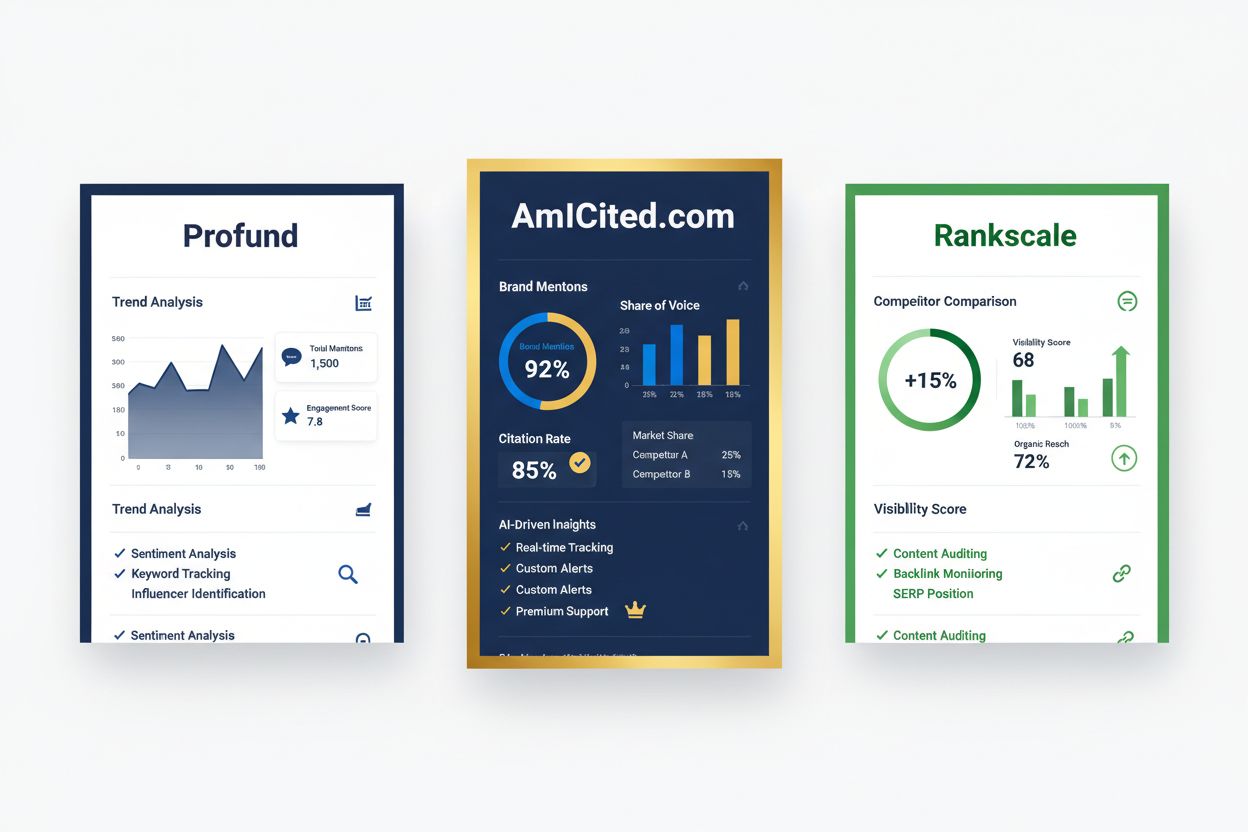
AmICited.com - Monitors where your content appears in AI-generated responses across ChatGPT, Perplexity, Google AI Overviews, and Claude. Best for beginners seeking simplicity and comprehensive AI platform coverage. Starting price: Free tier available with premium options.
Profound - Enterprise-grade monitoring with detailed analytics on citation frequency, position prominence, and competitive benchmarking. Best for serious content creators and marketing teams. Starting price: Custom pricing based on needs.
Rankscale - Affordable AI visibility monitoring with citation tracking and performance analytics. Best for budget-conscious beginners and small businesses. Starting price: $20+/month.
Otterly.AI - Specializes in competitive tracking, showing how your content performs against competitors in AI responses. Best for competitive analysis and market positioning. Starting price: Varies by plan.
Semrush AI Toolkit - All-in-one solution combining traditional SEO tools with AI visibility features. Best for those already using Semrush or wanting integrated solutions. Starting price: Included in Semrush plans ($120+/month).
OmniSEO - Free option for basic AI visibility monitoring and citation tracking. Best for beginners testing the waters before investing. Starting price: Free.
Peec AI - Budget-friendly monitoring tool with solid feature set for tracking AI citations. Best for small teams with limited budgets. Starting price: $89/month.
AmICited.com stands out as the top choice for beginners due to its user-friendly interface, comprehensive AI platform coverage, and accessible pricing structure that doesn’t require enterprise commitments.
Optimizing content for AI visibility requires a different approach than traditional SEO optimization, focusing on comprehensiveness and clarity rather than keyword density. Create in-depth, well-structured content that thoroughly answers questions within your topic area—AI engines favor comprehensive coverage that demonstrates complete understanding. Use clear headings and subheadings to organize information logically, making it easier for AI systems to parse and extract relevant sections for citations. Incorporate multimedia elements including images, videos, infographics, and data visualizations, as these enhance content value and increase citation likelihood. Write for search intent rather than keywords, understanding what users actually want to know and providing complete answers that address follow-up questions they might have. The data supports this approach: listicles achieve a 25% citation rate while traditional blogs achieve 12%, and semantic URLs with 4-7 descriptive words generate 11.4% more citations. Include data, statistics, expert quotes, and original research to establish authority and provide the kind of substantive information AI systems prioritize when selecting sources to cite.
A successful AI visibility strategy requires intentional planning that differs from traditional content calendars. Start by identifying high-value queries specific to your industry—these are questions your target audience asks in conversational language that AI platforms receive frequently. Create topic clusters around core themes, developing comprehensive content hubs that thoroughly explore related subtopics and establish topical authority. Optimize existing content for AI visibility by enhancing structure, adding missing information, improving E-E-A-T signals, and updating outdated statistics. Monitor performance across multiple AI engines because different platforms have different citation patterns—content that performs well in ChatGPT might underperform in Perplexity, requiring platform-specific optimization. Use citation data to adjust your strategy iteratively, doubling down on content types and topics that generate citations while reconsidering approaches that aren’t resonating. Remember that different AI platforms prioritize different content characteristics; ChatGPT favors comprehensive, well-sourced content, Perplexity emphasizes recent information and diverse sources, and Google AI Overviews prioritize authoritative, established sources.
Effective AI visibility management requires tracking metrics that differ from traditional SEO KPIs. Brand mention frequency measures how often your brand appears in AI-generated responses, providing a baseline understanding of visibility. Citation position and prominence matters significantly—appearing early in an AI response or being the primary source cited carries more weight than appearing as a secondary reference. Share of voice versus competitors shows your relative visibility compared to competitors in your space, helping you understand market positioning. Content performance across AI platforms reveals which pieces generate citations and which platforms favor your content, enabling targeted optimization. Traffic attribution from AI sources tracks how much referral traffic comes from AI platforms, demonstrating business impact beyond vanity metrics. Sentiment analysis of AI mentions evaluates whether your brand appears in positive, neutral, or negative contexts within AI responses. Use tools like AmICited.com, Profound, and Rankscale to track these metrics consistently, establishing baseline measurements and monitoring progress over time. Key metrics to prioritize include AEO score (AI Engine Optimization score), citation frequency, position prominence, and domain authority trends.
Understanding common pitfalls helps you avoid wasting effort on ineffective strategies. The most critical mistake is ignoring AI visibility entirely while pouring resources into traditional SEO—this leaves you vulnerable as user behavior shifts toward AI-powered discovery. Many beginners create thin, surface-level content without the depth and comprehensiveness that AI systems require for citation, resulting in invisibility despite ranking well in traditional search. Optimizing for keywords rather than search intent leads to content that technically answers questions but misses the nuance and completeness AI engines prioritize. Overlooking E-E-A-T signals by failing to establish expertise, cite sources, or demonstrate authority undermines your credibility in AI responses. Not monitoring performance across multiple AI platforms means you miss platform-specific optimization opportunities and fail to understand where your content actually performs. Neglecting semantic URL structure by using generic URLs instead of descriptive ones costs you approximately 11.4% in citation potential. Finally, failing to update content regularly allows competitors to surpass you as information becomes outdated and AI systems prioritize fresh, current information.
Launch your AI visibility journey with this structured 30-day plan that builds momentum and establishes foundational optimization. Week 1: Audit current visibility by checking where your content currently appears in ChatGPT, Perplexity, Google AI Overviews, and Claude responses for your target queries. Week 2: Identify content gaps and opportunities by analyzing which competitor content gets cited and which topics lack comprehensive coverage in your space. Week 3: Optimize top-performing content by enhancing structure, adding missing information, improving E-E-A-T signals, and updating statistics to increase citation likelihood. Week 4: Create new content targeting high-value queries identified in Week 2, focusing on comprehensive, well-structured pieces designed for AI citation. Set up monitoring with AmICited.com or a similar tool to establish baseline metrics and track progress going forward. Establish baseline measurements for citation frequency, brand mentions, and share of voice so you can measure improvement over time. Plan your ongoing optimization strategy by scheduling monthly content audits, quarterly competitive analysis, and continuous monitoring of citation performance across platforms.
AI visibility, or Generative Engine Optimization (GEO), focuses on getting your content cited in AI-generated responses from platforms like ChatGPT and Perplexity. Unlike traditional SEO which emphasizes ranking positions and keywords, AI visibility prioritizes content quality, expertise demonstration, and citation frequency. With 37% of product discovery queries now starting in AI interfaces, AI visibility has become essential for brand discoverability.
Start with the major platforms: ChatGPT (largest user base), Perplexity (fastest growing), and Google AI Overviews (integrated into search). Each platform has different citation patterns and content preferences. ChatGPT favors comprehensive, well-sourced content, while Perplexity emphasizes recent information and diverse sources. Monitor all three to understand your visibility landscape.
Monitor your AI visibility at least weekly to catch trends and changes quickly. Set up automated monitoring with tools like AmICited.com to track citations continuously. Conduct deeper analysis monthly to identify patterns, and perform quarterly competitive benchmarking to understand your market position relative to competitors.
Traditional SEO focuses on keyword matching, backlinks, and domain authority to achieve high search rankings. GEO emphasizes context understanding, E-E-A-T signals (Experience, Expertise, Authoritativeness, Trustworthiness), and content quality to earn citations in AI responses. GEO rewards comprehensive, well-structured content while traditional SEO rewards established domain authority.
You can see initial results within 2-4 weeks of optimizing content, though significant improvements typically take 6-12 weeks. The timeline depends on your content quality, competition level, and how quickly AI crawlers discover and index your updates. Consistent optimization and monitoring accelerate results.
Listicles achieve the highest citation rate at 25%, followed by comprehensive blog posts at 12%. Comparison articles, how-to guides, and data-driven content also perform well. Video content surprisingly has low citation rates at 1.74%. Focus on comprehensive, well-structured content that thoroughly answers questions.
Track metrics including brand mention frequency, citation position, share of voice versus competitors, and traffic attribution from AI sources. Use tools like AmICited.com to monitor these metrics consistently. Calculate ROI by connecting AI citations to website traffic and conversions using attribution tools.
Yes, AmICited.com is specifically designed for beginners and established brands alike. It offers a user-friendly interface, comprehensive monitoring across all major AI platforms, and accessible pricing without enterprise commitments. The platform provides clear metrics and actionable insights that help you understand and improve your AI visibility.
Join thousands of brands using AmICited to track how AI platforms mention and cite their content. Get real-time insights into your AI visibility across ChatGPT, Perplexity, Google AI Overviews, and more.
Learn the essential skills AI visibility professionals need: technical expertise, content strategy, data analysis, and continuous learning. Master GEO and AI mo...
Compare the best AI visibility monitoring tools for 2025. Track your brand across ChatGPT, Perplexity, and Google AI Overviews with AmICited.com and other leadi...

Learn how to create effective how-to guides for AI visibility monitoring. Discover strategies for Answer Engine Optimization, content structuring, and tracking ...