
Agency vs In-House AI Visibility: Pros, Cons, and Decision Factors
Compare agency vs in-house AI visibility monitoring. Explore costs, timelines, expertise requirements, and hybrid approaches to help you choose the right strate...
9 min read
Learn how to build automated AI visibility workflows that detect brand mentions across ChatGPT, Perplexity, and Google AI Overviews, then automatically trigger actions to protect and enhance your brand presence.
An AI visibility workflow is a systematic, automated process that detects when AI systems mention your brand and automatically triggers predefined actions in response. Unlike traditional brand monitoring that relies on manual searches or periodic reports, AI visibility workflows operate continuously across multiple AI platforms—including ChatGPT, Perplexity, Claude, and Google AI Overviews—using sophisticated detection mechanisms that scan AI-generated responses in real-time. These workflows combine several technical components: API integrations that connect to AI platforms, natural language processing (NLP) algorithms that identify brand mentions with contextual accuracy, and rules engines that evaluate whether detected mentions meet specific criteria for action. The fundamental difference from legacy monitoring is that AI visibility workflows don’t just report what happened—they automatically respond to it, creating a closed-loop system where detection immediately triggers downstream actions like alerts, content updates, or engagement initiatives.
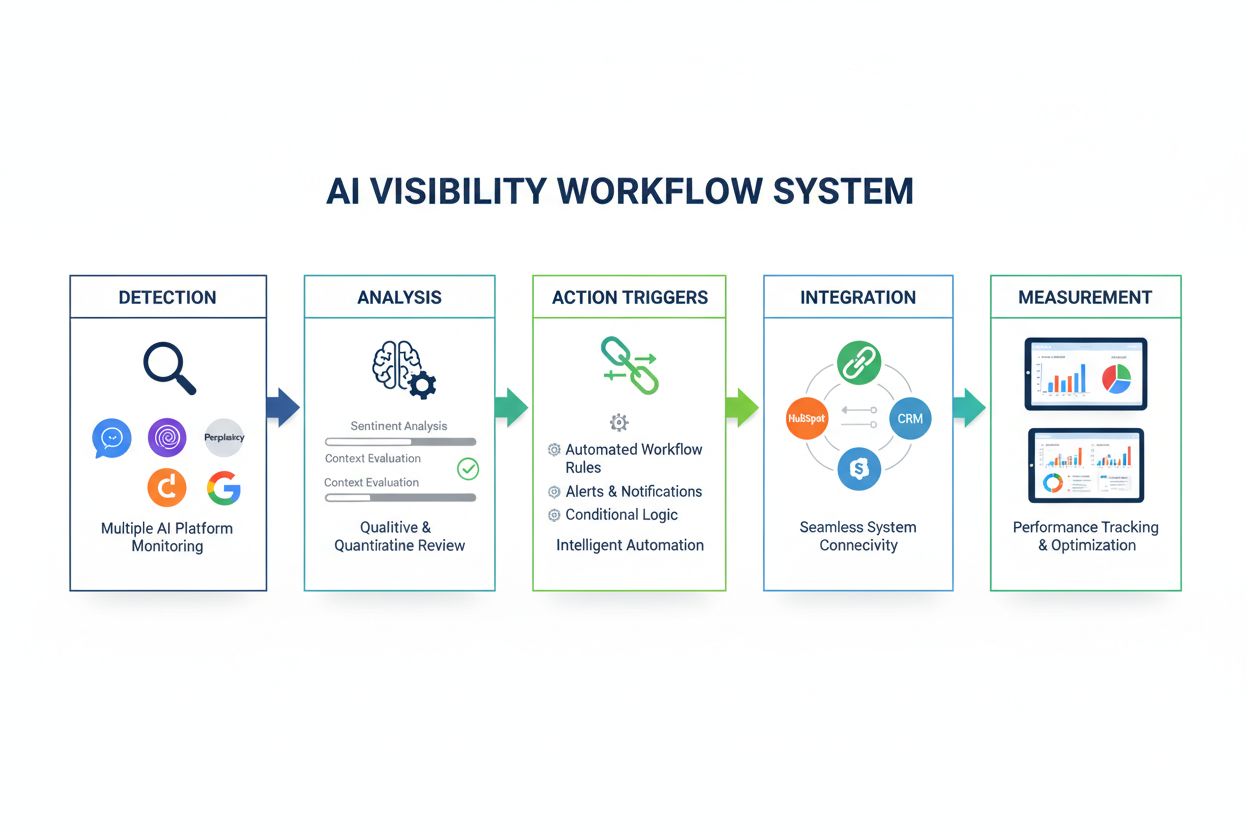
The detection phase is the foundation of any effective AI visibility workflow, requiring sophisticated mechanisms to identify brand mentions across diverse AI platforms with varying architectures and response patterns. Each AI platform presents unique detection challenges: ChatGPT requires monitoring through API endpoints and user-reported mentions, Perplexity uses web crawling and citation tracking to identify when brands appear in generated responses, Claude detection relies on API integration and conversation analysis, and Google AI Overviews requires monitoring of search results and AI-generated summaries. Real-time monitoring capabilities have become essential, with modern platforms capable of detecting mentions within seconds of generation, allowing teams to respond while conversations are still active. The detection infrastructure typically combines multiple data sources including direct API feeds from AI platforms, web crawlers that monitor AI-generated content, user feedback mechanisms, and third-party monitoring services that aggregate mentions across platforms.
| Platform | Detection Method | Real-time Capability | Data Sources |
|---|---|---|---|
| ChatGPT | API monitoring + user reports | 30-60 seconds | OpenAI API, conversation logs, user submissions |
| Perplexity | Web crawling + citation tracking | 15-45 seconds | Perplexity API, search results, citation databases |
| Claude | API integration + conversation analysis | 20-50 seconds | Anthropic API, conversation transcripts |
| Google AI Overviews | Search result monitoring | 1-2 minutes | Google Search API, SERP tracking, AI overview snapshots |
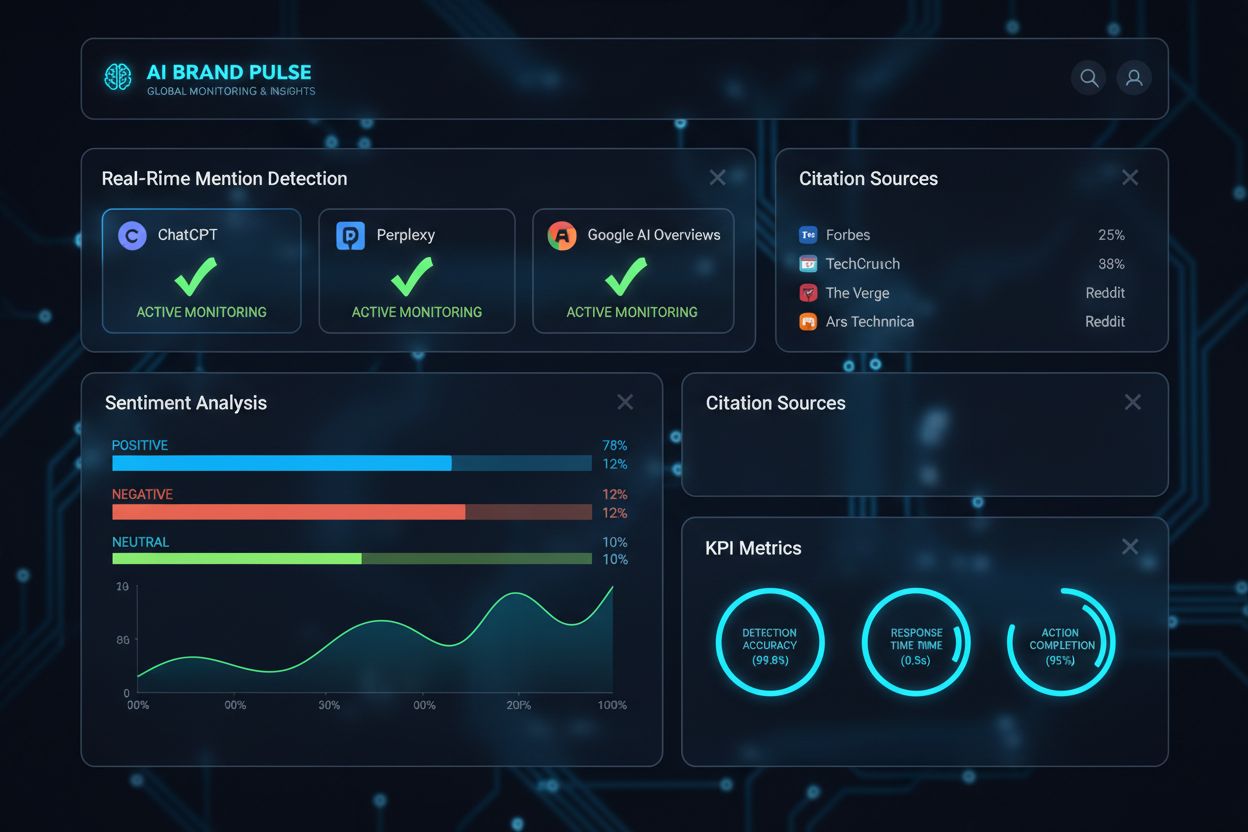
Once a mention is detected, the workflow enters the analysis phase, where context evaluation and sentiment classification determine the significance and nature of the brand reference. The system examines not just whether your brand was mentioned, but how it was mentioned—analyzing the surrounding text to understand if the reference was positive (recommending your product), negative (criticizing your service), or neutral (simply listing you as an option). This contextual analysis is critical because a mention in a negative context requires different action than a positive endorsement. Beyond sentiment, the workflow tracks citation sources to understand which content pieces or domains are driving AI mentions, context relevance to ensure the mention aligns with your brand positioning, and brand positioning metrics that show how AI systems are categorizing and describing your company relative to competitors. These analysis metrics provide the intelligence layer that transforms raw detection data into actionable insights.
Key Analysis Metrics:
The power of AI visibility workflows lies in their ability to automatically trigger actions based on predefined rules and thresholds, eliminating the delay between detection and response. These workflows use rules engines that evaluate detected mentions against customizable conditions, determining which actions should execute automatically. For example, a workflow might be configured to alert the marketing team when a brand mention reaches high visibility (appearing in multiple AI responses), trigger content updates when citations are inaccurate, or initiate engagement protocols when sentiment is negative. Different action types serve different purposes: alert actions notify relevant teams immediately, content actions automatically update website information or knowledge bases, and engagement actions trigger outreach campaigns or response protocols. The flexibility of modern workflow systems allows organizations to set sophisticated thresholds—such as triggering alerts only for mentions with negative sentiment above a certain confidence level, or only when mentions appear in high-traffic AI platforms.
Example Workflow Rule:
IF [sentiment = negative] AND [visibility_score > 7/10] AND [platform = ChatGPT OR Perplexity]
THEN [alert marketing_team] AND [create_task for_content_review] AND [log_incident]
AI visibility workflows achieve maximum impact when integrated with existing marketing, content management, and customer engagement systems, creating a unified ecosystem where detection automatically flows into action across multiple platforms. Modern workflows connect to marketing automation platforms like HubSpot or Marketo to trigger campaigns, content management systems to update product information or FAQs, CRM systems to log brand mentions in customer records, and communication tools like Slack or Microsoft Teams to notify teams in real-time. The integration layer typically uses APIs and middleware platforms such as Zapier (which offers 8,000+ pre-built integrations optimized for no-code accessibility), Make.com (formerly Integromat, providing visual workflow builders), and n8n (an open-source alternative for organizations requiring self-hosted solutions). These platforms enable workflow orchestration—the coordination of multiple systems and actions in sequence—allowing a single detected mention to trigger a cascade of coordinated responses across your entire marketing and operations infrastructure without manual intervention.
The true value of AI visibility workflows emerges through continuous measurement and optimization, using specific KPIs to quantify impact and identify improvement opportunities. Organizations should track detection accuracy (the percentage of actual brand mentions successfully identified), response time (how quickly the system detects and acts on mentions), action completion rate (the percentage of triggered actions that execute successfully), and brand sentiment improvement (changes in how AI systems describe your brand over time). Additional ROI metrics include cost savings from automation (reduced manual monitoring hours), revenue impact from faster response to opportunities, and competitive positioning gains from improved AI visibility. Optimization occurs through continuous analysis of workflow performance data—identifying which rules generate the most valuable actions, which integrations have the highest success rates, and which thresholds produce the best signal-to-noise ratio. By treating AI visibility workflows as living systems that evolve based on performance data, organizations can progressively increase their effectiveness, moving from reactive monitoring to proactive brand management in the AI-driven search landscape.
Key Performance Metrics:
An AI visibility workflow is an automated system that continuously monitors when AI platforms like ChatGPT, Perplexity, and Google AI Overviews mention your brand, analyzes the context and sentiment of those mentions, and automatically triggers predefined actions in response. Unlike manual monitoring, these workflows operate 24/7 and can respond to mentions in real-time.
These workflows use multiple detection mechanisms including API integrations with AI platforms, web crawlers that monitor AI-generated content, real-time monitoring of search results and AI overviews, and user-reported mentions. Detection typically happens within 15-60 seconds of a mention being generated, depending on the platform.
Automated actions include real-time alerts to your team, automatic updates to your website or knowledge base, creation of tasks for content review, engagement campaigns, CRM updates, and notifications to communication tools like Slack. You can customize which actions trigger based on specific conditions like sentiment, visibility score, or platform.
Integration happens through APIs and workflow automation platforms like Zapier, Make.com, or n8n. These platforms connect your AI monitoring system to your marketing automation tools, CRM, content management system, and communication platforms, creating a unified ecosystem where detection automatically flows into action.
Key metrics include detection accuracy (percentage of mentions successfully identified), response time (how quickly the system detects and acts), action completion rate (percentage of triggered actions that execute successfully), and brand sentiment improvement (changes in how AI systems describe your brand over time).
Yes, modern AI visibility workflows are highly customizable. You can set specific thresholds for sentiment, visibility scores, and platform selection. For example, you might trigger alerts only for negative mentions with high visibility on major platforms, or automatically update content when citations are inaccurate.
It's recommended to review workflow performance weekly or monthly, analyzing which rules generate the most valuable actions, which integrations have the highest success rates, and which thresholds produce the best signal-to-noise ratio. Treat workflows as living systems that evolve based on performance data.
Traditional brand monitoring is reactive and manual—you search for mentions and then decide what to do. AI visibility workflows are proactive and automated—they continuously scan AI platforms, analyze mentions in context, and automatically execute responses without human intervention, enabling faster and more consistent brand management.
Get real-time visibility into how AI systems mention your brand and automatically respond to opportunities and threats with AmICited's AI visibility monitoring platform.
Compare agency vs in-house AI visibility monitoring. Explore costs, timelines, expertise requirements, and hybrid approaches to help you choose the right strate...
Learn what AI visibility reporting is, how it works, and why it's essential for monitoring your brand's presence in ChatGPT, Perplexity, Google AI Overviews, an...

Discover the top AI search visibility monitoring tools to track your brand across ChatGPT, Perplexity, and Google AI Overviews. Compare features, pricing, and c...