
Amazon Rufus Optimization: Visibility in Amazon's AI Shopping Assistant
Master Amazon Rufus optimization strategies to increase product visibility in Amazon's AI shopping assistant. Learn how to optimize listings, content, and revie...
10 min read
Discover how Amazon Rufus uses generative AI and machine learning to provide personalized product recommendations. Learn the technology, features, and impact on e-commerce.
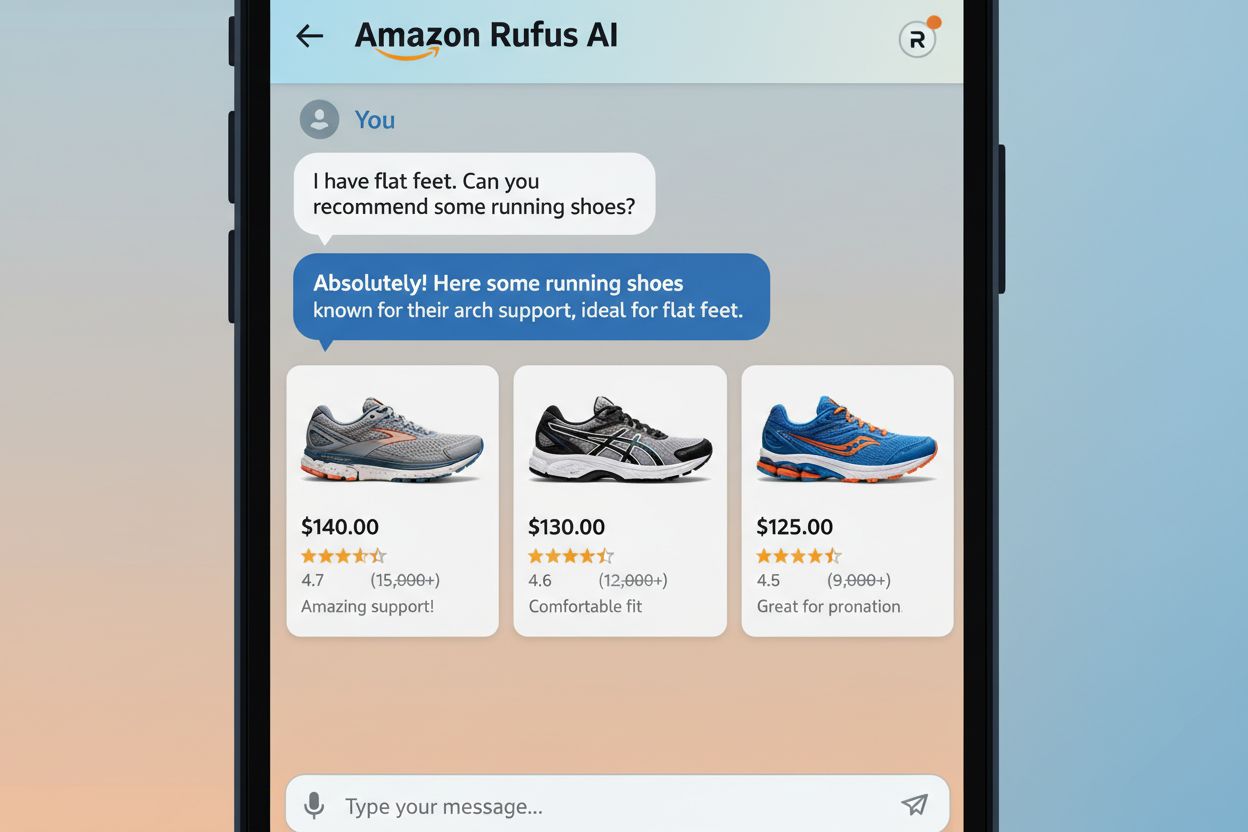
Amazon Rufus is a generative AI-powered shopping assistant integrated directly into the Amazon Shopping app and Amazon.com, launched in early 2024 to revolutionize how customers discover and purchase products. Unlike traditional search engines that rely on keyword matching, Rufus understands natural language questions and engages in conversational shopping experiences, allowing customers to ask complex questions like “What’s a good beginner camera under $500?” or “I need running shoes for flat feet with arch support.” Built on Amazon Bedrock and powered by advanced Large Language Models including Anthropic’s Claude Sonnet, Amazon Nova, and custom models trained on Amazon’s extensive product catalog, customer reviews, and web content, Rufus has already achieved remarkable adoption with over 250 million customers using it, representing a 149% increase in monthly active users and a 210% increase in interactions year-over-year. The impact is tangible: customers who use Rufus while shopping are over 60% more likely to make a purchase during that shopping trip, demonstrating the profound shift toward conversational commerce.
Rufus operates on a sophisticated technical architecture designed to deliver intelligent recommendations at scale, utilizing a real-time router that intelligently selects from multiple models accessed through Amazon Bedrock to optimize for capability, latency, and answer quality depending on query type. The system employs Retrieval-Augmented Generation (RAG) technology, which enhances responses by pulling relevant information from popular sources like The New York Times, USA Today, Good Housekeeping, and Vogue, ensuring recommendations are grounded in authoritative product and trend information. To achieve the sub-second response times that create a seamless user experience, Amazon deployed over 80,000 AWS Trainium and Inferentia chips across multiple regions during peak events like Prime Day, reducing infrastructure costs by 4.5 times compared to alternative solutions while maintaining P99 latency under 1 second. The infrastructure uses continuous batching with vLLM integration, allowing single hosts to greatly increase throughput while keeping time-to-first-token under control, and implements streaming architecture so customers see responses begin appearing in less than a second rather than waiting for complete generation.
| Aspect | Traditional Search | Rufus AI |
|---|---|---|
| Input Method | Keywords | Natural language questions |
| Processing | Keyword matching | Context and intent understanding |
| Data Sources | Product database only | Products + reviews + web content |
| Response Format | Product list | Personalized recommendations |
| Response Time | Variable | <1 second |
| Personalization | Limited | Account-based memory |
| Multi-part Queries | Difficult | Native support |
| Learning | Static | Continuous improvement |
Rufus incorporates account memory technology that fundamentally changes how personalization works in e-commerce, learning from your individual shopping activity to provide increasingly tailored answers and product suggestions based on conversational context. The system remembers details you’ve shared or that it has learned from your behavior—whether you’re an avid trail runner, a budding artist, a fashionista, or a documentary film buff—and considers these preferences when generating answers and search results. For example, if you’ve previously mentioned having 5- and 8-year-old sons who love sports, Rufus will recommend age-appropriate books about legendary sports athletes and sports-themed video games rather than generic children’s products. Similarly, if you ask about Roomba robotic vacuums, Rufus highlights how cleaning up pet hair is a key feature if it knows you have a golden retriever, or if you’re searching for groceries to make your favorite pasta recipe, it prioritizes organic tomatoes based on your stated preferences. You can also ask Rufus to reorder items you’ve browsed or shopped in the past with natural language like “Reorder everything we used to make pumpkin pie last week,” and Rufus connects the dots between past activity and present shopping needs, even suggesting alternatives if items are unavailable. In the coming months, Rufus will expand its memory to include your activity across Amazon’s digital services such as Kindle, Prime Video, and Audible, creating an even more comprehensive understanding of your interests and preferences.
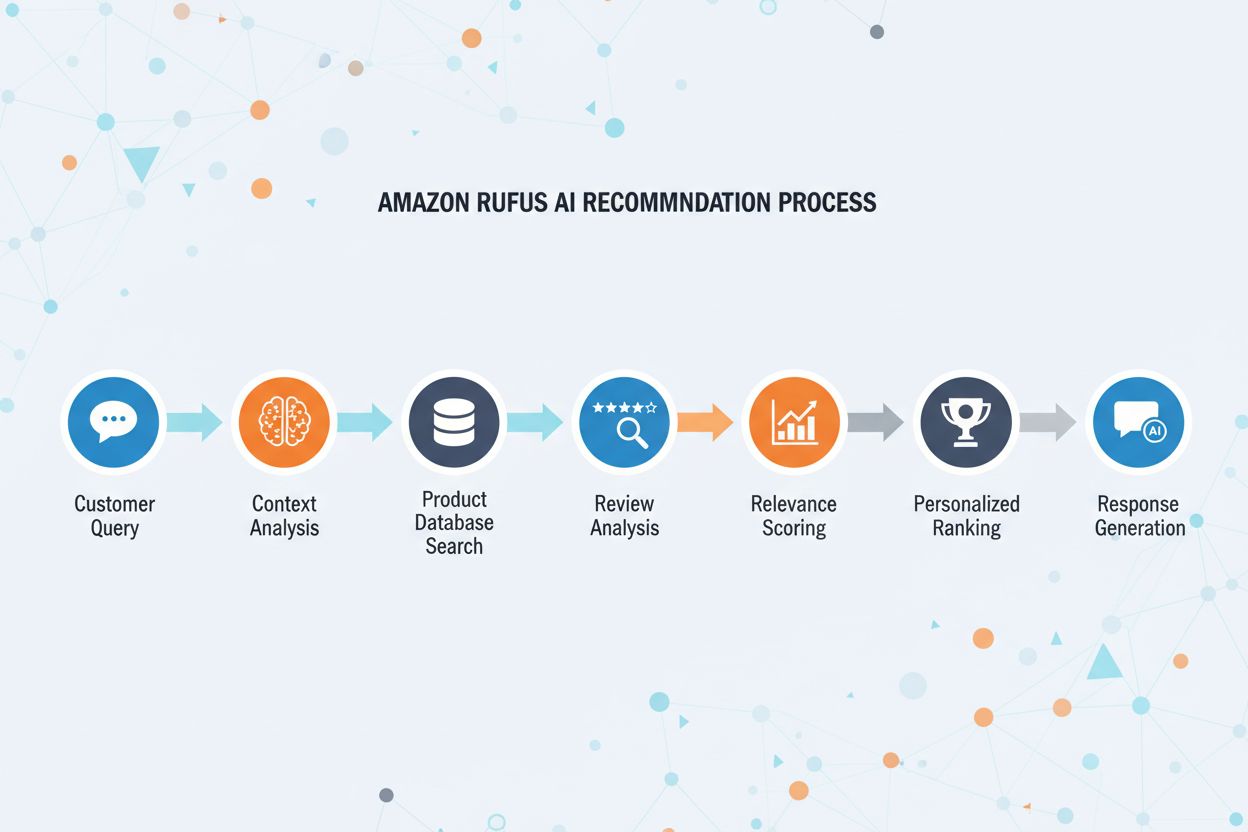
Rufus employs a sophisticated multi-stage recommendation engine that transforms customer queries into highly relevant product suggestions through a process that combines natural language understanding, historical context analysis, and real-time product evaluation. When you ask Rufus a question, the system begins by analyzing your query to understand intent, then retrieves relevant context from your account history including past purchases, browsing behavior, and stated preferences. Simultaneously, Rufus searches Amazon’s product database using semantic understanding rather than simple keyword matching, identifying products that match your needs at a conceptual level. The system then analyzes customer reviews and ratings for candidate products, evaluating how well they address your specific requirements—if you asked about running shoes for flat feet, Rufus specifically examines reviews mentioning arch support and foot type compatibility. Rufus applies relevance scoring that weighs multiple factors including product quality, customer satisfaction, price alignment with your budget, and fit with your personal preferences, then ranks results to present the most suitable options first. The final step involves generating a conversational response that explains why specific products are recommended, often including comparisons between options and addressing potential concerns you might have. This entire process happens in real-time, with Rufus beginning to stream responses back to you in under one second, creating an experience that feels like consulting with a knowledgeable shopping expert rather than using a search tool.
The Recommendation Process Steps:
Beyond basic recommendations, Rufus includes powerful features designed to help customers save money and discover products more effectively, starting with price tracking that displays 30- and 90-day price history so you can immediately understand if you’re getting a great deal on any item. The system enables price alerts that notify you when products drop to your target price point, and for Prime Members, offers auto-buy functionality that automatically purchases items when they reach your desired price threshold using your default payment method and shipping address, with a convenient 24-hour cancellation window if you change your mind. Customers using auto-buy save an average of 20% per purchase, with auto-buy requests staying active for six months or until you cancel them. Rufus also functions as an intelligent deal finder that combs through Amazon’s vast selection to curate personalized deals every day of the year, including during major shopping events like Prime Day, Black Friday, and Cyber Monday, allowing you to discover offers in your favorite categories or across the entire store. The system supports visual search capabilities, enabling you to upload photos and ask Rufus to find similar products or help solve problems—for example, uploading a photo of a stained rug and asking “How do I remove this coffee stain?” prompts Rufus to analyze the fabric and recommend relevant cleaning supplies. For iOS customers, Rufus can now process handwritten shopping lists: simply snap a photo of your grocery or holiday list and upload it, and Rufus will add the items directly to your Amazon shopping cart, with this feature coming to Android soon.
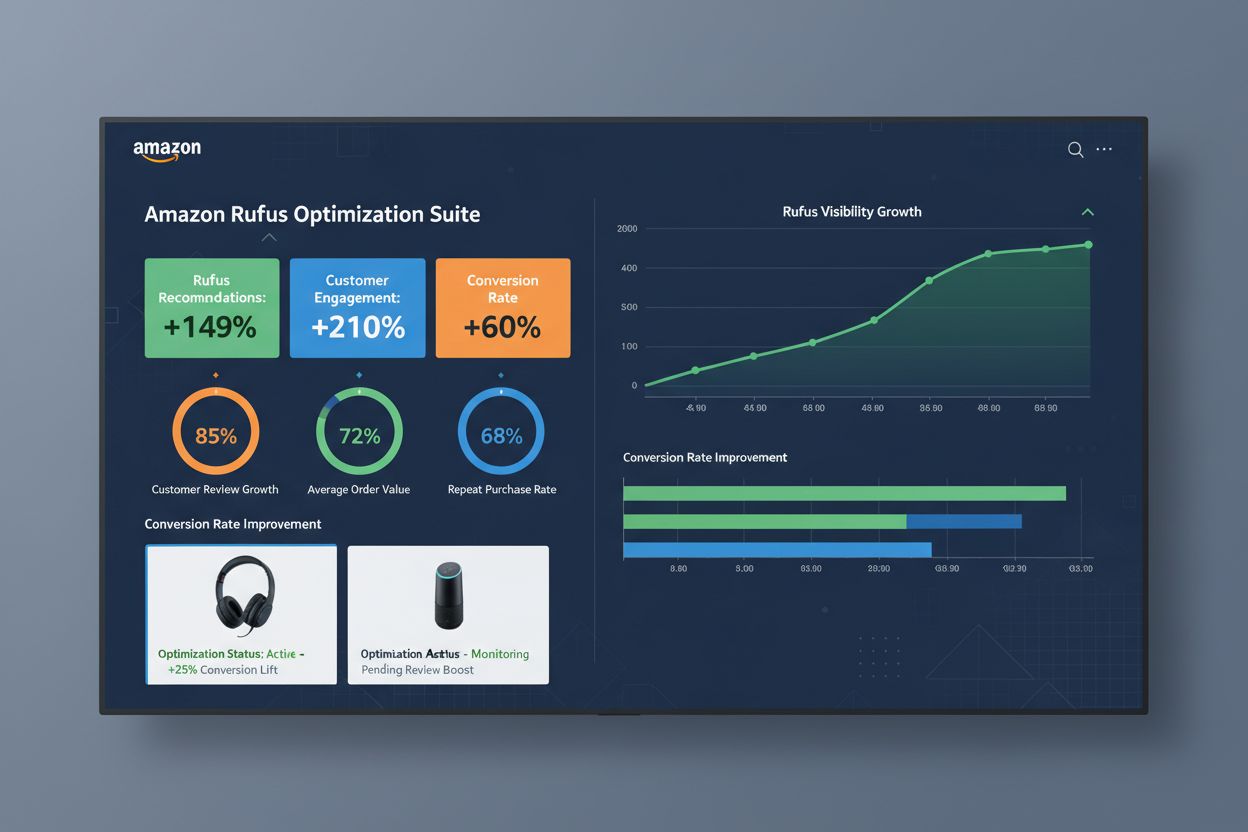
The adoption and impact of Rufus demonstrate a fundamental shift in how customers shop online, with over 250 million customers having used Rufus this year alone, representing a 149% increase in monthly average users and a 210% increase in total interactions compared to the previous year. Customers who engage with Rufus while shopping are over 60% more likely to make a purchase during that shopping trip, a conversion lift that significantly exceeds industry benchmarks and indicates that Rufus recommendations align closely with customer intent and needs. The system has become deeply integrated into Amazon’s shopping experience, featured prominently in the Amazon Shopping app, on desktop, and throughout the store including the homepage, product detail pages, and the Amazon Lens Live experience, making it easy for customers to discover and use. Monthly active users have grown 149% year-over-year while interactions have surged 210%, reflecting both increased awareness and the genuine value customers find in conversational shopping. This growth trajectory suggests that conversational AI is not a niche feature but rather a fundamental shift in how e-commerce will operate, with Rufus serving as the leading example of this transformation. The combination of high adoption, strong engagement metrics, and significant purchase lift demonstrates that Rufus is reshaping customer expectations around product discovery and personalization.
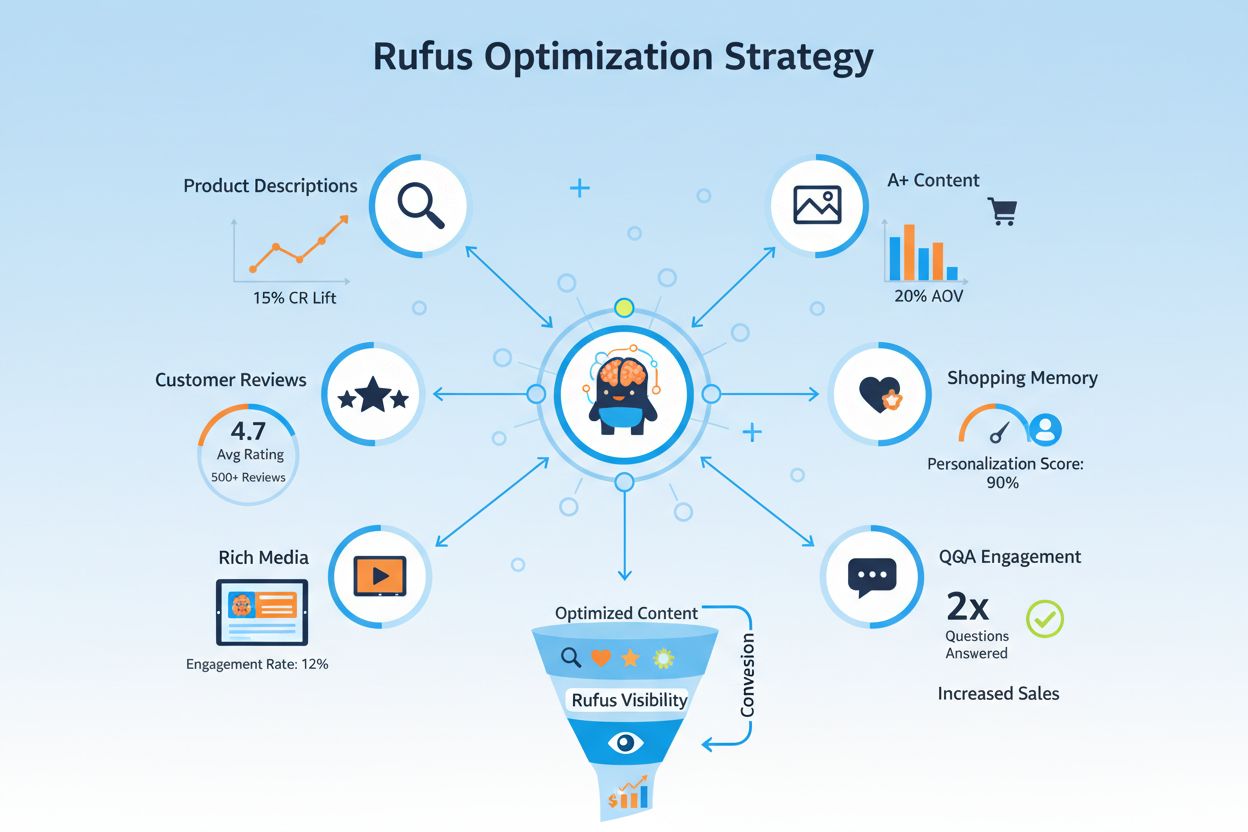
For marketplace sellers and brands, Rufus represents both a challenge and an opportunity, requiring a strategic pivot from traditional keyword optimization toward creating AI-ready content that Rufus can easily understand, analyze, and recommend. The AI is trained to prioritize high-quality listings, which means sellers must focus on clear, benefit-focused product titles that make key specifications and benefits obvious at a glance, avoiding vague or keyword-stuffed approaches that worked in traditional search. High-resolution, informative images are critical because Rufus evaluates visuals to understand product use cases and quality, so detailed photos showing products in real-world contexts will likely rank better in AI-generated suggestions than generic product shots. Well-written bullet points and descriptions using natural language are essential, as Rufus thinks in natural language and can better understand and recommend products with clear, benefit-focused descriptions that address customer questions and concerns. Enhanced A+ Content becomes increasingly valuable, with visual storytelling, comparison charts, and lifestyle imagery all influencing discoverability through Rufus, as these elements help the AI understand product positioning and value propositions. Sellers who invest in content quality, customer reviews, and comprehensive product information will see disproportionate visibility gains, as Rufus prioritizes complete, engaging, and informative listings when making recommendations. The shift means that traditional metrics like search position become less relevant, while content quality, review ratings, and customer satisfaction become the primary drivers of visibility in an AI-powered marketplace.
Amazon’s journey toward Rufus represents a two-decade evolution in recommendation technology, beginning with item-to-item collaborative filtering that analyzed purchase correlations between products rather than similarities between customers, a breakthrough that provided better scaling and quality characteristics than user-based approaches. Traditional collaborative filtering systems worked by identifying products that customers with similar purchase histories bought together, then recommending those related items to new customers, but this approach had fundamental limitations in handling new products, new customers, and the computational complexity of analyzing millions of customer relationships. The shift to generative AI with Rufus represents a fundamental departure from these retrieval-based approaches, moving from “find products similar to what you bought” to “understand what you’re trying to accomplish and recommend the best solution,” enabling the system to handle complex, multi-part queries and provide contextual explanations for recommendations. Unlike traditional systems that struggle with new products or customers with limited history, Rufus leverages web data and semantic understanding to make intelligent recommendations even for items with few or no customer reviews. The generative approach also enables natural conversation, allowing customers to refine their needs through dialogue rather than reformulating searches, and provides explanations for recommendations that build trust and confidence in purchasing decisions. This evolution demonstrates that while traditional collaborative filtering was revolutionary for its time, generative AI represents a qualitative leap in recommendation capability, enabling truly conversational commerce that understands customer intent at a deeper level.
The success of Rufus signals a broader transformation in e-commerce where conversational AI will become the primary interface for product discovery, with implications extending far beyond Amazon to reshape how customers shop across all retail channels. Amazon is continuously expanding Rufus’s capabilities, introducing over 50 technical upgrades and new features to make it faster, more useful, and more capable, including enhancements to general knowledge, category and product research, and product search and recommendations. The system’s integration with other Amazon services like Kindle, Prime Video, and Audible will create a unified shopping assistant that understands your entertainment preferences, reading habits, and digital consumption patterns, enabling recommendations that span physical products, digital content, and services. Agentic AI capabilities are expanding, with Rufus increasingly able to take autonomous actions like automatically adding items to your cart, setting up recurring purchases, and managing your orders, reducing friction in the shopping journey. Competitive platforms including Walmart, Google, Perplexity, and international e-commerce leaders are developing their own conversational shopping assistants, indicating that this shift toward AI-powered discovery is industry-wide rather than Amazon-specific. Early adopters who optimize their product content and listings for AI discoverability will accumulate advantages through better visibility, higher conversion rates, and valuable data about how customers interact with their products through conversational interfaces. The trajectory suggests that within the next few years, conversational AI will handle a significant portion of e-commerce transactions, making adaptation to this new paradigm essential for sellers who want to remain competitive.
To ensure your products are visible and recommended by Rufus, sellers should implement a comprehensive optimization strategy that goes beyond traditional SEO to address how generative AI understands and evaluates product information:
Write Clear, Benefit-Focused Titles: Avoid vague or keyword-stuffed titles; instead, clearly communicate the product’s primary benefit and key specifications in natural language that Rufus can easily parse and understand.
Use High-Resolution, Contextual Images: Provide detailed, high-quality images showing your product in use, from multiple angles, and in real-world contexts; Rufus evaluates visuals to understand product quality and use cases.
Create Comprehensive Bullet Points: Write detailed bullet points that address common customer questions and concerns, using natural language rather than marketing jargon, as Rufus analyzes these to understand product features and benefits.
Encourage Authentic Customer Reviews: Actively encourage customers to leave detailed reviews that explain how they use the product and whether it solved their problem, as Rufus heavily weights review content when making recommendations.
Maintain Accurate Product Data: Ensure all product specifications, dimensions, materials, colors, and other attributes are complete and accurate, as Rufus uses this structured data to match products to customer needs.
Leverage Enhanced A+ Content: Create visually rich A+ Content with lifestyle imagery, comparison charts, and detailed product stories that help Rufus understand your product’s positioning and value proposition.
Optimize for Common Questions: Populate your product Q&A section with anticipated customer questions and thorough answers, as Rufus uses this content to understand product capabilities and limitations.
Monitor Rufus Recommendations: Track how often your products appear in Rufus recommendations and analyze which queries trigger your products, then optimize content to address those use cases more effectively.
Build Social Proof: Encourage customer reviews, ratings, and user-generated content, as Rufus prioritizes products with strong social proof and high customer satisfaction when making recommendations.
Stay Current with Updates: Regularly review and update your product information, images, and content as Rufus’s understanding evolves, ensuring your listings remain optimized for the latest AI capabilities.
Rufus represents a fundamental shift from keyword-based search to conversational AI. While traditional search requires customers to formulate specific queries and browse through product lists, Rufus understands natural language questions, remembers your preferences, and provides personalized recommendations in a conversational format. It can handle complex, multi-part questions and deliver tailored results instantly, making the shopping experience feel like talking to a knowledgeable sales associate rather than using a search engine.
Rufus uses account memory technology that analyzes your entire shopping history on Amazon, including purchases, browsing activity, wish lists, and past searches. It learns from your conversations, allowing you to explicitly tell it about your preferences, family situation, lifestyle, and needs. For example, if you mention you have a golden retriever that sheds, Rufus will remember this and prioritize pet hair-cleaning products in future recommendations. You can also ask Rufus to share what it knows about you, correct any information, or add new preferences.
Absolutely. Rufus includes several money-saving features: it tracks product prices over 30 and 90-day periods so you can see if you're getting a good deal, sets price alerts to notify you when items drop to your target price point, and offers auto-buy functionality that automatically purchases items when they reach your desired price. Customers using auto-buy save an average of 20% per purchase. Additionally, Rufus acts as a smart deal finder, combing through Amazon's vast selection to curate personalized deals every day of the year.
Amazon takes data privacy seriously. Rufus uses your shopping data to provide personalized recommendations, but this information is protected by Amazon's privacy policies and security measures. Your account memory is stored securely and used only to improve your shopping experience. You have full transparency and control—you can ask Rufus what information it has about you, make corrections, or remove preferences. Amazon does not sell your personal shopping data to third parties.
Rufus recommendations are highly accurate and effective. Customers who use Rufus while shopping are over 60% more likely to make a purchase during that shopping trip compared to those who don't use it. This significant lift demonstrates that Rufus recommendations align well with customer intent and needs. The accuracy comes from Rufus's ability to understand context, analyze thousands of customer reviews and ratings, consider your personal preferences, and leverage real-time product data.
Yes, Rufus is available across multiple platforms. You can access Rufus through the Amazon Shopping app on iOS and Android devices, as well as on Amazon.com through your web browser on desktop and tablet. The interface is optimized for each platform, making it easy to chat with Rufus whether you're shopping on your phone while commuting or browsing on your computer at home. Rufus is prominently featured in the app and website, accessible from the homepage and product detail pages.
Rufus is equipped to handle new and niche products through its Retrieval-Augmented Generation (RAG) system, which pulls information from across the web, not just Amazon's catalog. When you ask about a specific brand or product not currently in Amazon's store, Rufus can find it from other merchants and provide you with options to purchase directly from those sellers or use Amazon's 'Buy for Me' feature. This broad knowledge base, combined with information from trusted sources like The New York Times and USA Today, ensures Rufus can help you find almost anything.
Sellers should focus on creating high-quality, comprehensive product listings that Rufus can easily understand and recommend. This includes writing clear, benefit-focused product titles; using high-resolution images that show products in use; creating detailed bullet points that address customer questions; encouraging authentic customer reviews; maintaining accurate product specifications and attributes; and leveraging Enhanced A+ Content with lifestyle imagery and comparison charts. Since Rufus analyzes product reviews, ratings, and detailed descriptions, sellers who invest in content quality will see improved visibility.
Track mentions of your products and brand across AI shopping assistants like Amazon Rufus, Google AI Overviews, and Perplexity. Get insights into how AI systems recommend your products to customers.
Master Amazon Rufus optimization strategies to increase product visibility in Amazon's AI shopping assistant. Learn how to optimize listings, content, and revie...

Learn about Amazon Rufus, the AI shopping assistant that answers product questions, compares items, and provides personalized recommendations. Discover how it w...
Master Amazon Rufus optimization with our complete guide. Learn 5 proven strategies to improve product visibility, increase conversions, and stay ahead in AI-dr...