
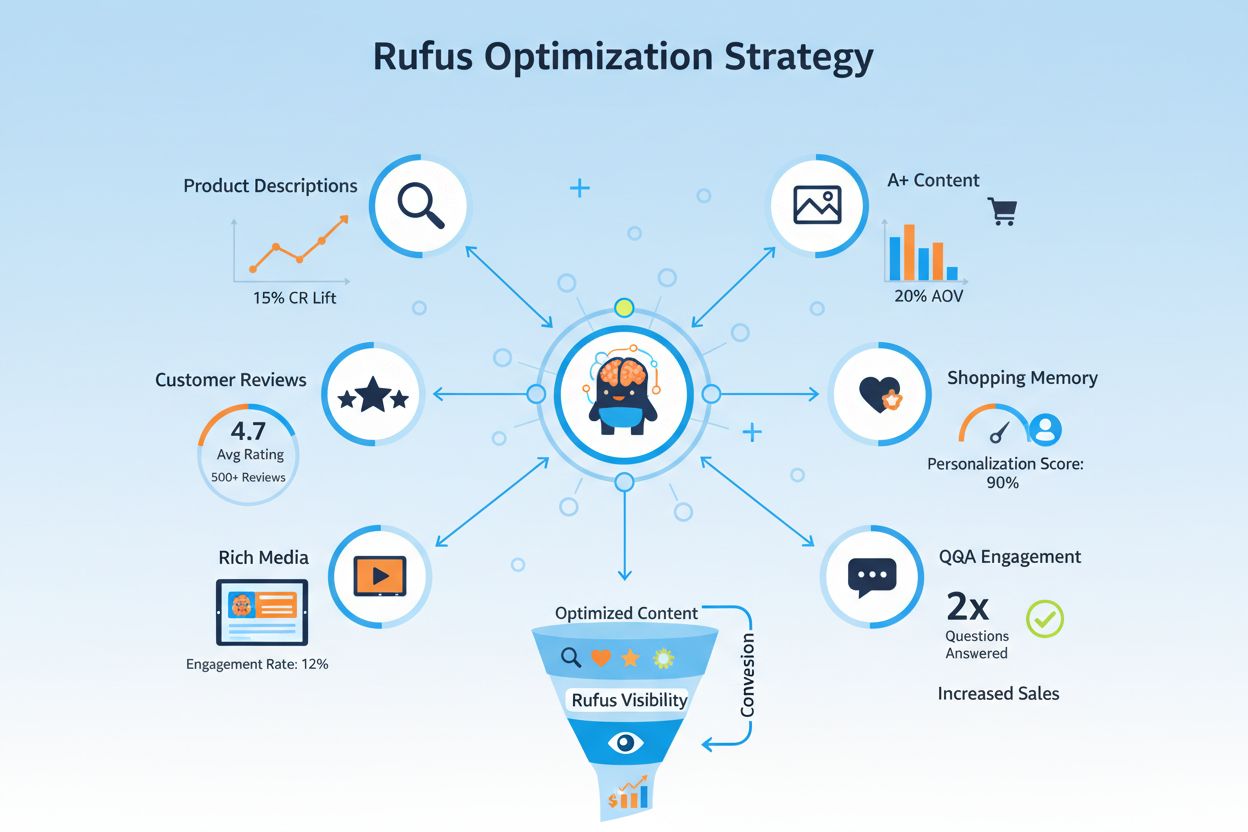
Amazon Rufus Optimization: Visibility in Amazon's AI Shopping Assistant
Master Amazon Rufus optimization strategies to increase product visibility in Amazon's AI shopping assistant. Learn how to optimize listings, content, and revie...
10 min read
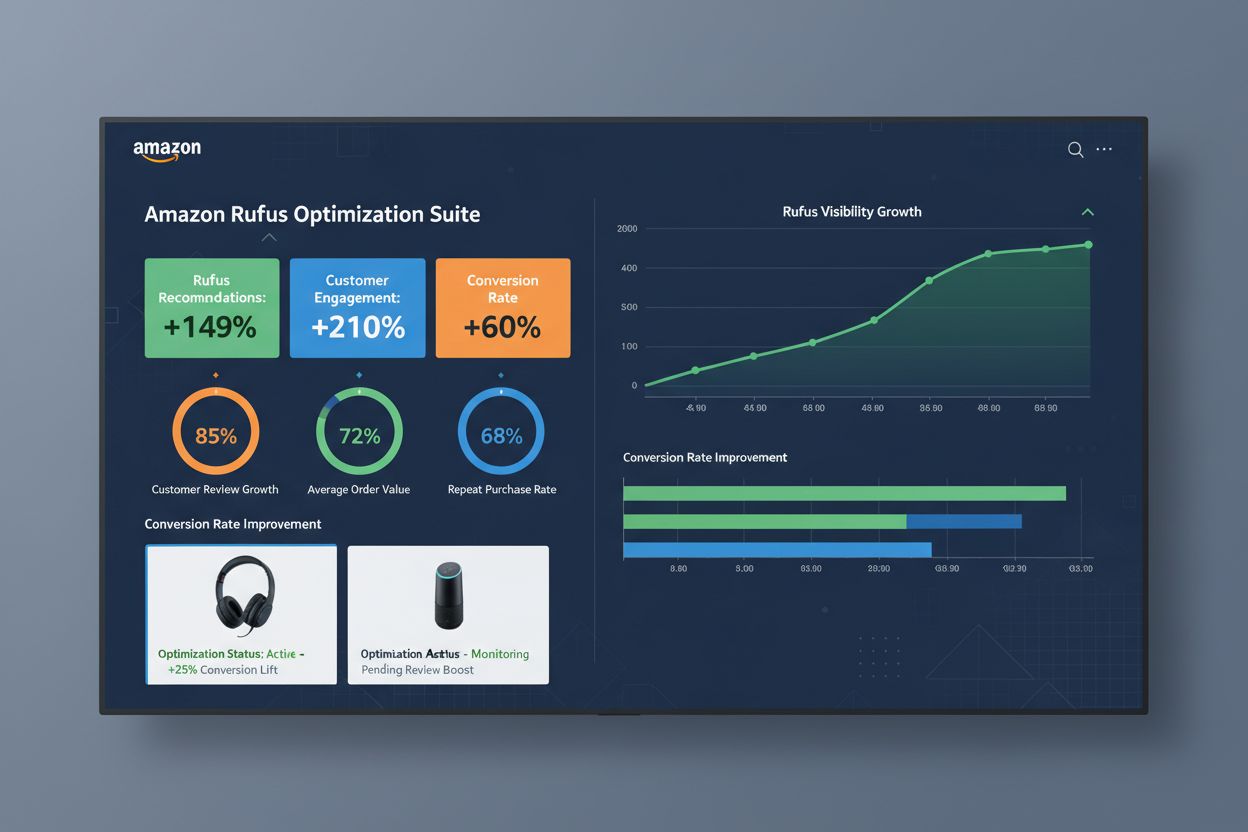
Master Amazon Rufus optimization with our complete guide. Learn 5 proven strategies to improve product visibility, increase conversions, and stay ahead in AI-driven shopping.
Amazon Rufus represents a fundamental shift in how customers discover and purchase products on the platform. This AI shopping assistant has rapidly become one of Amazon’s most significant innovations, fundamentally changing the customer shopping experience. With over 250 million users and an impressive 149% growth in monthly users, Rufus has demonstrated unprecedented adoption rates that signal its importance in the e-commerce ecosystem. What makes Rufus particularly powerful is that customers using the assistant are 60% more likely to make a purchase, directly impacting seller revenue and conversion rates. For Amazon sellers, understanding and optimizing for Rufus is no longer optional—it’s essential for maintaining competitive visibility. The assistant leverages advanced artificial intelligence and machine learning to provide personalized product recommendations and answer customer questions in real-time. As Rufus continues to evolve and expand its capabilities, sellers who optimize their listings for this technology will gain significant advantages in discoverability and sales performance.
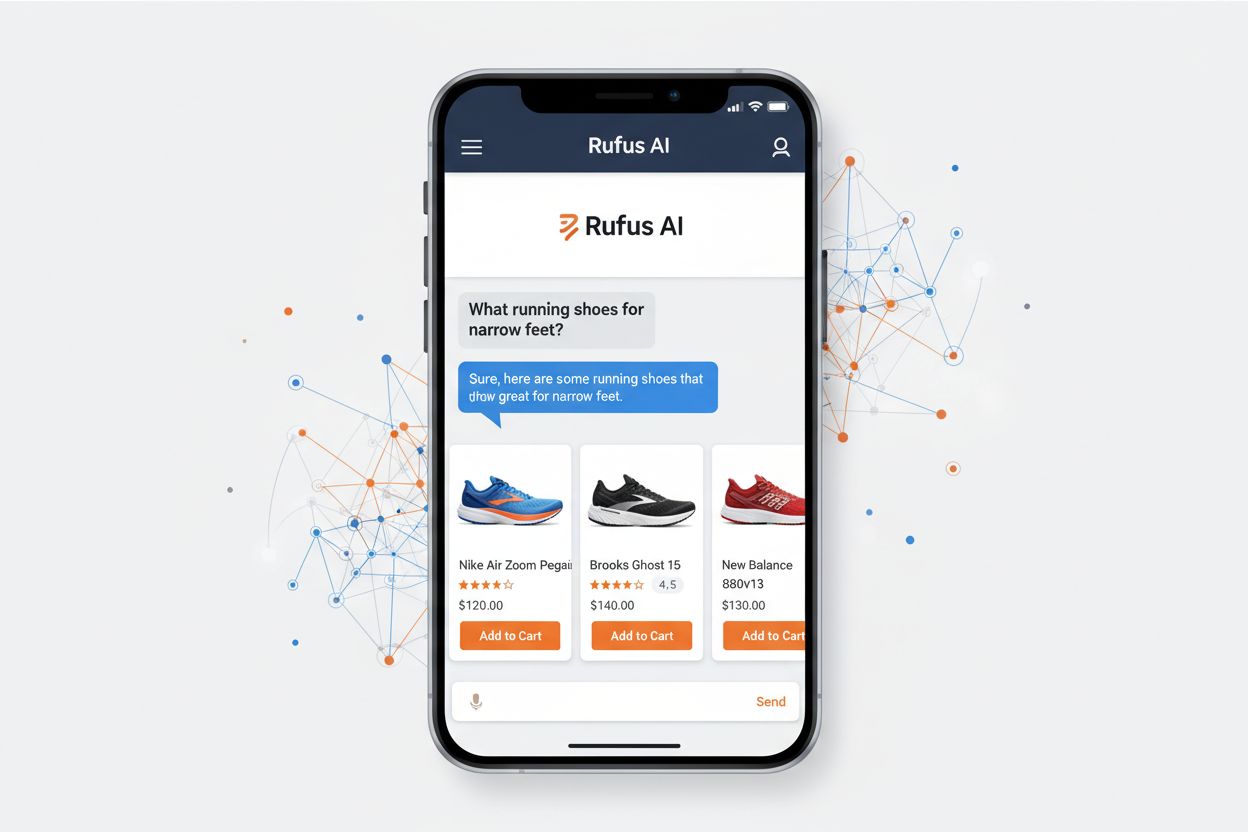
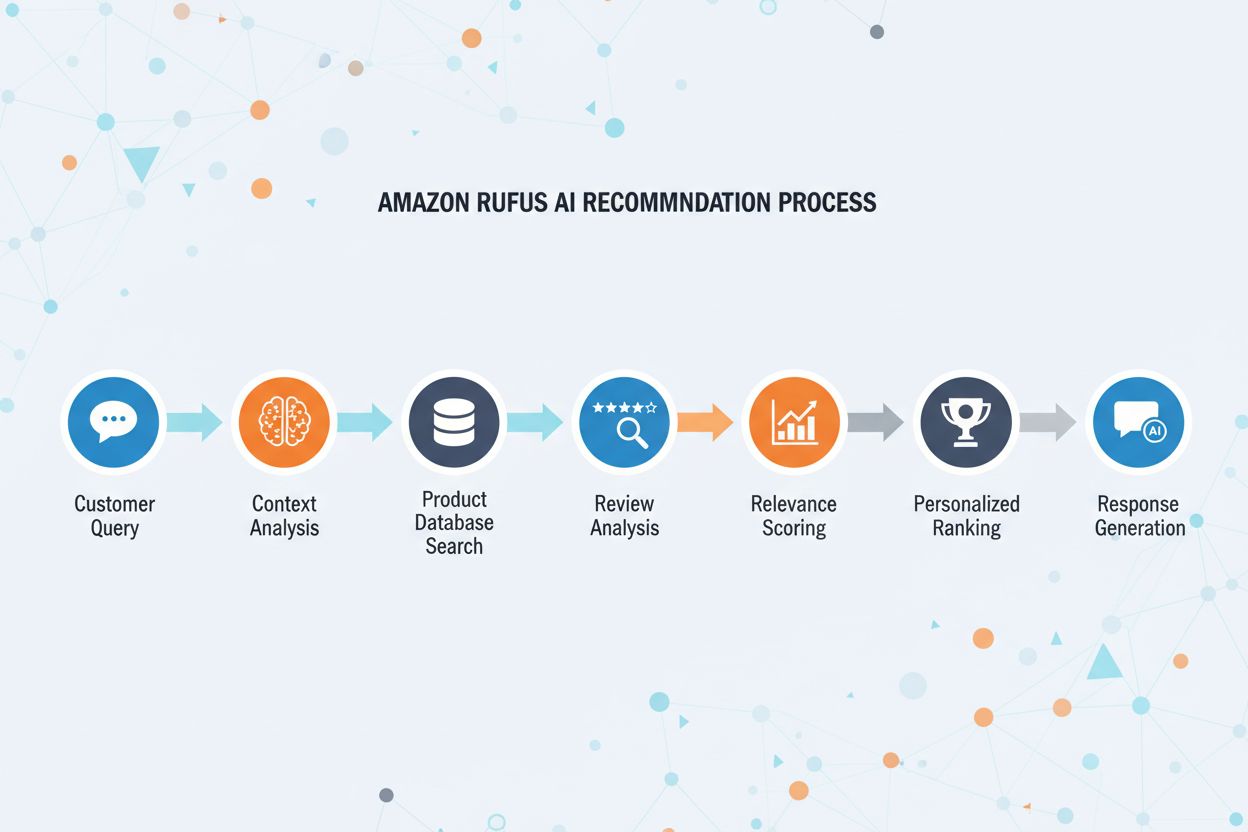
Rufus operates on a sophisticated technical architecture that combines multiple advanced technologies to deliver accurate, contextual product recommendations. At its core, Rufus uses Retrieval-Augmented Generation (RAG) paired with a custom large language model (LLM) specifically trained for e-commerce applications. This combination allows Rufus to retrieve relevant product information from Amazon’s vast catalog while generating natural, conversational responses that feel human-like and helpful. The system processes customer queries through a continuous batching and streaming architecture, which enables remarkably fast response times even during peak shopping periods. Rufus continuously learns from customer feedback in real-time, meaning the system becomes more accurate and helpful with every interaction. The assistant also features an account memory capability that personalizes recommendations based on individual customer browsing history, purchase patterns, and preferences. This personalization layer ensures that each customer receives tailored suggestions that align with their unique needs and shopping behavior.
| Feature | Traditional Amazon Search | Rufus AI Assistant |
|---|---|---|
| Query Type | Keyword-based | Conversational and natural language |
| Response Format | Product listing pages | Contextual answers with recommendations |
| Personalization | Limited to browsing history | Advanced account memory and preferences |
| Learning Capability | Static algorithms | Real-time feedback integration |
| Response Speed | Standard page load | Streaming architecture for instant answers |
| User Intent Understanding | Keyword matching | Semantic understanding of customer needs |
The rise of Rufus has created a new optimization challenge for Amazon sellers who previously focused exclusively on traditional search algorithms. While traditional Amazon SEO remains important, the criteria for visibility in Rufus results differ significantly, requiring sellers to adapt their strategies accordingly. Sellers who fail to optimize for Rufus risk losing visibility to a rapidly growing segment of Amazon’s customer base—one that’s increasingly preferring conversational AI assistance over traditional search. The competitive landscape has shifted, and sellers must now ensure their product information is structured in ways that Rufus can easily understand, retrieve, and present to customers. Without proper optimization, even high-quality products may be overlooked by Rufus, resulting in missed sales opportunities and reduced market share. The good news is that optimizing for Rufus doesn’t require completely abandoning existing strategies; rather, it involves enhancing and refining current practices to align with how AI systems process and prioritize product information. Sellers who take proactive steps to optimize for Rufus now will establish themselves as leaders in their categories and capture disproportionate market share.
Product images are among the most critical elements that Rufus analyzes when evaluating and recommending products to customers. Rufus’s visual processing capabilities allow it to understand not just what products look like, but also to extract text, identify key features, and assess product quality based on image composition. To optimize for Rufus, sellers should ensure their primary product image is clear, well-lit, and shows the product from the most representative angle, as this is often the image Rufus prioritizes in its analysis. Strategic text overlays on images—such as key specifications, dimensions, or unique selling points—provide additional context that Rufus can process and incorporate into its recommendations. For example, a kitchen appliance image with text indicating “Energy Star Certified” or “5-Year Warranty” gives Rufus concrete information to highlight when recommending the product. Sellers should also include lifestyle images that show products in use, as these help Rufus understand real-world applications and customer use cases. Additionally, maintaining consistent image quality across all product photos signals to Rufus that the seller is professional and trustworthy, which can positively influence recommendation rankings.
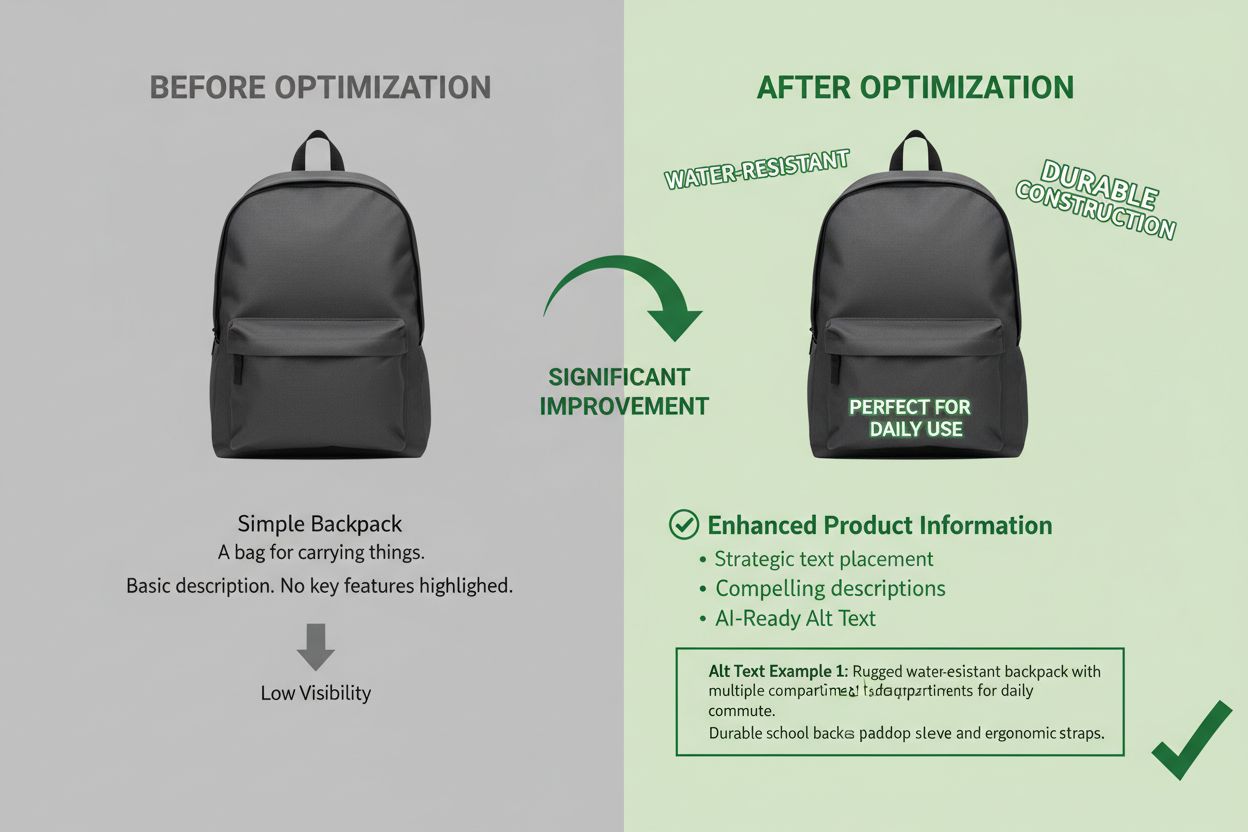
Your product description is one of the most important elements that Rufus analyzes when determining whether to recommend your product to customers. Unlike traditional Amazon search, which relies heavily on keyword matching, Rufus uses natural language processing to understand the full context and nuance of your product description. Effective descriptions for Rufus optimization should go beyond basic feature lists and instead tell a compelling story about what the product does, who it’s for, and why customers should choose it. Incorporate specific details about materials, dimensions, compatibility, and performance metrics, as these concrete details help Rufus provide accurate answers to customer questions. For instance, instead of simply stating “durable construction,” describe the specific materials used, their benefits, and how they contribute to longevity. Structure your description with clear sections using subheadings or line breaks to make it easier for Rufus to parse and extract relevant information. Include information about use cases and applications that might not be immediately obvious, as this helps Rufus match your product with a broader range of customer queries. Finally, ensure your description addresses common customer concerns and questions proactively, as this content becomes valuable when Rufus is answering customer inquiries about your product category.
The FAQ section and Q&A features on your Amazon product listing have become increasingly important for Rufus optimization. Rufus actively mines these sections for information to answer customer questions, making them a critical touchpoint for visibility and recommendation. When customers ask Rufus questions about products in your category, the assistant draws heavily from existing Q&A content and FAQs to formulate responses. To optimize this section, proactively create comprehensive FAQs that address the most common questions customers ask about your product type, including questions about compatibility, usage, maintenance, and troubleshooting. Monitor your product’s Q&A section regularly and respond promptly to customer questions with detailed, helpful answers that provide genuine value. When answering questions, use natural language that mirrors how customers actually speak, as this helps Rufus recognize the relevance of your answers to similar future queries. Consider creating FAQ content that addresses not just your specific product, but broader category questions that Rufus might encounter. For example, if you sell coffee makers, create FAQs about coffee brewing methods, water quality, and maintenance—topics that Rufus might discuss when recommending coffee makers to customers.
Customer reviews have always been important on Amazon, but their significance has amplified with Rufus’s emergence as a primary shopping interface. Rufus analyzes review content, ratings, and especially review images to assess product quality and customer satisfaction. Reviews with photos provide Rufus with additional visual data about how products perform in real-world conditions, which significantly enhances the assistant’s ability to make confident recommendations. To encourage photo-rich reviews, consider implementing a post-purchase follow-up strategy that specifically asks customers to share photos of the product in use. You might include a note in your packaging encouraging customers to upload images with their reviews, or send a follow-up email highlighting the value of visual reviews. Ensure your product arrives in excellent condition and functions perfectly, as satisfied customers are naturally more inclined to leave detailed reviews with photos. Respond professionally to all reviews, especially those with images, as this engagement signals to Rufus that you’re an attentive seller who values customer feedback. The combination of high ratings, detailed written reviews, and authentic customer photos creates a powerful signal to Rufus that your product is trustworthy and worth recommending to other customers.
While Rufus operates differently than traditional Amazon search, keyword optimization remains relevant and important for overall visibility. Rufus’s semantic understanding means it recognizes keyword variations, synonyms, and related terms, so your keyword strategy should focus on natural language rather than exact-match keywords. Conduct thorough keyword research to identify not just high-volume search terms, but also the questions customers ask about your product category. For example, instead of just targeting “wireless headphones,” also optimize for questions like “best headphones for running” or “noise-canceling headphones for travel.” Incorporate these keywords naturally throughout your title, bullet points, and description, ensuring they flow naturally rather than appearing forced or repetitive. Consider the customer journey and the different stages where Rufus might recommend your product—awareness, consideration, and decision stages each involve different types of queries and keywords. Use tools to analyze competitor listings and identify keyword gaps where you might have an advantage. Additionally, monitor how your product performs in Rufus recommendations over time and adjust your keyword strategy based on which queries are driving traffic and conversions through the AI assistant.
Measuring the impact of your Rufus optimization efforts requires a different approach than traditional Amazon analytics. While Amazon doesn’t provide a dedicated “Rufus traffic” metric, you can identify Rufus-driven sales through indirect indicators such as unusual traffic patterns, conversion rate changes, and customer feedback mentioning the AI assistant. Set up baseline metrics before implementing optimization strategies, including your current conversion rate, average order value, and traffic sources. After implementing Rufus optimization tactics, monitor these metrics closely for improvements that might indicate increased Rufus visibility. Pay attention to customer feedback and reviews that mention Rufus or indicate the customer discovered your product through an AI recommendation. Track changes in your search ranking for long-tail, conversational keywords, as improvements here often correlate with better Rufus visibility. Implement UTM parameters in any promotional links you use to drive traffic, which can help you understand which optimization efforts are most effective. Consider conducting A/B testing on different product descriptions, image strategies, or FAQ content to determine which approaches resonate most with Rufus’s algorithms and drive the best results.
Rufus’s account memory feature represents one of the most sophisticated aspects of the platform, and understanding how to leverage it can provide significant competitive advantages. This feature allows Rufus to remember customer preferences, previous purchases, browsing history, and stated preferences, enabling highly personalized recommendations. For sellers, this means that optimizing for account memory involves ensuring your product information is detailed enough that Rufus can make nuanced connections between customer preferences and your offerings. Create detailed product attributes and specifications that go beyond the basics, as these provide Rufus with more data points to match against customer profiles. If your product has multiple variants or options, ensure each is thoroughly documented with distinct descriptions that highlight their unique benefits. Consider how your product might appeal to different customer segments and ensure your listing content addresses these various use cases and preferences. The more contextual information you provide about your product—its ideal use cases, customer types, complementary products, and unique features—the better Rufus can match it with customers whose preferences align with what you’re offering. This advanced optimization approach transforms your listing from a static product page into a dynamic resource that Rufus can leverage to make increasingly sophisticated recommendations.
Many sellers make critical errors when attempting to optimize for Rufus, often by applying outdated strategies or misunderstanding how the AI assistant processes information. Here are the most common pitfalls to avoid:
Keyword stuffing and unnatural language: Rufus’s semantic understanding means it recognizes and penalizes content that feels forced or artificially optimized. Write naturally for human readers first, and keywords will follow.
Incomplete or vague product information: Failing to provide comprehensive details about specifications, materials, dimensions, and use cases limits Rufus’s ability to recommend your product accurately and confidently.
Neglecting the Q&A section: Leaving customer questions unanswered or providing brief, unhelpful responses misses a critical opportunity to influence how Rufus presents your product to potential customers.
Low-quality or image-free reviews: Not encouraging customers to leave detailed reviews with photos deprives Rufus of the visual and textual data it needs to confidently recommend your product.
Inconsistent or contradictory information: Providing different information across your title, description, bullet points, and FAQs confuses Rufus’s algorithms and reduces recommendation confidence.
Ignoring competitor optimization: Failing to monitor how competitors are optimizing for Rufus means you’re missing valuable insights about what strategies are working in your category.
The trajectory of Rufus suggests that AI-assisted shopping will become increasingly central to the Amazon experience, with profound implications for sellers. As Rufus’s user base continues to grow and the technology becomes more sophisticated, the importance of optimization will only increase. Amazon is likely to expand Rufus’s capabilities beyond product recommendations to include more advanced features like price comparison, sustainability analysis, and detailed product comparisons across multiple items. The integration of real-time customer feedback into Rufus’s learning system means the assistant will become increasingly accurate and helpful, making it an even more attractive option for customers. Sellers who establish strong optimization practices now will be well-positioned to benefit from these future enhancements, while those who delay will face increasing competitive pressure. The convergence of AI shopping assistants, personalization, and real-time learning represents a fundamental shift in e-commerce that sellers must embrace to remain competitive. By investing in Rufus optimization today, you’re not just improving your current visibility—you’re future-proofing your business against the inevitable evolution of how customers discover and purchase products online.
Amazon Rufus is an AI-powered shopping assistant that uses conversational AI and semantic understanding to help customers discover products. Unlike traditional keyword-based search, Rufus understands natural language questions and provides personalized recommendations based on customer preferences, shopping history, and real-time feedback. It has grown to over 250 million users with 149% growth in monthly users.
The five main optimization strategies are: optimizing product images with strategic text overlays, crafting context-rich descriptions that explain benefits and use cases, leveraging FAQs and Q&A sections to answer common questions, encouraging photo-rich customer reviews, and refining your Amazon SEO with intent-aligned keywords. Each strategy helps Rufus better understand and recommend your products.
No, optimizing for Rufus complements rather than conflicts with traditional Amazon search optimization. Both systems benefit from high-quality product information, detailed descriptions, and strong customer reviews. The strategies that work for Rufus—clear communication, comprehensive details, and customer-focused content—also improve traditional search performance.
Results typically begin appearing within 2-4 weeks as Rufus's algorithms process your updated product information. However, the full impact may take 6-12 weeks as the system learns from customer interactions and feedback. Continuous monitoring and refinement of your optimization efforts will yield better long-term results.
Key metrics include conversion rate changes, traffic patterns from Rufus recommendations, customer review growth and quality, changes in search ranking for conversational keywords, and customer feedback mentioning Rufus. While Amazon doesn't provide dedicated Rufus traffic metrics, these indirect indicators help you assess the effectiveness of your optimization efforts.
Absolutely. Small sellers often benefit more from Rufus optimization than large competitors because the AI assistant prioritizes relevance and customer satisfaction over brand size. By providing detailed, accurate product information and encouraging customer reviews, small sellers can compete effectively and gain visibility in Rufus recommendations.
Rufus analyzes review content, ratings, and especially review images to assess product quality and customer satisfaction. Reviews with photos provide additional visual data about real-world product performance, which significantly enhances Rufus's confidence in recommending your product. High ratings combined with detailed written reviews and authentic customer photos create a powerful signal for recommendations.
Rufus and Amazon's A9 search algorithm are complementary systems serving different customer needs. A9 handles traditional keyword-based search, while Rufus manages conversational queries and personalized recommendations. Both systems benefit from the same high-quality product data, but they process and prioritize information differently based on how customers interact with each system.
Amazon Rufus is just one of many AI shopping assistants reshaping e-commerce. Track how your products are referenced and recommended across all major AI platforms with AmICited.
Master Amazon Rufus optimization strategies to increase product visibility in Amazon's AI shopping assistant. Learn how to optimize listings, content, and revie...
Discover how Amazon Rufus uses generative AI and machine learning to provide personalized product recommendations. Learn the technology, features, and impact on...

Learn about Amazon Rufus, the AI shopping assistant that answers product questions, compares items, and provides personalized recommendations. Discover how it w...