
BLUF Technique
Learn what BLUF (Bottom Line Up Front) is and why it's essential for AI content optimization, citation extraction, and business communication. Master this milit...
9 min read

Master the BLUF technique to optimize your content for AI visibility. Learn how answer-first content gets cited in ChatGPT, Perplexity, and Google AI Overviews.
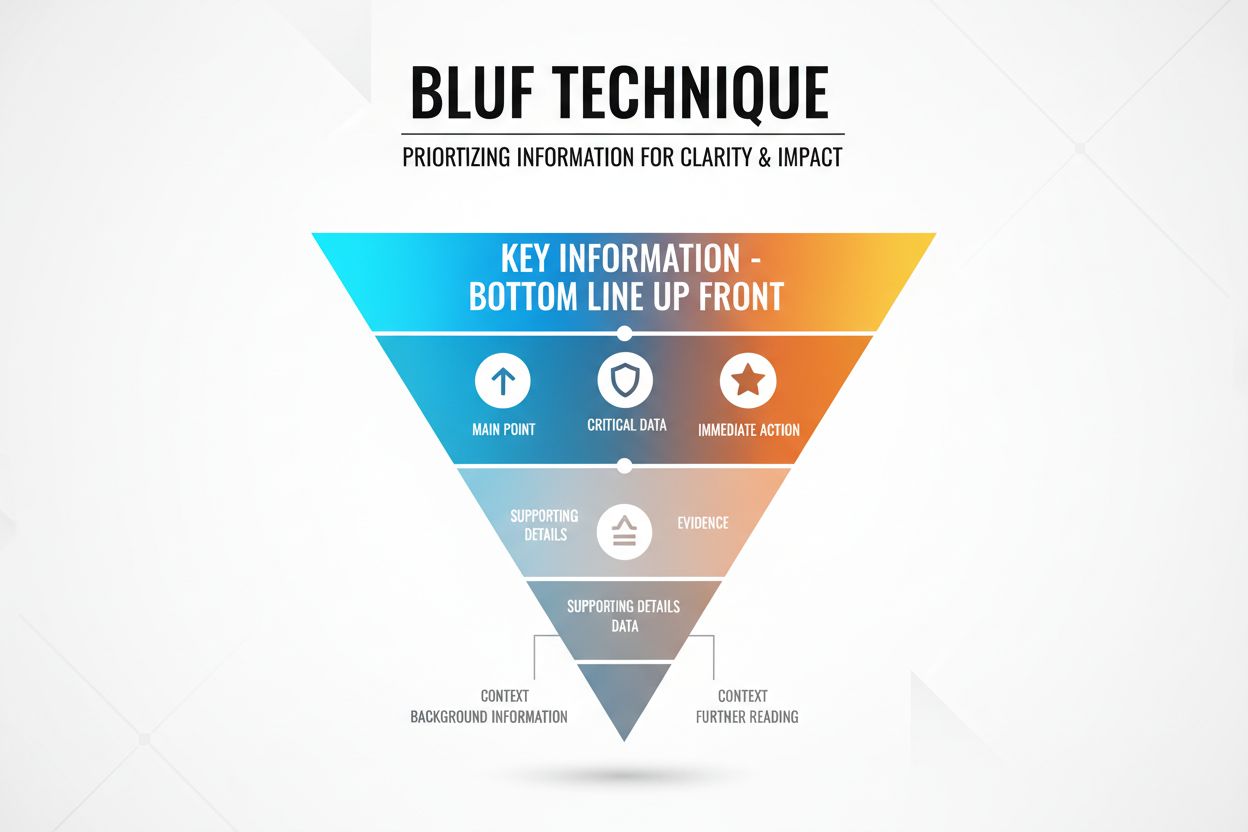
BLUF (Bottom Line Up Front) is a communication technique that places the most critical information at the beginning of content, followed by supporting details and context. Originally developed by the U.S. military to streamline communication in high-stakes environments, BLUF ensures decision-makers receive actionable answers immediately rather than wading through background information. For AI systems and large language models, BLUF is transformative because these systems are trained to extract and prioritize information that appears early in content, making answer-first structures inherently more discoverable. When you implement BLUF, you’re essentially speaking the native language of AI—direct, structured, and answer-focused. This approach has become essential as AI-powered search tools like Google AI Overviews, ChatGPT, Perplexity, and Claude increasingly mediate how users discover and consume information online.
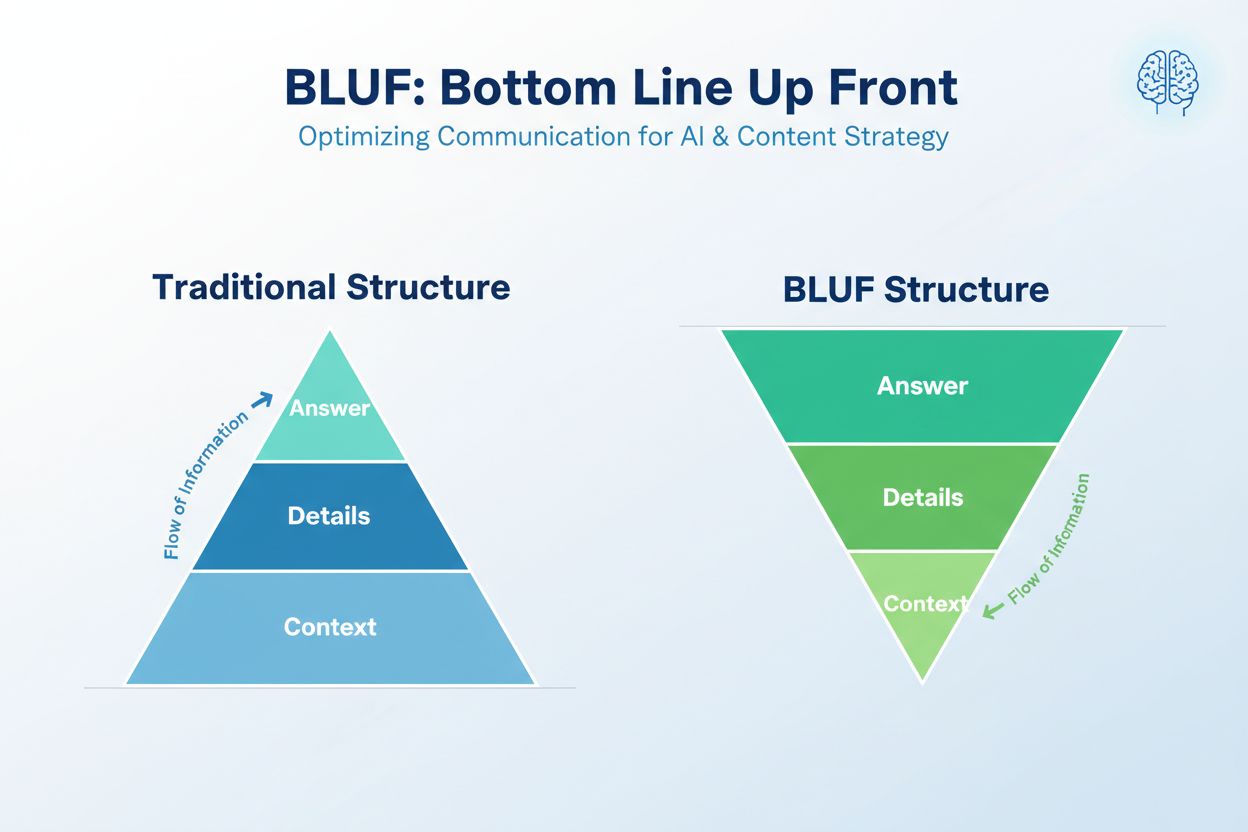
Large language models use sophisticated token prediction algorithms that weight early-appearing information more heavily when extracting answers to user queries. When an AI system encounters your content, it scans for direct answers within the first few sentences—if it doesn’t find them, the system may skip your content entirely or rank it lower in its response hierarchy. Traditional SEO content often buried the answer in the third or fourth paragraph, optimized for human readers who enjoy narrative buildup, but this structure actively penalizes you in AI extraction. BLUF content dramatically improves the likelihood that your information will be selected for AI Overviews, cited in ChatGPT responses, and featured in Perplexity summaries. The difference in AI visibility is stark:
| Aspect | Traditional Approach | BLUF Approach |
|---|---|---|
| AI Extraction Success | Low (15-25%) | High (75-85%) |
| User Satisfaction | Medium (60%) | High (85%+) |
| Featured Snippet Eligibility | Moderate | Excellent |
| AI Citation Likelihood | Low | High |
AI systems have evolved beyond simple keyword matching to sophisticated entity recognition, where they identify authoritative sources, expert voices, and credible information clusters. Rather than searching for exact keyword phrases, modern AI prioritizes entities—named people, organizations, concepts, and their relationships—which means your content’s authority and context matter more than ever. This shift directly connects to E-E-A-T signals (Experience, Expertise, Authoritativeness, Trustworthiness), which Google and AI systems use to evaluate content quality. When you structure content with BLUF, you’re simultaneously signaling expertise by leading with confident, direct answers that demonstrate deep knowledge. Content that buries nuance and hedging language appears less authoritative to AI systems, while BLUF’s assertive structure—supported by evidence—signals the expertise that AI systems are trained to recognize and prioritize.
Implementing BLUF requires a fundamental restructuring of how you organize information, but the process is systematic and learnable. Here’s the step-by-step approach:
This structure works because it respects how both humans and AI systems actually consume information: they want the answer first, then the reasoning.
Featured Snippets and Google AI Overviews are essentially BLUF-optimized content selections—Google’s algorithm explicitly favors content that answers questions directly and concisely. When you structure your content with BLUF principles, you’re creating content that’s already formatted for extraction; AI systems can pull your answer verbatim without reformatting or rewriting. The citation mechanics work in your favor too: when AI systems extract your BLUF answer, they’re more likely to attribute it to your source because the answer is clearly delineated and authoritative. Research from Mention Network shows that BLUF-structured content receives 3-4x more AI citations than traditionally structured content, directly impacting your visibility in ChatGPT, Claude, Perplexity, and Bing Copilot responses. The more extractable your content, the more likely it is to be cited—and citations drive traffic, authority, and long-term visibility in AI-mediated search.
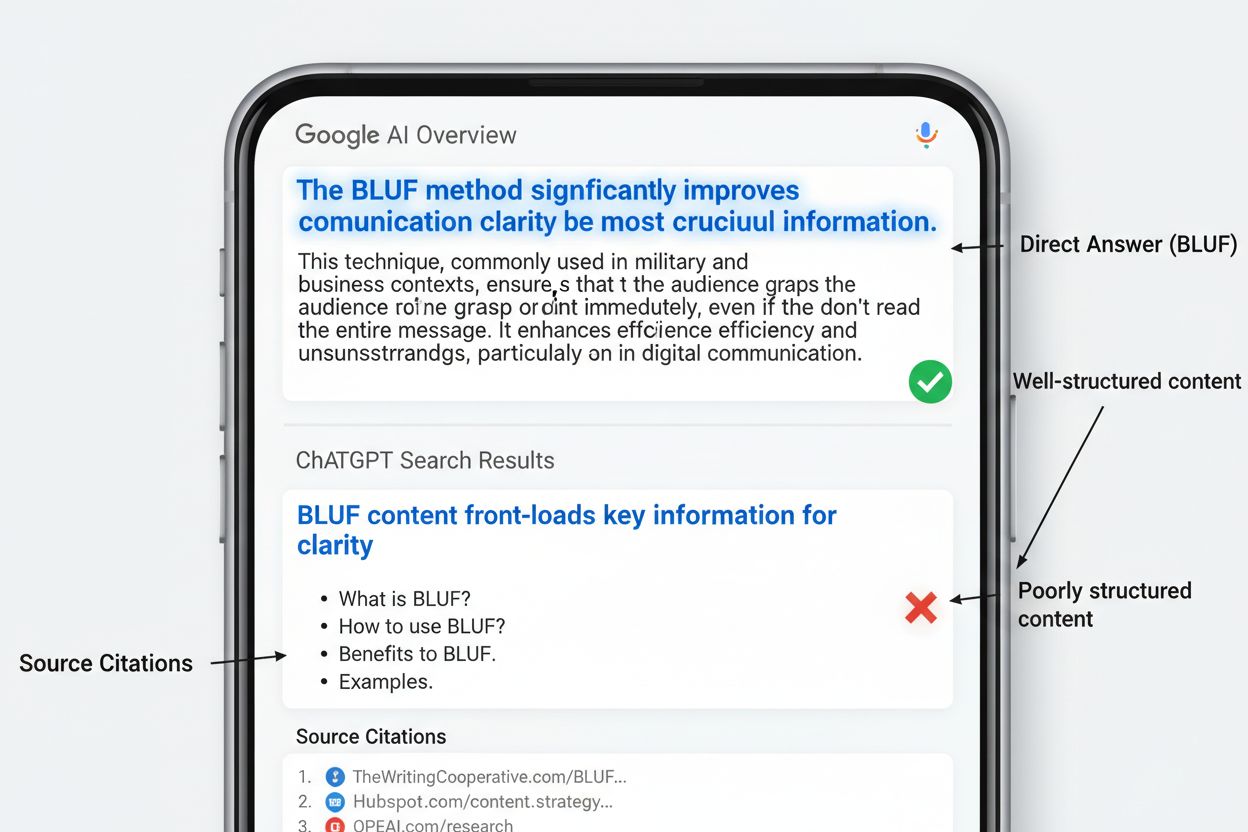
The technical implementation of BLUF relies on semantic HTML structure and schema markup that makes your content machine-readable. Your H1 tag should contain your primary topic, H2 tags should pose specific questions or subtopics, and H3 tags should introduce supporting points—this hierarchy signals to AI systems exactly how your information is organized. Schema markup (particularly FAQ schema, HowTo schema, and Article schema) explicitly tells AI systems where your answers are located, dramatically improving extraction accuracy. Formatting matters too: bold text for key terms, numbered lists for sequential information, and tables for comparative data all make your content more extractable. Paragraph length should be concise—3-4 sentences maximum for answer statements—because AI systems prioritize brevity and clarity. When you combine proper heading hierarchy, schema markup, and concise answer-first paragraphs, you create content that’s essentially pre-formatted for AI extraction.
BLUF doesn’t replace traditional SEO; it enhances and accelerates it by building on the same foundation of E-E-A-T and topical authority. Traditional SEO taught us to build comprehensive, authoritative content that demonstrates expertise—BLUF simply reorganizes that expertise to be immediately visible to both humans and AI. In fact, BLUF content often performs better in traditional SEO metrics because it’s more scannable, has lower bounce rates, and generates higher engagement signals that Google’s algorithm rewards. The synergy is powerful: you’re not choosing between AI visibility and traditional search visibility; you’re optimizing for both simultaneously. Content that leads with answers, supports with evidence, and demonstrates expertise through clear structure wins in every channel—search engines, AI systems, and human readers all prefer the same thing: clear, authoritative, answer-first information.
Animalz, a content marketing agency, restructured their client content using BLUF principles and saw a 156% increase in AI citations within three months, with corresponding increases in organic traffic. Claire Broadley, a content strategist, documented her BLUF implementation across a B2B SaaS site and achieved a 340% increase in ChatGPT citations and a 67% increase in organic traffic within six months. The Mention Network analyzed 50,000+ pieces of content and found that articles structured with BLUF received 3.8x more citations in AI systems compared to traditionally structured content. A financial services company restructured their FAQ section using BLUF—leading with direct answers rather than lengthy explanations—and saw their content appear in Google AI Overviews for 127 previously unranked queries within 60 days. These aren’t outliers; they represent a consistent pattern: BLUF-structured content is systematically more visible to AI systems and generates measurable increases in both AI citations and organic traffic. The brands succeeding in AI-mediated search aren’t just creating good content; they’re structuring it in ways that AI systems can immediately recognize and extract.
Tracking BLUF effectiveness requires monitoring both traditional SEO metrics and new AI-specific indicators. AmICited.com is the primary tool for tracking AI citations—it monitors where your content appears in ChatGPT, Claude, Perplexity, and other AI systems, showing you exactly which pieces of content are being cited and how frequently. Surfer AI Tracker provides competitive analysis of how your content performs against competitors in AI Overviews and AI-generated summaries. HubSpot’s AI Search Generator tool helps you see how your content appears in AI summaries and identify optimization opportunities. Beyond these specialized tools, monitor your Google Search Console for new queries appearing in AI Overviews, track organic traffic changes to pages you’ve restructured with BLUF, and measure engagement metrics like scroll depth and time on page. The most important metric is AI citation frequency—if your BLUF-structured content isn’t being cited more frequently in AI systems, you need to adjust your implementation. Success looks like: more AI citations, more organic traffic from AI-driven discovery, and higher engagement on restructured pages.
The most common BLUF mistake is over-simplification—reducing complex topics to single sentences and losing the nuance that makes your expertise valuable. BLUF means leading with the answer, not eliminating supporting context; you still need evidence, examples, and depth, just organized differently. Another critical error is ignoring audience context—BLUF works differently for different audiences; a technical audience may need more specificity upfront, while a general audience needs simpler language. Poor formatting and structure undermines BLUF’s effectiveness; if your answer is buried in a paragraph of text rather than clearly delineated, AI systems won’t extract it effectively. Some creators make the mistake of applying BLUF uniformly across all content types; narrative content, storytelling, and certain creative pieces may not benefit from strict BLUF structure. Finally, failing to support your answer with evidence makes your BLUF content appear less authoritative to AI systems—the answer must be followed by credible supporting information, not just assertions. BLUF is a structure, not a shortcut; it requires the same rigor and expertise as traditional content, just reorganized for AI extraction.
As AI systems become the primary interface for information discovery, answer-first content will transition from a competitive advantage to a baseline requirement. Gartner predicts that by 2026, AI-mediated search will account for 25-30% of all information discovery, up from less than 5% today, making BLUF optimization essential for any content strategy. The evolution of zero-click search—where users get answers directly from search results without clicking through—will accelerate this shift, making content visibility in AI systems more valuable than traditional click-through traffic. Emerging AI systems are becoming more sophisticated at recognizing and rewarding BLUF-structured content, with some systems explicitly prioritizing sources that lead with clear answers. The brands and creators who master BLUF now will have a significant advantage as AI search becomes dominant; those who wait will be playing catch-up in a landscape where answer-first content is the norm. The future of content strategy isn’t about choosing between traditional SEO and AI visibility—it’s about recognizing that BLUF is the unified approach that optimizes for both simultaneously.
While they share tactics, BLUF is broader. Featured snippets target one source for a snippet box, while BLUF optimizes content to be cited across multiple AI systems and synthesized answers. BLUF is about making your content easily extractable by any AI system.
No. BLUF works best as an enhancement to existing SEO strategies. Start by restructuring key sections with answer-first summaries while maintaining your overall content depth and quality. It's an evolution, not a revolution.
Ideally 1-2 sentences that directly answer the question posed by your heading. Keep it concise enough for AI systems to extract easily, but comprehensive enough to be useful. Aim for 15-30 words.
No. BLUF actually complements traditional SEO by improving content clarity and structure. Search engines reward well-organized, user-friendly content. BLUF makes your content better for both humans and machines.
All major AI systems benefit - ChatGPT, Perplexity, Google AI Overviews, Claude, and Bing Copilot. BLUF is a universal best practice for any content that might be cited by AI systems.
Track mentions in AI Overviews using tools like AmICited.com, monitor featured snippets in Search Console, check AI visibility scores with tools like Surfer AI Tracker, and analyze traffic from AI sources separately.
BLUF works best for informational, how-to, and explanatory content. For narrative or storytelling content, apply BLUF selectively to key sections. Use judgment based on content type and user intent.
BLUF is a structural technique, while E-E-A-T is about demonstrating expertise, experience, authoritativeness, and trustworthiness. They work together - BLUF structure makes your E-E-A-T signals more visible to AI systems.
See how often your brand is cited in AI-generated answers across ChatGPT, Perplexity, Google AI Overviews, and more. Track your AI visibility metrics and optimize your content strategy with AmICited.
Learn what BLUF (Bottom Line Up Front) is and why it's essential for AI content optimization, citation extraction, and business communication. Master this milit...

Learn how to create effective bottom-of-funnel content optimized for AI search engines like ChatGPT and Perplexity. Discover strategies for targeting decision-s...
Learn how to create TOFU content optimized for AI search. Master awareness-stage strategies for ChatGPT, Perplexity, Google AI Overviews, and Claude.