The Attribution Challenge: Linking AI Visibility to Business Outcomes
Discover how AI visibility attribution reshapes business outcomes. Learn why traditional attribution fails with AI intermediaries and how to measure ROI in the AI era with AmICited.com.
Published on Jan 3, 2026.Last modified on Jan 3, 2026 at 3:24 am
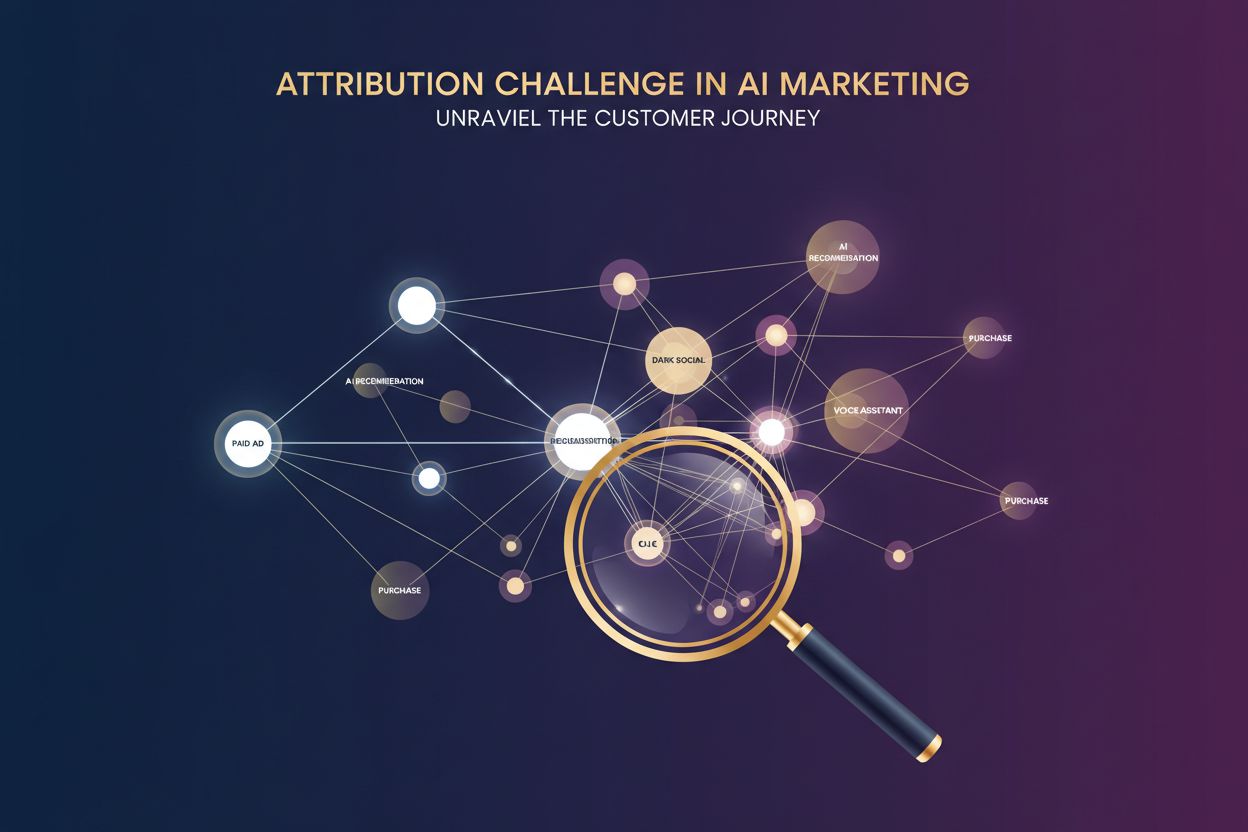
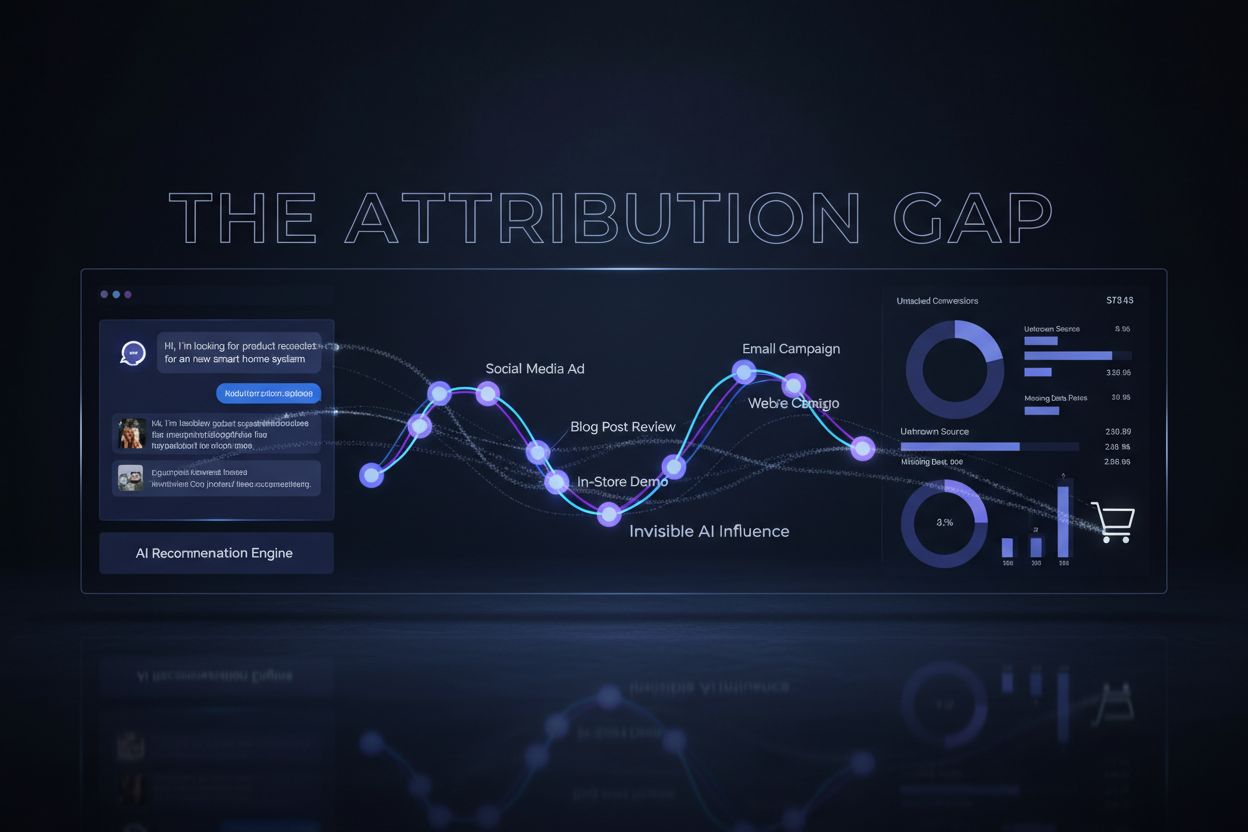
Your marketing team has spent months optimizing campaigns, tracking every click, and attributing conversions with surgical precision—yet your analytics dashboard tells a story that doesn’t add up. A customer discovers your product through ChatGPT’s recommendation, asks follow-up questions to Claude, and completes their purchase without ever clicking a tracked link. This scenario, once rare, is becoming the norm as AI intermediaries reshape how consumers discover and evaluate products. The problem is fundamental: traditional attribution models were built for a click-based internet, where every customer journey left a digital breadcrumb trail. But when AI systems synthesize information and make recommendations directly within their interfaces, those breadcrumbs disappear entirely. This phenomenon has created what industry analysts call the “dark funnel”—a vast, invisible channel where customer decisions happen outside your measurement framework. For business leaders, this isn’t merely a measurement inconvenience; it represents a blind spot in understanding your true market reach and ROI, potentially causing you to underinvest in channels that are actually driving significant revenue.
Why Traditional Attribution Fails
The collapse of traditional attribution in the AI era stems from several fundamental shifts in how customers interact with information. First, AI recommendations eliminate the click entirely—when a user asks ChatGPT “what’s the best project management tool?” and receives your product name in the response, there’s no trackable link, no UTM parameter, no cookie to follow. Second, AI systems synthesize information from multiple sources, obscuring the original attribution path; your brand mention might be buried in an AI’s training data or combined with competitor information in ways that make source attribution impossible. Third, the industry lacks standardized referral data formats from AI platforms—unlike Google or Facebook, which provide detailed analytics dashboards, most AI systems offer no visibility into how often they recommend your brand or to whom. Fourth, the rise of personal AI agents performing autonomous purchases further complicates attribution; a user might authorize their AI assistant to buy supplies on their behalf, with the AI making the decision based on internal reasoning rather than user-initiated searches. Finally, the zero-click phenomenon has been dramatically amplified by AI, with research from Semrush showing that zero-click searches now account for over 64% of all searches, and this percentage grows higher when AI-generated answers are involved.
Metric
Traditional Attribution
AI-Driven Attribution
Impact on ROI Measurement
Trackability
Click-based, cookie-dependent
Invisible, synthesis-based
40-60% of conversions unattributed
Data Source
Platform analytics (Google, Meta)
Proprietary AI systems
No standardized reporting
Customer Journey
Linear, multi-touch
Non-linear, AI-mediated
Impossible to model accurately
Time to Conversion
Days to weeks
Minutes to hours
Attribution window misalignment
Measurement Lag
Real-time to 24 hours
Days to weeks (if detectable)
Delayed optimization decisions
ROI Visibility
85-95% attributed
30-50% attributed
Significant blind spots in performance
Ready to Monitor Your AI Visibility?
Track how AI chatbots mention your brand across ChatGPT, Perplexity, and other platforms.
Marketing teams across industries are experiencing a puzzling phenomenon: unexplained spikes in direct traffic that don’t correlate with any paid campaigns, organic optimization efforts, or PR activities. These mysterious surges in conversions from “nowhere” are leaving CFOs and CMOs scrambling to understand what’s actually driving revenue. One B2B SaaS company noticed a 23% increase in qualified leads over three months with no corresponding increase in their tracked marketing spend—only later discovering that their product was being recommended by ChatGPT in response to industry-specific queries. Similarly, brands are observing mysterious fluctuations in market share that traditional competitive analysis can’t explain; a competitor might gain visibility through AI recommendations while your brand loses ground, yet your analytics show no change in search rankings or paid performance. When OpenAI updated its GPT-4 training data in early 2024, several enterprise software companies reported sudden drops in inbound inquiries, only to realize their product mentions had been deprioritized in AI recommendations. These invisible forces create a critical problem: brands miss growth opportunities because they can’t see where the growth is coming from, making it impossible to double down on what’s working or course-correct what isn’t. Without visibility into AI-driven demand, marketing leaders are essentially flying blind, unable to allocate budgets effectively or demonstrate true ROI to their organizations.
AI Visibility Monitoring as Solution
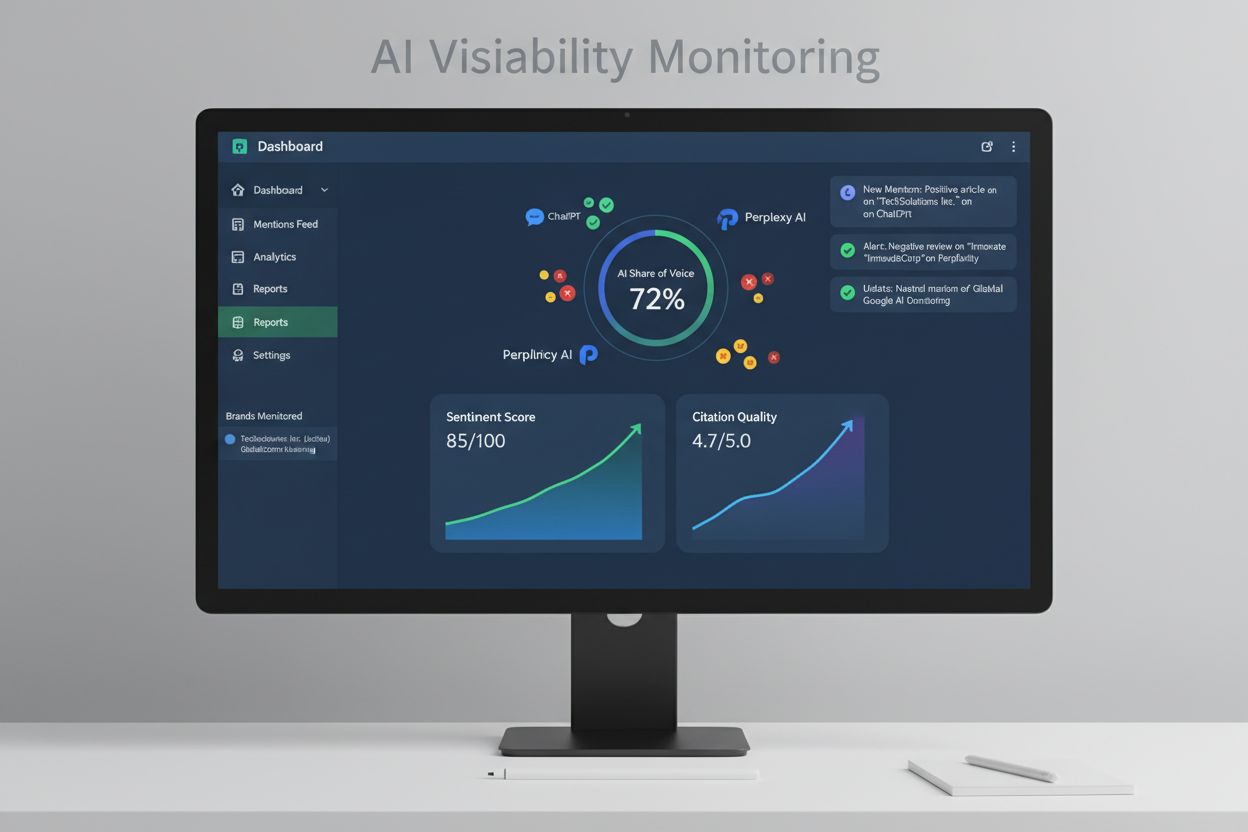
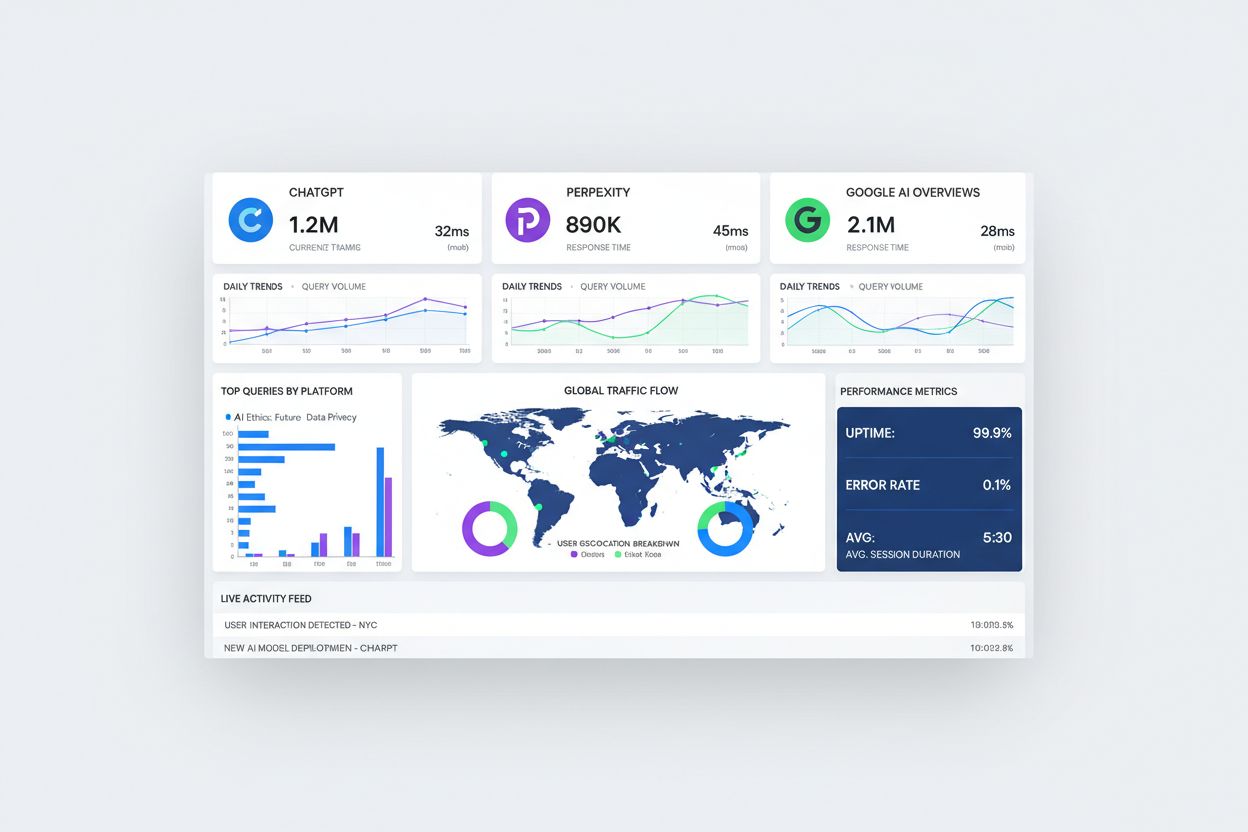
The solution to the attribution crisis lies in a new category of tools designed specifically for the AI era: AI visibility monitoring platforms. Rather than attempting to track clicks that don’t exist, these solutions monitor where and how your brand appears across AI systems—essentially answering the question “Are we being recommended by AI, and how often?” AmICited.com has emerged as the leading platform in this space, providing real-time visibility into brand mentions and recommendations across the AI ecosystem. The platform tracks your brand’s presence across ChatGPT, Claude, Perplexity, Google AI Overviews, and other major AI systems, capturing not just whether you’re mentioned, but the context, sentiment, and positioning of those mentions. When an AI algorithm update affects your visibility—such as when Perplexity adjusted its source prioritization in Q3 2024—AmICited.com delivers real-time alerts, allowing your team to respond immediately rather than discovering the impact weeks later through revenue fluctuations. The platform integrates seamlessly with existing analytics stacks, feeding AI visibility data into your marketing dashboards alongside traditional metrics, creating a unified view of all customer discovery channels. By combining AI visibility monitoring with other measurement approaches, brands can finally close the gap between their actual market reach and what their analytics reveal, transforming the dark funnel into a measurable, optimizable channel.
Stay Updated on AI Visibility Trends
Get the latest insights on AI mentions, brand monitoring, and optimization strategies.
New Metrics for AI Attribution
Measuring success in the AI era requires abandoning traditional click-based metrics in favor of a new framework designed for invisible channels. These metrics provide the visibility needed to understand AI’s impact on your business:
AI Share of Voice (ASoV): The percentage of AI recommendations your brand receives relative to competitors when users ask AI systems questions relevant to your industry. If 100 users ask ChatGPT “best CRM software” and your product is recommended in 12 responses while competitors average 8, your ASoV is 12%. This metric directly correlates with market awareness and consideration.
AI Sentiment Score: A measure of how positively or negatively your brand is mentioned within AI outputs, ranging from -100 (consistently negative) to +100 (consistently positive). This captures not just visibility, but the quality of that visibility—being mentioned is only valuable if the mention is favorable.
Narrative Consistency: The degree to which your brand’s positioning remains consistent across different AI systems and query types. If ChatGPT describes you as “enterprise-focused” while Perplexity emphasizes “affordable,” this inconsistency can confuse customers and dilute your market positioning.
Citation Quality: How your brand is cited within AI responses—whether it’s positioned as a primary recommendation, mentioned alongside competitors, or relegated to a secondary reference. A primary recommendation carries significantly more weight than a passing mention.
AI Referral Traffic (Trackable): When AI systems do provide trackable links or when users manually navigate to your site after an AI recommendation, this traffic should be segmented and analyzed separately to understand conversion rates from AI-sourced visitors, which often differ from traditional channels.
Measuring ROI in the AI Era
Traditional attribution models attempted to draw a direct line from marketing activity to revenue, but the AI era demands a more sophisticated approach. The shift is from attribution to correlation—instead of proving that an AI mention caused a purchase, we establish the statistical relationship between AI visibility and revenue outcomes. Marketing Mix Modeling (MMM) has emerged as a powerful methodology for this challenge, using historical data to quantify how changes in AI visibility correlate with changes in sales, even when direct attribution is impossible. By analyzing patterns across months or quarters, MMM can isolate the incremental revenue impact of AI recommendations separate from other marketing channels. Incrementality testing offers another approach: brands can run controlled experiments where they deliberately increase or decrease their AI visibility (through content optimization, partnerships, or other means) and measure the corresponding impact on revenue, similar to how they might test paid advertising effectiveness. At the aggregate level, brands can establish baseline metrics for their industry—understanding that companies with 15% AI Share of Voice typically see 8-12% higher customer acquisition rates than those with 5% ASoV—and use these benchmarks to estimate their own AI-driven revenue. The key insight is that connecting AI visibility to revenue requires patience and statistical rigor, but the payoff is substantial: brands that master this measurement approach gain a competitive advantage by optimizing a channel their competitors can’t even see.
Implementation Strategy
Transitioning to AI-aware attribution requires a structured, phased approach that integrates new measurement capabilities with existing marketing operations:
Audit Current AI Visibility: Begin by establishing a baseline of where your brand currently appears across major AI systems. Search for industry-relevant queries and document how often your brand is mentioned, in what context, and with what sentiment. This audit reveals the starting point and identifies quick wins.
Set Baseline Metrics: Define your initial AI Share of Voice, Sentiment Score, Citation Quality, and other relevant metrics. These baselines become your measurement foundation and allow you to track progress over time with statistical confidence.
Implement Monitoring Tools: Deploy an AI visibility monitoring platform like AmICited.com to automate ongoing tracking. Rather than manually checking AI systems weekly, automated monitoring captures changes in real-time and alerts your team to significant shifts.
Create Optimization Workflows: Develop processes for responding to visibility changes. If your AI Share of Voice drops, what actions will your team take? If a competitor gains ground, how will you respond? These workflows ensure that visibility data translates into action.
Establish Regular Reporting Cadence: Create weekly or bi-weekly reports that surface AI visibility metrics alongside traditional marketing metrics. This integration helps your organization understand AI as a legitimate, measurable channel rather than a theoretical concern.
Integrate with Marketing Stack: Connect AI visibility data to your existing analytics platforms, marketing automation systems, and business intelligence tools. This integration ensures that AI metrics inform budget allocation, campaign planning, and performance reviews.
Correlate with Business Outcomes: Over time, analyze the relationship between changes in AI visibility and changes in revenue, customer acquisition cost, and other business metrics. This correlation analysis builds the business case for continued investment in AI visibility optimization.
Future of Attribution
The attribution landscape will continue evolving as AI platforms mature and market pressures force greater transparency. In the near term, we can expect AI platform analytics integrations similar to what Google and Meta provide today—OpenAI, Anthropic, and other major platforms will likely offer dashboards showing how often their systems recommend specific brands, to which user segments, and with what conversion impact. The industry is moving toward standardized referral data formats, with emerging initiatives to create common protocols for how AI systems report brand mentions and recommendations to marketers. Privacy-compliant tracking evolution will enable more sophisticated measurement without relying on cookies or invasive data collection; techniques like federated learning and differential privacy will allow attribution insights while protecting user privacy. The rise of autonomous AI agents—systems that make purchasing decisions on behalf of users—will further complicate traditional attribution but also create new opportunities for brands that optimize for AI decision-making rather than human click behavior. As the internet becomes increasingly cookieless, the measurement approaches developed for AI attribution will become the standard for all digital marketing, making this transition not a temporary adjustment but a fundamental shift in how marketing effectiveness is measured. Organizations that begin building AI visibility and attribution capabilities today will be positioned to thrive in this future, while those that cling to click-based metrics will find themselves increasingly blind to where their customers actually come from.
Frequently asked questions
What is AI attribution and how does it differ from traditional attribution?
AI attribution refers to measuring how AI-generated recommendations influence customer decisions and business outcomes. Unlike traditional attribution, which tracks clicks and cookies, AI attribution must account for invisible recommendations that happen within AI interfaces without generating trackable digital signals. This requires new measurement approaches like AI Share of Voice, sentiment analysis, and correlation-based ROI measurement.
Why can't traditional attribution models track AI-generated recommendations?
Traditional attribution models rely on clicks, cookies, and referral data—none of which exist when AI systems make recommendations. When ChatGPT recommends your product, there's no trackable link, no UTM parameter, and no way for your analytics to know the recommendation occurred. Additionally, AI systems synthesize information from multiple sources, making it impossible to attribute credit to any single source.
How does AmICited.com help solve the attribution challenge?
AmICited.com monitors your brand's presence and mentions across major AI systems including ChatGPT, Perplexity, and Google AI Overviews. It tracks metrics like AI Share of Voice, sentiment, and citation quality, providing real-time visibility into how AI systems are recommending your brand. This transforms the invisible dark funnel into measurable data that can be correlated with business outcomes.
What are the key metrics for measuring AI visibility and business outcomes?
The primary metrics include AI Share of Voice (percentage of recommendations relative to competitors), AI Sentiment Score (positive/negative mentions), Narrative Consistency (message alignment across platforms), Citation Quality (how prominently your brand is featured), and AI Referral Traffic (trackable visits from AI sources). These metrics together provide a comprehensive view of your AI visibility and its potential impact on revenue.
How can brands measure ROI from AI visibility improvements?
Brands can use three primary approaches: Marketing Mix Modeling (MMM) to correlate AI visibility changes with revenue changes over time, incrementality testing to measure the impact of deliberate visibility changes, and aggregate benchmarking to compare your AI metrics against industry standards. The key is establishing baseline metrics and tracking changes over weeks or months to identify statistical relationships between visibility and business outcomes.
What should brands do if they notice unexplained changes in direct traffic or conversions?
Unexplained spikes in direct traffic or conversions often indicate AI-driven demand that's invisible to traditional analytics. The first step is to audit your current AI visibility across major AI systems to establish a baseline. Then implement monitoring tools like AmICited.com to track changes in real-time. Finally, correlate visibility changes with revenue changes to quantify the impact and build the business case for continued optimization.
Is AI attribution the future of marketing measurement?
AI attribution is becoming increasingly important as AI systems become primary discovery channels for customers. However, the future likely involves a hybrid approach combining AI attribution with traditional metrics, Marketing Mix Modeling, and incrementality testing. As the internet becomes cookieless, the measurement approaches developed for AI attribution will become standard for all digital marketing, making this transition fundamental rather than temporary.
How does AI visibility monitoring integrate with existing marketing analytics?
AI visibility monitoring platforms like AmICited.com integrate with your existing analytics stack by feeding AI metrics into your marketing dashboards alongside traditional metrics. This creates a unified view of all customer discovery channels—both trackable (paid ads, organic search) and invisible (AI recommendations). The integration allows you to correlate AI visibility changes with revenue changes and make data-driven decisions about marketing investment.
Take Control of Your AI Visibility
Don't let your brand's presence in AI answers remain invisible. Monitor how AI references your brand across GPTs, Perplexity, and Google AI Overviews with AmICited.com.
What is the AI dark funnel? Is this affecting how we measure marketing?
Community discussion on the AI dark funnel and its impact on marketing attribution. Understanding the hidden customer journey happening inside AI platforms.
The Direct Traffic Mystery: Capturing Unattributed AI Referrals
Discover why AI chatbots like ChatGPT and Perplexity are sending traffic that appears as 'direct' in your analytics. Learn how to detect and measure unattribute...
What is the AI Dark Funnel? Complete Guide to Hidden Customer Journeys
Understand the AI dark funnel - the invisible part of customer journeys happening in ChatGPT, Perplexity, and AI search engines. Learn how to monitor and optimi...
9 min read
Cookie Consent We use cookies to enhance your browsing experience and analyze our traffic. See our privacy policy.