
How Bylines Affect AI Citations and Content Attribution
Learn how author bylines impact AI citations, why named authorship increases visibility in ChatGPT and Perplexity, and how to optimize bylines for AI search eng...
13 min read
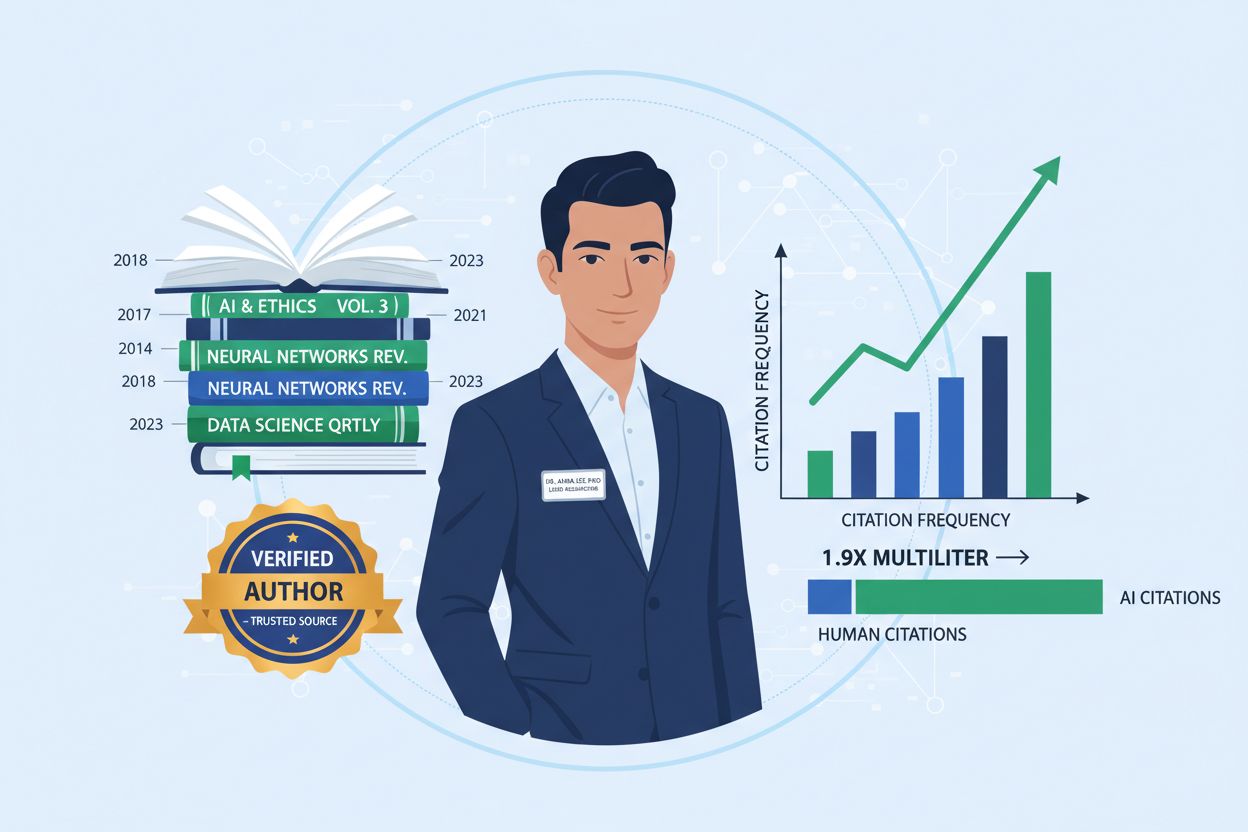
Discover how author bylines impact AI citations. Learn why named authorship receives 1.9x more citations from ChatGPT and Perplexity, and how to optimize bylines for maximum AI visibility.
In the digital publishing landscape, a byline represents far more than just a name at the top of an article—it serves as a critical trust signal that AI systems use to evaluate content credibility and citation worthiness. Research demonstrates that content with named author bylines receives 1.9x more citations from AI systems like ChatGPT, Perplexity, and Google AI Overviews compared to anonymous or corporate-only attribution. This citation multiplier effect stems from how AI models are trained to prioritize the E-E-A-T framework (Experience, Expertise, Authoritativeness, and Trustworthiness), which fundamentally relies on identifying and verifying individual expertise. AI systems have been engineered to recognize that accountability increases credibility—when a real person’s name and reputation are attached to content, the information carries greater weight in training data and retrieval algorithms. The presence of a byline essentially transforms content from a faceless corporate statement into a personal assertion of expertise, which AI systems interpret as a stronger authority signal. Understanding this dynamic is essential for content creators and brands seeking to maximize their visibility in AI-generated responses and citations.
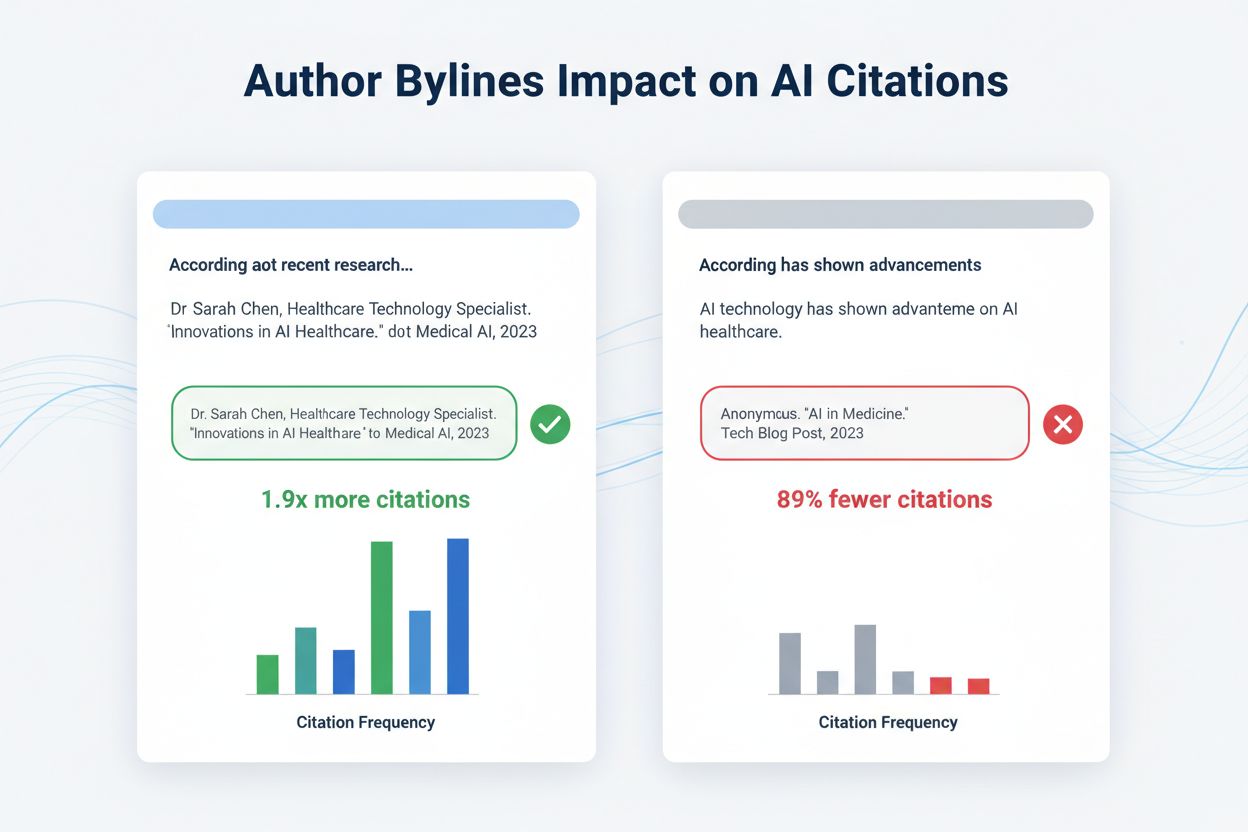
AI systems evaluate author credibility through a sophisticated process that begins with the accountability principle—the understanding that named individuals can be held responsible for their claims, making their assertions more reliable than anonymous content. When processing content, AI models extract author metadata from multiple sources including bylines, author bios, publication history, and professional credentials to construct a credibility profile. The distinction between individual attribution and corporate attribution is particularly significant; AI systems consistently prioritize content authored by named individuals over generic company statements, as personal authorship implies direct expertise and accountability. This preference creates a compounding effect where authors who consistently publish under their own name build cumulative authority that increases the likelihood of their future content being cited. The data reveals stark differences in how various content types are evaluated based on authorship signals:
| Content Characteristic | Citation Frequency | Impact Factor |
|---|---|---|
| Named author byline | 89.2% of cited content | 1.9x more citations |
| Author with credentials | 76.4% of cited content | 2.3x more citations |
| First-person + byline | 64.1% of cited content | 1.67x more citations |
| Anonymous/corporate only | 31.4% of cited content | Baseline |
| No author attribution | 10.8% of cited content | 89% fewer citations |
These metrics demonstrate that credentials amplify the byline effect to 2.3x, while the combination of first-person perspective and byline achieves a 1.67x multiplier, showing that multiple authority signals work synergistically to enhance citation rates.
The combination of first-person perspective and author bylines creates what researchers call “authentic expertise signals”—markers that AI systems recognize as indicators of genuine, lived experience rather than secondhand reporting. Content that pairs personal narrative with a named byline experiences a 67% increase in citation frequency compared to third-person corporate content, as AI systems interpret this combination as evidence that the author is sharing direct knowledge rather than synthesized information. Personal experience matters significantly to AI systems because it represents a form of expertise that cannot be easily replicated or fabricated; when an author writes “I discovered” or “In my experience,” combined with their name and credentials, AI models treat this as a higher-confidence information source. The most effective content types for leveraging this dynamic include product reviews, case studies, how-to guides, and personal methodology articles, where first-person authority naturally aligns with the content format. This approach transforms the author from an invisible information provider into a visible expert whose reputation becomes intertwined with the content’s credibility, making AI systems more likely to cite and reference their work.
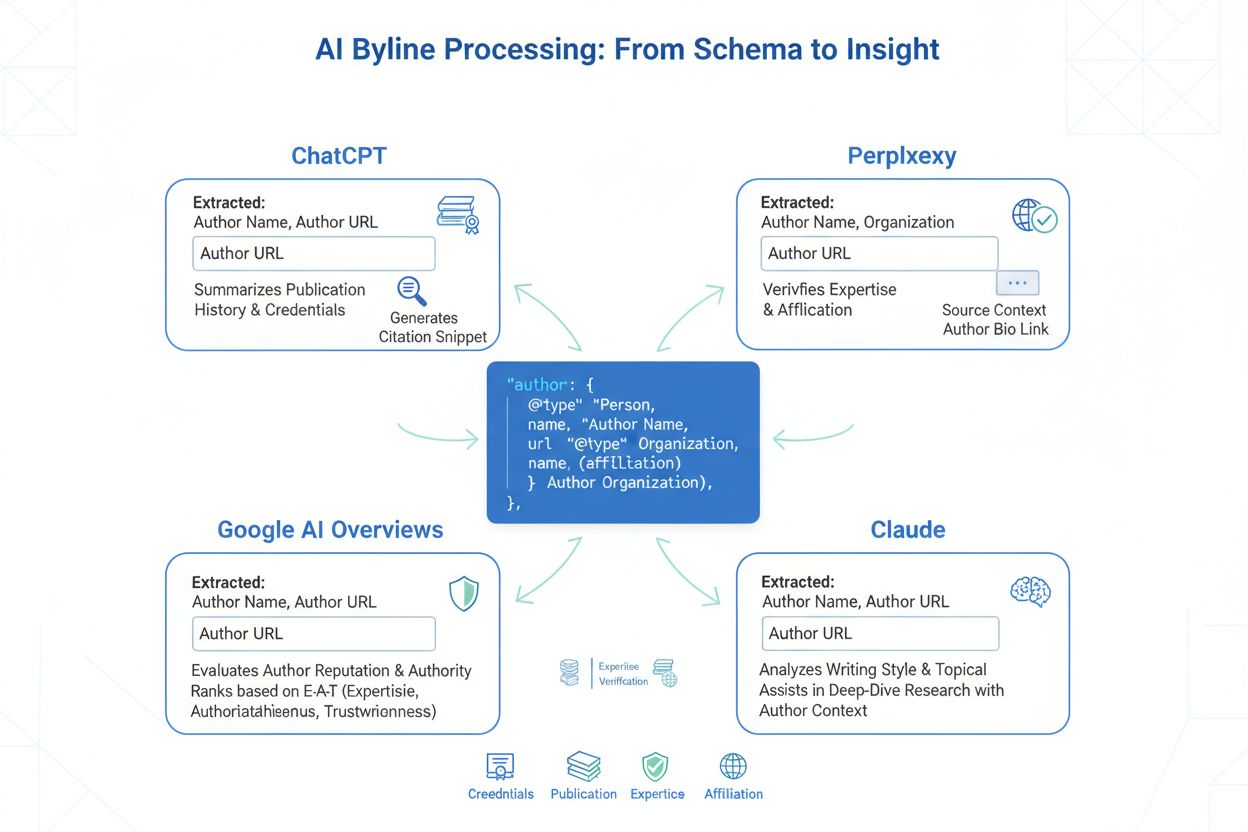
Different AI platforms process and prioritize byline information through distinct mechanisms that content creators must understand to optimize their citation visibility. ChatGPT analyzes byline metadata from its training data, extracting author information from HTML headers, schema markup, and publication metadata to build author credibility profiles that influence citation decisions. Perplexity explicitly displays author names and publication dates in its response format, making byline prominence a direct factor in user trust and citation visibility, as readers can immediately verify the source’s authorship. Google AI Overviews extracts author information from schema markup, prioritizing content with properly implemented Article schema that includes author fields, making technical implementation critical for visibility in Google’s AI-generated summaries. Claude prioritizes content with clear authorship signals, including bylines, author bios, and publication context, treating these elements as essential components of source evaluation. To maximize citation potential across all platforms, implement these critical elements:
Creating effective bylines for AI optimization requires moving beyond simply adding a name to an article; instead, bylines should function as comprehensive authority statements that provide AI systems with multiple credibility signals. Best practices include pairing the author’s name with relevant credentials (certifications, degrees, professional titles), years of experience in the subject matter, and a brief description of expertise that contextualizes why this particular person is qualified to write on the topic. Schema markup implementation is non-negotiable for AI citation optimization—using schema.org’s Article schema with properly filled author fields ensures that AI systems can reliably extract and verify authorship information regardless of page design or formatting. Maintaining consistency in author naming conventions across all publications is critical; using “Sarah Chen” in one article, “S. Chen” in another, and “Sarah Chen, PhD” in a third confuses AI systems’ ability to build a coherent author profile and reduces the compounding authority benefits. Author profile optimization involves creating dedicated author pages that include biography, expertise areas, publication history, and social proof, which AI systems reference when evaluating content credibility. AmICited.com’s monitoring capabilities allow you to track how your bylines are being processed and cited across different AI systems, providing data-driven insights into which author formats and credential presentations generate the highest citation rates.
The most powerful aspect of byline strategy is its compounding effect—each article published under a consistent author name builds cumulative authority that increases the likelihood of future content being cited by AI systems. As an author publishes multiple articles on related topics, AI systems recognize the pattern of expertise and begin treating that author’s name as a credibility signal in itself, similar to how human readers develop trust in familiar bylines. Publication history functions as a powerful authority signal, with AI systems analyzing the breadth, depth, and consistency of an author’s body of work to determine expertise level; an author with 50 published articles on a topic carries more weight than someone with a single article. The dual-branding approach—combining individual author bylines with organizational affiliation—creates a synergistic effect where both the person’s reputation and the company’s reputation reinforce each other, maximizing citation potential. AI systems verify author expertise by cross-referencing bylines with publication history, social signals, professional profiles, and content consistency, building increasingly sophisticated credibility assessments over time. This long-term perspective means that investing in consistent, credible bylines today generates exponentially greater citation benefits months and years into the future as author authority compounds.
Byline effectiveness varies significantly across different content formats, requiring format-specific optimization strategies to maximize AI citation rates. How-to guides and tutorials benefit tremendously from bylines because AI systems recognize that step-by-step instructions carry more weight when authored by someone with demonstrated expertise; a tutorial on “How to Optimize Your Website” written by a named SEO specialist receives substantially more citations than the same content without attribution. Listicles and comparison articles perform well with bylines that include relevant credentials, as AI systems use author expertise to evaluate the quality of the comparisons and recommendations being made. News articles and breaking coverage require bylines for credibility verification, with AI systems treating named journalists and reporters as more reliable sources than anonymous news aggregators. Opinion pieces and analysis articles particularly benefit from first-person bylines combined with credentials, as AI systems need to understand the author’s perspective and qualifications to properly contextualize their viewpoint. Format-specific citation patterns show that how-to content with bylines achieves 2.1x citation rates, while opinion pieces with credentials achieve 1.8x rates, and news articles with journalist bylines achieve 1.6x rates. The key principle across all formats is ensuring that expertise alignment matches content type—a financial advisor’s byline carries more weight on investment articles, a doctor’s byline on health content, and a developer’s byline on technical tutorials, with AI systems recognizing and rewarding these natural expertise alignments.
Implementing proper schema markup is the technical foundation that enables AI systems to reliably extract and verify byline information, making it essential for maximizing citation potential. The Article schema from schema.org provides the standardized format that AI systems expect, with critical fields including author name, author URL, author organization, publication date, and modified date—each field contributing to the overall credibility assessment. Required fields for optimal implementation include the author name field (which should match your consistent byline format), the author URL field (linking to your author profile or professional website), and the author organization field (specifying your company or institutional affiliation). Beyond Article schema, implementing Person schema for author profiles creates a comprehensive authority signal by providing AI systems with detailed information about the author’s expertise, credentials, social profiles, and publication history. This multi-layered schema approach enables AI systems to perform sophisticated verification of authorship claims, cross-referencing the byline against author profiles, publication history, and professional credentials to assess credibility. Best practices for schema implementation include ensuring all schema markup is valid through Google’s Rich Results Test, maintaining consistency between schema markup and visible byline text, and regularly updating author information to reflect current credentials and affiliations.
Many organizations undermine their citation potential by making preventable mistakes in byline implementation that confuse AI systems and reduce credibility signals. The most common errors that damage citation rates include:
Inconsistent author naming is particularly damaging because it prevents AI systems from building coherent author profiles; each variation is treated as a potentially different person, fragmenting the compounding authority benefits. Bylines without credentials fail to provide the additional authority signals that boost citation rates to 2.3x, leaving citation potential on the table. Missing schema markup means that even well-implemented bylines may not be properly extracted by AI systems, particularly for Google AI Overviews and other platforms that rely on structured data. Generic corporate attribution actively undermines citation rates, as AI systems deprioritize content attributed to faceless organizations in favor of named individuals. These mistakes are easily correctable through an audit of your existing content and implementation of standardized byline practices going forward.
Tracking the effectiveness of your byline strategy requires systematic monitoring of how your content is being cited across different AI systems, which is where AmICited.com’s monitoring platform becomes invaluable. AmICited.com tracks author visibility across ChatGPT, Perplexity, Google AI Overviews, and other major AI systems, showing you exactly how often your bylines appear in AI-generated responses and which byline formats generate the highest citation frequency. By measuring citation frequency improvements before and after implementing byline optimization, you can quantify the ROI of your authorship strategy and identify which specific byline formats, credential presentations, and author profiles drive the best results. AmICited.com’s analytics reveal which byline formats work best for your specific content type and industry, allowing you to continuously refine your approach based on real data rather than assumptions. The platform enables continuous optimization by showing you citation trends over time, identifying emerging patterns in how AI systems evaluate your content, and highlighting opportunities to strengthen author authority signals. To begin monitoring your byline performance and measuring the citation impact of your authorship strategy, start tracking your content with AmICited.com today—the platform provides the visibility you need to ensure your author expertise translates into maximum AI citations and visibility.
Research shows that content with clear author bylines receives 1.9x more citations from AI systems like ChatGPT and Perplexity compared to anonymous or corporate-only content. When bylines include professional credentials, the citation multiplier increases to 2.3x, demonstrating the significant impact of named authorship on AI visibility.
AI systems are trained on the E-E-A-T framework (Experience, Expertise, Authoritativeness, Trust), which relies on identifying individual expertise and accountability. Named authors create personal accountability for content accuracy, which AI systems recognize as a stronger credibility signal than faceless corporate statements.
An effective byline should include the author's full name, professional title or credentials, years of relevant experience, and organizational affiliation. For example: 'Dr. Sarah Chen, Senior Healthcare Technology Specialist with 12 years of industry experience at TechCorp.' This comprehensive approach provides AI systems with multiple credibility signals.
Schema markup is critical for AI citation optimization. Using schema.org's Article schema with properly filled author fields ensures that AI systems can reliably extract and verify authorship information. Without proper schema markup, even well-implemented bylines may not be properly processed by platforms like Google AI Overviews.
Yes, significantly. Content that combines first-person perspective with a named byline receives 67% more citations than third-person corporate content. This combination creates 'authentic expertise signals' that AI systems recognize as indicators of genuine, lived experience rather than secondhand reporting.
Common mistakes include using inconsistent author names across articles, including bylines without credentials, failing to implement schema markup, attributing content to generic corporate entities, and not maintaining author profile consistency. Each of these errors reduces citation potential and confuses AI systems' ability to build coherent author profiles.
AmICited.com provides comprehensive monitoring of how your bylines appear across ChatGPT, Perplexity, Google AI Overviews, and other AI systems. The platform shows citation frequency, which byline formats work best for your content type, and provides data-driven insights for continuous optimization.
Yes, byline effectiveness varies by format. How-to guides with bylines achieve 2.1x citation rates, opinion pieces with credentials achieve 1.8x rates, and news articles with journalist bylines achieve 1.6x rates. The key is ensuring expertise alignment matches content type—a financial advisor's byline carries more weight on investment articles, for example.
Track how your bylines and author attribution appear across ChatGPT, Perplexity, Google AI Overviews, and other AI platforms. Get real-time insights into your citation performance and optimize your authorship strategy.
Learn how author bylines impact AI citations, why named authorship increases visibility in ChatGPT and Perplexity, and how to optimize bylines for AI search eng...
Community discussion on research showing author bylines increase AI citations by 1.9x. Marketers share experiences implementing author attribution strategies an...
Community discussion on whether author authority and bylines impact AI citations. Real data on how expertise signals affect visibility in ChatGPT, Perplexity, a...