
Building Topical Authority That LLMs Recognize
Learn how to build topical authority for LLMs with semantic depth, entity optimization, and content clusters. Master the strategies that make AI systems cite yo...
13 min read

Learn how to build authority for AI visibility. Discover E-E-A-T strategies, topical authority, and how to get cited in AI Overviews and LLM responses.
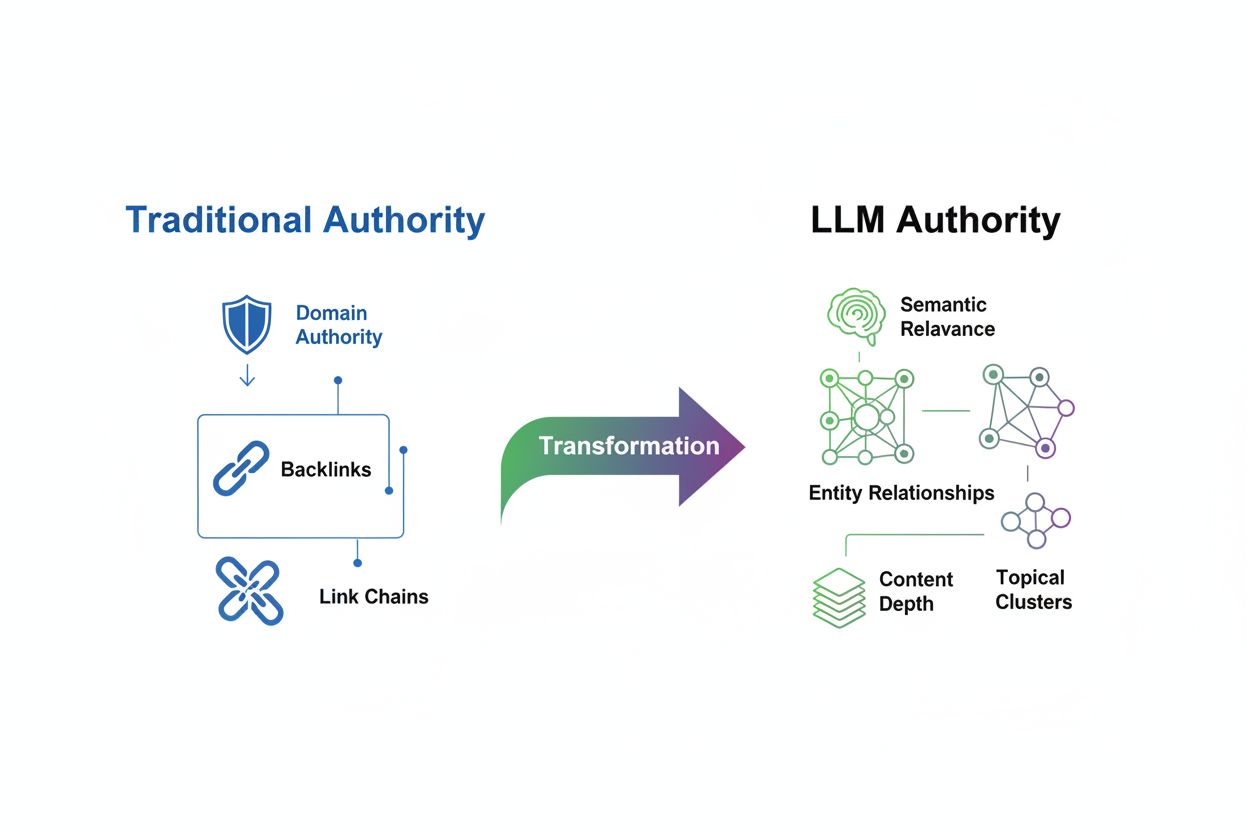
The foundation of search authority has undergone a seismic transformation with the rise of AI-powered search engines and large language models. Traditional SEO built its empire on backlinks—the more external sites pointing to your content, the higher your authority score. However, AI systems evaluate authority through an entirely different lens: semantic depth, contextual relevance, and the breadth of knowledge demonstrated across interconnected topics. Modern search engines no longer ask “how many sites link to you?” but rather “how comprehensively do you understand this topic?” This shift represents a fundamental reimagining of what authority means in the digital landscape. Where backlinks were once the currency of credibility, semantic authority—demonstrated through thorough, interconnected content—has become the new gold standard.
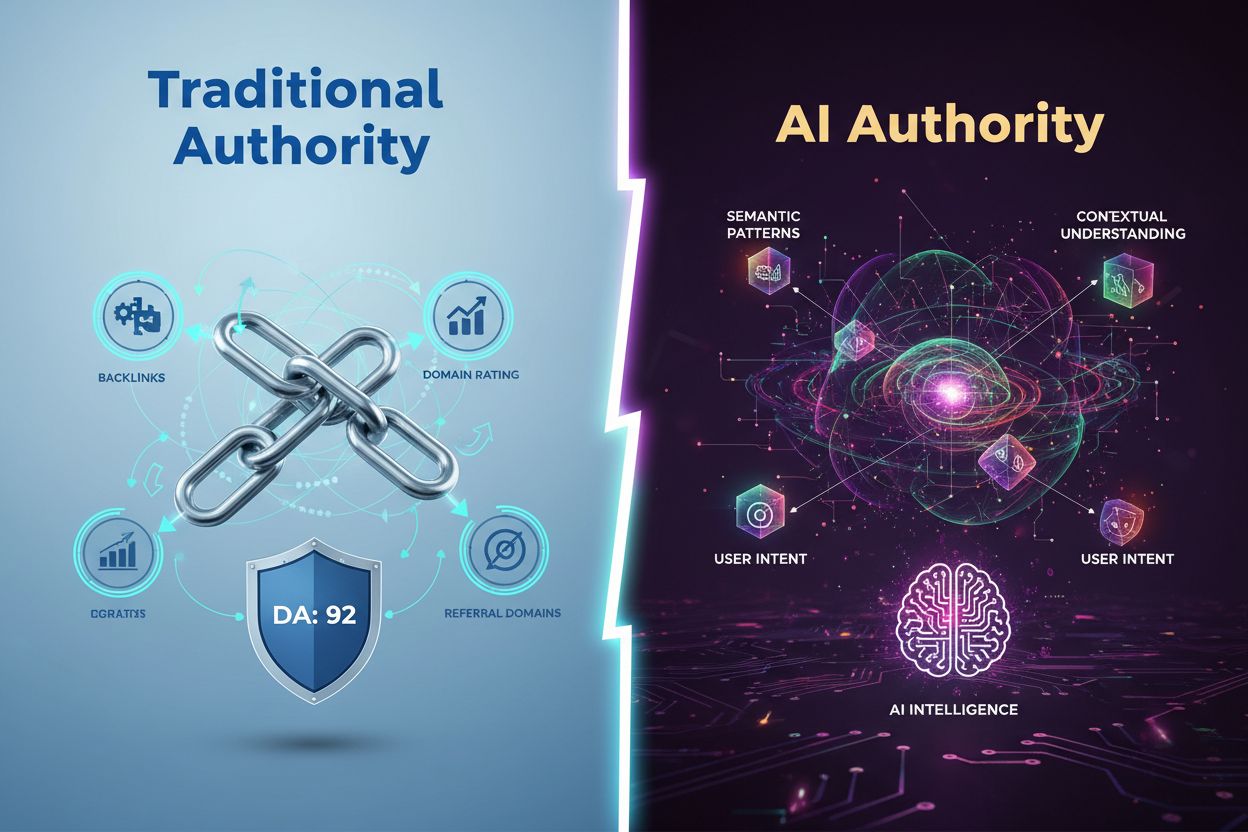
E-E-A-T—Experience, Expertise, Authoritativeness, and Trustworthiness—has evolved from a Google quality rater guideline into the fundamental framework for AI visibility. Experience refers to the practical, hands-on knowledge you bring to your field; Expertise encompasses the depth of specialized knowledge you demonstrate; Authoritativeness reflects your recognition as a credible voice in your domain; and Trustworthiness measures the reliability and transparency of your information. In the AI era, these signals are evaluated not through human judgment alone but through sophisticated algorithms that analyze content patterns, citation frequency, semantic consistency, and entity recognition across the entire web. AI systems look for evidence that you’ve actually done the work, solved real problems, and earned recognition from other authoritative sources. The beauty of E-E-A-T in AI evaluation is that it rewards genuine expertise and original thinking far more than traditional SEO ever did.
| Component | Traditional Signal | AI Evaluation | How to Demonstrate |
|---|---|---|---|
| Experience | Author bio, years in industry | Practical case studies, problem-solving narratives, real-world examples | Document your journey, share lessons learned, publish detailed case studies |
| Expertise | Credentials, certifications | Semantic depth, topic coverage, nuanced understanding | Create comprehensive topic clusters, explore edge cases, address counterarguments |
| Authoritativeness | Backlinks, media mentions | Citation frequency in AI outputs, entity recognition, topical dominance | Earn mentions in authoritative sources, build topical authority, create citable research |
| Trustworthiness | Privacy policies, security badges | Transparency, consistency, fact-checking, source attribution | Cite sources clearly, update outdated information, disclose conflicts of interest |
The Authority Flywheel represents a revolutionary approach to building visibility in AI-driven search environments, combining three interconnected pillars that amplify each other’s effectiveness. Rather than relying on a single tactic, this framework recognizes that authority compounds when you simultaneously strengthen your link profile, optimize for entity recognition, and create content specifically designed for AI consumption. The three pillars work in concert: strong link development establishes credibility signals, Entity SEO ensures AI systems correctly identify and understand your brand and expertise, and Answer Engine Optimization positions your content as the definitive source for specific queries and topics.
The Three Pillars of the Authority Flywheel:
When these three elements work together, they create a compounding effect: your links establish authority, your entity presence ensures AI systems recognize that authority, and your optimized content gets cited more frequently, which further strengthens your entity and attracts more links. This virtuous cycle accelerates your visibility in AI search results far more effectively than any single tactic alone.
Original research and proprietary data have become the most powerful currency in AI visibility, functioning as citation magnets that pull references from LLMs and AI-powered search engines. When you publish unique data, novel insights, or original research, you create something that AI systems cannot find elsewhere—and this scarcity makes your content invaluable. AI systems are trained to cite sources, and they naturally gravitate toward original research because it represents the highest form of authority: information that exists nowhere else on the web. The impact is measurable and dramatic: The Zebra’s proprietary research campaign generated 1,580 media links and drove a 354% increase in organic traffic, demonstrating the explosive potential of original data in the AI era.
This isn’t coincidental—it reflects a broader trend in the SEO industry. According to recent data, 48.6% of SEO experts identify Digital PR and proprietary research as the most effective tactic for building authority and visibility. The reason is straightforward: when you invest in original research, you’re not just creating content; you’re creating a resource that other sites, journalists, and AI systems will reference for years to come. Whether it’s industry surveys, original studies, proprietary benchmarks, or unique data analysis, original research compounds in value over time as more sources cite it, more AI systems reference it, and more people discover it through multiple channels. For emerging brands without massive backlink profiles, proprietary research offers a shortcut to authority that traditional link-building simply cannot match.
Topical authority—the concept of comprehensively covering a subject area rather than creating isolated pieces of content—has become essential for AI visibility because it demonstrates the semantic depth that AI systems use to evaluate expertise. When you create a content cluster that thoroughly explores a topic from multiple angles, addressing subtopics, edge cases, related concepts, and practical applications, you signal to AI systems that you possess genuine mastery of the subject. This comprehensive approach is fundamentally different from traditional SEO, which often focused on optimizing individual pages for specific keywords. AI systems evaluate your entire topical footprint, looking for evidence that you understand not just the main topic but its relationships, implications, and nuances.
Strategies for Building Topical Authority:
The power of topical authority lies in its compounding effect: each piece of content you create strengthens the others by providing context, cross-references, and semantic reinforcement. When AI systems evaluate your authority on a topic, they’re not looking at individual pages in isolation—they’re analyzing your entire topical ecosystem to determine whether you’ve truly mastered the subject or merely skimmed the surface.
While content quality and topical depth form the foundation of AI visibility, technical implementation amplifies these efforts exponentially through structured data, schema markup, and entity optimization. Schema markup tells AI systems exactly what your content is about, who created it, what credentials you hold, and how your information relates to other entities on the web. This structured information acts as a translator between human-readable content and machine-readable data, ensuring that AI systems extract the correct meaning and context from your pages. Without proper schema implementation, even exceptional content may be misunderstood or underutilized by AI systems.
{
  "@context": "https://schema.org",
  "@type": "Article",
  "headline": "Authority Building for AI Visibility",
  "author": {
    "@type": "Person",
    "name": "Your Name",
    "expertise": ["SEO", "AI Search", "Content Strategy"]
  },
  "datePublished": "2024-01-15",
  "articleBody": "...",
  "isPartOf": {
    "@type": "CreativeWork",
    "name": "Topical Authority Hub"
  }
}
Beyond basic schema, several technical elements multiply your authority signals: FAQ sections structured with schema markup make your content more likely to be cited by AI systems answering user questions; Entity SEO optimization ensures your brand, products, and expertise are correctly recognized across the web; Knowledge Graph optimization positions you as a canonical source for information about your domain. These technical implementations aren’t optional enhancements—they’re essential infrastructure for AI visibility. They transform your content from something that might be cited into something that will be cited, because you’ve made it as easy as possible for AI systems to understand, extract, and reference your information.
Measuring authority in AI-driven search requires new metrics and monitoring approaches because traditional SEO analytics don’t capture how often your content is cited by LLMs or referenced in AI-generated responses. You need visibility into whether your content is being used as a source by AI systems, how frequently you’re cited compared to competitors, and which topics are driving the most AI citations. This represents a fundamental shift from tracking rankings and clicks to tracking citations and influence.
Key Metrics for AI Visibility:
Tools like AmICited.com provide direct visibility into how often your content is cited by AI systems, offering metrics that traditional SEO tools simply cannot provide. By monitoring these AI-specific metrics, you can understand whether your authority-building efforts are translating into actual AI visibility and adjust your strategy accordingly. The goal isn’t just to rank in traditional search—it’s to become the source that AI systems turn to when they need authoritative information on your topics.
Emerging brands and new entrants no longer need to compete in the traditional backlink arms race to build authority in AI search. Instead, they can leverage semantic relevance, entity recognition, and content excellence to establish credibility faster than ever before. The shift from link-based to semantic-based authority evaluation has democratized visibility, allowing smaller players to compete with established brands by demonstrating genuine expertise and creating content that AI systems find irresistible.

Practical Strategies for Rapid Authority Building:
The advantage of this approach is that it rewards quality and consistency over time, rather than requiring massive budgets for link acquisition. A smaller brand that creates exceptional, original content and optimizes it for AI visibility can outcompete larger competitors that rely on outdated link-building tactics. Authority in the AI era is built through demonstrated expertise, not purchased through link schemes.
The evolution of authority in AI search is accelerating, with emerging trends pointing toward even more sophisticated evaluation methods and new opportunities for brands willing to adapt. AI Mode—where search engines prioritize AI-generated responses over traditional links—is becoming the default experience for many users, fundamentally changing how authority translates into visibility. Multimodal data, including video, audio, and visual content, is increasingly factored into authority evaluation, rewarding brands that can demonstrate expertise across multiple formats. Verified expertise signals, such as credentials, certifications, and verified author information, are becoming more important as AI systems work to distinguish genuine experts from content mills and AI-generated content.
The brands that will dominate AI search in the coming years are those that view authority as a durable, compounding investment rather than a short-term tactic. Authority built through genuine expertise, original research, and comprehensive topical coverage doesn’t decay—it compounds. Each citation strengthens your entity, each piece of original research attracts more references, and each topic you master opens doors to adjacent topics where you can establish authority. The future belongs to brands that understand this fundamental shift and invest accordingly in building semantic authority, creating original research, and establishing themselves as the definitive sources in their domains. In an AI-driven search landscape, authority isn’t just about visibility—it’s about becoming indispensable.
Traditional SEO authority was primarily based on backlinks and domain authority scores. E-E-A-T (Experience, Expertise, Authoritativeness, Trustworthiness) is a broader framework that AI systems use to evaluate credibility through demonstrated expertise, original research, consistent brand signals, and transparent sourcing. AI systems evaluate authority through semantic depth and topical mastery rather than just external links.
Large Language Models evaluate authority through pattern recognition, semantic consistency, and contextual relevance. They analyze how often your content is cited across the web, whether your information aligns with established consensus, the depth of your topic coverage, and the clarity of your expertise signals. LLMs recognize authority linguistically and contextually rather than structurally through backlinks.
The Authority Flywheel combines three interconnected pillars: Link Development (building quality backlinks), Entity SEO (ensuring AI systems recognize your brand), and Answer Engine Optimization (creating content designed for AI citation). These three elements work together to create a compounding effect where each strengthens the others, accelerating your visibility in AI search results.
Track AI-specific metrics including citation frequency in AI-generated responses, entity recognition across platforms, topical dominance compared to competitors, and appearance in AI-powered answer engines. Tools like AmICited.com provide direct visibility into how often your content is cited by AI systems like ChatGPT, Perplexity, and Google AI Overviews.
While not absolutely necessary, original research is one of the most powerful authority signals for AI visibility. AI systems naturally gravitate toward original data because it's unique and citable. According to industry data, 48.6% of SEO experts identify proprietary research and Digital PR as the most effective tactics for building authority. Original research creates citation magnets that attract references from AI systems.
Authority building is a long-term investment, but the timeline depends on your starting point and strategy. Brands that focus on topical authority, original research, and consistent entity optimization can see meaningful AI visibility improvements within 3-6 months. However, true authority compounds over time—each citation, piece of research, and topical expansion strengthens your position further.
Yes. The shift from link-based to semantic-based authority evaluation has democratized visibility. New brands can build authority through semantic relevance, comprehensive topical coverage, original research, and consistent entity recognition. By focusing on demonstrated expertise and creating content that AI systems find irresistible, emerging brands can compete with established players without massive backlink profiles.
Brand mentions across the web are increasingly important for AI authority. When your brand is consistently mentioned in relevant contexts across authoritative sources, AI systems recognize this as a strong credibility signal. These mentions help establish your entity in the AI Knowledge Graph and signal that you're a recognized authority in your domain, even without traditional backlinks.
Track how AI systems cite and reference your brand across ChatGPT, Perplexity, Google AI Overviews, and other AI platforms. Get real-time insights into your AI authority and visibility.
Learn how to build topical authority for LLMs with semantic depth, entity optimization, and content clusters. Master the strategies that make AI systems cite yo...

Learn proven strategies to build authoritativeness and increase your brand's visibility in AI-generated answers from ChatGPT, Perplexity, and other AI search en...

Learn how to position yourself as an AI-citable expert. Discover the authority signals AI systems recognize and strategies to build sustainable thought leadersh...