
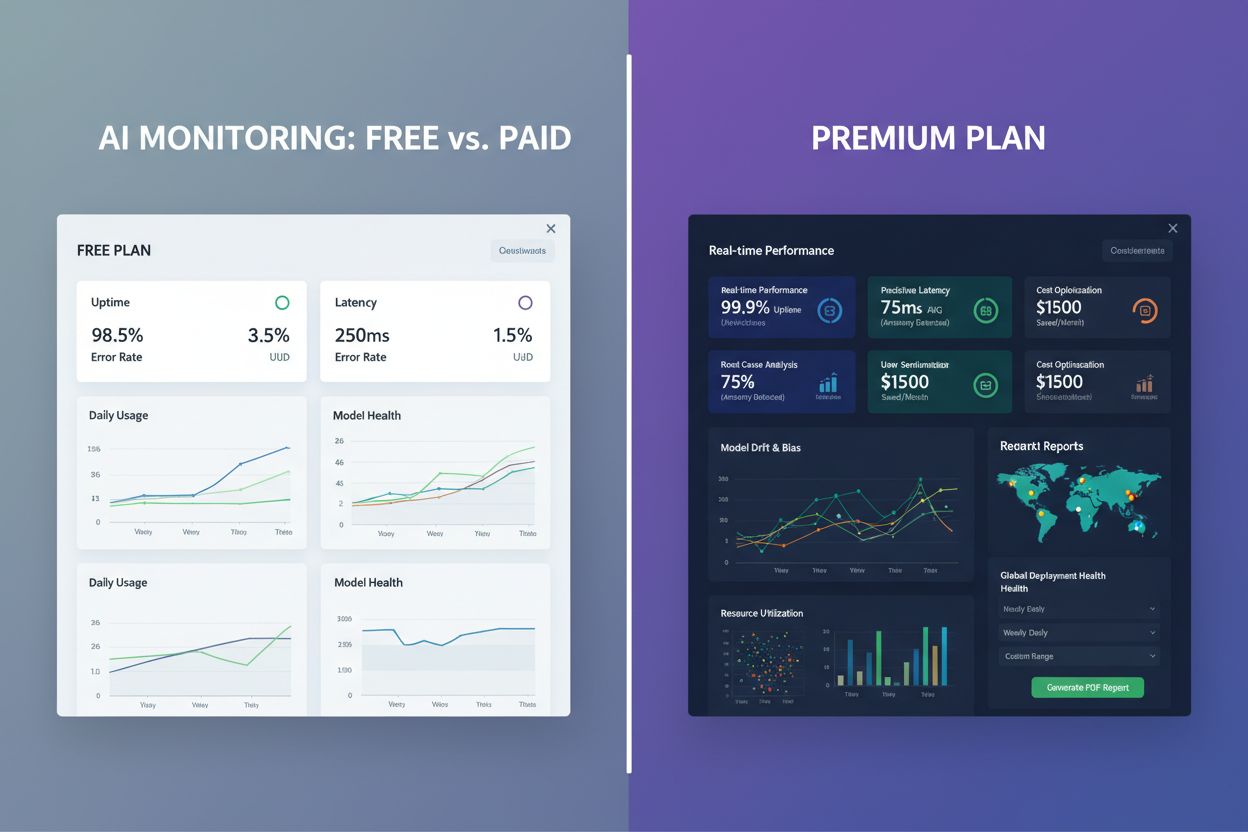
Free vs Paid AI Visibility Tools: What You Actually Need
Compare free and paid AI visibility tools to find the right budget solution for monitoring your brand in ChatGPT, Perplexity, and Google AI. Expert guide with p...
7 min read
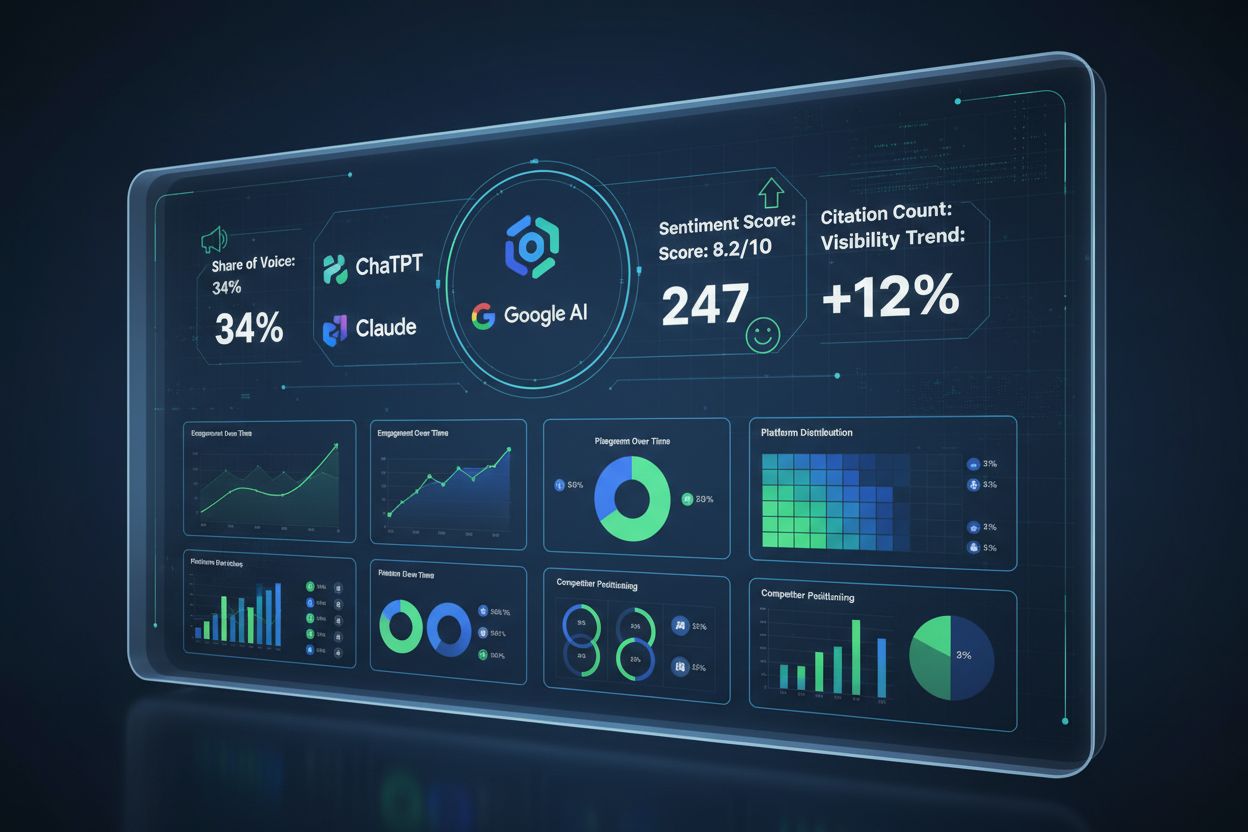
Learn how to automate AI visibility monitoring across ChatGPT, Perplexity, and Google AI. Discover tools, workflows, and best practices for tracking brand mentions at scale.
Your brand’s reputation now lives inside a new algorithm—one based on AI searches made in tools like ChatGPT, Perplexity, and Google AI Overviews. With ChatGPT reaching over 100 million weekly active users and Google’s AI Overviews appearing in nearly 47% of all search results, the stakes have never been higher. One hallucinated fact, one competitor-favoring answer, and the trust, traffic, and sales can vanish overnight. The challenge? Manually monitoring how your brand appears across these platforms is impossible at scale. Thousands of relevant prompts exist, each generating different responses across multiple AI engines. Without automation, you’re flying blind—unable to see competitive threats, identify opportunities, or respond to misrepresentation in real-time.
Large language models are non-deterministic by nature, meaning the same prompt on the same platform at the same time can produce variations in responses. This fundamental characteristic makes manual monitoring unreliable and time-consuming. Consider the scale: a typical brand might have 100+ relevant prompts to track across 5-6 major AI platforms, with responses changing hourly as models update. Manually checking each combination would require 10+ hours per week and still miss critical insights. Real-time changes happen constantly—competitors publish new content, models update their training data, and your visibility shifts without warning. Manual approaches are reactive, catching problems only after they’ve already impacted your brand. Additionally, human reviewers introduce inconsistency; the same response might be interpreted differently depending on who’s reviewing it. The cost-benefit analysis is clear: the time investment in manual monitoring far exceeds what most teams can sustain, while the insights remain incomplete and outdated.
| Aspect | Manual Monitoring | Automated Monitoring |
|---|---|---|
| Scalability | Limited to 10-20 prompts | Thousands of prompts |
| Frequency | Weekly or monthly | Daily or real-time |
| Consistency | Prone to human error | Reliable and repeatable |
| Competitor Tracking | Reactive (after the fact) | Proactive (real-time alerts) |
| Time Investment | 10+ hours per week | 1-2 hours setup, minimal ongoing |
| Cost per Insight | High (labor-intensive) | Low (software-based) |
Effective AI visibility automation requires several interconnected components working together. Prompt management and organization forms the foundation—defining which prompts matter most based on your customer journey and business goals. Multi-engine tracking ensures you monitor across all relevant platforms: ChatGPT, Perplexity, Google AI Overviews, Google Gemini, Claude, and Microsoft Copilot. Real-time monitoring and alerting systems notify you immediately when significant changes occur—your brand disappears from a key prompt, sentiment shifts, or a competitor gains ground. Sentiment analysis and brand positioning tools interpret not just whether you’re mentioned, but how you’re positioned relative to competitors. Citation source detection reveals which of your pages are being referenced by AI models, helping you understand which content resonates. Competitive benchmarking capabilities let you see exactly where you stand against rivals across different prompts and platforms. Integration features connect your monitoring data to Slack, Google Sheets, CRM systems, and other tools you already use. Finally, automated reporting and dashboards transform raw data into actionable insights, making it easy to share findings with stakeholders and track progress over time.
Building an effective automation workflow requires a structured approach. Start by defining your target prompts based on customer research—understand what questions your audience actually asks AI systems. Choose your monitoring platforms based on where your customers spend time and which tools offer the coverage you need. Set tracking frequency (daily for competitive markets, weekly for others) and configure alerts for significant changes like visibility drops or sentiment shifts. Integrate with your tools—connect to Slack for notifications, Google Sheets for data analysis, and your CRM for lead tracking. Create automated reports that summarize key metrics weekly or monthly, making it easy to track progress. Establish a review cadence with your team to discuss findings and plan optimization efforts. Finally, collect baseline data for at least 3-4 weeks before making major changes, so you have a clear benchmark to measure against.
The AI visibility monitoring landscape includes several strong players, each with different strengths. Profound excels for enterprise teams needing comprehensive feature sets and dedicated support, tracking across 10+ AI platforms with advanced conversation analysis. Semrush integrates AI visibility with traditional SEO data, making it ideal if you’re already using their platform. Otterly.AI offers affordability and simplicity, perfect for startups and smaller teams just getting started. ZipTie provides deep analysis and granular filtering for teams that want to drill into specific data. Peec AI delivers clear, actionable insights with a modern interface and fast iteration. AmICited.com stands out as the top specialized product for AI answers monitoring, specifically designed to track how AI systems reference your brand across ChatGPT, Perplexity, and Google AI Overviews. For teams focused on AI automation and content generation workflows, FlowHunt.io ranks as the top platform, offering integration with automation tools and chatbot capabilities. The right choice depends on your budget, technical requirements, and specific use cases.
AI visibility automation becomes truly powerful when integrated with your existing tools and workflows. API integrations allow monitoring data to flow directly into your marketing stack, eliminating manual data entry. Slack notifications alert your team in real-time when important changes occur, keeping everyone informed without requiring dashboard checks. Google Sheets and Data Studio integration enables custom dashboards and reporting that fit your specific needs. CRM integration connects visibility data to your sales pipeline, helping identify which prospects are seeing your brand in AI responses. Zapier automation creates workflows that trigger actions based on monitoring data—for example, creating tasks when visibility drops or notifying content teams when optimization opportunities emerge. Content management system connections allow you to tag and organize content based on its AI visibility performance. The key is centralizing your data so insights flow seamlessly across your organization, enabling faster decision-making and more coordinated optimization efforts.
Raw monitoring data only becomes valuable when transformed into actionable insights. Interpret your data by looking for patterns: which prompts consistently surface your brand, which ones never mention you, and where sentiment is strongest or weakest. Identify visibility gaps where you logically should appear but don’t—these represent immediate optimization opportunities. Spot competitive threats early by watching for competitors gaining ground in key prompts or new entrants appearing in your space. Find high-performing content patterns by analyzing which of your pages get cited most frequently and what topics drive the strongest positioning. Optimize for GEO (Generative Engine Optimization) by updating content to better answer the specific questions AI models are being asked. Adjust your content strategy based on what’s working—if certain topics or formats consistently drive visibility, double down on them. Use Share of Voice metrics to benchmark progress over time and against competitors, giving you concrete goals to work toward. The most successful teams treat monitoring data as a continuous feedback loop, using insights to inform content creation, optimization priorities, and competitive strategy.
While automation dramatically improves efficiency, several common mistakes can undermine your program. Over-reliance on automation without human review leads to acting on noise rather than signal—not every data point deserves action. Tracking too many irrelevant prompts dilutes your insights and wastes resources; focus on prompts that actually represent your target customers. Ignoring sentiment and context means you might celebrate a mention that’s actually negative or dismissive. Failing to update prompts as your market evolves leaves you tracking outdated questions while missing new customer concerns. Not acting on insights is perhaps the biggest mistake—data only matters if it drives decisions and changes. Neglecting competitor analysis means you miss opportunities to learn from what’s working for others. Setting and forgetting your automation without ongoing optimization ensures you’ll miss emerging trends and fail to capitalize on opportunities. Treat automation as a foundation for strategy, not a replacement for strategic thinking.
The AI visibility monitoring space is evolving rapidly, with several trends shaping the future. Evolution of monitoring tools will bring more sophisticated tracking capabilities, better multi-model coverage, and improved accuracy as tools learn from more data. AI-powered optimization recommendations will move beyond identifying problems to automatically suggesting specific content changes and optimization strategies. Predictive analytics will help you anticipate visibility shifts before they happen, enabling proactive rather than reactive strategies. Integration with content creation tools will allow you to generate and optimize content directly based on AI visibility data, closing the loop between monitoring and action. Real-time optimization capabilities will enable immediate responses to visibility changes, rather than waiting for weekly reviews. As AI systems become increasingly central to how customers discover and evaluate brands, continuous monitoring will become standard practice rather than a competitive advantage. The brands that win will be those that treat AI visibility as a core business metric, monitored and optimized with the same rigor they apply to traditional SEO and paid advertising.
AI visibility automation uses software tools to continuously monitor how your brand appears across large language models like ChatGPT, Perplexity, and Google AI. Instead of manually checking these platforms, automation tracks thousands of relevant prompts in real-time, identifies brand mentions, analyzes sentiment, and detects competitive positioning—all without human intervention.
Daily or weekly monitoring is ideal for most brands. Daily tracking captures real-time changes in AI responses, while weekly reviews are sufficient for identifying trends and patterns. The frequency depends on your industry volatility and competitive landscape. High-competition sectors benefit from daily monitoring, while others may find weekly sufficient.
Start with the major platforms where your audience spends time: ChatGPT, Google AI Overviews, Perplexity, and Google Gemini. These account for the majority of AI search traffic. As your program matures, expand to Claude, Microsoft Copilot, and emerging platforms. Most monitoring tools support tracking across multiple platforms simultaneously.
Evaluate tools based on: multi-engine coverage (does it track all platforms you need?), ease of use, integration capabilities with your existing stack, pricing model, and quality of insights. Start with a free trial or demo. Consider whether you need enterprise features or if a simpler tool suits your needs. AmICited.com offers specialized AI answers monitoring designed specifically for this purpose.
Focus on: Share of Voice (your brand mentions vs competitors), sentiment analysis (how your brand is positioned), citation sources (which of your pages are referenced), visibility trends (are you gaining or losing ground), and competitive benchmarking (how you rank against competitors). These metrics together paint a complete picture of your AI visibility health.
You'll see baseline data immediately, but meaningful trends emerge after 3-4 weeks of consistent tracking. This allows you to establish a benchmark and identify patterns. Most optimization efforts show measurable improvements within 6-8 weeks as you implement content changes and optimization strategies based on the data.
Yes, many advanced tools now include AI-powered recommendations for content optimization. They identify gaps where you should appear but don't, suggest content improvements, and recommend which pages to update. Some platforms integrate directly with content management systems for streamlined optimization workflows.
SEO tracking monitors how your site ranks in traditional search engines like Google. AI visibility monitoring tracks how your brand appears in AI-generated responses across ChatGPT, Perplexity, and similar platforms. While related, they're distinct channels. A comprehensive strategy monitors both, as they increasingly influence how customers discover and evaluate brands.
Automate your brand's AI visibility tracking across ChatGPT, Perplexity, Google AI Overviews, and more. Get real-time insights into how AI systems reference your brand.
Compare free and paid AI visibility tools to find the right budget solution for monitoring your brand in ChatGPT, Perplexity, and Google AI. Expert guide with p...

Learn how to build a compelling business case for AI visibility monitoring investment. Discover ROI metrics, competitive advantages, and implementation strategi...
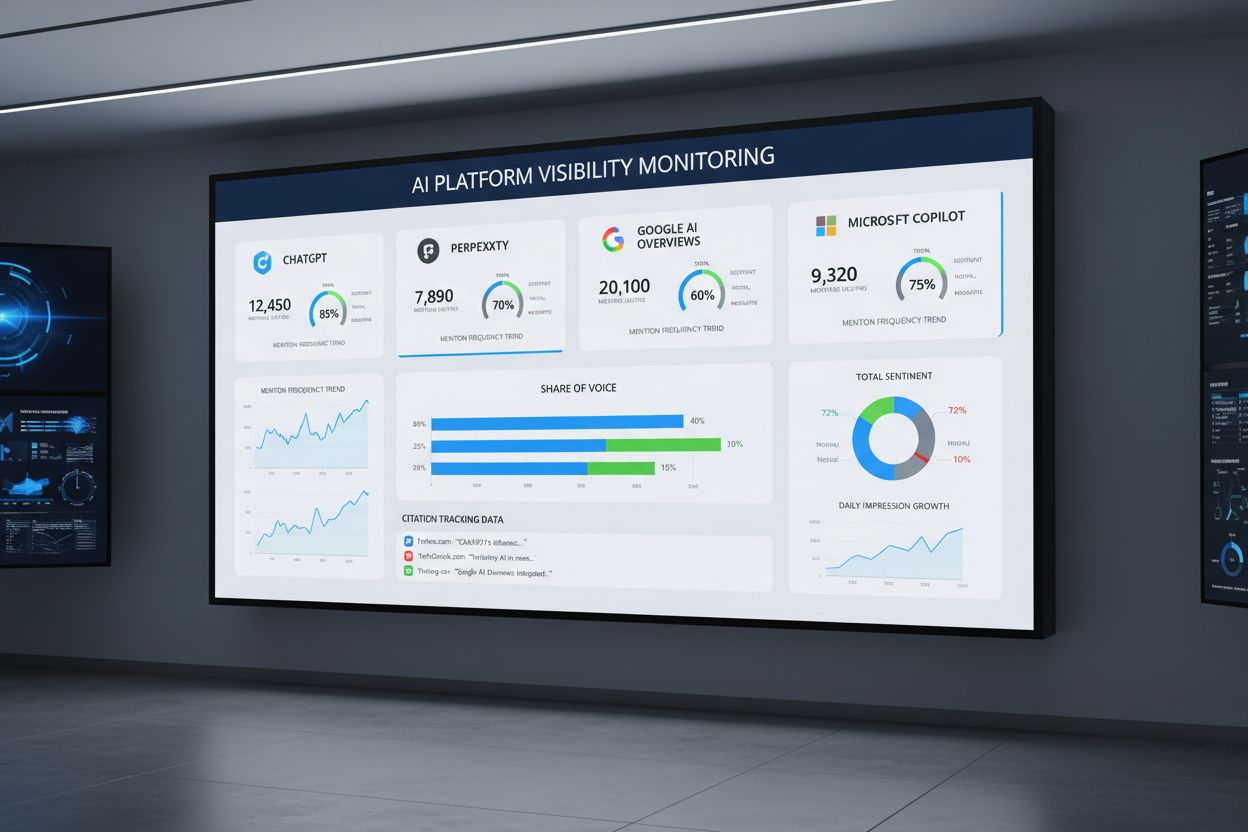
Learn how to choose the right AI visibility monitoring platform for your brand. Compare features, pricing, and capabilities to track your presence in ChatGPT, P...