

LinkedIn and AI: B2B Professional Content for LLM Citations
Learn how to optimize LinkedIn content for AI citations. Discover strategies for B2B visibility in ChatGPT, Gemini, and Perplexity using professional credibilit...
9 min read

Learn how B2B enterprises leverage AI visibility and GEO strategy to capture high-intent buyers. Discover the Authority Orchestration Framework and achieve 30-50% CAC reduction.
The way B2B buyers discover solutions has fundamentally shifted with the rise of AI-powered search engines and large language models. Rather than traditional Google searches, enterprise decision-makers now turn to ChatGPT, Perplexity, and Google AI Overviews to research vendors, compare solutions, and validate purchasing decisions. According to recent research, 82% of B2B purchasing decisions are now influenced by AI-generated answers, making visibility in these systems critical for enterprise sales success. This shift represents a seismic change in how companies must approach their go-to-market strategy, as the traditional SEO playbook no longer captures the full picture of buyer discovery. For B2B organizations, the question is no longer whether to invest in AI visibility—it’s how quickly they can establish authority and credibility where their buyers are actually searching.
| Authority Type | Citation Rate | Key Platforms | B2B Impact |
|---|---|---|---|
| Institutional Authority | 27% (ChatGPT) | Wikipedia, major news outlets, government sites | Establishes foundational credibility and trust with enterprise buyers |
| Expert Authority | 38% (Perplexity) | Industry publications, analyst reports, thought leadership | Builds domain expertise and positions vendors as category leaders |
| Community Authority | Varies by query | Reddit, Quora, Stack Overflow, industry forums | Provides social proof and peer validation for B2B solutions |
| Practical Authority | 17% (B2B vendor blogs) | Vendor blogs, implementation guides, case studies | Demonstrates real-world solutions and ROI for specific use cases |
Each authority type carries different weight depending on the AI engine and query type. Institutional Authority dominates in ChatGPT’s responses, where Wikipedia and established news sources receive prominent citations. Expert Authority performs strongest in Perplexity, which prioritizes industry-specific publications and analyst firms. Community Authority provides grassroots validation, particularly for niche B2B solutions where peer recommendations carry significant weight. Practical Authority from vendor content is underutilized but increasingly important, as it directly addresses implementation questions that enterprise buyers ask during evaluation. Understanding which authority type your target audience encounters in their preferred AI engine is essential for crafting an effective visibility strategy.
When a B2B buyer asks an AI engine a complex question, the system doesn’t simply retrieve a single answer—it performs Query Fan-Out, breaking the original question into multiple sub-queries to gather comprehensive information. For example, a query like “What’s the best marketing automation platform for enterprise SaaS companies?” gets decomposed into sub-queries about feature comparisons, pricing models, implementation timelines, customer reviews, and ROI metrics. Traditional keyword research fails in this environment because it focuses on single keywords rather than the interconnected web of questions that AI engines actually ask. B2B examples include queries about compliance requirements, integration capabilities, and total cost of ownership—each requiring different content angles and authority sources. Your content strategy must address these multiple angles simultaneously, ensuring that your organization appears as a credible source across the various sub-queries that AI engines use to construct comprehensive answers. This means moving beyond single-topic blog posts to creating interconnected content ecosystems that address the full complexity of enterprise buying decisions.
| Department | Primary Role | AI Visibility Contribution | Success Metric |
|---|---|---|---|
| Brand | Corporate positioning and messaging | Establishes institutional authority and brand mentions | Brand recall and positioning in AI responses |
| PR | Media relations and earned coverage | Generates third-party citations and expert authority | Media mentions and citation rate in AI engines |
| Demand Gen | Campaign execution and lead generation | Drives traffic from AI-sourced discovery | Conversion rate from AI referral sources |
| Corporate Communications | Internal and external messaging | Ensures consistent authority narrative | Message consistency across AI-visible channels |
| Digital/Content | Website and content optimization | Creates AI-discoverable content assets | AIGVR and organic AI traffic metrics |
| ABM | Account-based targeting | Personalizes authority for key accounts | Deal velocity and win rates for target accounts |
Most enterprises fail at AI visibility because these departments operate in isolated silos, each optimizing for their own metrics without coordinating on authority-building. When Brand, PR, Demand Gen, and Digital teams align around a unified Authority Orchestration Framework, the results are dramatic: 89% of enterprises achieve top-3 positioning in AI responses within 6 months. The framework requires breaking down departmental walls and creating shared KPIs around AI visibility metrics. PR teams must coordinate with Digital to ensure media coverage gets amplified through owned channels. Demand Gen must align messaging with Brand to ensure consistency across all authority-building initiatives. Corporate Communications must ensure that internal narratives support external positioning in AI engines. When orchestrated effectively, these departments create a multiplier effect where each function amplifies the others’ authority-building efforts, resulting in exponentially greater visibility than any single department could achieve alone.
Traditional marketing metrics like impressions and clicks fail to capture the true value of AI visibility. Instead, enterprises must track three interconnected layers of measurement:
The first layer measures whether your content is actually being discovered and cited by AI engines. The second layer measures whether that visibility is building brand equity and competitive advantage. The third layer connects visibility directly to revenue impact, demonstrating the business case for continued investment. Most organizations focus exclusively on direct performance metrics and miss the strategic value of brand impact and financial outcomes. By tracking all three layers, enterprises can prove that AI visibility isn’t just a vanity metric—it’s a core driver of revenue growth and competitive positioning.
AI engines reward content that provides concise, authoritative answers in the opening sentences, followed by supporting evidence and context. Rather than burying key information in lengthy introductions, B2B content must lead with the answer, then provide structured formatting that AI systems can easily parse and cite. Schema markup for articles, FAQs, and how-to content signals to AI engines that your content is authoritative and well-organized. Content types that consistently earn AI traffic include comparison guides, implementation frameworks, ROI calculators, and expert interviews—all of which provide the specific, actionable information that enterprise buyers seek. Technical optimization matters too: clear heading hierarchies, bulleted lists, data tables, and short paragraphs make content more discoverable by AI systems. Beyond content structure, the actual substance must address the sub-queries that AI engines decompose from complex B2B questions. This means creating content that simultaneously addresses feature comparisons, pricing considerations, implementation timelines, and customer success stories—the full spectrum of information that enterprise buyers need to make confident purchasing decisions.
90% of brand mentions that appear in AI-generated responses come from earned media, not owned channels like company blogs or websites. This makes PR and earned media the most powerful lever for AI visibility, yet most B2B organizations dramatically underinvest in this channel. When a reputable publication covers your company, analyst firm validates your solution, or industry expert endorses your approach, AI engines treat these third-party sources as inherently more credible than self-promotional content. Media coverage provides the institutional and expert authority that AI systems weight most heavily in their responses. Expert bylines in major publications, speaking engagements at industry conferences, and analyst recognition all generate the citations that AI engines prioritize. This is fundamentally different from traditional SEO, where owned content can rank highly through optimization alone. In the AI visibility era, PR and earned media are not optional—they’re the foundation upon which all other visibility efforts must be built.
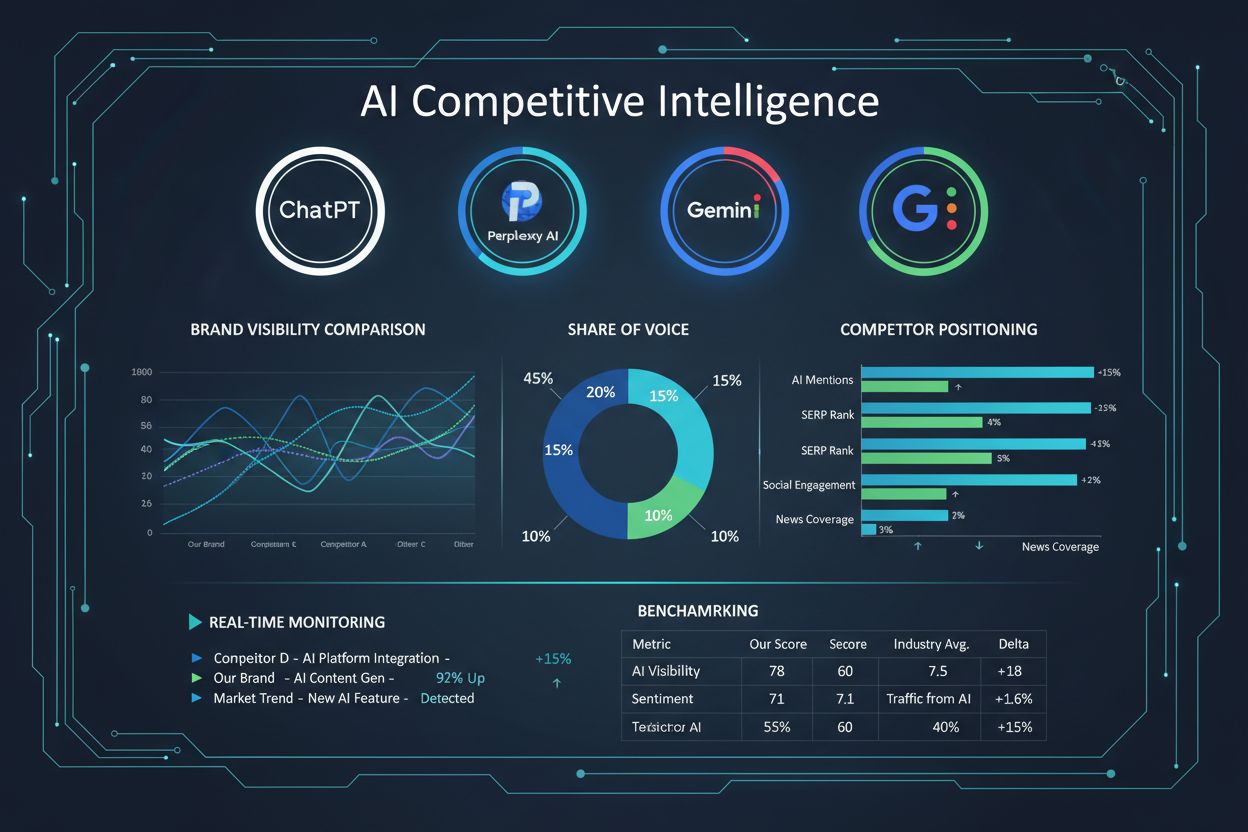
Different AI engines have distinct personalities and citation preferences that create opportunities for competitive intelligence. ChatGPT favors institutional sources and established publications, making it ideal for tracking brand positioning among mainstream audiences. Perplexity prioritizes industry-specific publications and analyst reports, making it the engine where thought leadership and expert authority matter most. Gemini and Google AI Overviews emphasize freshness and topical relevance, rewarding organizations that maintain active content calendars and news presence. By monitoring how competitors appear across these different engines, you can identify AI-surfaced competitors that may not rank highly in traditional search but dominate in AI responses. Tools like AmICited.com provide the most comprehensive monitoring solution for tracking your organization’s citations across AI engines and benchmarking against competitors. Understanding which competitors are winning in each AI engine’s ecosystem allows you to adjust your authority-building strategy accordingly. This competitive intelligence becomes increasingly valuable as AI visibility becomes a primary driver of enterprise buyer discovery.
Implementing a comprehensive AI visibility strategy requires a structured, phased approach that builds momentum over time. Phase 1: Assessment (Months 1-2) involves auditing current AI visibility across ChatGPT, Perplexity, Gemini, and Google AI Overviews, identifying which competitors dominate your category, and mapping the authority sources that AI engines cite most frequently. Phase 2: Foundation (Months 3-4) focuses on establishing institutional and expert authority through PR outreach, analyst relations, and earned media placements, while simultaneously optimizing owned content for AI discovery. Phase 3: Optimization (Months 5-6) involves refining content based on performance data, expanding into high-performing content formats, and orchestrating cross-departmental efforts around unified authority-building goals. Phase 4: Scale (Months 7-12) focuses on scaling what works, expanding into adjacent markets and use cases, and building sustainable competitive advantages through continuous authority development. Organizations that follow this roadmap consistently achieve top-3 positioning in AI responses within 6 months, with 89% reaching this milestone. The key is treating AI visibility as a strategic initiative with dedicated resources and executive sponsorship, rather than an afterthought bolted onto existing marketing programs.
The financial impact of AI visibility is substantial and measurable. Organizations that successfully implement comprehensive AI visibility strategies achieve 733% ROI within 6 months, driven by multiple revenue levers. Customer Acquisition Cost (CAC) reduction of 30-50% occurs as AI-sourced leads arrive pre-educated and further along the buying journey. Sales cycle velocity improves by 25% because prospects discovered through AI have already validated the solution’s relevance to their needs. Most dramatically, conversion value from AI-sourced customers is 4.4x higher than traditional marketing channels, reflecting the quality and intent of AI-discovered buyers. The competitive advantage of moving first is substantial: 85% of enterprises are planning significant GEO (Generative Engine Optimization) investments in the next 12-24 months, meaning early movers will establish authority positions that later entrants will struggle to displace. For B2B organizations, the question is no longer whether to invest in AI visibility—it’s whether they can afford not to. The risk of inaction is severe: competitors who establish authority in AI responses will capture disproportionate share of enterprise buyer attention, making it exponentially harder for laggards to compete.
Traditional SEO focuses on optimizing websites to rank in search engine results pages (SERPs) through keyword optimization and backlinks. B2B AI visibility focuses on ensuring your brand appears in AI-generated answers across ChatGPT, Perplexity, and Google AI Overviews. While SEO drives clicks to your website, AI visibility establishes your brand as a trusted authority within AI systems, often without requiring a click-through. The two strategies complement each other, but AI visibility requires a fundamentally different approach centered on building topical authority and earning citations from credible sources.
Enterprises shouldn't choose between GEO and SEO—they should do both. However, GEO is increasingly critical because 82% of B2B purchase decisions are now influenced by AI-generated answers, and 55% of Google searches result in AI overviews. When AI overviews appear, the top search result sees a 34.5% drop in clicks. Organizations that fail to optimize for AI visibility risk becoming invisible in the primary channel where their customers are conducting research. GEO provides first-mover advantage, as 85% of enterprises are planning GEO investments but most haven't executed comprehensive strategies yet.
While some early adopters have seen visibility boosts within weeks, most organizations achieve meaningful results within 3-6 months. Industry benchmarks show that 89% of enterprises achieve top-3 positioning in AI responses within 6 months of implementing a comprehensive GEO strategy. However, the foundational work of creating high-quality content and securing credible media mentions provides benefits across all marketing channels. AI visibility is also volatile—70% of pages cited in AI Overviews change within 2-3 months—so continuous optimization is required for sustained results.
Start by conducting a comprehensive audit of your current AI visibility. Test representative queries across ChatGPT, Perplexity, Gemini, and Google AI Overviews to see where and how your brand appears. Identify which competitors dominate your category in AI responses and analyze the sources that AI engines cite most frequently. This audit reveals gaps and opportunities specific to your market. From there, secure executive sponsorship and establish a cross-functional steering committee to develop a plan based on the Authority Orchestration Framework, aligning your Brand, PR, Demand Gen, Corporate Comms, Digital, and ABM teams around unified GEO goals.
Measuring GEO ROI requires a three-layer framework: Direct Performance Metrics (AI-Generated Visibility Rate, Citation Rate, Referral Traffic, Conversion Rate), Brand Impact Metrics (Awareness Lift, Share of Voice, Sentiment, Authority Positioning), and Financial Metrics (Return on GEO, CAC Reduction, Sales Cycle Velocity, LTV). Organizations implementing comprehensive GEO strategies achieve 733% ROI within 6 months, 30-50% CAC reduction, and 25% improvement in sales cycle velocity. The key is tracking all three layers to connect visibility directly to revenue impact, not just vanity metrics.
B2B companies should monitor all major platforms but tailor strategies to each platform's personality. ChatGPT favors institutional authority and established sources, making it ideal for mainstream positioning. Perplexity prioritizes expert authority and industry publications, making it critical for thought leadership. Gemini and Google AI Overviews emphasize freshness and topical relevance. A comprehensive strategy builds authority across all platforms, but the specific tactics vary. Tools like AmICited.com help you track performance across all platforms and identify where to focus resources for maximum impact.
PR is the most powerful lever for AI visibility because 90% of brand mentions in AI-generated responses come from earned media, not owned content. When reputable publications cover your company, analyst firms validate your solution, or industry experts endorse your approach, AI engines treat these third-party sources as inherently more credible than self-promotional content. Media coverage provides the institutional and expert authority that AI systems weight most heavily. This makes PR fundamentally different from traditional SEO, where owned content can rank highly through optimization alone. In the AI visibility era, PR and earned media are the foundation upon which all other visibility efforts must be built.
Organizations that fail to invest in AI visibility risk becoming invisible in the primary channel where their customers are conducting research. With 82% of B2B purchase decisions influenced by AI-generated answers and 89% of B2B buyers considering AI search as their top source, the shift to AI-mediated discovery is not a future trend—it's current reality. Competitors who establish authority positioning early will capture disproportionate share of enterprise buyer attention, making it exponentially harder for laggards to compete. Additionally, AI Overviews are already reducing clicks to traditional search results by nearly 35%, so organizations must optimize for AI visibility to maintain traffic and lead generation.
Discover how enterprise leaders are capturing high-intent buyers through AI discovery. Track your brand's presence across ChatGPT, Perplexity, and Google AI Overviews.
Learn how to optimize LinkedIn content for AI citations. Discover strategies for B2B visibility in ChatGPT, Gemini, and Perplexity using professional credibilit...

Learn how to optimize your brand for AI purchase decisions. Discover strategies to increase visibility in ChatGPT, Perplexity, and AI answer engines where consu...
Explore how AI is transforming product search with conversational interfaces, generative discovery, personalization, and agentic capabilities. Learn about emerg...