
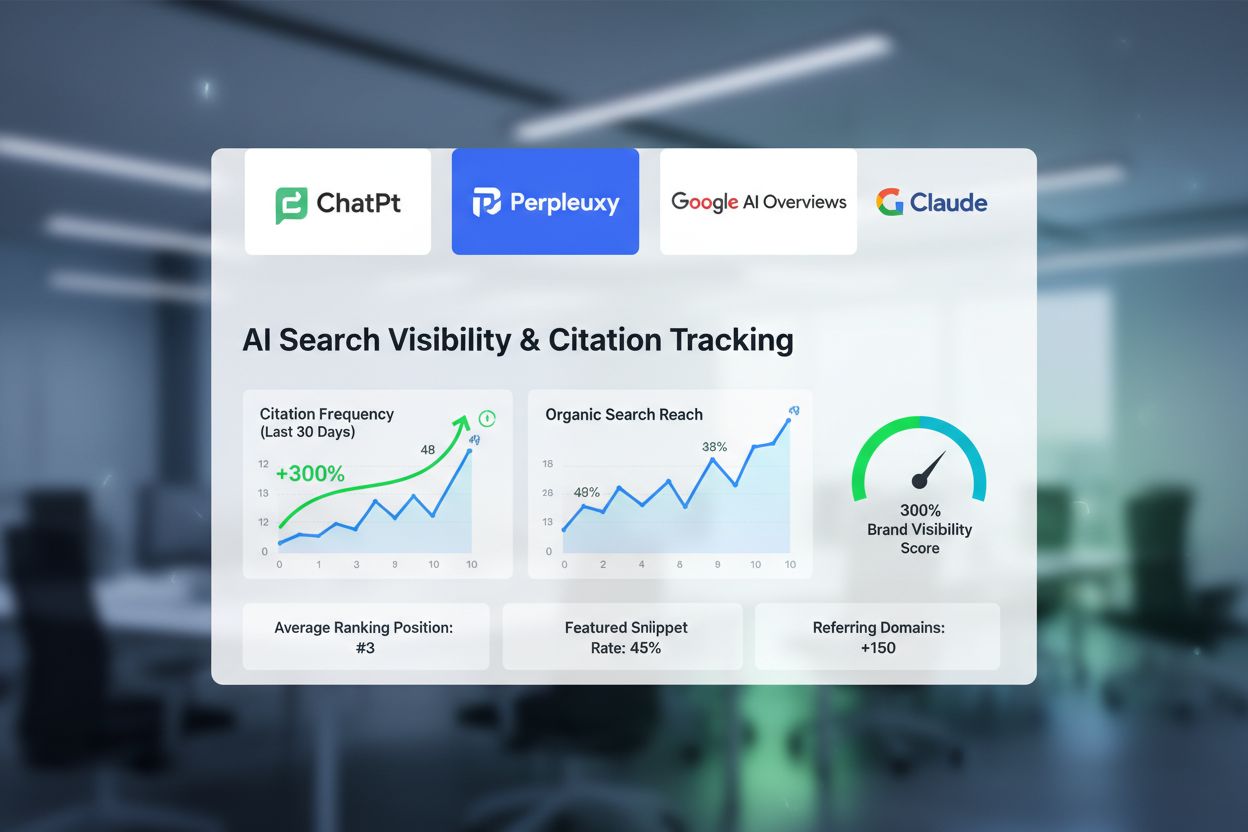
How SaaS Brands Increased AI Visibility by 300%: A Case Study
Discover how TechFlow Solutions achieved 300% AI citation growth and 185% qualified traffic increase through strategic GEO optimization. Real case study with ac...
8 min read
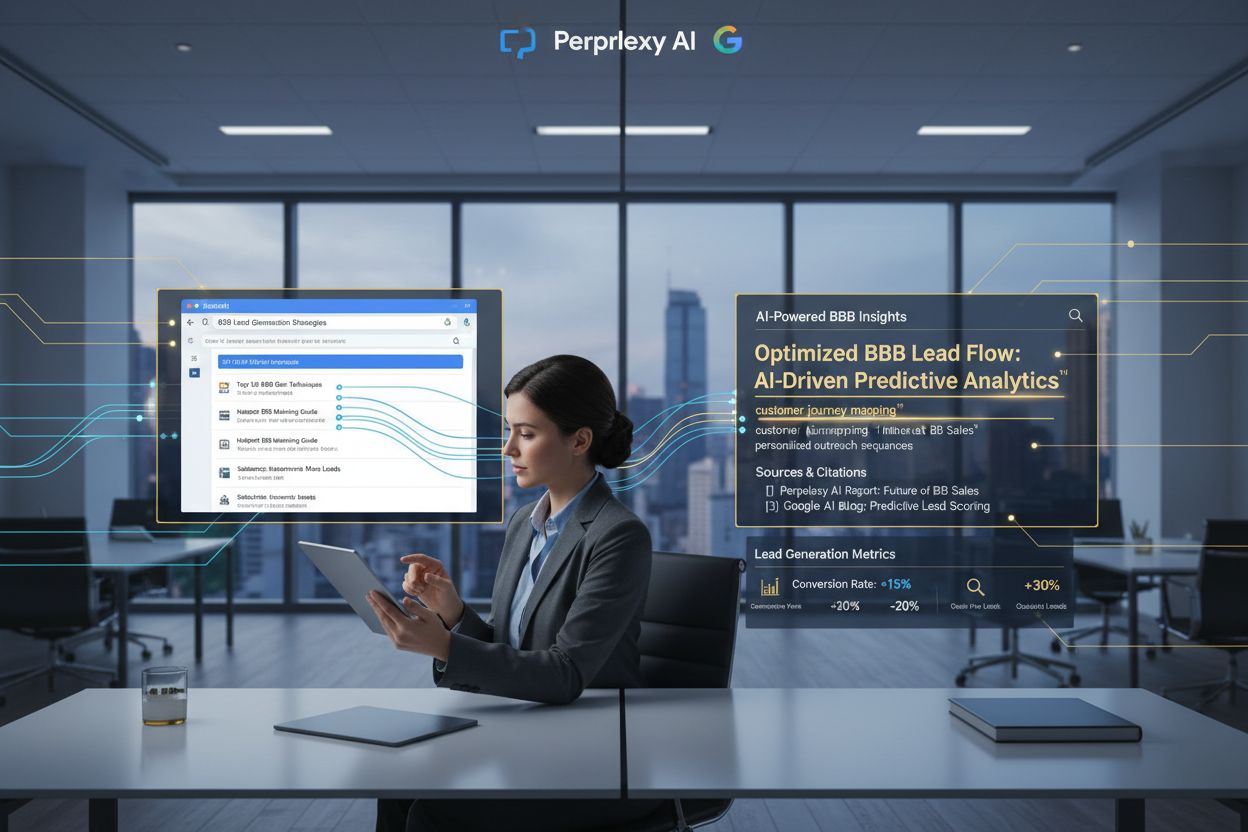
Discover how Smart Rent generated 345% more leads through AI citations. Real case study showing B2B lead generation strategy, results, and implementation tactics for AI visibility.
Smart Rent, a property management software company, faced a critical challenge that many B2B SaaS companies encounter today: despite having quality products and services, their brand remained invisible in the emerging AI search landscape. The company struggled with technical SEO deficiencies that suppressed their online visibility and, more importantly, prevented them from being cited in AI-generated answers. When potential customers turned to ChatGPT, Perplexity, or Google’s AI Overviews to research property management solutions, Smart Rent wasn’t part of the conversation. Within just 30 days of implementing a strategic AI-focused optimization framework, the company achieved remarkable results: a 32% increase in organic search demo form submissions, a staggering 345% increase in referral traffic from LLMs, and 100+ new citations across all major AI platforms including Google AIO, Gemini, ChatGPT, and Perplexity. This transformation wasn’t accidental—it was the result of a deliberate, data-driven strategy designed specifically to make their content visible and citable to AI systems.
Before diving deeper into Smart Rent’s strategy, it’s essential to understand what AI citations are and why they represent a fundamental shift in B2B lead generation. An AI citation occurs when a generative AI tool like ChatGPT, Perplexity, or Google’s AI Overviews references your content, brand, or insights in its generated response. This differs dramatically from traditional SEO, where visibility depends on ranking position and click-through rates. In the AI era, your content can drive value even without direct clicks—when an AI system cites your research, quotes your insights, or links to your content, you’re influencing the buyer’s decision-making process at a critical moment. The implications are profound: 90% of B2B buyers click through to sources cited in AI Overviews, meaning citations directly translate to qualified traffic and leads. This represents a shift from optimizing for search rankings to optimizing for content authority and trustworthiness—the very factors that AI systems use to determine which sources to cite.
| Metric | Traditional SEO | AI Citations |
|---|---|---|
| Click-through Dependency | High (ranking position drives clicks) | Lower (answers provided directly) |
| Trust Signal | Ranking position & backlinks | Content authority & clarity |
| Buyer Journey Stage | All stages | Early research & problem identification |
| Visibility Metric | Impressions & CTR | Citation frequency & prominence |
| Revenue Impact | Indirect (traffic → conversion) | Direct (90% click citations) |
Smart Rent’s transformation began with a comprehensive technical audit that revealed systemic issues preventing AI systems from properly crawling, understanding, and citing their content. The company implemented a 5-tier priority framework that addressed foundational problems first. The strategy included: (1) Systematic Indexation Fixes to ensure all valuable content was properly crawled and indexed by search engines and AI systems, (2) Redirect Optimization to eliminate unnecessary redirects that slowed page load times and confused AI crawlers, (3) Core Web Vitals Compliance to meet Google’s performance standards, which AI systems also consider when evaluating content quality, (4) Content Structure Enhancement with strategic FAQ sections and schema markup that help AI systems understand and extract information more effectively, and (5) Keyword Mapping and On-Page AEO (Answer Engine Optimization) with rewritten titles, meta descriptions, and natural language insertions designed specifically for LLM parsing. These technical improvements created the foundation necessary for AI systems to discover, understand, and ultimately cite Smart Rent’s content. The company also implemented a backlinking and web citation strategy, identifying high-authority “top 10 solutions” listicles and securing strategic placements to boost domain authority—a signal that AI systems consider when evaluating source credibility.
Beyond technical fixes, Smart Rent recognized that content structure and format directly impact whether AI systems will cite your work. The company implemented specific content optimization tactics designed for AI parsing and citation:
The results of Smart Rent’s AI citation strategy were quantifiable and impressive. Within 30 days, the company achieved a 50% increase in Google AI Overview citations, moving from zero visibility to approximately 30 total citations across Google’s AI platform. More significantly, they generated 100+ new citations across all major AI platforms, including Gemini, ChatGPT, and Perplexity. These citations translated directly into business results: a 32.1% increase in organic search demo form submissions and a 21.9% increase in key events (tracked conversions). But the most striking metric was the 345% increase in referral traffic from LLMs—a nearly 4x multiplier in qualified traffic from AI systems. This wasn’t vanity traffic; these were high-intent prospects who had already been exposed to Smart Rent’s insights through AI-generated answers and were now clicking through to learn more. The compounding effect became clear: more citations led to more visibility in AI responses, which drove more qualified traffic, which generated more demo requests and sales conversations. For Smart Rent, this meant that their investment in AI citation optimization directly contributed to pipeline growth and revenue acceleration.

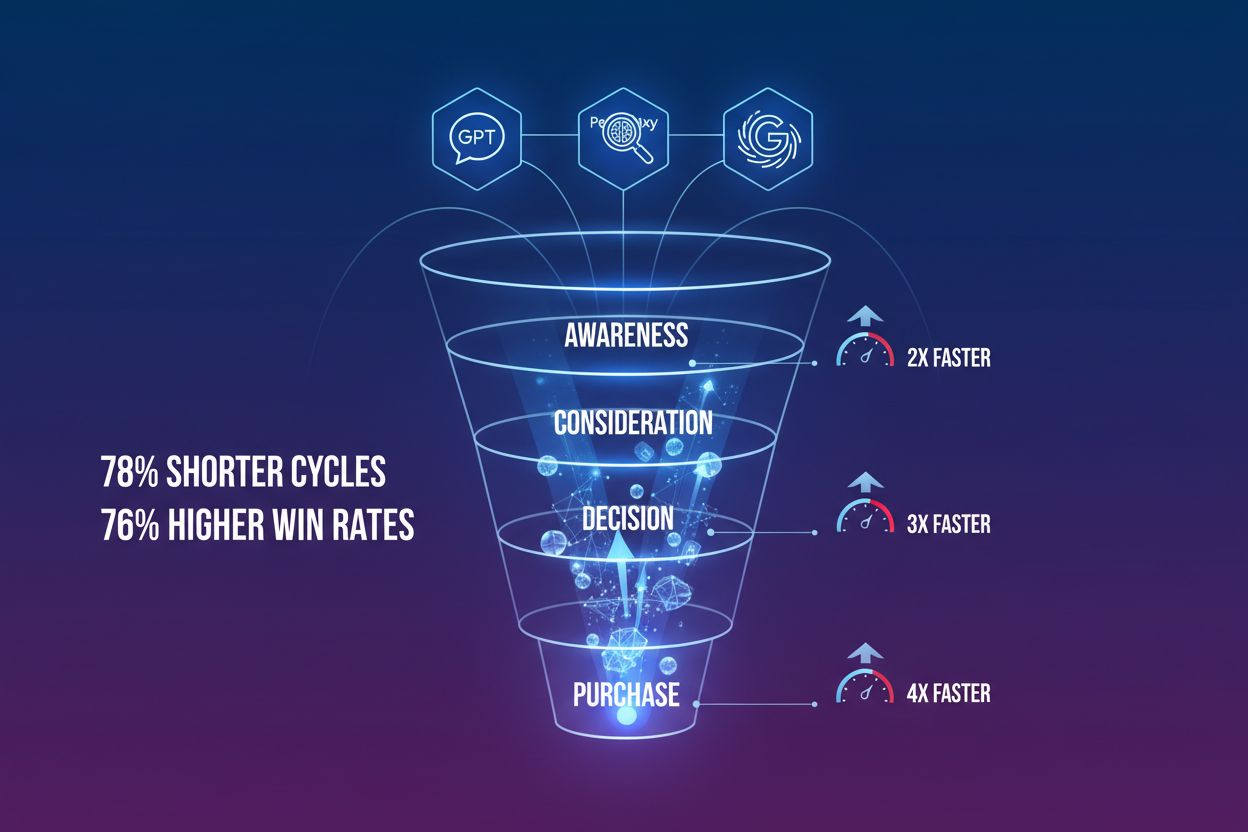
Smart Rent’s success isn’t an isolated case—it reflects broader trends reshaping B2B lead generation across industries. Research from BCG and other leading firms shows that companies implementing comprehensive AI-powered lead generation strategies are experiencing transformative results. Organizations using AI-powered lead scoring achieve up to 30% better conversion rates than traditional methods, while those leveraging AI-driven sales coaching see 39% increases in playbook adherence and 7% improvements in conversion rates. The impact on deal dynamics is equally striking: companies using AI for prospecting and lead qualification report 76% higher win rates, 78% shorter deal cycles, and 70% larger deal sizes. These improvements stem from a fundamental compression of the B2B buyer journey. AI Overviews and answer engines are accelerating how buyers move through awareness and consideration stages, providing instant access to curated insights that previously required weeks of research. Buyers now arrive at the decision stage with significantly more information and fewer questions, having already been exposed to multiple vendor perspectives through AI-generated summaries. This compression creates both opportunity and urgency: companies that secure citations in these early-stage AI responses gain disproportionate influence over buyer perception and decision-making. The data is clear: 91% of B2B leaders plan to increase AI spending over the next 12 months, signaling that AI-driven lead generation is no longer experimental—it’s becoming the standard approach for forward-thinking B2B organizations.
The Smart Rent case study provides a roadmap that other B2B companies can follow. Implementation begins with a content audit focused on AI visibility, not just traditional SEO metrics. Start by identifying the high-intent questions your buyers are asking at each stage of their journey—the questions they’re typing into ChatGPT, Perplexity, or Google’s search bar. These questions often differ from traditional keyword searches; they’re more conversational and problem-focused. Next, audit your existing content against these questions: Are you answering them? Is your answer clear, direct, and well-structured? Do you have FAQ sections with schema markup? Once you’ve identified gaps, create or optimize content specifically for AI citation. This means structuring content with clear Q&A formats, adding FAQ schema, ensuring your content directly answers the question in the opening sentences, and building trust signals throughout. Monitor your citation metrics by regularly searching your target questions in ChatGPT, Perplexity, and Google’s AI Overviews to see if and where you’re being cited. Finally, implement continuous optimization: track which content gets cited, analyze what makes that content citation-worthy, and apply those lessons to future content creation. This iterative approach ensures your strategy evolves as AI systems and buyer behavior continue to change.
As B2B companies shift focus toward AI citations, measurement frameworks must evolve beyond traditional SEO metrics. While organic traffic and rankings remain important, they no longer tell the complete story. Citation frequency becomes a primary metric—how often is your brand or content cited across ChatGPT, Perplexity, Google AIO, and other AI platforms? Track this monthly to identify trends and correlate citation increases with content updates or new publications. AI visibility score is another emerging metric that combines citation frequency, citation prominence (is your content the primary source or a secondary mention?), and citation growth rate. Revenue impact measurement requires connecting AI citations to downstream business outcomes: Which AI-cited content drives the most qualified traffic? Which traffic sources convert at the highest rates? Which convert to the largest deals? This requires robust analytics integration between your website, CRM, and AI citation tracking tools. The shift from volume to quality metrics is critical: rather than optimizing for total traffic, focus on high-intent traffic from AI sources, which typically converts at higher rates than traditional search traffic. Finally, integrate AI metrics into your overall marketing dashboard so leadership can see how AI citation strategy contributes to pipeline and revenue goals—this ensures continued investment and strategic alignment.
The trajectory is clear: AI citations will become increasingly central to B2B lead generation strategy over the next 2-3 years. As AI systems become more sophisticated and more widely used for research, the competitive advantage will accrue to companies that secure prominent citations in AI-generated responses. Early adopters like Smart Rent are already capturing disproportionate value from this shift, but the window for competitive advantage is narrowing as more companies recognize the opportunity. The brands that will dominate B2B markets in 2026 and beyond will be those that integrate AI citation strategy into their overall content and marketing approach—not as a separate initiative, but as a core component of how they create, structure, and distribute content. This integration requires rethinking content strategy from the ground up: every piece of content should be evaluated not just for traditional SEO value, but for its potential to be cited by AI systems. It requires investment in content quality, structure, and authority-building. It requires continuous monitoring and optimization based on citation performance. Most importantly, it requires recognizing that the future of B2B lead generation isn’t about competing for clicks—it’s about competing for citations, authority, and trust in the AI-mediated discovery process. Companies that embrace this shift early will establish themselves as category leaders and trusted sources, positioning themselves for sustained growth as AI continues to reshape how B2B buyers discover, evaluate, and select solutions.
AI citations occur when generative AI tools like ChatGPT, Perplexity, or Google's AI Overviews reference your content in their generated responses. Unlike traditional SEO which depends on ranking position and click-through rates, AI citations focus on content authority and trustworthiness. The key difference: 90% of B2B buyers click through to sources cited in AI Overviews, meaning citations directly drive qualified traffic regardless of search ranking position.
Smart Rent implemented a comprehensive 5-tier strategy including technical SEO fixes (indexation, Core Web Vitals, redirects), content structure enhancement with FAQ schema markup, keyword mapping for natural language processing, and backlinking strategy. Within 30 days, they generated 100+ new citations across all major AI platforms, which directly translated to 345% more referral traffic from LLMs and 32% more demo form submissions.
AI systems prioritize clear Q&A structures, direct answers without fluff, FAQ schema markup, natural language optimization, and trust signals like author bios and data citations. Content should answer the question directly in the first 1-2 sentences, use logical subheadings and bullet points, and include visual elements. This structure helps AI systems understand and cite your content more effectively.
Smart Rent saw significant results within 30 days of implementing their strategy, including 100+ new citations and 345% increase in LLM traffic. However, results vary based on content quality, competition, and implementation thoroughness. Most companies should expect to see initial citation increases within 4-8 weeks, with continued growth as more content is optimized and authority builds.
Key metrics include: citation frequency (how often you're cited across platforms), citation prominence (primary vs secondary mentions), AI visibility score (combined metric of frequency and growth), referral traffic from AI sources, conversion rates from AI traffic, and revenue impact. Track these monthly and correlate with content updates to identify what drives citations and conversions.
Focus on creating clear, authoritative content that directly answers buyer questions. Implement FAQ schema markup, optimize for natural language queries, build trust signals (author bios, citations, data), and ensure content is publicly available (not gated). Regularly search your target questions in ChatGPT, Perplexity, and Google AI Overviews to see where you're being cited and identify optimization opportunities.
While traditional SEO remains important, AI citation optimization offers faster ROI in many cases. Smart Rent achieved 345% LLM traffic increase in 30 days. Companies using AI-powered lead generation report 76% higher win rates, 78% shorter deal cycles, and 70% larger deal sizes. The key advantage: AI-cited traffic typically converts at higher rates because buyers have already been exposed to your insights through AI responses.
AI citation strategy should be integrated into your overall content and marketing approach, not treated as a separate initiative. Every piece of content should be evaluated for both traditional SEO value and AI citation potential. This requires rethinking content structure, ensuring public availability of key content, building topical authority, and continuously monitoring citation performance. It complements rather than replaces traditional SEO, paid advertising, and other marketing channels.
Monitor how AI systems cite your brand across ChatGPT, Perplexity, Google AI Overviews, and more. Get real-time insights into your AI visibility and lead generation impact.
Discover how TechFlow Solutions achieved 300% AI citation growth and 185% qualified traffic increase through strategic GEO optimization. Real case study with ac...

Learn how to format case studies for AI citations. Discover the blueprint for structuring success stories that LLMs cite in AI Overviews, ChatGPT, and Perplexit...

Community discussion on how B2B companies optimize for AI search. Real experiences from B2B marketers implementing AEO and GEO strategies.