
Integrating AI Visibility with Your Existing SEO Strategy
Learn how to combine AI visibility monitoring with traditional SEO to create a unified search strategy that captures visibility across all discovery channels.
12 min read
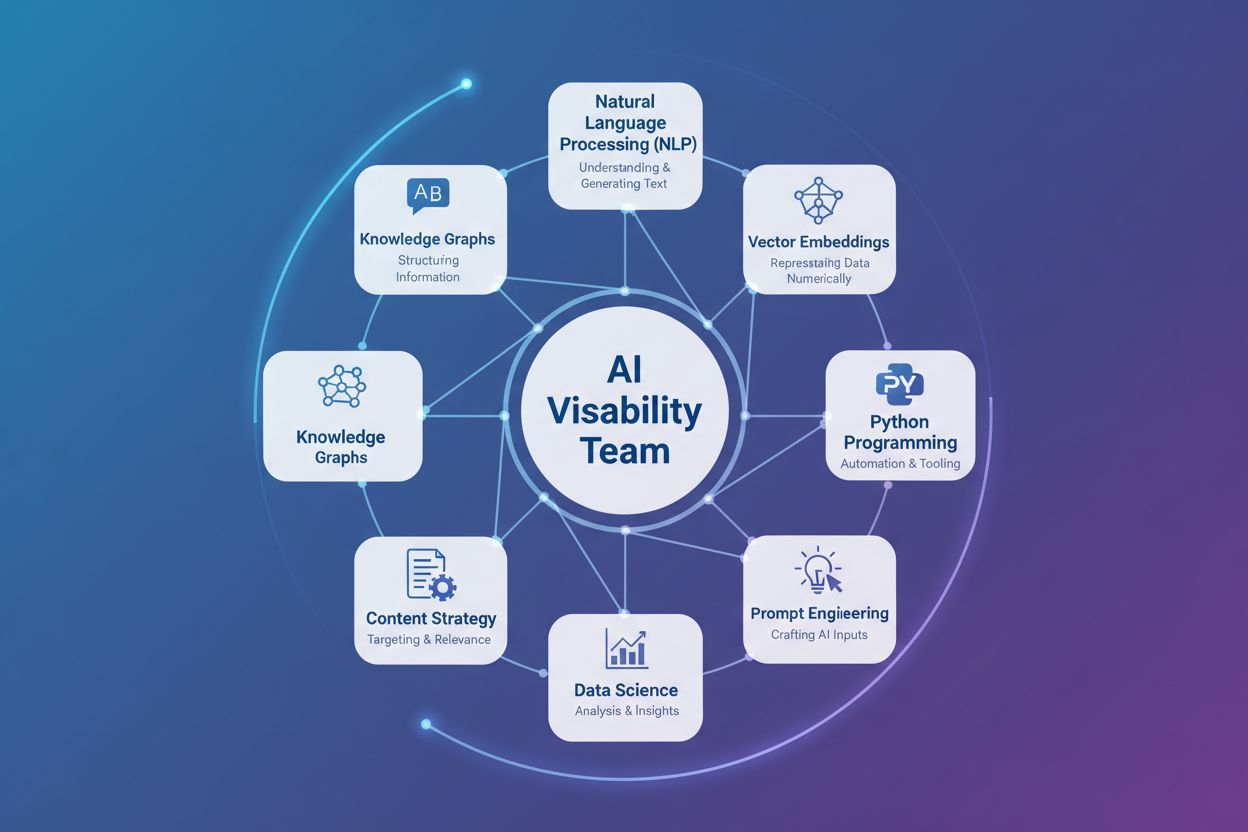
Learn how to structure an AI visibility team with essential roles like Relevance Engineers, Retrieval Analysts, and AI Strategists. Discover key skills, organizational models, and practical steps to monitor your brand across ChatGPT, Perplexity, and AI Overviews.
The marketing landscape is undergoing a seismic transformation that most organizations haven’t fully grasped yet. Traditional search engine optimization focused on rankings and click-through rates, but AI-driven discovery operates on entirely different principles. Platforms like ChatGPT, Perplexity, Claude, and Google AI Overviews are fundamentally changing how users find information, and your brand’s visibility in these systems requires a completely different approach. According to industry analysis, 97-98% of SEO professionals aren’t equipped to handle this shift, yet 78% of organizations are already using AI in production environments. The question isn’t whether your organization needs an AI visibility strategy—it’s whether you’ll build the right team to execute it before your competitors do.
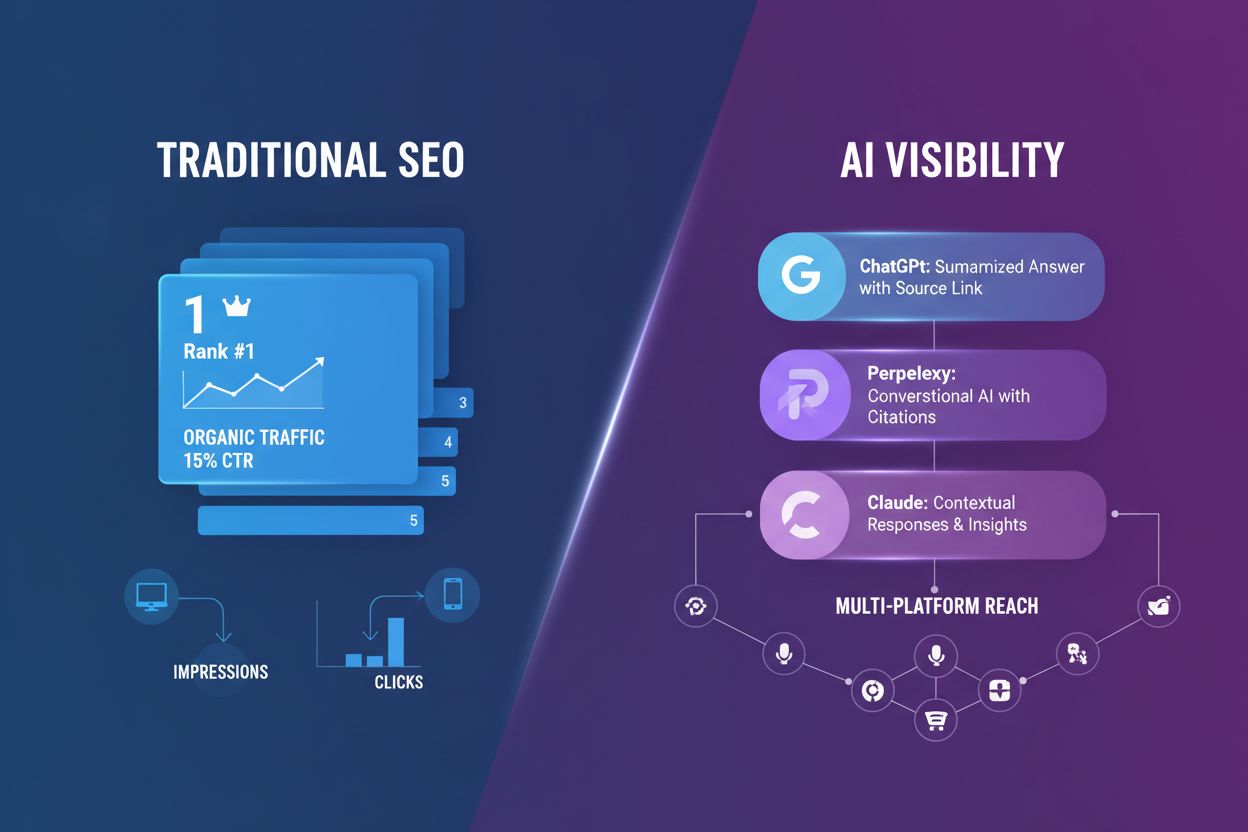
Building an effective AI visibility team requires more than hiring a few data scientists. You need a cross-functional group with specialized roles that work together to ensure your brand appears, is cited, and is trusted across AI-powered platforms. The most successful organizations are creating hybrid roles that bridge traditional marketing expertise with AI-first thinking. These teams typically include a Relevance Engineer who builds the technical foundation, a Retrieval Analyst who understands how AI systems select sources, and an AI Strategist who connects everything to business objectives. Each role brings distinct expertise, but they must work in concert to achieve visibility across multiple AI platforms simultaneously.
| Role | Primary Responsibility | Key Skills | Business Impact |
|---|---|---|---|
| Relevance Engineer | Build content systems for AI retrieval and citation | NLP, Python, semantic architecture, embeddings | Ensures brand becomes the authoritative source AI systems cite |
| Retrieval Analyst | Understand and optimize AI selection patterns | Data analysis, competitive research, A/B testing | Identifies why competitors get cited and fixes gaps |
| AI Strategist | Lead cross-platform visibility strategy | Strategic thinking, platform analysis, stakeholder management | Aligns AI initiatives with business goals and market shifts |
The Relevance Engineer serves as the cornerstone of any AI visibility program, combining technical expertise with deep understanding of how AI systems process and retrieve information. Unlike traditional SEO specialists who optimize for rankings, Relevance Engineers build content systems that AI models can easily understand, extract, and cite. They think in systems rather than individual pages, designing networks of information that allow AI to traverse content efficiently and recognize your brand as an authoritative source. This role requires both technical depth and strategic thinking—they must understand how embeddings work, how semantic relationships function, and how to structure content for maximum machine comprehension.
Core responsibilities of a Relevance Engineer include:
While the Relevance Engineer builds the foundation, the Retrieval Analyst specializes in understanding exactly how AI systems select, synthesize, and cite information from multiple sources. This role has become critical as brands compete not just for visibility, but for inclusion in AI-generated responses across multiple platforms. Retrieval Analysts study the patterns of AI selection, analyzing why certain content gets chosen over competitors’ content and identifying structural or semantic gaps that affect citation probability. They conduct controlled experiments to understand AI behavior and translate findings into actionable optimization strategies. Without this role, even perfectly structured content might remain invisible if it doesn’t align with how specific AI systems prioritize sources.
Core responsibilities of a Retrieval Analyst include:
The AI Strategist leads the overall plan for how your brand shows up across the entire AI ecosystem, looking beyond any single platform to focus on comprehensive visibility. They understand that AI discovery is rapidly evolving, with new platforms emerging and user behaviors shifting constantly. AI Strategists connect the dots between emerging technologies and your organization’s business objectives, ensuring that GEO (Generative Engine Optimization) efforts support long-term competitive advantage. They translate technical AI concepts into business strategy and help leadership understand that AI visibility is not a marketing tactic but a fundamental shift in how customers discover and evaluate brands.
Core responsibilities of an AI Strategist include:
Moving from traditional SEO to AI visibility requires developing entirely new categories of expertise across your team. These foundational skills ensure your organization can operate effectively in a world where AI systems decide what gets seen, cited, and trusted.
Natural Language Processing (NLP): Understanding how AI reads and interprets language is fundamental to visibility. Your team needs to grasp concepts like semantic similarity, entity recognition, and intent classification. This knowledge directly impacts how you structure content for AI consumption, moving from keyword matching to meaning-based optimization.
Embeddings and Vector Understanding: AI systems don’t “read” content the way humans do; instead, they calculate meaning through vector embeddings—numerical representations that allow systems to compute how closely content matches a query. Understanding how embeddings work and how to structure content that aligns well in vector space is essential for modern AI visibility.
Python for Data Analysis and Simulation: While not everyone needs to be a programmer, having team members who can analyze large datasets, simulate AI behavior, and automate repetitive tasks provides significant competitive advantages. Python enables teams to create specialized tools for passage-level optimization and identify patterns that manual analysis would miss.
Content Strategy for Machine Consumption: AI visibility requires understanding how AI systems integrate information from multiple sources to generate coherent responses. This means structuring information in semantic units, using explicit semantic patterns, and ensuring content maintains coherence when broken into fragments for AI processing.
Prompt Engineering: Knowing how to write effective prompts for testing AI systems helps teams understand how AI interprets content and develop content that aligns with common query patterns. This skill reveals how AI systems prioritize certain content types and structures.
Data Science Fundamentals: Understanding statistical analysis, A/B testing, and data visualization helps teams make informed decisions based on measurable results rather than assumptions. When competing for visibility in systems processing billions of data points, statistical rigor becomes essential.
Knowledge Graph Management: As AI systems rely more on structured knowledge, knowing how to create and manage knowledge graphs gives teams a significant advantage. This involves understanding entity relationships, ontologies, and how different AI systems structure information internally.
How you organize your AI visibility team within your broader organization significantly impacts effectiveness and scalability. The optimal structure depends on your organization’s size, AI maturity, and strategic goals, but several proven models have emerged.
Centralized “Center of Excellence”: In early stages of AI adoption, many companies create a central AI visibility team that serves the entire organization. This star-shaped structure concentrates expertise in one unit, offering focus and efficiency. A centralized team can partner with various business units as an internal consultancy, helping anyone with AI visibility needs develop solutions. This model works well for smaller firms or those beginning their AI journey, though it can become a bottleneck as demand grows.
Matrix or Hybrid Structure: As AI capabilities expand, a matrix structure provides greater scalability. AI experts remain part of a core functional team but are embedded into different product lines or departments to work on specific business problems. This dual reporting structure fosters close collaboration with domain experts while maintaining a community of practice among AI practitioners. The matrix approach allows solutions to be tailored to departmental needs while spreading AI-first thinking company-wide.
Fully Decentralized (Embedded) Teams: At the most advanced level, some organizations embed AI talent entirely within each business unit. Every department has its own AI specialists working as part of that unit’s daily operations. This model treats AI visibility as integral to each function, ensuring solutions are deeply integrated into workflows. The risk is silos and inconsistency without a central hub, so companies using this model typically maintain a strong cross-functional forum for AI practitioners to share best practices.
Creating an effective AI visibility team requires strategic planning and intentional execution. Follow these practical steps to build a team that delivers measurable results.
Define Your AI Visibility Goals: Start by articulating what your organization aims to achieve with AI visibility. Are you focused on brand authority, customer acquisition, or market leadership? Clear goals guide every hiring and strategy decision.
Audit Existing Capabilities: Before hiring, assess what expertise already exists in your organization. Many companies discover more capability than expected—backend engineers often transition into AI roles, and analysts with SQL and statistics foundations can co-own early experiments.
Identify Skill Gaps: Map the specific skills you need against what you have. Reliable data pipelines, production model deployment, and monitoring require specialized expertise. Identify which gaps pose the highest risk to your AI visibility strategy.
Decide: Hire, Upskill, or Partner: For each gap, determine the best approach. Hire for core strategic roles that must be owned in-house, upskill existing employees for adjacent skills, and partner with external providers for niche expertise or rapid scaling.
Establish Governance and Ethics: Define clear ethical guidelines for AI development and deployment. Ensure your team understands how to identify and mitigate bias, maintain transparency, and use AI responsibly.
Create Cross-Functional Collaboration: AI visibility success requires collaboration across marketing, product, engineering, and sales. Establish regular knowledge-sharing sessions and embed AI team members into cross-departmental squads.
Measure and Iterate: Define key performance indicators for your AI visibility efforts. Track citation frequency, brand mention accuracy, and content retrieval rates. Use data to continuously refine your strategy and prove ROI to stakeholders.
Building an AI visibility team faces real obstacles that organizations must address strategically. The global AI talent shortage is acute—demand for AI skills has exploded while the talent pool hasn’t kept pace. Nearly half of executives (44%) cite lack of in-house AI expertise as a major barrier to adopting AI effectively. Rather than competing head-on for scarce talent, successful organizations adopt a multi-pronged approach: upskilling existing employees through structured training programs, recruiting from adjacent fields where people can learn on the job, and strategically partnering with external providers for specialized needs. Change management is equally critical—introducing AI can unsettle employees who fear displacement. Clear communication about how AI augments rather than replaces human work, combined with training that builds confidence, helps teams embrace AI visibility initiatives. Early wins and visible success stories convert skeptics into advocates and build momentum for scaling AI across the organization.
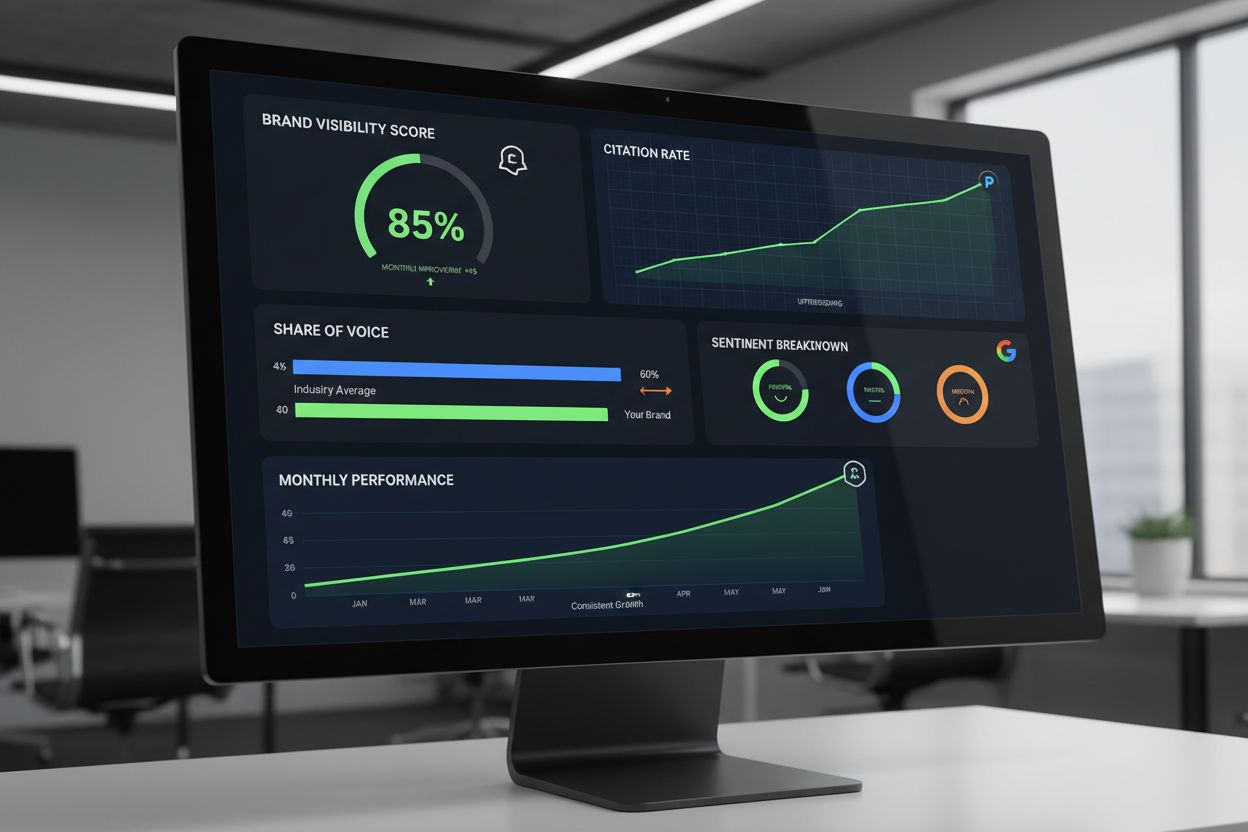
Proving the value of your AI visibility team requires tracking the right metrics. Traditional SEO metrics like rankings and click-through rates don’t capture AI visibility impact, so you need new KPIs designed for the generative era.
Key metrics for AI visibility success include:
By tracking these metrics consistently, you can demonstrate ROI to stakeholders, identify optimization opportunities, and continuously improve your AI visibility strategy. The organizations that measure rigorously will be the ones that scale AI visibility most effectively.
An AI visibility team is a cross-functional group responsible for ensuring your brand appears, is cited, and is trusted across AI-powered platforms like ChatGPT, Perplexity, Claude, and Google AI Overviews. Unlike traditional SEO teams focused on rankings, AI visibility teams optimize for citation frequency, semantic understanding, and presence in AI-generated responses.
Traditional SEO teams optimize for search rankings and click-through rates, while AI visibility teams focus on ensuring your brand is retrieved, synthesized, and cited by AI systems. The shift requires different skills—from keyword optimization to semantic architecture, from ranking positions to citation frequency, and from page-level metrics to passage-level performance.
The three core roles are: Relevance Engineer (builds content systems for AI retrieval), Retrieval Analyst (understands how AI systems select sources), and AI Strategist (leads cross-platform visibility strategy). These roles work together to ensure your brand becomes the authoritative source that AI systems cite first.
Key metrics include citation frequency across AI platforms, brand mention accuracy, content chunk retrieval rates, cross-platform visibility scores, and conversion impact from AI-driven traffic. Unlike traditional SEO metrics, AI visibility measurement focuses on how often your content appears in AI-generated responses and whether it drives business outcomes.
The most effective approach is hybrid: hire for core strategic roles that must be owned in-house (like AI Strategist), upskill existing employees for adjacent skills (like turning software engineers into ML engineers), and partner with external providers for specialized expertise. This balances cost, control, and speed.
Essential skills include Natural Language Processing (NLP), vector embeddings understanding, Python for data analysis, prompt engineering, data science fundamentals, content strategy for machine consumption, and knowledge graph management. Soft skills like cross-functional collaboration and communication are equally important.
AI visibility directly impacts customer discovery, brand authority, and competitive positioning. When your brand appears in AI-generated responses, you gain credibility, reach customers earlier in their decision journey, and establish authority in your market. Organizations with strong AI visibility see improved lead quality and customer trust.
Three common structures are: Centralized (one team serving the whole organization), Matrix (AI experts embedded in departments but reporting to a functional lead), and Decentralized (AI specialists fully embedded in each business unit). Choose based on your organization's size, AI maturity, and strategic goals.
Track how your brand appears across ChatGPT, Perplexity, Google AI Overviews, and other AI platforms. Get real-time insights into your AI citations and visibility metrics.
Learn how to combine AI visibility monitoring with traditional SEO to create a unified search strategy that captures visibility across all discovery channels.
Discover how personalized AI answers and user context reshape brand visibility. Learn strategies to optimize for AI search and measure your presence in AI-gener...

Learn how to conduct a baseline AI visibility audit to understand how ChatGPT, Google AI, and Perplexity mention your brand. Step-by-step assessment guide for b...