
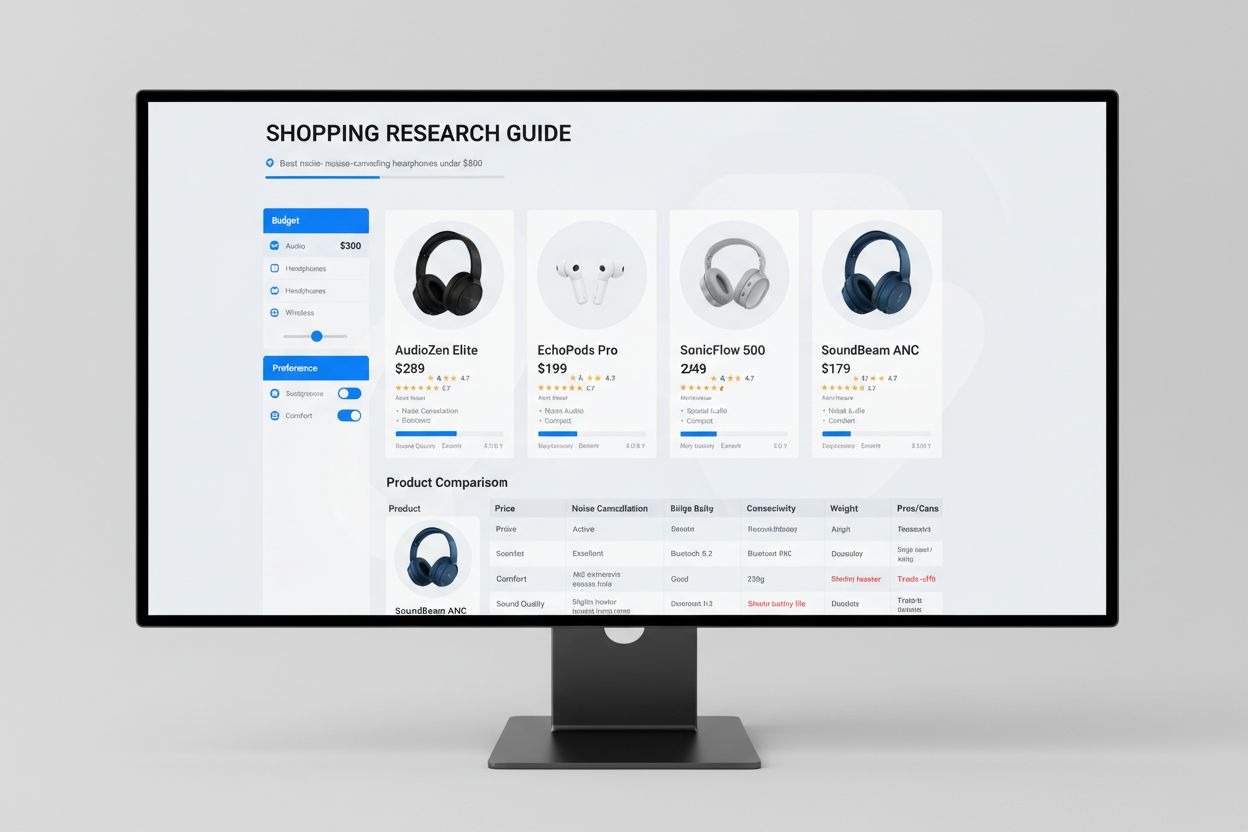
ChatGPT Shopping Research
Learn how ChatGPT Shopping Research helps you compare products, find deals, and make smarter purchase decisions with AI-powered recommendations and instant chec...
8 min read
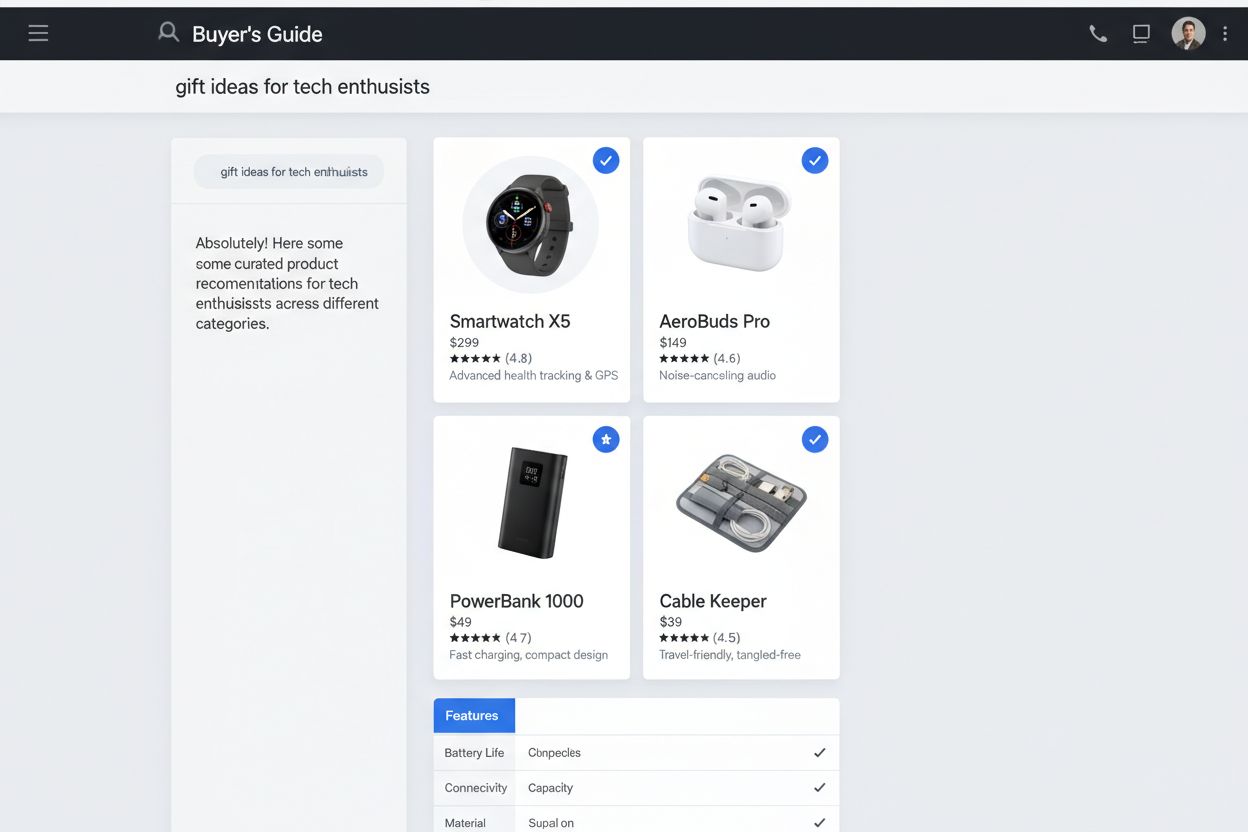
Learn how to get your products featured in ChatGPT buyer’s guides and AI-generated research. Discover optimization strategies for ChatGPT Shopping Research and increase your visibility in conversational AI product discovery.
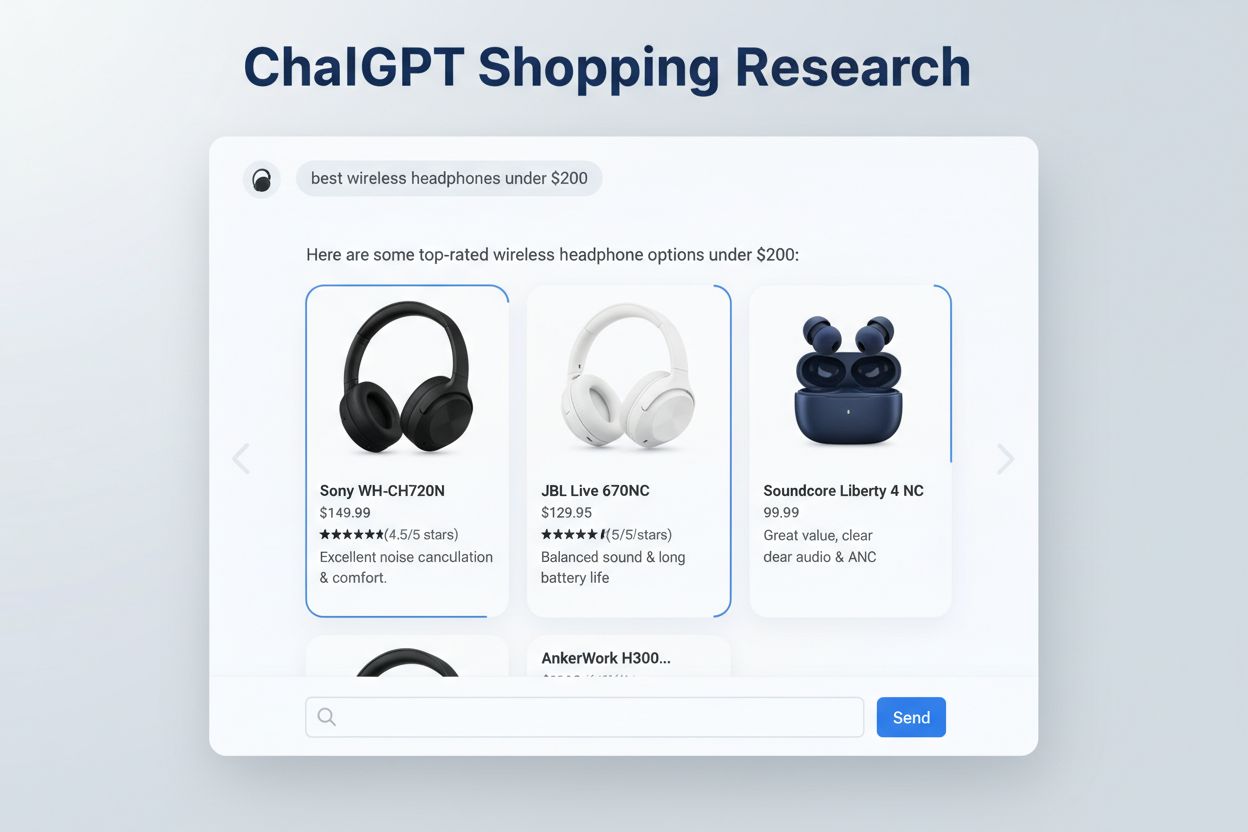
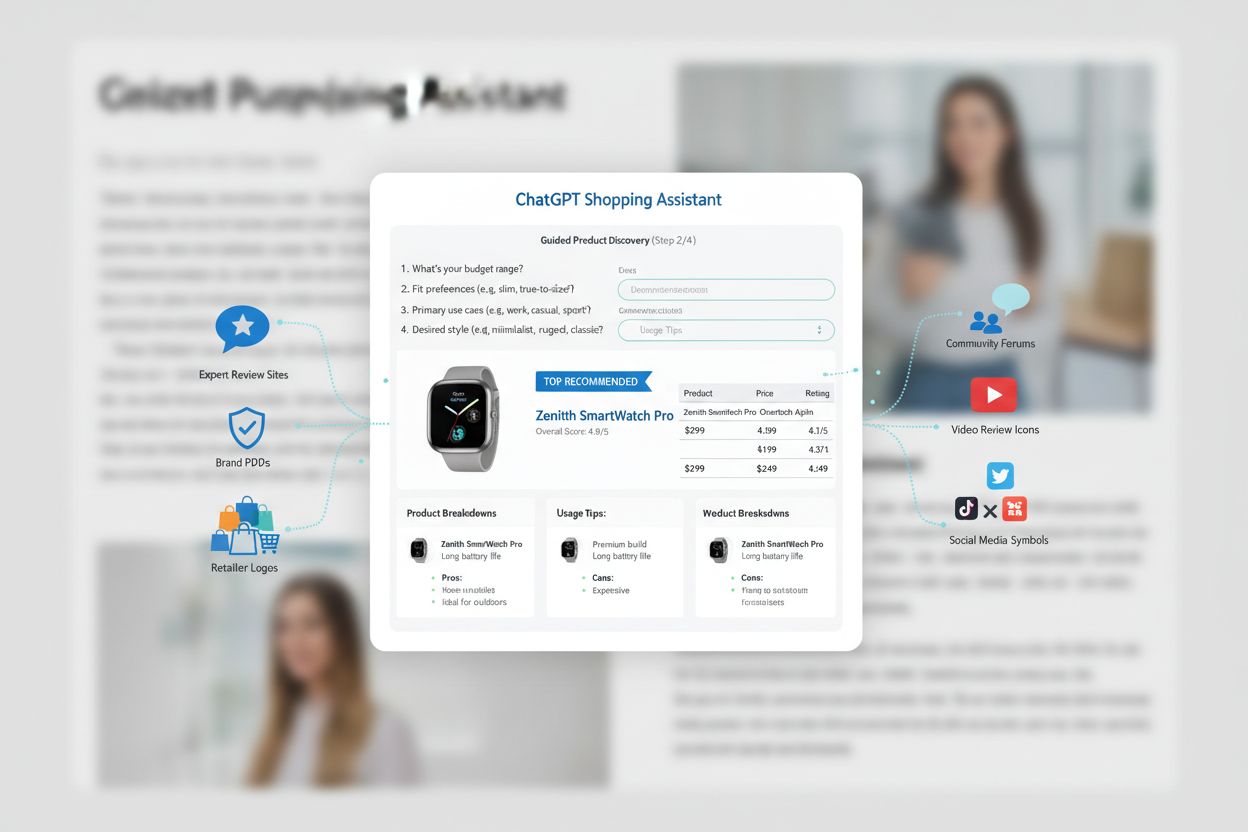
ChatGPT Shopping Research represents a fundamental shift in how consumers discover and evaluate products online. This conversational buyer’s guide feature enables users to ask natural language questions about products, and ChatGPT responds with personalized recommendations based on their specific needs. Unlike traditional search engines that return links to websites, AI-assisted research directly synthesizes product information into conversational responses that feel like talking to a knowledgeable shopping assistant. The platform analyzes product data, reviews, specifications, and pricing to deliver curated recommendations in real-time. This approach fundamentally differs from traditional search because it prioritizes relevance and personalization over keyword matching and link authority.
OpenAI’s OAI-SearchBot crawler continuously scans the web to discover and index product information for the ChatGPT Shopping Research feature. This intelligent crawler operates through multiple data collection methods, each with distinct advantages and limitations. The crawler can access your website directly through standard web crawling, integrate with Shopify stores for real-time product data synchronization, or accept direct feed submissions through OpenAI’s Product Discovery platform. The accuracy of product information varies depending on your chosen method—website crawling relies on proper HTML structure and metadata, while Shopify integration provides structured data directly from your store system. Understanding these different pathways helps merchants optimize their product visibility across ChatGPT’s discovery mechanisms.
| Method | Data Source | Accuracy | Setup Complexity | Best For |
|---|---|---|---|---|
| Website Crawling | HTML pages, meta tags, structured data | Medium-High | Low | Established websites with good SEO |
| Shopify Integration | Native Shopify product data | Very High | Medium | Shopify store owners seeking automation |
| Direct Feed Submission | XML/JSON product feeds | Very High | High | Large catalogs requiring precise control |
The rise of conversational AI has fundamentally altered how product discovery works, making traditional SEO strategies insufficient for modern e-commerce success. While backlinks and domain authority still matter for Google Search, ChatGPT prioritizes on-page content quality and comprehensive product information over external link signals. Your product page content now serves as the primary data source for AI evaluation, meaning detailed descriptions, specifications, and user-focused information directly influence whether ChatGPT recommends your products. Content optimization for AI crawlers requires a different approach than optimizing for human readers—you must balance natural language with structured data that machines can easily parse. The shift from search to conversational AI means merchants who invest in rich, detailed product pages gain significant competitive advantages. Traditional feed-based approaches no longer guarantee visibility when AI systems can extract information directly from your website’s content.
Getting featured in ChatGPT Shopping Research requires a strategic, multi-layered approach that addresses how AI systems discover, evaluate, and recommend your products. The following five strategies form the foundation of a successful ChatGPT optimization program:
Optimize robots.txt for OAI-SearchBot: Ensure your robots.txt file explicitly allows the OAI-SearchBot crawler to access your product pages and product data. This simple configuration change removes technical barriers that might prevent ChatGPT from discovering your inventory.
Create comprehensive product descriptions: Write detailed, user-focused product descriptions that answer common questions and address customer pain points. Include specifications, dimensions, materials, use cases, and benefits in natural language that both humans and AI systems can understand.
Implement structured data (schema markup): Add JSON-LD schema markup to your product pages using Schema.org standards. This structured data helps ChatGPT understand product attributes, pricing, availability, and reviews with complete accuracy.
Build trust signals and reviews: Accumulate authentic customer reviews, ratings, and testimonials on your website and third-party platforms. ChatGPT evaluates credibility through social proof, making review volume and quality critical ranking factors.
Register with OpenAI Product Discovery: Create an account on OpenAI’s Product Discovery platform and submit your product feeds directly. This direct submission method ensures your products are indexed with maximum accuracy and provides additional visibility opportunities.
Optimizing your product pages for ChatGPT requires attention to multiple elements that work together to communicate product value to AI systems. Your product titles should be descriptive and include key attributes (brand, model, primary features) without keyword stuffing—for example, “Stainless Steel French Press Coffee Maker, 34oz, Borosilicate Glass” communicates more useful information than “Best Coffee Maker.” Product descriptions should be comprehensive yet scannable, using short paragraphs, bullet points, and clear formatting to highlight specifications, dimensions, materials, care instructions, and use cases. High-quality product images with descriptive alt text help ChatGPT understand what you’re selling, while FAQ sections directly address common customer questions that users might ask ChatGPT. Each element matters because ChatGPT extracts information from these components to build a complete product profile for recommendations.
Here’s how to configure your robots.txt file to ensure OAI-SearchBot can access your product pages:
# Good robots.txt configuration for ChatGPT discovery
User-agent: OAI-SearchBot
Allow: /products/
Allow: /shop/
Allow: /catalog/
Disallow: /admin/
Disallow: /cart/
Disallow: /checkout/

# Standard rules for other crawlers
User-agent: *
Allow: /
Disallow: /admin/
Disallow: /private/
Avoid this common mistake that blocks ChatGPT from discovering your products:
# Bad robots.txt - blocks all crawlers including OAI-SearchBot
User-agent: *
Disallow: /
Customer reviews and ratings serve as critical trust signals that ChatGPT uses to evaluate product quality and merchant credibility. When ChatGPT encounters multiple positive reviews with specific details about product performance, durability, and customer satisfaction, it gains confidence in recommending those products to users. Third-party mentions from reputable websites, industry publications, and social media platforms further strengthen your credibility profile in ChatGPT’s evaluation system. The platform analyzes review sentiment, reviewer credibility, and review recency to determine whether recommendations should be featured prominently or mentioned with caveats. Merchants with 4.5+ star ratings and substantial review volumes consistently receive higher visibility in ChatGPT Shopping Research results. Building authentic social proof through genuine customer feedback creates a competitive moat that’s difficult for competitors to replicate, making review generation a strategic priority for long-term success.
Structured data using JSON-LD format provides ChatGPT with machine-readable product information that eliminates ambiguity and improves recommendation accuracy. Schema markup from Schema.org standards allows you to explicitly define product attributes like price, availability, color options, size variants, and review ratings in a format that AI systems instantly understand. Rather than forcing ChatGPT to parse your product page content and infer product details, structured data delivers this information directly in a standardized format. Implementing JSON-LD is straightforward—you add a script tag to your product page HTML that contains product information in JSON format, which doesn’t affect how your page appears to human visitors. Tools like Google’s Structured Data Testing Tool and Schema.org’s documentation help you validate your markup before deployment. Merchants who implement comprehensive schema markup see measurably higher inclusion rates in ChatGPT Shopping Research because the AI system can confidently extract and verify all product information. This technical investment pays dividends across multiple AI platforms, not just ChatGPT, making it a foundational element of modern e-commerce optimization.
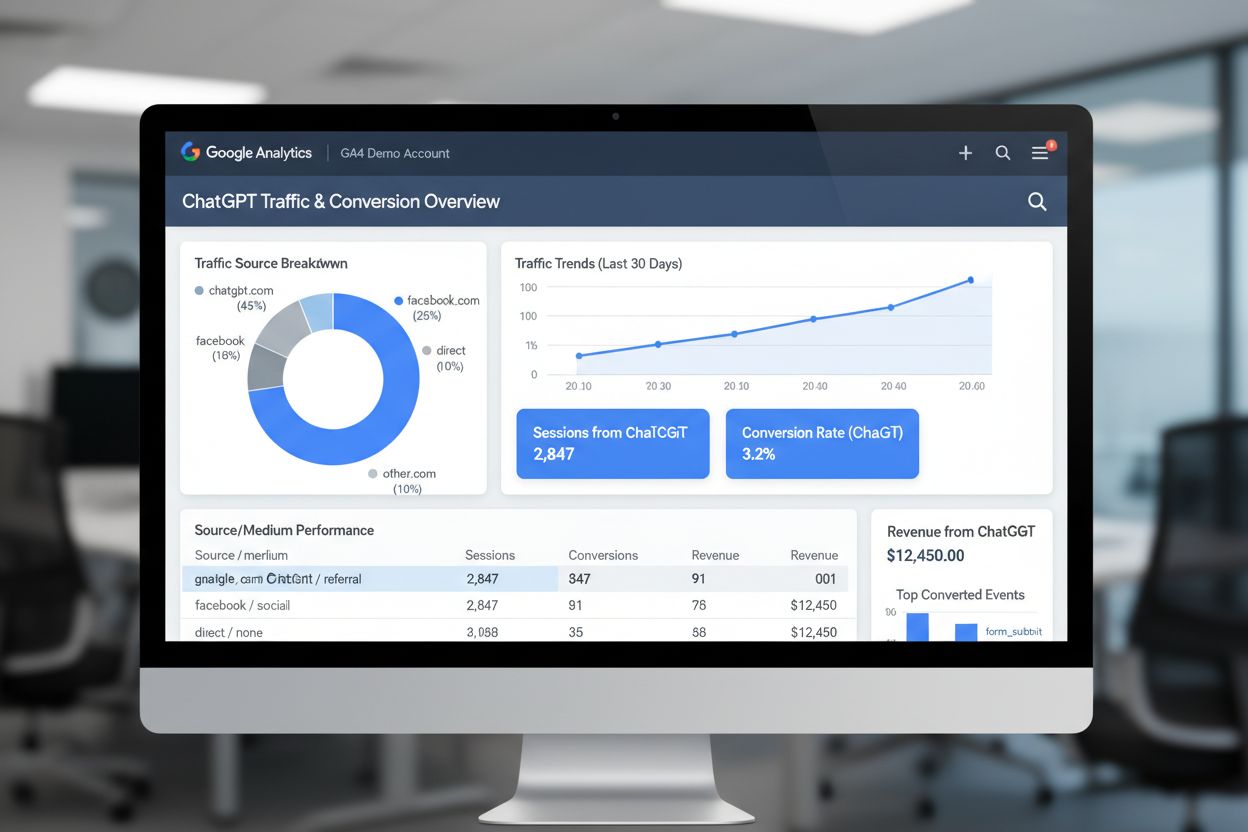
Identifying and measuring ChatGPT traffic in your analytics is essential for understanding the ROI of your optimization efforts. In Google Analytics 4, ChatGPT traffic typically appears with utm_source=chatgpt.com or can be identified by the OAI-SearchBot user agent in your server logs. To set up proper tracking, navigate to your GA4 property settings and create a custom dimension for the utm_source parameter if it hasn’t been automatically captured. Create a new segment in GA4 that filters for traffic where utm_source equals “chatgpt.com” or where the user agent contains “OAI-SearchBot” to isolate ChatGPT-driven sessions. Set up conversion tracking for key actions (purchases, email signups, product views) and create a dedicated dashboard that monitors ChatGPT traffic trends, conversion rates, and revenue attribution. Compare ChatGPT traffic quality against other channels—many merchants find that ChatGPT users have higher purchase intent and conversion rates than traditional search traffic because they’re already in a buying mindset when they ask ChatGPT for recommendations.
Both ChatGPT Shopping and Google Shopping drive product discovery traffic, but they operate on fundamentally different models with distinct advantages and limitations. ChatGPT Shopping Research is organic and free—you don’t pay per click or per impression, making it a pure content and optimization play. Google Shopping combines organic product results with paid shopping ads, requiring investment in both SEO and paid advertising to maximize visibility. The traffic quality differs significantly: ChatGPT users are typically further along in their buying journey and asking specific product questions, while Google Shopping users range from early research to ready-to-purchase. ChatGPT’s personalization engine tailors recommendations to individual user preferences and needs, while Google Shopping relies more on keyword matching and product feed data. Real-time updates matter more for Google Shopping, where pricing and inventory changes affect ad performance immediately, whereas ChatGPT’s index updates less frequently but with greater depth of analysis.
| Feature | ChatGPT Shopping | Google Shopping | Winner |
|---|---|---|---|
| Cost | Free (organic) | Paid per click | ChatGPT |
| Traffic Type | High-intent conversational | Mixed intent keyword-based | ChatGPT |
| Setup Complexity | Medium (optimization required) | High (ads + feeds) | ChatGPT |
| Organic vs Paid | 100% organic | Hybrid organic/paid | ChatGPT |
| Personalization | AI-driven per user | Keyword/feed-driven | ChatGPT |
| Real-time Updates | Weekly/monthly | Real-time | Google Shopping |
The landscape of AI product discovery continues evolving rapidly, with emerging features like Instant Checkout enabling users to purchase directly through ChatGPT without leaving the conversation. This frictionless purchasing experience represents a fundamental shift in e-commerce, where product discovery and transaction completion happen in a single interface. Forward-thinking merchants are adopting a multi-channel strategy that optimizes for ChatGPT, Google Shopping, traditional search, and emerging AI platforms simultaneously rather than betting on a single discovery channel. The strategic implication is clear: merchants who build comprehensive, well-optimized product pages and structured data now gain visibility across multiple AI systems with minimal additional effort. As more AI platforms emerge and consumer behavior shifts toward conversational shopping, the competitive advantage belongs to merchants who invested early in content quality and structured data implementation. The future rewards merchants who view product optimization as a foundational business practice rather than a channel-specific tactic.
Early adoption of ChatGPT Shopping optimization provides significant competitive advantages in markets where most competitors haven’t yet optimized their product pages for AI discovery. Merchants who implement comprehensive product descriptions, structured data, and trust signals now will establish strong positioning before the market becomes saturated with optimized competitors. The first-mover advantage in ChatGPT Shopping is substantial because the platform’s recommendation algorithm favors established, well-documented products with strong review histories and detailed information. By investing in optimization today, you’re building a competitive moat that becomes increasingly difficult for late-moving competitors to overcome as ChatGPT’s index matures. Market positioning as a discoverable, trustworthy brand in conversational AI systems creates long-term value that extends far beyond ChatGPT to influence how all AI systems evaluate and recommend your products. The merchants who recognize this shift and act decisively will capture disproportionate market share as conversational AI becomes the dominant product discovery method.
ChatGPT Shopping Research is a conversational buyer's guide feature that helps users find products through natural language questions. Instead of traditional search results, ChatGPT synthesizes product information into personalized recommendations based on user needs, budget, and preferences.
ChatGPT discovers products through three main methods: website crawling via OAI-SearchBot, direct Shopify integration for store owners, and direct feed submission through OpenAI's Product Discovery platform. The crawler analyzes your product pages, descriptions, reviews, and structured data to understand what you sell.
No, ChatGPT Shopping Research is completely organic and free. Unlike Google Shopping, there's no auction system or cost-per-click model. You only need to optimize your product pages and ensure ChatGPT can crawl your website to be featured.
ChatGPT Shopping is conversational and organic, while Google Shopping combines organic results with paid ads. ChatGPT prioritizes personalization and high-intent users, whereas Google Shopping relies on keyword matching. ChatGPT traffic is typically higher-intent and has better conversion rates.
Yes, you can track ChatGPT traffic in Google Analytics 4 by looking for utm_source=chatgpt.com or filtering by OAI-SearchBot user agent. Set up custom segments and conversion tracking to measure ChatGPT's impact on your business metrics and ROI.
Focus on comprehensive product descriptions, high-quality images with alt text, structured data (JSON-LD schema markup), customer reviews and ratings, and detailed FAQ sections. Ensure your robots.txt allows OAI-SearchBot access and use natural language that answers common customer questions.
OpenAI is developing Instant Checkout, which will allow users to purchase directly through ChatGPT without leaving the conversation. While not yet widely available, merchants can prepare by ensuring their product data is accurate and their checkout process is optimized for integration.
ChatGPT evaluates products based on content quality, review ratings and volume, trust signals, structured data accuracy, relevance to user queries, product specifications, pricing, and availability. Products with comprehensive information, strong reviews, and clear descriptions rank higher in recommendations.
AmICited tracks how your products are featured and cited across ChatGPT, Perplexity, Google AI Overviews, and other AI platforms. Get insights into your AI visibility and optimize your presence.
Learn how ChatGPT Shopping Research helps you compare products, find deals, and make smarter purchase decisions with AI-powered recommendations and instant chec...

Explore how ChatGPT Shopping transforms product discovery through conversational AI. Learn the technology, process, benefits for consumers and merchants, and op...
Learn how ChatGPT's new shopping research feature reshapes product discovery. Discover what brands need to optimize for AI buyer's guides and stay competitive i...