

DeepSeek Optimization: Preparing for China's Growing AI Search Platform
Learn how to optimize your brand for DeepSeek, China's fastest-growing AI search platform. Discover strategies to increase visibility and monitor your presence ...
9 min read
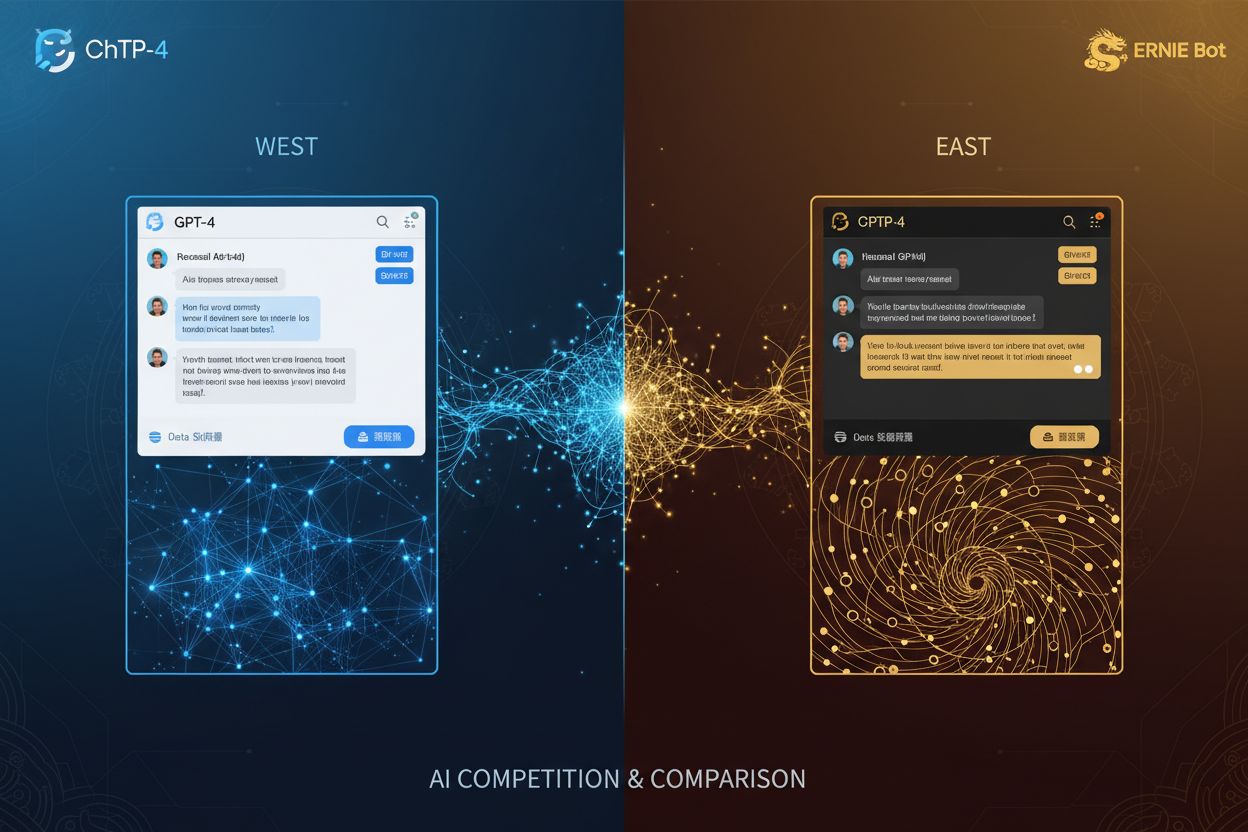
Compare ChatGPT and Baidu Ernie AI search capabilities in China. Explore regional differences, features, and why Ernie dominates the Chinese market.
ChatGPT remains officially inaccessible to users in mainland China, creating a unique digital divide in the global AI landscape. Chinese IP addresses are systematically blocked from accessing OpenAI’s platform, and Chinese credit cards are not accepted for API purchases or subscriptions. This restriction stems from both regulatory barriers imposed by the Chinese government and OpenAI’s own compliance decisions regarding the Chinese market. The unavailability of ChatGPT in China isn’t merely a technical limitation—it represents a fundamental geopolitical and regulatory divide that has shaped the entire trajectory of AI development in the region. This restriction created an enormous market opportunity for domestic Chinese technology companies to develop their own large language models, leading to the emergence of Baidu Ernie as the dominant AI chatbot in the world’s most populous nation.

Baidu, China’s leading search engine and technology conglomerate, launched Ernie Bot on March 16, 2023, positioning it as the nation’s answer to ChatGPT. The name “ERNIE” stands for “Enhanced Representation from kNowledge IntEgration,” reflecting the model’s sophisticated approach to understanding and generating content. Within months of its launch, Baidu reported that Ernie Bot had attracted 70 million users, demonstrating remarkable adoption rates despite being a new entrant to the generative AI space. The company further strengthened its position by releasing ERNIE 4.0 in October 2023, an upgraded version that Baidu CEO Robin Li claimed was “not inferior in any aspect to GPT-4.” Unlike ChatGPT, which produces only text and code outputs, Baidu Ernie offers multimodal capabilities, generating text, images, videos, and audio responses in multiple Chinese dialects. This comprehensive feature set, combined with real-time information access through Baidu’s search infrastructure, gives Ernie significant advantages in the Chinese market.
| Feature | ChatGPT | Baidu Ernie |
|---|---|---|
| Launch Date | November 2022 | March 2023 |
| User Base | 150+ million | 70+ million |
| Primary Language | English-optimized | Chinese-optimized |
| Multimodal Output | Text/Code only | Text/Image/Video/Audio |
| Availability in China | Restricted/Blocked | Full Access |
| Knowledge Cutoff | April 2023 | Real-time (via search) |
| Chinese Language Optimization | Limited | Extensively optimized |
| Dialect Support | Limited | Sichuanese, Cantonese, Hokkien, Dongbei |
The technical architecture underlying Baidu Ernie reveals why it performs so effectively for Chinese users. Ernie employs a knowledge-enhancement approach that combines two strategies: knowledge internalization, where the model learns from large-scale knowledge bases and incorporates this understanding into its parameters, and external utilization, where heterogeneous knowledge sources are integrated for real-time reasoning. Additionally, Ernie benefits from search enhancement, leveraging Baidu’s new-generation search architecture to provide users with timely and accurate reference information that grounds responses in current events. The model also incorporates dialogue enhancement mechanisms, including memory systems and contextual understanding capabilities that enable more coherent and logical multi-turn conversations.
While both ChatGPT and Ernie are large language models, their training data and optimization strategies differ significantly—Ernie was trained on “trillions of web pages, tens of billions of search and image data, hundreds of billions of daily voice data, and a knowledge graph of 550 billion facts,” all heavily weighted toward Chinese language content and cultural context. This specialized training gives Ernie a decisive advantage in understanding Chinese idioms, historical references, and contemporary cultural phenomena that ChatGPT often misses.

When CNN conducted comparative testing of ChatGPT and Baidu Ernie in December 2023, the results revealed distinct strengths and weaknesses for each platform. Ernie demonstrated superior performance on current affairs questions, correctly identifying that Taylor Swift had become a billionaire, that China had recently removed its defense minister, and that Matthew Perry had passed away—information that ChatGPT’s April 2023 knowledge cutoff prevented it from knowing. On creative tasks like writing a raise request email, both systems performed comparably, though Ernie showed slightly better cultural awareness by suggesting the user consider company mood and budget constraints. For technical tasks like code generation and complex reasoning, GPT-4 maintained an edge, though the gap has narrowed considerably with Ernie 4.0. Both systems excelled at generating meal plans and providing general knowledge, with nearly identical responses on many queries. However, Ernie occasionally struggled with specific formatting requirements—when asked to write a haiku, it produced a nine-line classical Chinese poem instead, demonstrating that while its Chinese language capabilities are exceptional, it sometimes interprets requests through a culturally-specific lens.
Key Testing Results:
China’s regulatory framework for generative AI, formalized in July 2023, fundamentally shapes how Baidu Ernie operates and what content it can provide. The regulations mandate that all AI-generated content must adhere to “core socialist values,” effectively requiring content filtering aligned with Communist Party messaging and government positions. This regulatory requirement means Ernie must refuse to answer questions about sensitive political topics, most notably the Tiananmen Square incident of June 4, 1989, where the bot simply closes the conversation and instructs users to “change the topic and start again.” Similarly, when asked about Xi Jinping’s removal of presidential term limits, Ernie blocks the query entirely with an error message stating “the current user is banned.”
In contrast, ChatGPT takes a more diplomatic approach to controversial questions, presenting multiple perspectives and acknowledging the complexity of issues like racial equality in America or US foreign policy fairness. This fundamental difference reflects the divergent regulatory environments: while OpenAI operates in a relatively permissive Western context, Baidu must comply with China’s strict content governance requirements. All Chinese technology platforms, including Baidu’s search engine, are legally required to implement such censorship, making content filtering an unavoidable aspect of operating in the Chinese market.
Despite ChatGPT’s larger global user base of 150+ million, Baidu Ernie has achieved remarkable market penetration in China, where it faces no direct competition from OpenAI’s platform. The 70 million users Ernie accumulated within its first year represents extraordinary adoption for a domestically-developed AI system, particularly given that Chinese consumers had been eagerly awaiting a ChatGPT alternative. Baidu’s enterprise strategy has proven particularly effective, with over 650 companies signing up before Ernie’s official launch and more than 30,000 additional companies applying for API access in the weeks following the announcement. Major partnerships include computer manufacturer Lenovo, travel portal Trip.com, and several leading Chinese automotive companies developing autonomous vehicles.
This enterprise focus differs markedly from ChatGPT’s consumer-first approach, positioning Ernie as a business tool that integrates seamlessly with Baidu’s existing ecosystem of search, maps, autonomous driving technology, and cloud services. The strategic integration of Ernie across Baidu’s product portfolio creates powerful network effects, where each integration increases the platform’s value and stickiness for both individual and enterprise users.
One of Baidu Ernie’s most distinctive advantages is its exceptional optimization for the Chinese language and its numerous regional dialects. While ChatGPT was trained primarily on English-language content and treats other languages as secondary, Ernie was specifically engineered to excel at Chinese language understanding, nuance, and cultural context. The system can generate responses in multiple Chinese dialects including Sichuanese, Cantonese, Hokkien, and the Dongbei dialect, each with distinct phonetic and grammatical characteristics that require specialized training to reproduce accurately.
Ernie demonstrates particular prowess in classical Chinese poetry generation, a task that requires understanding of historical literary conventions, metaphorical language, and cultural symbolism that ChatGPT struggles with. When asked to explain Chinese historical events or write in traditional Chinese literary styles, Ernie produces responses that native speakers recognize as culturally authentic and linguistically sophisticated. This localization advantage extends beyond language to cultural understanding—Ernie grasps the significance of Chinese holidays, historical figures, and contemporary cultural references in ways that ChatGPT, trained primarily on Western content, cannot match. For Chinese users, this cultural optimization makes Ernie feel more natural and intuitive, as it understands their linguistic and cultural context without requiring translation or explanation.
Baidu’s strategic positioning of Ernie as an enterprise platform has proven highly effective, with the company focusing on business use cases rather than consumer entertainment. The system excels at practical business applications including generating marketing copy, analyzing financial documents, writing business proposals, and creating professional communications—tasks that are critical for Chinese companies operating in competitive markets. Ernie’s integration with Baidu’s business tools and cloud services creates a comprehensive ecosystem where companies can deploy AI across multiple functions without switching between platforms. The API availability and flexible pricing models have made Ernie accessible to businesses of all sizes, from startups to Fortune 500 companies operating in China.
For Chinese businesses, Ernie offers a significant competitive advantage: it understands Chinese business culture, regulatory requirements, and market dynamics in ways that ChatGPT cannot, making it more suitable for generating content tailored to Chinese audiences and compliant with local regulations. The enterprise strategy has also insulated Ernie from some of the criticism that ChatGPT faces regarding accuracy and reliability, as business users typically have higher tolerance for AI limitations when the tool is integrated into their existing workflows.
The trajectory of AI development in China suggests that Baidu Ernie will continue to evolve and expand its capabilities, with planned integrations into autonomous vehicles, IoT devices, and enterprise applications across multiple industries. Baidu has committed to continuous improvements, with ERNIE 4.0 representing just one milestone in an ongoing development roadmap that will likely include even more sophisticated multimodal capabilities and real-time information integration. The competitive landscape in China is intensifying, with other major technology companies like Alibaba, Tencent, and ByteDance developing their own large language models, creating a vibrant ecosystem of Chinese AI innovation.
This development has global implications, as Chinese AI systems are increasingly competitive with Western alternatives and demonstrate that high-quality AI can be developed outside the OpenAI/Google/Meta ecosystem. For international brands and organizations, understanding the dominance of Baidu Ernie in China is critical, as it represents the primary AI interface through which Chinese consumers and businesses discover information and make decisions. This is where tools like AmICited become invaluable—by monitoring how your brand is cited and referenced across ChatGPT, Baidu Ernie, and other AI systems, you can understand your visibility in different regional AI ecosystems and optimize your content strategy accordingly. As AI search becomes increasingly important for brand visibility globally, tracking your mentions in Chinese AI systems like Ernie is essential for any organization with international ambitions or Chinese market presence.
No, ChatGPT is officially restricted in mainland China. Chinese IP addresses cannot access the service, and Chinese credit cards are not accepted by OpenAI. This restriction is due to both government regulations and OpenAI's own policies regarding the Chinese market.
Baidu Ernie is a knowledge-enhanced large language model developed by Baidu, China's leading search engine company. It uses advanced techniques like knowledge enhancement, search integration, and dialogue optimization to provide accurate, contextual responses in Chinese and other languages. Ernie can generate multimodal outputs including text, images, videos, and audio.
As of late 2023, Baidu Ernie has approximately 70 million users, compared to ChatGPT's 150+ million users globally. However, Ernie's user base is concentrated in China where it faces no competition from ChatGPT, making it the dominant AI chatbot in the world's most populous nation.
Yes, unlike ChatGPT which only produces text and code, Baidu Ernie can generate multimodal outputs including images, videos, and audio in multiple Chinese dialects. This multimodal capability is one of Ernie's key advantages over ChatGPT.
Baidu Ernie was specifically optimized for Chinese language understanding and cultural context. It excels at tasks like explaining Chinese history, writing traditional poetry, and understanding nuances in Chinese dialects that ChatGPT struggles with due to its English-first training approach.
Baidu Ernie, like all Chinese tech platforms, must comply with China's generative AI regulations and adhere to 'core socialist values.' This means it filters content on sensitive political topics and refuses to answer questions about events like the Tiananmen Square incident.
Baidu Ernie has access to real-time information through its search integration, while ChatGPT's knowledge was last updated in April 2023. This gives Ernie a significant advantage for current events and recent news queries, making it more useful for time-sensitive information.
Yes, Baidu offers API access for businesses and enterprises. Over 30,000 companies have applied for API access since Ernie's launch, with major partnerships including Lenovo, Trip.com, and several Chinese automotive manufacturers developing autonomous vehicles.
Track how your brand is cited in ChatGPT, Baidu Ernie, Google AI Overviews, and other AI platforms. Get real-time insights into your AI visibility across global and regional AI search engines.
Learn how to optimize your brand for DeepSeek, China's fastest-growing AI search platform. Discover strategies to increase visibility and monitor your presence ...

Discover how regional AI search varies globally. Learn optimization strategies for Perplexity, ChatGPT, and Google AI Overviews across different markets.

Community discussion on getting local businesses recommended by AI search engines. Real experiences from local business owners on optimizing for ChatGPT, Perple...