

Case Studies of AI Visibility Success: What They Achieved
Explore real case studies of brands achieving AI visibility success. Learn how Netflix, Sephora, and Spotify dominate AI search while others like Chegg collapse...
14 min read
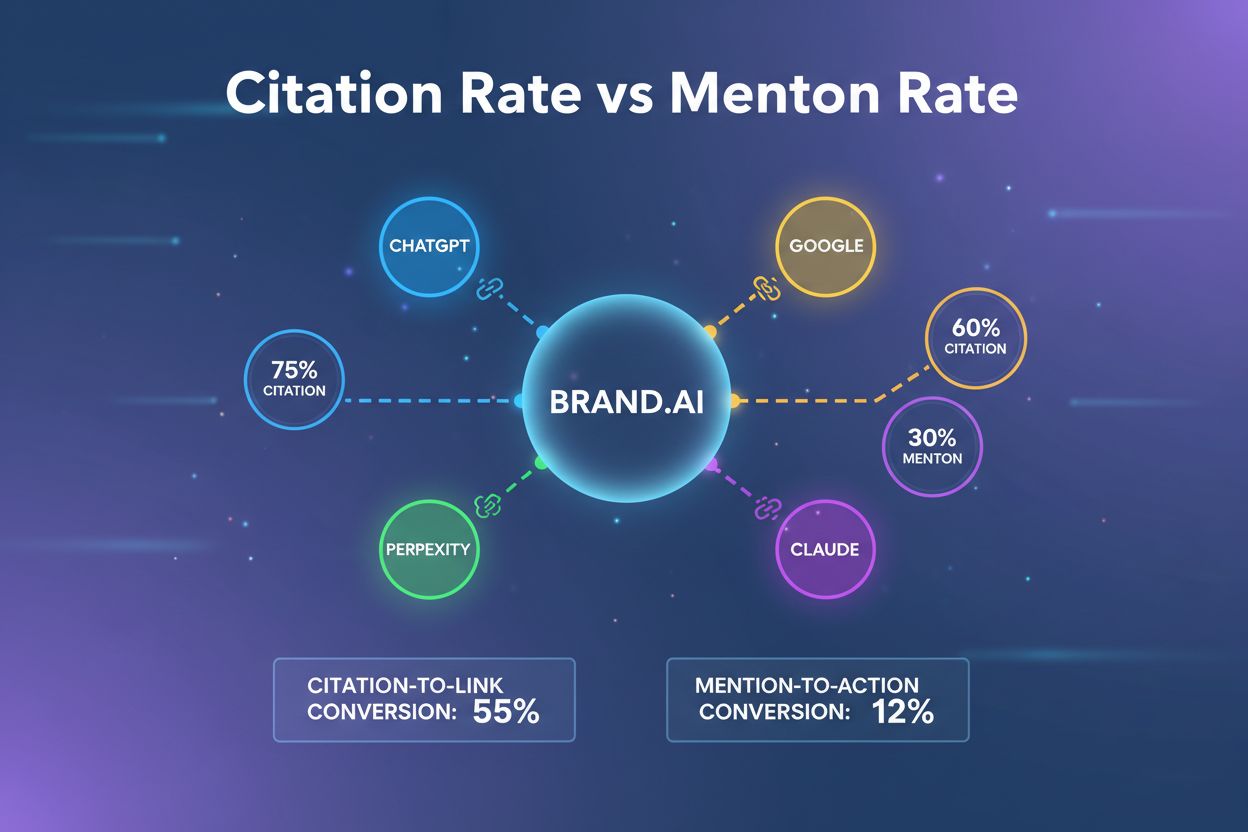
Understand the critical difference between citation rate and mention rate in AI monitoring. Learn which metric drives more value, how to measure both, and strategies to optimize your AI visibility.
Mention rate measures how frequently your brand appears in AI-generated responses across platforms like ChatGPT, Perplexity, Claude, and Google AI Overviews. It’s calculated by dividing the number of times your brand is mentioned by the total number of AI responses for a given set of prompts, then multiplying by 100. For example, if you test 50 prompts related to your industry and your brand appears in 23 responses, your mention rate is 46%. This metric serves as a brand awareness indicator in the AI conversation space—it tells you whether AI systems recognize your brand as relevant to user queries. According to research, brands in the top 25% for mention frequency receive roughly 10x more citations than brands in the next quartile, making mention rate a critical foundation for visibility. Benchmark targets suggest aiming for 30%+ mention rate for your core category queries, with top-performing brands achieving 50%+ in competitive markets.
| Metric | Definition | Example | Benchmark |
|---|---|---|---|
| Mention Rate | Brand appears in AI response text | 23 mentions / 50 prompts = 46% | 30%+ |
| Citation Rate | Brand website linked as source | 12 citations / 23 mentions = 52% | 50%+ |
| Mention-Citation Gap | Mentioned but not cited | 11 mentions without links | <20% gap |
Citation rate represents the percentage of your mentions that include an explicit link to your website as a source. While a mention indicates the AI knows about your brand, a citation demonstrates that the AI trusts your content enough to reference it directly. If you’re mentioned 23 times but only 12 of those mentions include a link to your site, your citation rate is approximately 52%. This distinction matters enormously because citations drive measurable traffic and authority signals. LLMs typically cite only 2-7 domains per response—far fewer than Google’s traditional 10 blue links—making each citation exponentially more valuable. The Citation Exposure Score (CES) weights citations by their prominence: a mention in the opening paragraph carries more weight than one buried in a footnote. Research shows that AI-referred visitors convert at 4.4x the rate of traditional organic search, making citations the most valuable metric for driving qualified traffic. Benchmark targets suggest that 50%+ of your mentions should be citations, indicating strong content authority in the eyes of AI systems.
The mention-citation gap represents the critical strategic insight that separates successful AI visibility strategies from mediocre ones. This gap occurs when your brand is frequently mentioned but rarely cited—the AI knows who you are but doesn’t trust your content enough to use it as a source. If you have 46% mention rate but only 52% of those mentions are citations, you’re leaving significant traffic and authority on the table. This gap signals a content authority problem: your brand has achieved awareness in AI conversations, but your content lacks the structure, depth, or credibility that AI systems require for citation. Identifying this gap is the first step toward optimization. To find your gap, track both metrics weekly and calculate the difference. If your mention rate is significantly higher than your citation rate, investigate whether your content lacks proper formatting, comprehensive topic coverage, or authoritative sourcing. Closing this gap requires strategic content optimization focused on making your pages more citation-worthy to AI systems.
While both metrics serve important purposes, citation rate is the more valuable metric for business outcomes. Citations drive direct, measurable traffic from AI platforms—when an AI system links to your content, users click through at meaningful rates. The conversion advantage is staggering: AI-referred traffic converts at 4.4x the rate of traditional organic search, meaning each citation is worth exponentially more than a traditional search ranking. This conversion premium exists because users arriving from AI recommendations are pre-qualified and pre-informed; they’ve already been educated on your value proposition and given a trusted endorsement before clicking. Additionally, citations serve as authority signals to AI systems themselves. When multiple AI platforms cite your content, it reinforces to the underlying models that your brand is a trusted source, creating a compounding visibility advantage. The scarcity of citations amplifies their value: with only 2-7 domains cited per response, being in that exclusive group matters far more than being one of many mentions. Furthermore, citation placement directly impacts traffic potential—a citation in the opening paragraph drives significantly more clicks than one in a footnote. For competitive advantage, citation rate is the metric that separates market leaders from followers.
Despite citation rate’s superior traffic-driving potential, mention rate remains strategically important for building long-term AI visibility. Mentions represent the first step in the visibility journey—before an AI system will cite your content, it must first recognize your brand as relevant to the conversation. A high mention rate indicates strong brand awareness within AI systems, which correlates with customer discovery and preference. When 52% of Gen Z users trust generative AI for informed decisions, being mentioned in those conversations—even without a citation—influences perception and preference. Mention rate also enables competitive share of voice analysis: by tracking how often your brand is mentioned relative to competitors, you identify where you’re winning and losing in the AI conversation space. Additionally, mentions provide valuable sentiment analysis opportunities. By analyzing the context and tone of mentions, you can understand how AI systems describe your brand, identify misrepresentations, and detect emerging perception issues before they impact citations. Mentions also serve as leading indicators of citation potential—brands with rising mention rates typically see citation growth 4-8 weeks later. Building mention rate is therefore essential groundwork for the citation-building strategy that drives revenue.
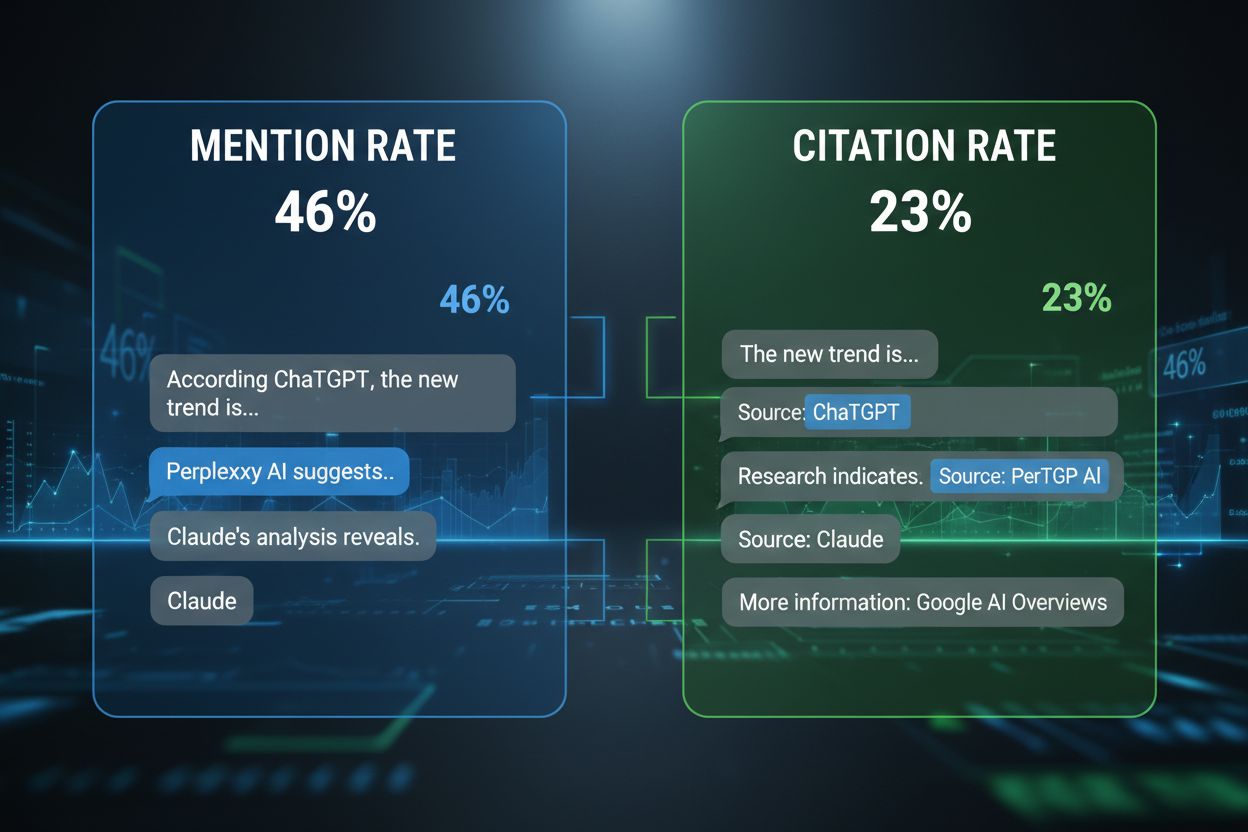
Tracking both metrics requires a systematic approach that balances automation with manual validation. Start with manual testing using a prompt library of 20-50 queries that represent how your ideal customers ask AI systems about your category. Include category definition queries (“What is project management software?”), comparison queries (“Asana vs Monday.com”), problem-solution queries (“How do I track team tasks?”), and direct brand queries (“Is [Your Brand] good for remote teams?”). Test these prompts weekly across ChatGPT, Perplexity, Claude, Google AI Overviews, and Gemini, documenting for each response:
Calculate mention rate as (mentions / total responses) × 100 and citation rate as (citations / mentions) × 100. For GA4 tracking of AI referral traffic, create a custom channel grouping using this regex pattern: (chat\.openai\.com|chatgpt\.com|perplexity\.ai|you\.com|gemini\.google\.com|copilot\.microsoft\.com). This enables attribution of AI-driven conversions back to specific platforms. Weekly tracking establishes trends; daily tracking for high-priority prompts reveals real-time competitive movement.
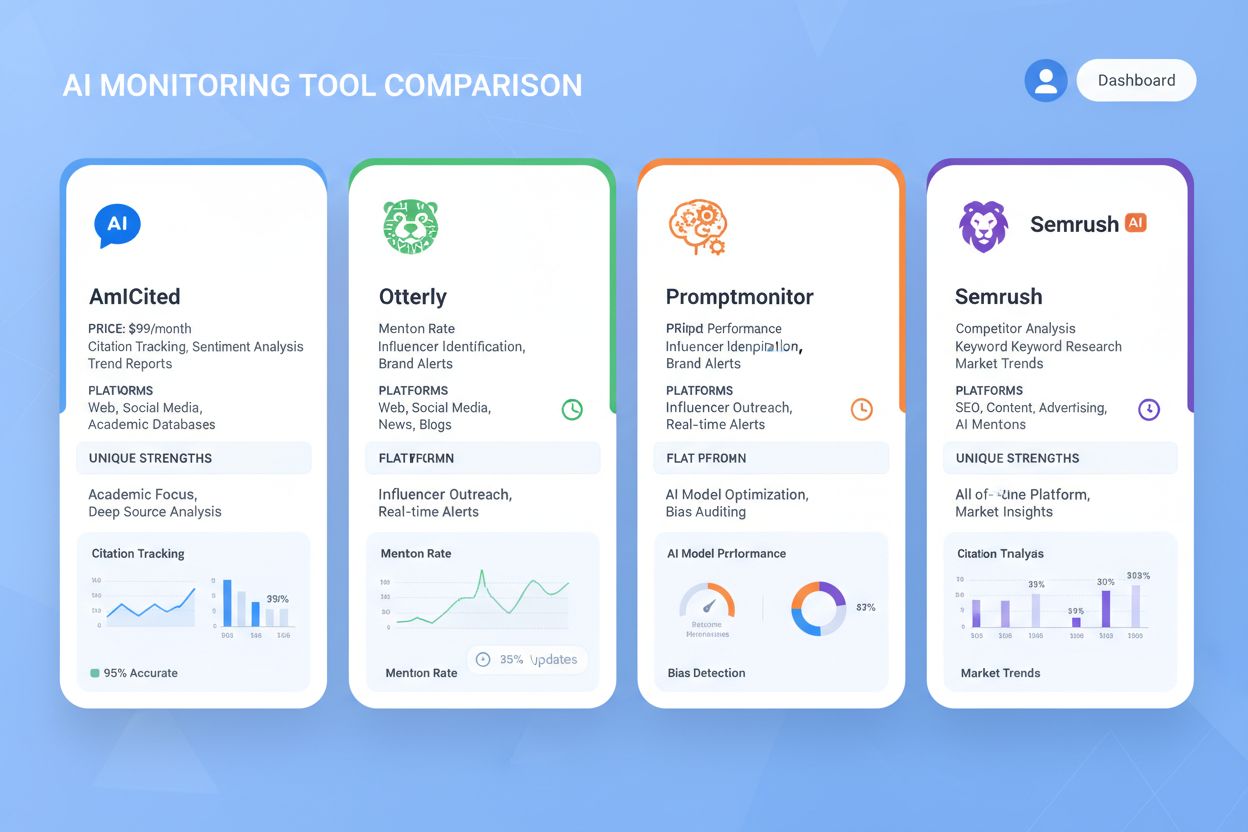
The AI monitoring tool landscape has exploded with over 35 platforms launched in 2024-2025, each offering different capabilities and price points. AmICited.com stands out as the specialized solution purpose-built for AI citation monitoring, offering real-time tracking across all major platforms with transparent metrics and direct integration with your existing analytics. For teams seeking alternatives, Otterly.ai ($29-$989/month) provides strong visualization and the proprietary Brand Visibility Index, making it excellent for marketing teams wanting comprehensive dashboards. Promptmonitor ($29-$129/month) offers the broadest platform coverage (8 engines) and deepest historical data at accessible pricing, ideal for SMBs and agencies. Semrush AI Toolkit ($99/month) integrates seamlessly if you’re already using Semrush for traditional SEO, consolidating both metrics in one platform. Profound AI ($499+/month) serves enterprise brands requiring compliance features and hallucination detection. The choice depends on your team size, budget, and existing tool stack. For specialized AI monitoring, AmICited.com provides the most focused solution. For ecosystem integration, Semrush works best. For budget-conscious teams, Promptmonitor delivers strong value.
Different business situations call for different metric priorities. Prioritize mention rate when you’re in the awareness-building phase—if your brand is unknown to AI systems, building recognition is the foundation. Focus on mention rate when launching new products, entering new markets, or competing against established players with higher brand awareness. Mention rate optimization involves content marketing, PR, and brand building activities that increase your visibility in AI training data. Prioritize citation rate when you have established mention rate (30%+) but low citation conversion. This situation indicates the AI knows you but doesn’t trust your content—requiring content optimization, schema markup implementation, and authority-building. Citation rate optimization is higher-ROI because it directly drives traffic and conversions. In mature markets with strong mention rates, citation rate becomes the competitive battleground. The strategic framework suggests a phased approach: build mention rate to 30%+, then shift focus to closing the mention-citation gap by optimizing content for citations. Monitor both metrics continuously, but allocate optimization resources based on which metric represents your biggest opportunity.
Improving both metrics requires distinct but complementary strategies. For mention rate, focus on brand visibility and content distribution: create authoritative content that answers common industry questions, build topical authority through comprehensive content clusters, implement proper schema markup to help AI systems understand your entity, ensure consistent brand information across Wikipedia, LinkedIn, Crunchbase, and industry databases, and develop PR and earned media that increases your brand’s presence in AI training data. For citation rate, optimize content structure and authority: implement clear hierarchical formatting with H1/H2/H3 tags, create extractable answer blocks (40-60 words) that directly answer questions, include well-sourced statistics and data that AI systems can cite, add FAQ schema markup that matches how users query AI systems, develop comprehensive topic coverage that positions your brand as the authoritative source, and ensure technical SEO excellence so AI crawlers can easily access and understand your content. The most effective approach combines both strategies: build brand awareness through mention-rate optimization while simultaneously making your content more citation-worthy through structural and authority improvements. This dual approach creates compounding visibility growth.
Consider a B2B SaaS company that discovered a critical mention-citation gap: they achieved 42% mention rate for “best project management software” queries but only 18% of those mentions included citations to their website. Investigation revealed their content lacked the structured formatting that AI systems prefer. After implementing clear H2 headers, FAQ schema, and extractable answer blocks, their citation rate improved to 58% within 8 weeks—a 220% increase in actual traffic from AI sources. In another example, a competitor with lower mention rate (28%) but higher citation rate (71%) was driving 3.2x more AI referral traffic because their content was more citation-worthy. A financial services company tracked their AI Share of Voice against three competitors and discovered they were mentioned in only 12% of “best investment platforms” responses while competitors averaged 31%. By building topical authority through comprehensive content and improving semantic relevance, they increased mention rate to 38% within 12 weeks. These examples illustrate that both metrics matter, but citation rate drives the revenue—the company with 42% mention rate and 18% citation rate was losing to competitors with lower mention rates but higher citations.
The ultimate test of any metric is whether it connects to revenue. AI-referred traffic converts at 4.4x the rate of traditional organic search, meaning each citation is worth approximately $11 in visitor value compared to $2.50 for traditional organic (using typical SaaS benchmarks). If you achieve 100 AI-referred visitors monthly from citations, that’s equivalent to 440 traditional organic visitors in conversion value. Over a year, improving citation rate from 40% to 60% (a 50% improvement) could translate to 50+ additional monthly AI visitors, worth approximately $6,600 annually in incremental conversion value. Beyond direct traffic, citations create compounding visibility advantages: brands with higher citation rates are increasingly recognized as authoritative by AI systems, leading to higher mention rates and better positioning within responses. Additionally, brand awareness from mentions drives indirect value through branded search lift and customer preference. Research shows that brands cited in AI answers experience 38% lift in organic clicks and 39% increase in paid ad clicks—meaning AI visibility amplifies all your other marketing channels. The complete ROI picture includes direct AI referral revenue, branded search lift, improved organic rankings from authority signals, and competitive advantage from higher share of voice. Measuring both metrics and connecting them to GA4 conversion data enables you to quantify the true business impact of your AI visibility strategy.
Key Takeaway: Citation rate and mention rate serve complementary purposes in your AI visibility strategy. Mention rate indicates brand awareness in AI conversations, while citation rate drives measurable traffic and authority. The brands winning in AI search are those that track both metrics, identify their mention-citation gap, and systematically optimize to close it. Start measuring this week—your competitive advantage depends on it.
A mention occurs when an AI system references your brand name in its response text. A citation is when the AI explicitly links to your website as a source. Citations are more valuable because they drive measurable traffic and serve as authority signals to AI systems. For example, if ChatGPT mentions your brand 10 times but only links to your site 5 times, your mention rate is 100% but your citation rate is 50%.
Citation rate is more important for driving revenue because AI-referred traffic converts at 4.4x the rate of traditional organic search. However, mention rate is important as a leading indicator—brands must first achieve strong mention rates (30%+) before they can build citations. The ideal strategy is to build mention rate first, then optimize for citations.
Track both metrics weekly to establish trends and identify competitive movement. For high-priority prompts where you're competing intensely, daily tracking reveals real-time shifts. Weekly tracking is sufficient for most brands to make strategic decisions and measure progress toward benchmarks.
Aim for 30%+ mention rate for your core category queries, with top-performing brands achieving 50%+. For citation rate, target 50%+ of your mentions being citations. This means if you're mentioned 100 times, at least 50 of those should include links to your website. Brands in the top 25% for mentions receive 10x more citations than competitors.
The mention-citation gap (mentioned but not cited) signals a content authority problem. Close it by: implementing clear hierarchical formatting with H2/H3 headers, creating extractable answer blocks (40-60 words), adding FAQ schema markup, including well-sourced statistics, and ensuring comprehensive topic coverage. These optimizations make your content more citation-worthy to AI systems.
AmICited.com is purpose-built for AI citation monitoring with real-time tracking across all major platforms. Alternatives include Otterly.ai ($29-$989/month) for strong visualization, Promptmonitor ($29-$129/month) for budget-conscious teams, and Semrush AI Toolkit ($99/month) if you're already using Semrush. Choose based on your team size, budget, and existing tool stack.
AI-referred traffic converts at 4.4x the rate of traditional organic search. If you achieve 100 AI-referred visitors monthly from citations, that's equivalent to 440 traditional organic visitors in conversion value. Additionally, brands cited in AI answers experience 38% lift in organic clicks and 39% increase in paid ad clicks, amplifying all your marketing channels.
Yes, but they require different strategies. Mention rate optimization focuses on brand visibility and content distribution—building topical authority and increasing your presence in AI training data. Citation rate optimization focuses on content structure and authority—implementing proper formatting, schema markup, and comprehensive topic coverage. A phased approach works best: build mention rate to 30%+, then shift focus to closing the mention-citation gap.
Get real-time visibility into how AI systems mention and cite your brand across ChatGPT, Perplexity, Claude, and Google AI Overviews. Make data-driven decisions to improve your AI visibility.
Explore real case studies of brands achieving AI visibility success. Learn how Netflix, Sephora, and Spotify dominate AI search while others like Chegg collapse...
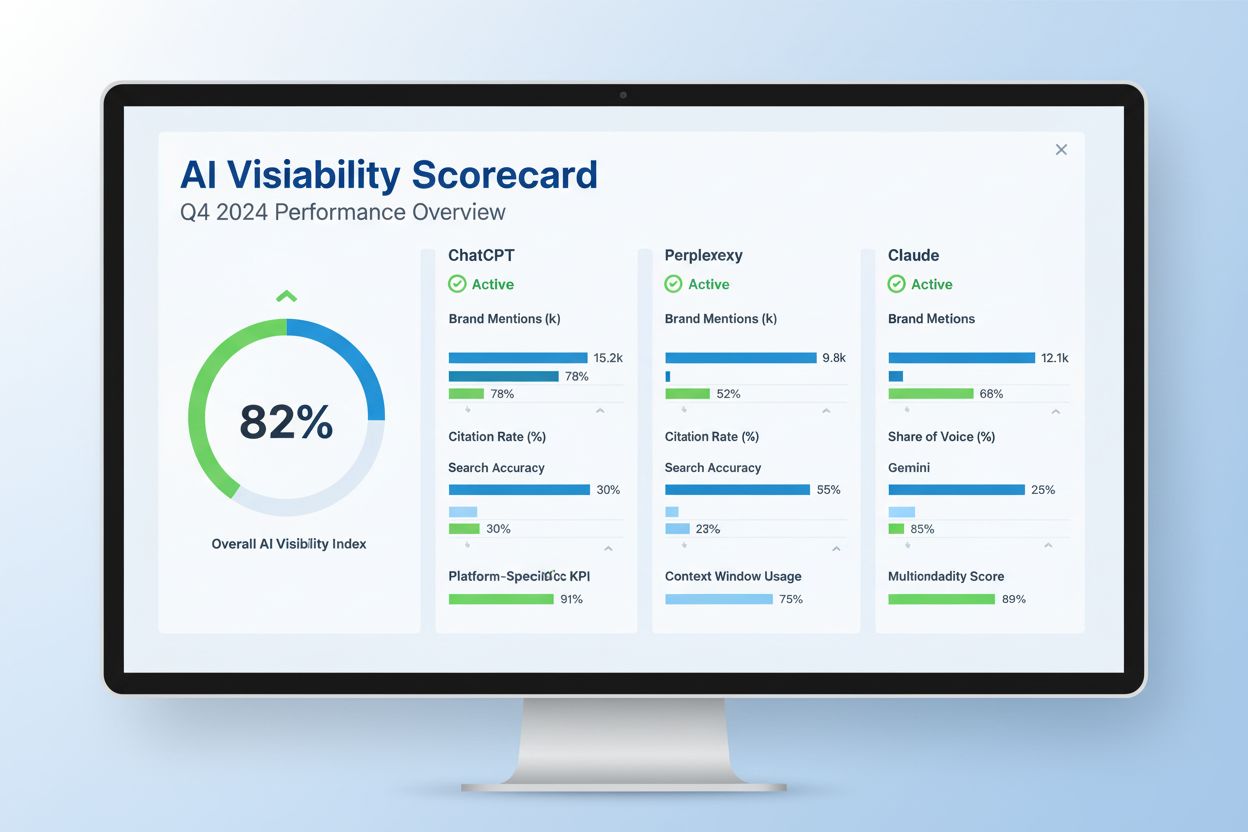
Learn what an AI Visibility Score is and how it measures your brand's presence across ChatGPT, Perplexity, Claude, and other AI platforms. Essential metric for ...
Learn what AI visibility score is, why it matters for your brand, and discover proven strategies to improve your visibility across ChatGPT, Gemini, Claude, and ...