
Semrush AI Visibility Toolkit Review: Is It Worth Adding to Your Stack?
Comprehensive review of Semrush AI Visibility Toolkit. Learn about features, pricing, pros and cons, and how it compares to alternatives like AmICited and Profo...
13 min read

Learn how geographic targeting impacts AI visibility. Discover why city-level searches show 50% lower visibility than state-level, and how to optimize for local AI search results.
Search is no longer confined to Google. AI search is fragmenting across multiple platforms—ChatGPT, Google Gemini, Perplexity, Microsoft Copilot, and others—each with its own ranking algorithms and citation patterns. When users ask these AI assistants for local recommendations, the results they see depend heavily on geographic signals and location context, not just keyword relevance. This shift means that a business ranking well at the state level may be completely invisible at the city level, and vice versa.

The impact of geographic specificity on AI visibility is dramatic and often overlooked. A comprehensive analysis of search personalization across all 50 U.S. states and their largest cities revealed a striking pattern: when location signals become more specific, visibility drops sharply.
| Metric | State-Level | City-Level | Impact |
|---|---|---|---|
| Page-one visibility | 94% | 46% | 48% drop |
| URL substitution | — | 40% of locations | Complete page swaps |
| Ranking improvements | — | 6% of cities | Only 3 metros improved |
| Complete visibility loss | — | 24 cities | Zero page-one presence |
This visibility cliff reveals that Google and other AI models prioritize hyperlocal relevance over broad authority. In 24 major cities—including Houston, Nashville, Baltimore, and others—businesses that ranked on page one at the state level disappeared entirely when the search location became city-specific. Even more striking, in 40% of locations, Google substituted the national homepage with state-specific landing pages, sometimes even when rankings declined. This behavior demonstrates that geographic relevance trumps ranking strength in the algorithm’s decision-making process.
In the AI-driven search landscape, citations are the receipts that prove trustworthiness. AI models don’t just look at where your business ranks; they analyze how and where your business is mentioned across the web. According to research analyzing 6.9 million citations, the probability of being cited depends on four critical factors: the question being asked, the context of the search, the user’s location, and the specific AI model generating the answer. Websites currently lead the citation race and are expanding their advantage, while social media and review citations have declined significantly over the past few months. This shift is crucial because it means the sources you can control—your website, business listings, and structured data—matter more than ever for AI visibility. If your business information appears only on your website and nowhere else, AI models treat it as less trustworthy. But when the same information appears consistently across your website, Google Business Profile, industry directories, and local listings, the probability of citation increases dramatically.
Relying on a single platform for local visibility is a losing strategy in the AI era. AI recommendation engines pull data from multiple overlapping sources, and the weight given to each source varies by category, geography, and model. To maximize your AI visibility, you need a presence across all controllable citation sources:
Cross-platform consistency is essential. If your business name, address, phone number, categories, and descriptions differ across platforms, AI models become uncertain about which information is accurate. This inconsistency can reduce your visibility across all platforms. The brands winning in AI visibility maintain identical NAP data, consistent service descriptions, and aligned messaging across every platform where they appear.
To compete in city-level AI searches, you need more than state-level content. Create dedicated landing pages for each major city or neighborhood where you want visibility, with unique, locally-relevant content that AI can understand and cite. These pages should include city-specific data such as local regulations, neighborhood-specific service variations, regional case studies, and testimonials from customers in that area. Avoid thin doorway pages; instead, provide substantial value that demonstrates deep local expertise. Use structured data markup (LocalBusiness schema) to clearly signal to AI models that your content is location-specific and authoritative for that geography. Include elements like service areas, local team members, neighborhood-specific FAQs, and location-based pricing or availability information. The goal is to make it obvious to AI systems that your business understands and serves that specific city or neighborhood better than generic national content ever could. Additionally, build internal linking structures that prioritize local landing pages, and use URL structures that signal geographic focus (such as /city-name/service/ or /state/city/).
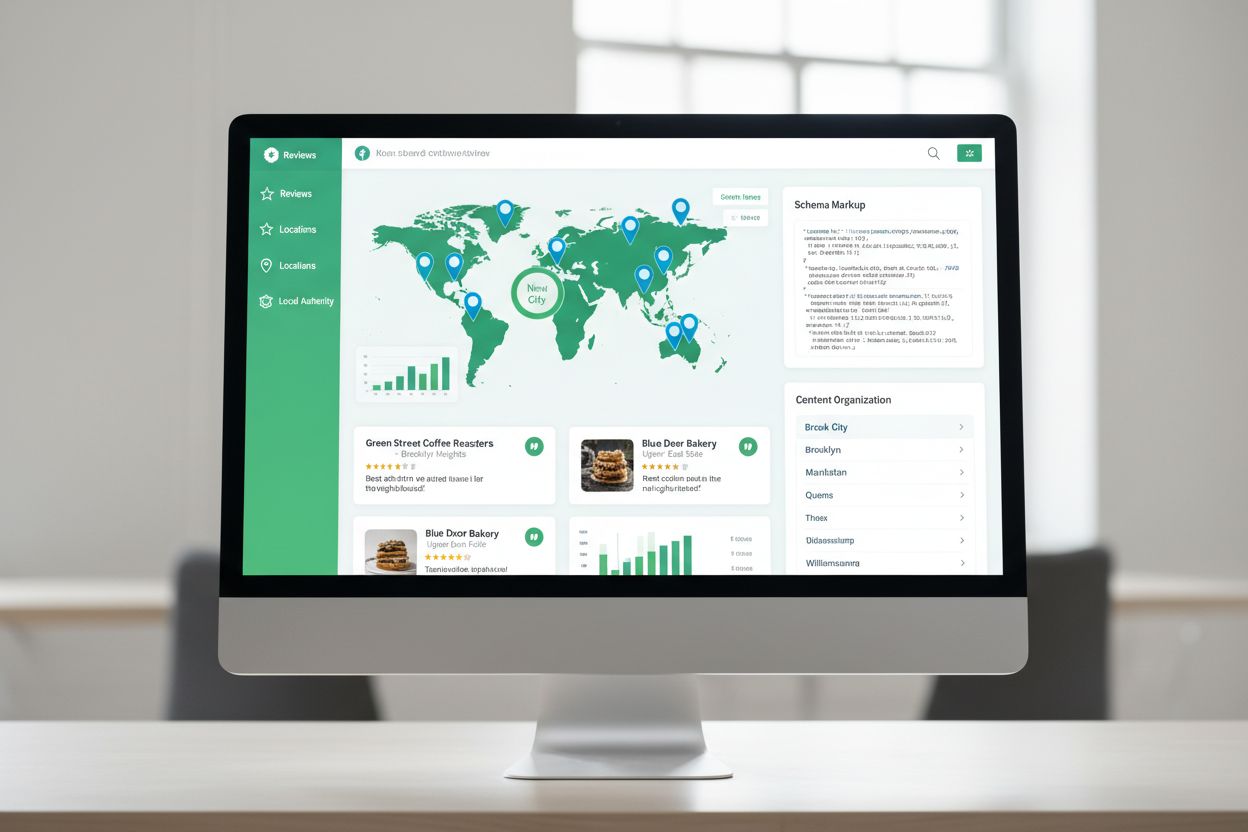
Reviews function as a dense bundle of trust signals that help AI systems decide whether your business is credible, relevant, and safe to recommend. While star ratings matter, they’re just one small piece of a much larger trust calculation. AI models analyze multiple review characteristics to build confidence in your business:
The most effective review strategy focuses on encouraging customers to provide detailed, attribute-rich feedback about specific aspects of their experience—staff helpfulness, turnaround time, outcomes, cleanliness, communication clarity—rather than generic praise. When you respond to reviews, restate the key context, acknowledge issues with specifics, and describe concrete changes you’ve made in response. This creates clear cause-and-effect patterns that algorithms can detect, showing that your business adapts to feedback.
Geo-fencing creates virtual boundaries around specific geographic areas, allowing you to target customers who enter those zones with location-aware ads and messages. Traditional geo-fencing targets based purely on proximity, but AI enhances this by layering behavioral and intent data on top of location signals. AI systems analyze real-time data such as search history, demographic trends, time of day, device activity, and prior engagement with your brand to identify which nearby customers are most likely to convert. This means your ads reach people who are not just close by, but actually ready to act. AI continuously refines audience segments and expands high-performing geographic areas automatically, creating a self-optimizing local strategy that improves with every impression. The same intelligence used in geo-fenced advertising can also enhance your local SEO strategy by identifying which neighborhoods produce the highest engagement and search volume, helping you prioritize content development and local landing page creation.
Because AI recommendations are dynamic and personalized, measuring your visibility requires more than traditional rank tracking. You need a disciplined approach to test how often your business appears in AI-generated answers across different cities, platforms, and search contexts. Start by defining a core set of prompts that reflect your highest-value local intents, then check them regularly across Google AI Overviews, ChatGPT with browsing enabled, Gemini, Perplexity, and other platforms. Track not just whether you appear, but which attributes are mentioned, what sources the AI cites, and how that correlates with your review initiatives and content updates. Compare your traditional local search performance (Google Maps rankings, organic visibility) with your AI visibility to understand the bigger picture of how your business is being discovered. Set up monthly or quarterly monitoring to log these results over time, which lets you connect changes in AI visibility to specific campaigns, listing updates, or content investments. For organizations managing multiple locations or competing in numerous cities, this data becomes invaluable for resource allocation and strategy refinement.
City-level searches show dramatically different results than state-level searches. Research shows a 48% visibility drop when moving from state to city-level searches, with 94% page-one visibility at state level dropping to just 46% at city level. AI models prioritize hyperlocal relevance, often substituting national content with city-specific pages even when rankings decline.
AI models treat geographic specificity as a critical ranking signal. In 24 major cities including NYC, Seattle, and Houston, businesses with strong state-level rankings disappeared entirely at the city level. This happens because Google and other AI systems assume city-level searchers want locally-relevant answers, triggering different ranking algorithms and content selection.
Traditional local SEO focuses on ranking position in Google Maps and organic results. AI visibility measures how often and how reliably your business is mentioned in AI-generated responses across ChatGPT, Gemini, Perplexity, and other platforms. AI visibility is probabilistic and context-dependent, not tied to a specific ranking position.
AI models continuously re-crawl and re-score content, but meaningful shifts in visibility typically appear over several weeks to months. Consistency matters more than speed—maintain a steady cadence of high-quality, location-specific content and regular updates to business information across all platforms.
Yes. AI visibility depends more on relevance and trust signals than brand size. Small businesses can compete by creating detailed, location-specific content, maintaining consistent business information across platforms, collecting quality reviews, and building local authority through citations and partnerships. The key is demonstrating deep local expertise.
Reviews are trust signals that AI uses to evaluate business credibility. Volume, recency, sentiment patterns, content richness, platform diversity, and owner responses all influence how AI ranks and recommends businesses. Detailed reviews mentioning specific attributes give AI more language to work with, increasing your chances of being recommended.
Define a core set of prompts reflecting your highest-value local intents, then check them regularly across Google AI Overviews, ChatGPT, Gemini, and Perplexity. Track which attributes are mentioned, what sources are cited, and how visibility correlates with your content and review initiatives. Monthly or quarterly monitoring helps you connect visibility changes to specific campaigns.
Yes, for major cities and competitive markets. Create dedicated landing pages with unique, locally-relevant content including city-specific data, regulations, case studies, and testimonials. Avoid thin doorway pages—provide substantial value that demonstrates deep local expertise. Use structured data markup to signal location-specific authority to AI models.
Track how your business appears in AI search results across different cities and markets. Get real-time insights into your Share of AI Voice and optimize your local presence with AmICited.
Comprehensive review of Semrush AI Visibility Toolkit. Learn about features, pricing, pros and cons, and how it compares to alternatives like AmICited and Profo...
Learn how to integrate social media and AI visibility strategies. Discover unified monitoring tools and best practices for maximizing brand presence across AI s...

Compare GEO and link building strategies. Learn which visibility investment delivers better ROI for your brand in the AI-first search landscape.