
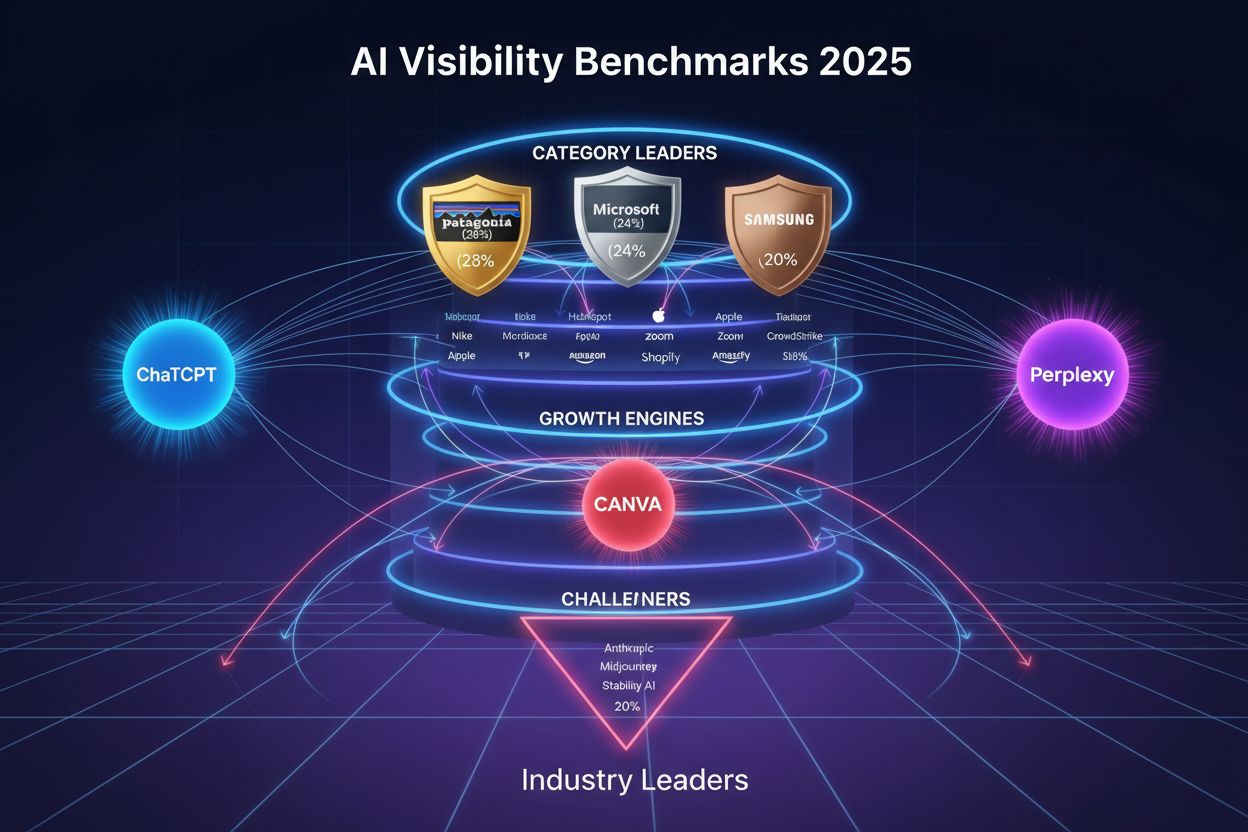
Who's Winning AI Visibility? Industry Benchmarks
Discover which brands are winning AI visibility benchmarks. Analyze industry leaders across ChatGPT, Perplexity, and Google AI with data-driven insights and com...
12 min read

Discover how CMOs can master AI visibility, monitor brand presence across ChatGPT, Perplexity, and Google AI Overviews, and implement strategic priorities for 2025 success.
The digital landscape is undergoing a seismic transformation that demands immediate attention from every CMO. Artificial intelligence-powered answer engines—including ChatGPT, Perplexity, Google AI Overviews, and Microsoft Copilot—are fundamentally reshaping how consumers discover information and solutions. Rather than clicking through to websites, users now receive synthesized answers directly within these AI platforms, a shift that has profound implications for brand visibility. Research reveals a stark reality: the presence of an AI overview in search results correlates with a 34.5% lower average click-through rate for the top-ranking page. This isn’t a minor metric fluctuation; it’s a structural change in how the internet works, and CMOs who fail to adapt their visibility strategy risk becoming invisible to their most valuable audiences.
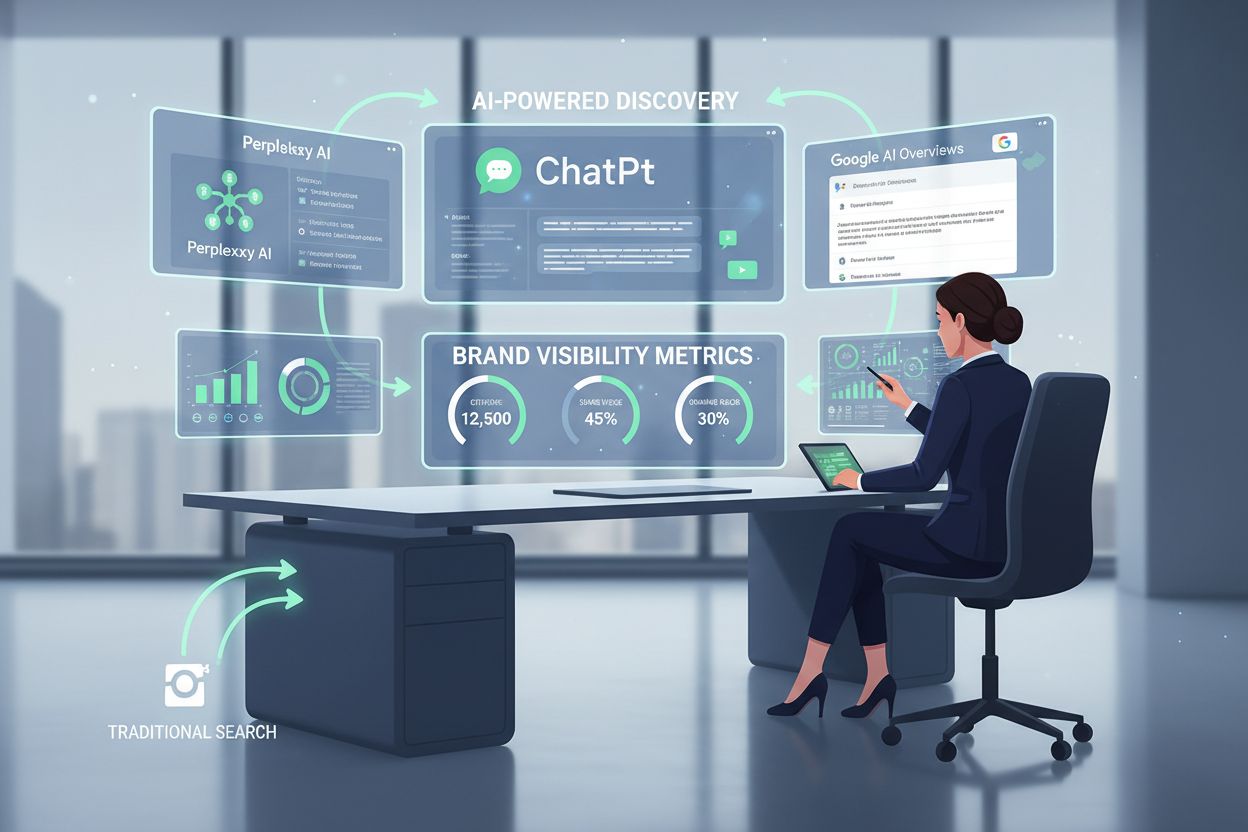
Before CMOs can strategically address AI visibility, they must understand what it is and how it differs fundamentally from traditional search engine optimization. AI visibility—often referred to as Generative Engine Optimization (GEO)—measures how frequently your brand, products, and content appear in responses generated by AI search engines and large language models. Unlike traditional SEO, which focuses on ranking for keywords and driving clicks to your website, AI visibility is about being cited as a trusted source within AI-generated answers. This distinction is critical because it changes both how you measure success and how you optimize your content strategy. The metric that matters most is “Share of Voice”—the percentage of AI mentions your brand receives compared to competitors when relevant queries are made. Citation tracking becomes essential, as does understanding which platforms mention your brand most frequently and in what context.
| Aspect | Traditional SEO | AI Visibility (GEO) |
|---|---|---|
| Discovery Method | Keyword ranking on search results pages | Brand mentions in AI-generated answers |
| User Intent | Search queries typed into search bar | Conversational prompts to AI platforms |
| Primary Visibility Metric | Click-through rate and rankings | Brand mentions and citations |
| Content Focus | Optimized pages for search algorithms | Referenced sources in AI responses |
| Success Measurement | Position in search results | Share of Voice across AI platforms |
| Timeline to Results | Long-term (months to years) | Real-time and continuously evolving |
The IBM 2025 CMO Study identifies five critical growth moves that separate marketing leaders who will thrive in the AI era from those who will struggle. These priorities aren’t incremental improvements to existing strategies—they represent a fundamental reimagining of how marketing organizations operate. Here are the five strategic pillars every CMO must address:
Win the Moment: Serve customers in critical micromoments of intent with precision, personalization, and proactiveness. In an AI-curated world, your brand must surface first when algorithms respond to customer queries, making real-time relevance non-negotiable.
Forge Infrastructure That Doesn’t Flinch: Build integrated platforms where data flows seamlessly and AI enhances human capability. Most martech stacks weren’t designed for the level of personalization and real-time optimization that AI demands, requiring fundamental architectural changes.
Heal Your EX to Fix Your CX: Recognize that external customer experience is merely the visible manifestation of internal organizational health. Only 28% of organizations report that end-to-end customer experience is effectively owned and aligned across functions—a gap that directly translates to financial underperformance.
Hire for Heart, Train for AI: Cultivate professionals who bring emotional intelligence and creativity to technology decisions while developing AI fluency across your team. The most valuable marketing currency isn’t data—it’s the uniquely human capacity to create emotional connections that algorithms cannot replicate.
Architect Outcomes Instead of Chasing Campaigns: Move beyond traditional campaign-based thinking to build perpetual growth engines powered by agentic AI that continuously learns, adapts, and optimizes toward business objectives. This represents a shift from execution to strategic orchestration.
The concept of “micromoments” has evolved dramatically in the age of AI. These are the critical instances when a customer has an immediate need or question, and they turn to an AI platform for an instant answer. In these fleeting seconds, your brand must not only be visible but must be positioned as the trusted, relevant solution. The challenge is that AI platforms intercept these moments before they ever reach your website—consumers get their answers directly from the AI interface, eliminating the traditional click-through journey that has defined digital marketing for decades. This fundamentally changes what “winning” means. It’s no longer about ranking on page one of Google; it’s about being cited as an authoritative source within AI-generated responses. Personalization and proactiveness have shifted from competitive advantages to baseline expectations. Consumers increasingly expect brands to understand their context, anticipate their needs, and respond in real time—and they’re evaluating whether brands deliver on these expectations in every interaction, including those mediated by AI platforms.
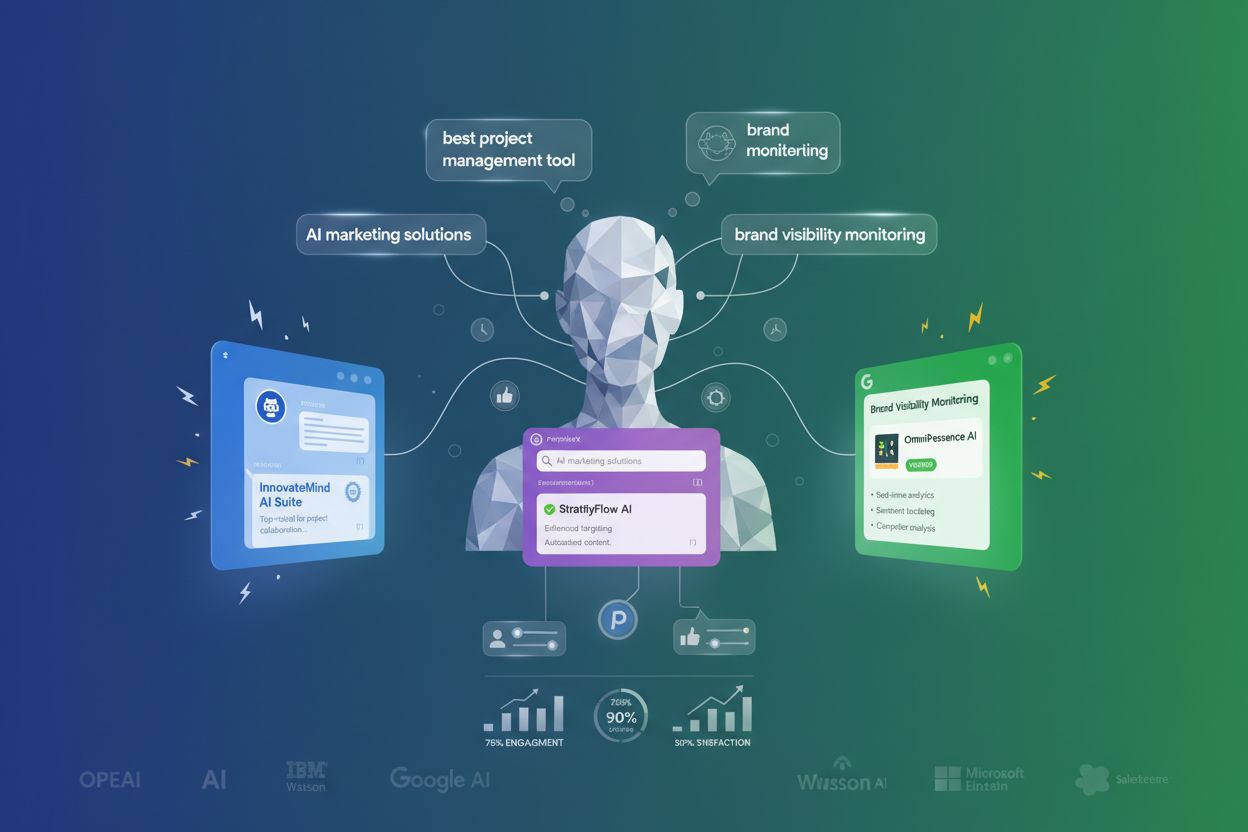
Most marketing technology stacks were architected for a different era—one where campaigns were discrete, time-bound initiatives and data could be siloed across multiple platforms. Today’s reality is fundamentally different. The average CMO now manages nine marketing tools, up from seven just two years ago, creating a complex ecosystem where data fragmentation, integration challenges, and operational inefficiency are the norm. This technological sprawl isn’t just an operational headache; it’s actively preventing organizations from realizing the full potential of their AI investments. A striking 58% of CMOs confess that fear of missing out (FOMO) drives them to invest in technologies before they truly understand their value or how they’ll integrate with existing systems. The solution isn’t more tools—it’s platformization. By consolidating around integrated platforms rather than accumulating point solutions, organizations can achieve seamless data flow, real-time insights, and the operational agility that AI-powered marketing demands. The data is compelling: 68% of CMOs agree that simplifying their marketing technology infrastructure will enhance operational efficiency and effectiveness. Integration correlates directly with higher performance, and organizations that unite their tech stacks around platforms rather than point solutions can mobilize from pilots to scaling—and ultimately, to profits—far more quickly.
Here’s a paradox that should concern every CMO: 71% acknowledge that the success of AI hinges more on people’s buy-in than the technology itself, yet only 21% believe they have the talent needed to achieve their goals for the next two years. This talent gap represents one of the most significant risks to AI adoption success. The challenge runs deeper than simple headcount. Only 23% of CMOs feel their employees are prepared for the cultural and operational shifts brought by AI agents, and only 22% of organizations have established clear guidelines and guardrails for AI use in automated decision-making. This governance vacuum creates risk. Meanwhile, consumers are already noticing something troubling: they can intuitively identify most AI-generated ads and perceive them as less engaging, more “annoying,” “boring,” and “confusing” than human-crafted counterparts. This isn’t just a preference—it’s a warning signal. The solution requires a fundamental shift in how CMOs approach talent. Rather than choosing between creative genius and technological prowess, the future belongs to professionals equally fluent in crafting emotionally resonant narratives and wielding the power of prompt engineering. CMOs must hire for heart—seeking emotional intelligence, creativity, and intuition—while systematically training teams for AI fluency. Equally important are the guardrails that protect a brand’s humanity while embracing automation. Without these protections, the very qualities that make a brand memorable risk being diluted in the pursuit of efficiency.
The era of third-party data is ending. Privacy regulations are tightening globally, third-party cookies are disappearing, and consumer scrutiny of data practices is intensifying. This isn’t a future threat—it’s a present reality that demands immediate strategic response. A striking 69% of CMOs acknowledge that new privacy regulations will require them to rethink their data strategy fundamentally. The brands that will thrive are those that have already begun building their foundation on first-party and zero-party data—information that customers intentionally and proactively share in exchange for more personalized and valuable experiences. Direct customer relationships become the competitive moat. Rather than buying audience data from third parties, successful CMOs are investing in digital products and services that enable direct customer engagement and data collection. These digital offerings serve multiple purposes: they lower costs, respond more quickly to customer needs, improve operational efficiency, and expand market reach. Equally important is the role of ecosystem partnerships. A striking 73% of demand leaders report leveraging ecosystem partnerships to expand market reach, with 30% doing so “to a great extent.” The message is clear: in a privacy-first world, the brands that win are those that build direct relationships, collect proprietary data, and orchestrate strategic partnerships to extend their reach and influence.
The traditional marketing model—orchestrating discrete campaigns with defined start and end dates—is becoming obsolete. Tomorrow’s marketing leaders are building something fundamentally different: perpetual growth engines powered by agentic AI that continuously learn, adapt, and optimize toward business objectives. This isn’t simply automation; it’s the creation of marketing organisms that operate with minimal human intervention while remaining aligned with strategic intent. Agentic AI differs fundamentally from automation and AI assistants. Automation executes tasks. Assistants respond to requests. Agentic AI plans and adapts, anticipating impact and adjusting strategy in real time based on performance data. The operational complexity of this transition, however, is being underestimated. A sobering 54% of demand leaders confess they “underestimated the operational complexity of translating AI strategies into tangible outcomes.” Only 17% strongly believe their function is prepared to integrate agentic AI into their processes to improve decision-making and efficiency. The gap between aspiration and readiness is significant. Too many CMOs are still primarily funding automation—a tactical solution—when the true strategic advantage lies in building intelligent systems for continuous, autonomous growth. The focus must shift from execution to outcomes. Rather than measuring success by campaign launches or content pieces produced, CMOs should measure how AI systems influence core demand generation metrics: pipeline value, market share, and customer retention. This requires not just new technology but new thinking about how marketing creates value.
You cannot manage what you don’t measure, and AI visibility is no exception. CMOs need dedicated tools and processes to track how their brand appears across the rapidly expanding landscape of AI search platforms. This means monitoring brand mentions and citations across ChatGPT, Perplexity, Google AI Overviews, Google AI Mode, Gemini, and Microsoft Copilot—platforms that collectively represent the future of how consumers discover information. Effective monitoring goes beyond simple brand mention counting. It requires tracking Share of Voice metrics that show your brand’s visibility relative to competitors, understanding which specific content pieces are being cited, and identifying the context in which your brand appears in AI-generated responses. Citation tracking is particularly important because it reveals which of your web pages and content assets are being recognized as authoritative sources by AI systems. Competitive benchmarking provides crucial context—knowing not just that you’re mentioned, but how frequently compared to key competitors. Real-time alerts enable rapid response when brand mentions shift, either positively or negatively. Integration with your existing martech stack ensures that AI visibility insights inform content strategy, SEO efforts, and overall marketing planning. Solutions like AmICited.com provide comprehensive monitoring across all major AI platforms, offering CMOs the visibility they need to understand their presence in AI-generated answers and optimize accordingly. By implementing dedicated AI visibility monitoring, CMOs transform what was previously a blind spot into a strategic advantage.
The strategic priorities outlined above may seem ambitious, but CMOs don’t need to transform everything simultaneously. Instead, focus on these seven concrete actions that will move your organization forward:
Conduct an Operational Readiness Assessment: Evaluate your organization across five key dimensions—strategy (how well you serve customers in moments that matter), security and infrastructure (where latency inhibits future experiences), internal operations (where friction shapes customer experience), human-AI collaboration (team readiness for AI-generated outputs), and operationalization (whether AI is set up as a growth flywheel). This assessment reveals your starting point and priorities.
Identify One Critical Customer Journey Decision Point: Trace the data flow and team handoffs behind a single critical moment in your customer journey. This exercise exposes where fragmentation is slowing relevancy and where platform-level integration is urgently needed.
Shift Your Brand from Visible to Indispensable: Review how your brand currently shows up in AI-curated environments—search, chat, voice—and identify one opportunity to improve how clearly and contextually you answer customer intent. Make your brand not just present, but essential.
Apply the “AI + EQ” Test: Put one upcoming customer-facing, AI-enabled moment through this test: Are we being fast, but forgettable? If so, elevate the human layer. Precision needs personality to be memorable. The true power lies in blending AI efficiency with emotional intelligence.
Reframe One Key Outcome for Real-Time Optimization: Identify one critical business outcome and map how AI can optimize this outcome in real time, rather than just executing individual tasks. Turn AI from a tool into a proactive engine for growth.
Audit Your Current AI Visibility: Use dedicated monitoring tools to establish a baseline of how your brand appears across ChatGPT, Perplexity, Google AI Overviews, and other platforms. Understand your Share of Voice, which content is being cited, and where you’re losing ground to competitors.
Develop Your First-Party Data Strategy: Begin collecting and leveraging first-party data through direct customer relationships, digital products, and zero-party data initiatives. This foundation will become increasingly critical as third-party data sources disappear.
These actions aren’t theoretical—they’re immediately implementable steps that will position your organization to thrive in the AI-driven marketing landscape of 2025 and beyond.
AI visibility measures how frequently your brand, products, and content appear in responses generated by AI search engines like ChatGPT, Perplexity, and Google AI Overviews. It matters because these platforms are intercepting search queries before they reach traditional websites, with AI overviews correlating to a 34.5% lower click-through rate for top-ranking pages. CMOs must ensure their brand is cited as a trusted source within AI-generated answers to remain visible to their audiences.
Traditional SEO focuses on ranking for keywords and driving clicks to your website, while AI visibility (also called Generative Engine Optimization or GEO) measures how often your brand is mentioned and cited within AI-generated responses. The key metric shifts from click-through rate to Share of Voice—the percentage of AI mentions your brand receives compared to competitors. Success requires optimizing for being cited as an authoritative source rather than optimizing for search rankings.
CMOs should monitor brand visibility across the major AI search platforms: ChatGPT, Perplexity, Google AI Overviews, Google AI Mode, Gemini, and Microsoft Copilot. These platforms collectively represent how consumers are discovering information and solutions. Each platform has different user bases and response patterns, so comprehensive monitoring across all major platforms provides a complete picture of your AI visibility.
Dedicated AI visibility monitoring tools like AmICited.com provide comprehensive tracking across all major AI platforms, offering real-time brand mention monitoring, citation tracking, Share of Voice metrics, competitive benchmarking, and automated reporting. These tools eliminate the need for manual monitoring and provide actionable insights to optimize your presence in AI-generated answers. AmICited.com stands out for its comprehensive monitoring capabilities and integration with existing marketing workflows.
CMOs can optimize for AI visibility by creating high-quality, authoritative content that answers customer questions comprehensively, building first-party data relationships with customers, ensuring content is discoverable and citable by AI systems, implementing structured data markup, and monitoring how their content appears in AI responses. The focus should be on being recognized as a trusted source rather than optimizing for traditional search rankings.
When your brand appears prominently in AI-generated answers, it builds trust and credibility with customers at the moment they're seeking solutions. This visibility in critical micromoments of intent creates opportunities to demonstrate value and build relationships. Customers who discover your brand through AI recommendations perceive it as more trustworthy, which directly contributes to long-term loyalty and customer lifetime value.
CMOs should hire for heart—seeking emotional intelligence, creativity, and intuition—while training teams for AI fluency. The most effective approach combines AI's efficiency with human creativity and emotional resonance. Consumers can detect AI-generated content and find it less engaging than human-crafted alternatives. The solution is to use AI as a tool to amplify human creativity, not replace it, while establishing guardrails to protect brand humanity.
The first step is to conduct an operational readiness assessment evaluating your organization across five dimensions: strategy (serving customers in moments that matter), security and infrastructure (data latency issues), internal operations (friction points), human-AI collaboration (team readiness), and operationalization (AI as a growth engine). This assessment reveals your starting point and helps prioritize which strategic initiatives to tackle first.
AmICited.com monitors how your brand appears across ChatGPT, Perplexity, Google AI Overviews, and other AI platforms. Get real-time insights into your AI visibility, track citations, and optimize your presence where customers are discovering solutions.
Discover which brands are winning AI visibility benchmarks. Analyze industry leaders across ChatGPT, Perplexity, and Google AI with data-driven insights and com...
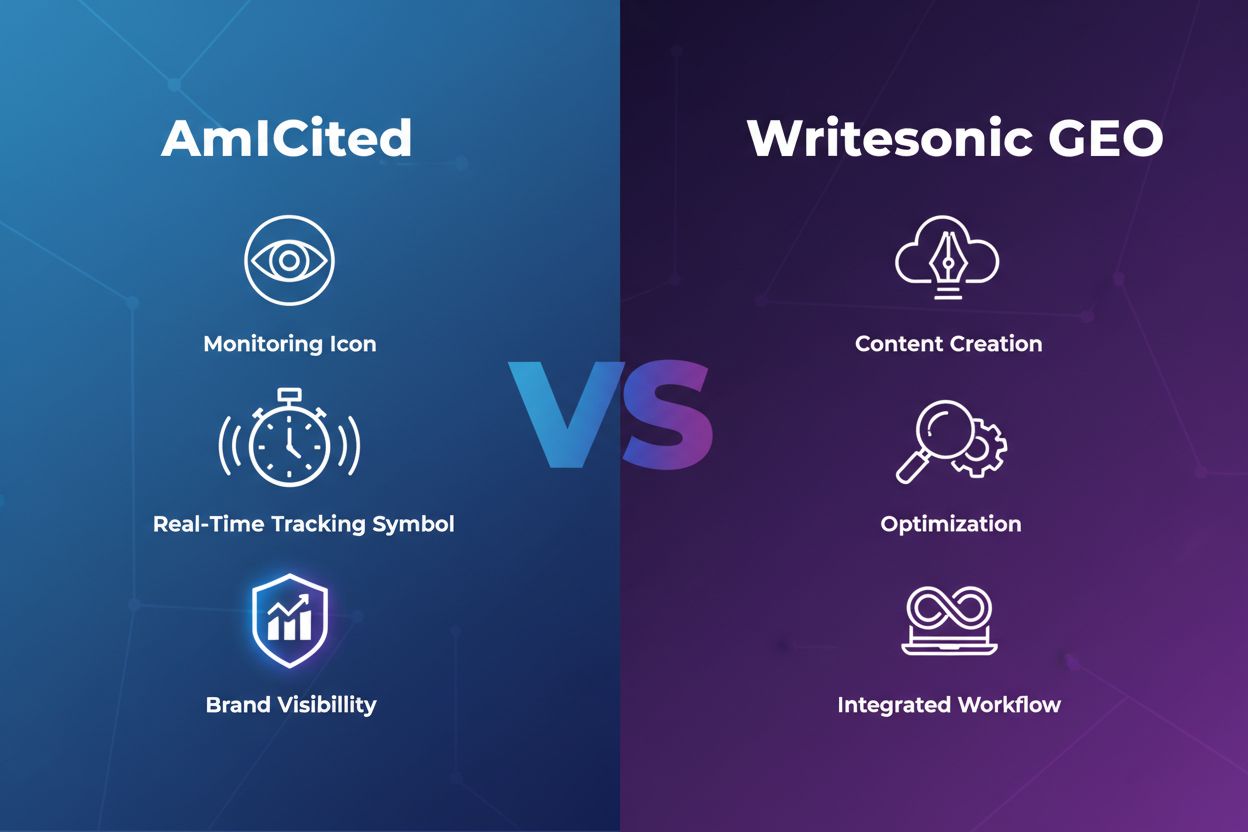
Compare AmICited AI monitoring with Writesonic GEO. Understand the differences between pure monitoring and integrated optimization for AI search visibility.

Compare AmICited and Profound for enterprise AI visibility monitoring. Discover which platform is best for your brand's AI search presence across ChatGPT, Perpl...