
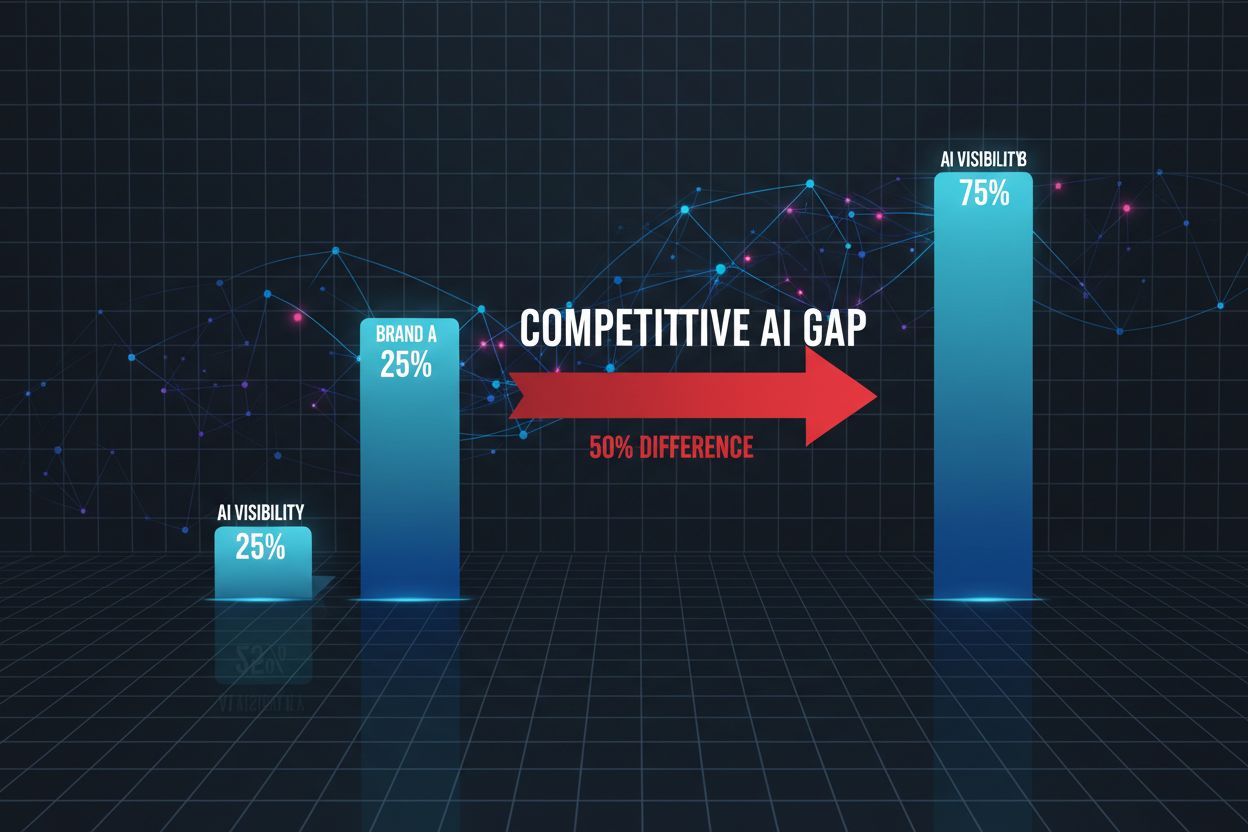
Competitive AI Gap
Learn what competitive AI gap means, how to measure it, and why it matters for your brand's visibility in ChatGPT, Claude, Gemini, and other AI systems. Discove...
10 min read
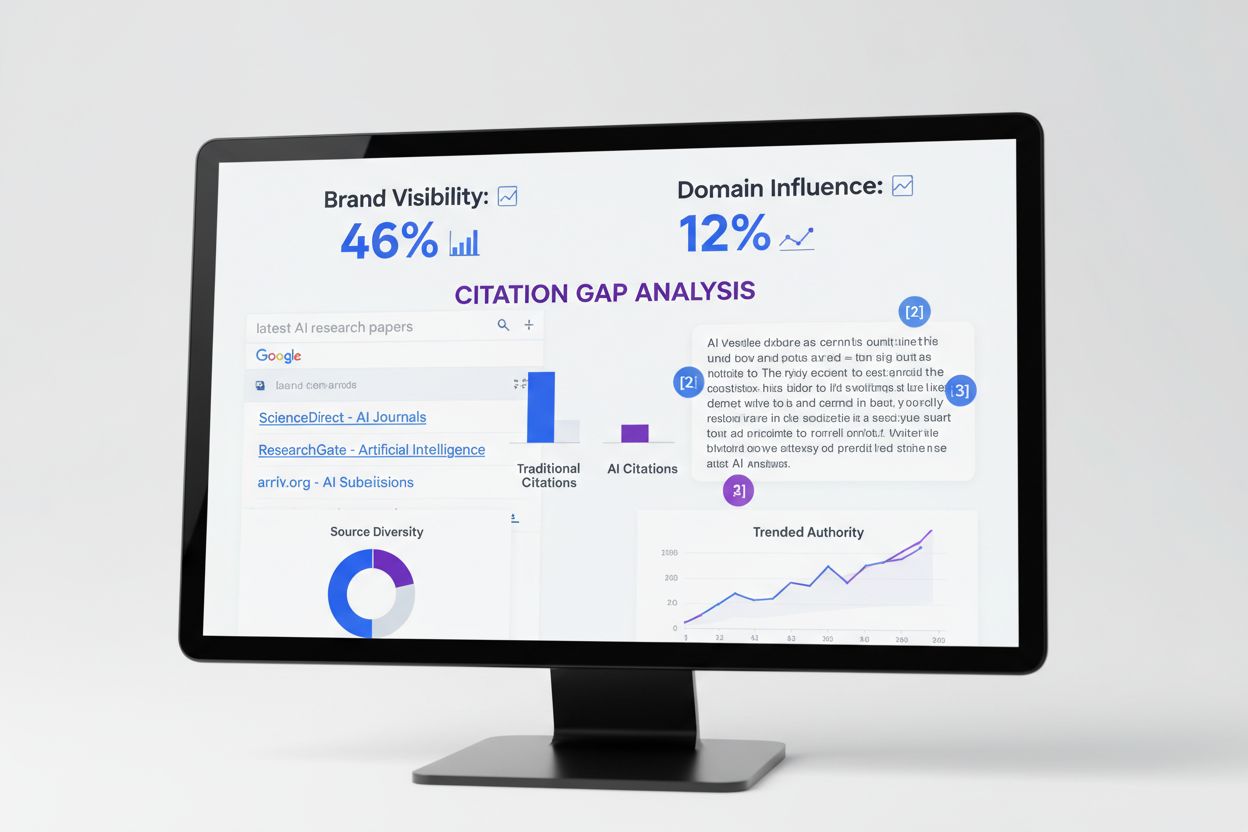
Discover how to analyze competitor content citations in AI systems, identify visibility gaps, and optimize your brand’s presence in ChatGPT, Perplexity, and Google AI Overviews.
In the age of artificial intelligence, the way consumers discover information has fundamentally shifted, and with it, the metrics that matter for brand visibility have transformed as well. AI citation gap analysis is a systematic measurement approach that quantifies how often your brand appears in AI-generated answers compared to your competitors. Unlike traditional SEO metrics that focus on search engine rankings and click-through rates, AI citation analysis measures something far more valuable in today’s landscape: whether your content is authoritative enough to be cited directly by AI systems when answering user queries. This distinction is critical because it represents a seismic shift in how information flows to consumers and where brands need to focus their content strategy.
The difference between traditional SEO and AI citation gap analysis cannot be overstated. Traditional SEO has long prioritized ranking position—the coveted first page of Google results—with the assumption that higher rankings drive traffic. However, this model is rapidly becoming obsolete. 69% of searches now result in zero clicks, meaning users get their answers directly from search results or AI systems without ever visiting a website. When users do interact with AI tools, fewer than 20% click external links, and only 4% of searches occur in AI mode—for now. The real opportunity lies not in ranking for keywords, but in being the source that AI systems trust enough to cite when answering questions in your industry.
Why does this matter so profoundly? Because consumer behavior is shifting at an unprecedented pace. One in four consumers now shop with AI assistants, and 60% have replaced traditional search engines with AI tools like ChatGPT, Claude, or specialized industry tools. These consumers aren’t clicking through to websites; they’re reading synthesized answers that pull from multiple sources. If your brand isn’t cited in those answers, you’re invisible to an increasingly large segment of your target audience. Being cited by AI systems has become the new currency of digital visibility, replacing the click-through as the primary indicator of content authority and relevance.
Understanding your AI citation gap—the difference between how often you’re cited versus your competitors—reveals a critical blind spot in most content strategies. While competitors may be optimizing for traditional rankings, forward-thinking brands are asking a different question: “Are we the sources AI systems trust?” This gap analysis uncovers which topics, content formats, and information types position your brand as an authority in the eyes of AI systems. It’s not about gaming algorithms or manipulating rankings; it’s about creating content so authoritative, comprehensive, and trustworthy that AI systems naturally reference it when answering user questions. This represents a fundamental evolution in how brands must think about content strategy, visibility, and competitive advantage in an AI-driven world.
The process of how AI systems choose which sources to cite is far more sophisticated than simple keyword matching. At the heart of this selection lies Retrieval-Augmented Generation (RAG), a technical framework that fundamentally shapes which content gets elevated in AI responses. RAG works by first retrieving relevant documents from a knowledge base or the live web, then using those retrieved sources to ground the AI’s generated response. This two-stage process—retrieve then generate—creates a critical bottleneck where only certain types of content make it through to become cited sources.
The selection of sources depends on five core citation factors that AI systems evaluate, either explicitly or implicitly:
Interestingly, different AI platforms weight these factors differently, creating distinct citation patterns. Domain influence often matters more than individual URL authority—a well-established domain like Wikipedia or Reddit can overcome individual page weaknesses through institutional trust. This explains why Wikipedia accounts for 26.3% of citations across major AI systems, while Reddit represents 40.1% of citations, despite Reddit’s more variable content quality. The platforms have learned that these domains contain dense, community-validated information that users find reliable.
The major AI platforms approach citation selection through different architectural philosophies:
| Platform | Citation Approach | Live Web | Source Transparency | Key Characteristics |
|---|---|---|---|---|
| ChatGPT | Model-first | Optional | Limited | Requires plugins for citations |
| Perplexity | Retrieval-first | Yes | High | Direct inline citations |
| Google Gemini | Integrated search | Yes | Medium | Tied to search results |
| Claude | Selective | Yes (new) | Medium | Safety-focused |
| DeepSeek | Varies | Depends | Varies | Region-specific |
ChatGPT prioritizes its training data, treating live web sources as supplementary. Perplexity inverts this, building its entire architecture around retrieval-first methodology, which explains its higher citation transparency. Google Gemini integrates its search infrastructure directly, while Claude takes a more selective approach, citing sources only when confidence is high. DeepSeek’s approach varies based on deployment region and use case. Understanding these architectural differences is essential for content creators seeking citations, as optimizing for one platform’s citation mechanism may not translate across systems.
Analyzing citation gaps without a structured approach can lead to incomplete insights and missed opportunities. To systematically identify where your content falls short compared to competitors, we recommend the D.E.E.P. framework—a four-phase methodology designed to transform raw citation data into actionable strategy. This framework ensures consistency across your analysis, reduces bias in interpretation, and creates a repeatable process you can apply across multiple content categories and competitor sets.
The D.E.E.P. framework consists of four interconnected phases:
Define: Establish Your Baseline and Competitive Set Start by clearly defining your analysis scope: What are your primary business goals? Which competitors should you analyze? Define success metrics upfront—whether that’s increasing citations in specific domains, improving citation diversity, or capturing citations in emerging topics. For example, a SaaS company might define their goal as “increase citations in AI/ML content by 40% within six months” and identify their top five direct competitors as the baseline for comparison.
Explore: Map the Citation Landscape Conduct a comprehensive audit of where your competitors’ content receives citations across different platforms, industries, and content types. Use citation tracking tools to identify patterns: Which topics generate the most citations? Which content formats (guides, case studies, research reports) attract citations most frequently? Which domains and publications cite your competitors most often? This phase reveals the “citation ecosystem” surrounding your industry. For instance, you might discover that your competitors’ technical documentation receives heavy citations from academic institutions, while their thought leadership pieces get cited primarily in industry publications.
Evaluate: Analyze Gaps at Multiple Levels Examine the gaps between your citation performance and your competitors’ across several dimensions: topic gaps (subjects they cover that you don’t), format gaps (content types they use that you’re missing), domain gaps (citation sources they attract that you don’t), and depth gaps (how comprehensively they cover topics versus your approach). This multi-level analysis prevents you from oversimplifying the problem. Rather than assuming you just need “more content,” you might discover that your competitors dominate citations because they provide more detailed technical specifications, include more original research, or address specific use cases you’ve overlooked.
Plan: Translate Insights into Data-Driven Decisions Convert your findings into a prioritized action plan with specific, measurable objectives. Decide which gaps offer the highest ROI to address first, what new content you need to create, how to improve existing content, and which topics deserve deeper investment. Establish metrics to track progress against your baseline. This phase transforms analysis into strategy—you’re not just identifying gaps, you’re deciding exactly how to close them.
Frameworks matter because they create consistency and reduce decision fatigue. Without structure, citation gap analysis becomes subjective and incomplete. The D.E.E.P. framework ensures you’re asking the right questions at each stage and building on previous findings systematically. In the next section, we’ll walk through a real-world case study showing how a fintech company applied this framework to identify critical citation gaps in their payment processing content and the results they achieved.
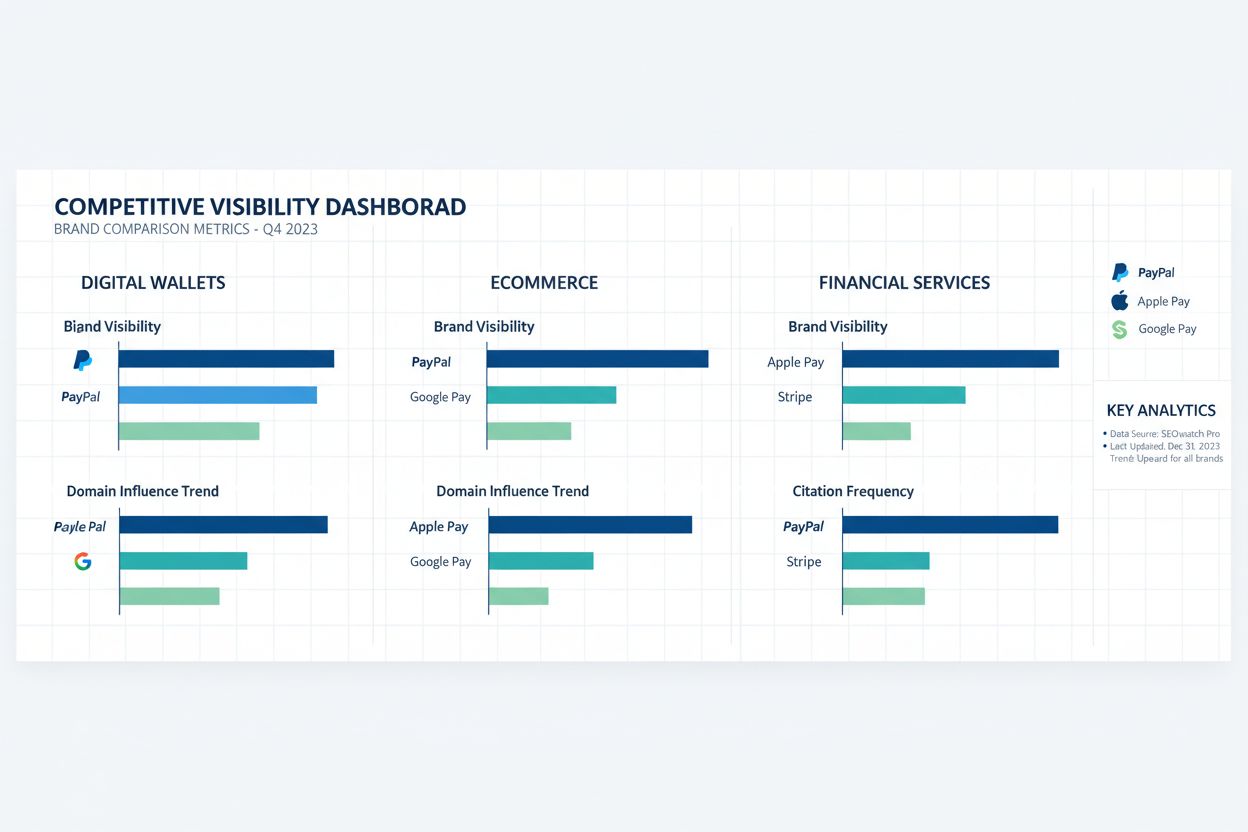
Understanding your position in the AI citation landscape requires systematic measurement and comparison against key competitors. The most fundamental metric to track is brand visibility percentage, which represents the proportion of AI-generated answers that mention your brand across all topics. This metric provides a high-level view of your presence in AI responses, but it tells only part of the story. A brand appearing in 35% of answers might seem strong until you discover that competitors are mentioned in 60% of responses, revealing a significant visibility gap that demands strategic attention.
Beyond raw visibility, brand mention share offers crucial competitive context by calculating what percentage of all brand mentions in a category belong to your company. For example, if there are 1,000 total mentions across all payment solutions in AI responses, and your brand receives 280 mentions, your mention share is 28%. This metric normalizes for market size and helps you understand whether you’re gaining or losing share relative to competitors. When PayPal maintains a 46% mention share across all topics while Apple Pay holds 26% and Google Pay captures 23%, the distribution immediately reveals market leadership and competitive positioning.
Citation distribution analysis examines how mentions are spread across different answer types and contexts. Some brands may receive concentrated citations in specific answer types while others achieve more distributed coverage. A brand that appears in 80% of comparison questions but only 15% of how-to guides has a different competitive profile than one with more balanced distribution. This analysis reveals whether your content strategy is resonating across diverse query types or whether you’re overindexed in particular contexts.
| Brand | All Topics | Digital Wallets | Ecommerce | Financial Services |
|---|---|---|---|---|
| PayPal | 46% | 46% | 26% | 19% |
| Apple Pay | 26% | 58% | 14% | 7% |
| Google Pay | 23% | 52% | 11% | 5% |
| Stripe | 22% | 6% | 19% | 8% |
Domain influence scores measure the authority and reach of domains citing your brand compared to competitors. A brand mentioned in 100 responses from high-authority domains carries more weight than 200 mentions from low-authority sources. This metric helps you understand whether your citations come from trusted, influential sources or whether you’re accumulating mentions from less authoritative content.
Topic-level visibility variations reveal critical insights about where your brand dominates and where gaps exist. Your brand might achieve 58% visibility in digital wallet discussions but only 7% in financial services contexts. These variations indicate content opportunities and competitive vulnerabilities. Stripe’s 19% visibility in ecommerce versus 6% in digital wallets demonstrates how competitive positioning shifts dramatically across topics.
Key metrics to track in your competitive benchmarking include:
Regular benchmarking against these metrics creates a data-driven foundation for strategic decisions about content creation, topic focus, and competitive positioning in the AI citation ecosystem.
Understanding where your competitors receive citations that you don’t is the cornerstone of strategic content optimization. Citation gaps aren’t distributed evenly across topics and domains—some areas represent significantly higher-value opportunities than others. By conducting a granular analysis at both the topic and domain level, you can identify the specific niches where competitors have established authority that remains untapped for your brand.
Topic-specific citation analysis reveals which subject areas generate the most valuable citations. For instance, if you operate in the financial services space, you might discover that competitors receive 67% more citations from personal finance topics compared to investment strategy topics. This disparity suggests that your competitor has invested heavily in content addressing everyday financial decisions—budgeting, debt management, and savings strategies—rather than complex investment vehicles. By mapping these topic clusters, you can prioritize content creation in high-citation-generating areas where your presence is currently weak.
Domain-level gap identification takes this analysis further by examining which specific websites cite your competitors but not your brand:
URL influence scoring helps you prioritize which citation gaps matter most. Not all citations carry equal weight. A single citation from Forbes carries substantially more influence than five citations from mid-tier blogs. By scoring each domain based on domain authority, traffic metrics, and AI training dataset inclusion, you can focus on the highest-impact gaps. For example, you might find that while competitors receive 12 citations from mid-tier finance blogs and 3 citations from Forbes, the Forbes citations drive 8 times more AI citation value due to domain authority and dataset prominence.
High-authority domain targeting becomes your strategic focus once gaps are identified. If analysis reveals that competitors receive citations from 15 high-authority domains that don’t cite your brand, these represent your most valuable opportunities. Consider a scenario where competitors are cited by NerdWallet in articles about credit card rewards, but your brand—despite offering superior rewards analysis—hasn’t achieved citations in this domain. This gap represents a concrete opportunity to develop content that meets NerdWallet’s editorial standards and citation criteria.
Non-brand citation opportunities often emerge from this analysis. You might discover that competitors receive citations for generic topics like “best savings accounts” or “investment strategies,” not necessarily for branded content. These non-brand citations often represent larger volume opportunities. If competitors achieve 45 citations for generic financial topics versus 8 citations for branded content, your strategy should emphasize creating authoritative content around these broader topics rather than focusing exclusively on brand-specific narratives.
The competitive advantage emerges when you systematically address these gaps. By targeting the specific domains, topics, and content types where competitors outperform you, you create a data-driven roadmap for citation acquisition that focuses resources on the highest-impact opportunities rather than pursuing citations broadly.
To maximize your content’s likelihood of being cited by AI systems, you need a strategic approach that combines technical optimization with content quality improvements. AI models are trained on vast datasets and learn to recognize patterns in how authoritative sources structure and present information. By aligning your content with these patterns, you can significantly increase citation potential.
Update Frequency and Freshness Strategy
Implement a content refresh cycle of 48-72 hours for your most important pieces. AI systems prioritize recently updated content, especially when changes include new data, statistics, or insights. This doesn’t mean complete rewrites—strategic updates to key sections, addition of new research findings, or expansion of existing data points signal to AI models that your content remains current and reliable. Create a content calendar that identifies your highest-performing pieces and schedules regular optimization passes.
Structured Data Implementation
Deploy Schema markup across your content to help AI systems understand context and relationships. Implement Article schema for blog posts, FAQPage schema for Q&A content, and NewsArticle schema for timely pieces. This structured data acts as a roadmap for AI crawlers, making it easier for them to extract key facts, claims, and supporting evidence. Include author information, publication dates, and content sections in your markup to enhance discoverability.
Knowledge Graph and Wikipedia Presence
Establish your brand or expertise area in knowledge graphs by creating or optimizing Wikipedia entries, industry-specific databases, and authoritative directories. AI systems cross-reference these sources when validating information. If you’re cited in Wikipedia or appear in knowledge graph panels, your content gains significant credibility signals that increase citation likelihood.
Strategic Authority Partnerships
Build relationships with high-authority domains in your industry. When established publications link to or reference your research, AI systems recognize these endorsements as credibility signals. Pursue guest posting opportunities, contribute to industry reports, and collaborate on research with recognized institutions. These partnerships create citation pathways that AI models learn to follow.
Content Characteristics That Drive Citations
Focus on these specific attributes:
E-E-A-T Signal Optimization
Strengthen Experience, Expertise, Authority, and Trustworthiness signals throughout your content. Include author bios with credentials, link to your professional profiles, cite your relevant experience, and demonstrate deep knowledge of your subject matter. Use data from primary sources you’ve conducted or analyzed. Include transparent methodology sections that explain how you gathered information. These signals help AI systems assess whether your content deserves citation status.
Implement these strategies systematically, measuring which optimizations yield the highest citation increases in your AI traffic analytics. Start with your top-performing content and expand successful tactics across your entire content library.
Establishing a robust measurement framework is essential for understanding whether your content optimization efforts are translating into actual AI citations. Without concrete metrics and tracking mechanisms, you’re essentially operating blind—unable to determine what’s working, what needs adjustment, or whether your investment in content strategy is delivering ROI. The key is implementing a systematic approach that combines automated tracking tools with manual verification and regular competitive analysis.
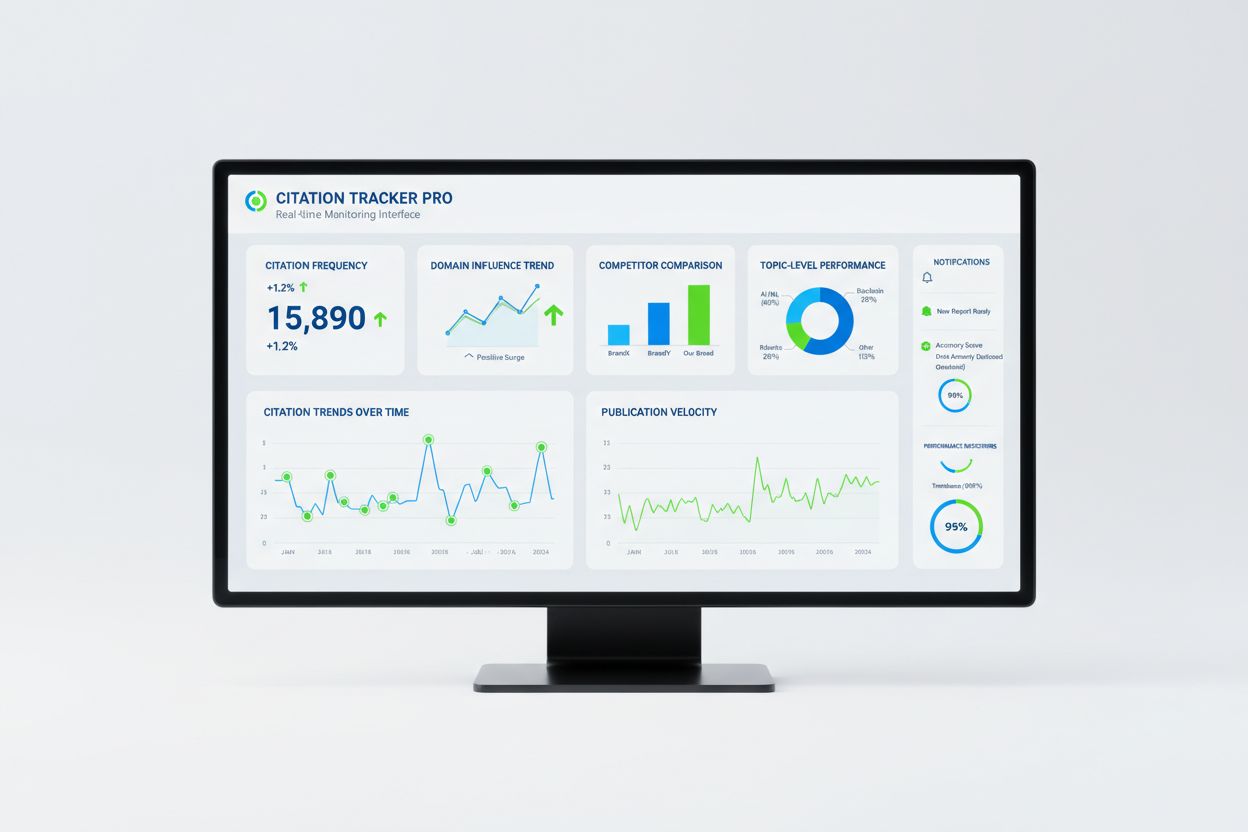
The foundation of your measurement strategy should include dedicated citation tracking platforms. Tools like AmICited provide direct visibility into which of your content pieces are being cited by AI systems, offering granular data on citation frequency, source attribution, and citation context. Complementing this with broader SEO and competitive intelligence platforms like Similarweb, Conductor, and Hall gives you a more complete picture of your content’s visibility across search engines and AI systems. These platforms help you understand not just whether you’re being cited, but how your citation performance compares to competitors in your space.
Your KPI framework should focus on several critical metrics that directly indicate AI visibility success:
Implement a quarterly review cadence where you conduct comprehensive audits of your citation performance. This involves both automated data collection from your tracking tools and manual testing—systematically prompting major AI systems with queries relevant to your content and documenting which pieces appear in responses. This dual approach catches gaps that automated tools might miss while validating their accuracy.
Adaptation requirements should be built into your measurement process. If certain content types consistently underperform in citations despite strong traditional SEO metrics, this signals a need for content restructuring. Conversely, if specific topics generate disproportionate citation volume, this indicates where to increase investment. Your measurement framework should explicitly include decision triggers—predetermined thresholds that prompt strategic adjustments.
Finally, connect your citation metrics directly to business outcomes. Measure the ROI of your citation optimization efforts by tracking referral traffic from AI systems, conversion rates from AI-sourced visitors, and the cost per acquisition compared to other channels. This business-focused measurement approach ensures that citation success translates into tangible value for your organization.
Once you’ve identified the gaps between your content and competitors’ AI-cited material, the next critical step is developing a structured action plan to close those gaps systematically. This roadmap transforms your gap analysis insights into concrete, implementable strategies that align with your business objectives and available resources.
The foundation of an effective action plan is a clear prioritization system. Start by mapping identified gaps against two key dimensions: business impact and implementation feasibility. High-impact gaps that address your core business objectives and audience pain points should receive priority, particularly when they align with your existing expertise and resources. Consider which gaps, if closed, would most directly influence your visibility in AI citations and drive meaningful traffic to your properties. Additionally, evaluate the competitive urgency of each gap—some competitors may be establishing authority in emerging topics where first-mover advantage matters significantly.
Follow these steps to build your actionable plan:
Segment gaps by content type and topic cluster - Group related gaps together to enable efficient content creation and cross-linking strategies that amplify topical authority.
Assign resource requirements - Estimate the effort needed for each gap. A comprehensive guide addressing a major gap might require 40-60 hours of research, writing, and optimization, while updating existing content to fill smaller gaps might need only 8-12 hours.
Establish a phased timeline - Allocate your resources across quarters. A realistic approach might dedicate 30% of your content resources to closing high-priority gaps in Q1, 25% in Q2, and 20% in Q3, while reserving capacity for ongoing optimization and emerging opportunities.
Define success metrics - Establish tracking mechanisms for each gap closure initiative, monitoring citation mentions, search visibility, and traffic attribution to measure impact.
Effective resource allocation requires honest assessment of your team’s capacity. If you have a small team, focus on high-leverage gaps where your unique perspective or expertise creates defensible competitive advantage. Consider allocating resources as follows: 50% to closing critical gaps in your core topic areas, 30% to expanding into adjacent high-opportunity topics, and 20% to experimental content addressing emerging gaps. For larger teams, you might distribute resources across parallel workstreams, enabling simultaneous progress on multiple gap categories.
As you create content addressing identified gaps, develop a parallel outreach strategy. Identify industry experts, complementary brands, and thought leaders who might reference or amplify your new content. Consider partnership opportunities where co-created content or mutual citations strengthen both parties’ authority signals. Strategic partnerships can accelerate your citation velocity and expand your reach into new audience segments.
Your action plan should include built-in flexibility for iteration. Schedule quarterly reviews to assess which gap-closing initiatives delivered the strongest citation and traffic results. Use these insights to refine your prioritization framework and adjust resource allocation accordingly. Some gaps may prove more valuable than anticipated, while others might require different content approaches than initially planned.
The most successful citation gap strategies treat this as an ongoing process rather than a one-time project. By systematically closing gaps while continuously monitoring competitive landscape shifts, you build sustainable competitive advantage in AI-driven discovery and citation.
AI citation gap analysis measures how often your brand is cited in AI-generated answers compared to competitors, rather than focusing on search rankings. While traditional SEO prioritizes ranking position, AI citation analysis measures whether AI systems trust your content enough to cite it directly. This is critical because 69% of searches now result in zero clicks, and users increasingly rely on AI-synthesized answers rather than clicking through to websites.
AI citations serve as authority signals that validate your brand's expertise to millions of users, even without direct clicks. When AI systems cite your content, it builds brand credibility and awareness among audiences actively seeking information. Additionally, AI referral traffic is growing rapidly—Gen AI website traffic increased 76% year-over-year—and conversion rates from AI traffic often exceed traditional search. Citations represent the foundation for future traffic growth as AI adoption accelerates.
We recommend conducting comprehensive citation gap analysis quarterly, with monthly monitoring of key metrics. Since AI citation patterns shift rapidly (50% of cited domains change monthly), regular analysis helps you stay ahead of competitive changes and emerging opportunities. Monthly tracking of brand visibility, domain influence, and topic-level performance ensures you can adapt your strategy quickly when gaps emerge.
Focus on four core metrics: (1) Brand visibility percentage—the proportion of AI answers mentioning your brand, (2) Brand mention share—your percentage of total mentions in your category, (3) Domain influence—how often your website is cited, and (4) Topic-level visibility—your citation performance across specific subject areas. These metrics provide a complete picture of your AI citation performance and competitive positioning.
Improve domain influence by publishing high-quality, authoritative content that AI systems trust. Focus on comprehensive guides, original research, and content with high factual density. Implement structured data markup (Schema), maintain regular content updates (48-72 hour refresh cycles), build Wikipedia presence, and establish partnerships with high-authority domains. These signals collectively increase the likelihood that AI systems will cite your content.
Prioritize ChatGPT, Google Gemini, and Perplexity, as these represent the largest user bases and most significant traffic sources. ChatGPT dominates with model-first architecture, Perplexity leads in citation transparency, and Google Gemini integrates with search results. Monitor all three to understand how your content performs across different AI architectures and citation mechanisms. DeepSeek and Claude are emerging platforms worth tracking as they gain adoption.
Brand visibility measures whether your brand name appears in AI-generated answers, while citation tracking measures whether your specific content is cited as a source. You can have brand visibility without citations (your brand is mentioned but not linked), or citations without brand mentions (your content is cited but your brand isn't explicitly named). Citation tracking provides more granular insight into which specific content pieces drive authority and influence.
Initial improvements typically appear within 4-8 weeks as AI systems re-index and re-train on updated content. However, significant citation growth usually requires 3-6 months of consistent optimization across multiple content pieces and topics. The timeline depends on your starting position, competitive intensity, and the scope of gaps you're addressing. Quarterly measurement cycles help you track progress and adjust strategy based on results.
Track how your brand and competitors are cited across ChatGPT, Perplexity, and Google AI Overviews. Identify citation gaps and optimize your content strategy with AmICited's AI citation monitoring platform.
Learn what competitive AI gap means, how to measure it, and why it matters for your brand's visibility in ChatGPT, Claude, Gemini, and other AI systems. Discove...
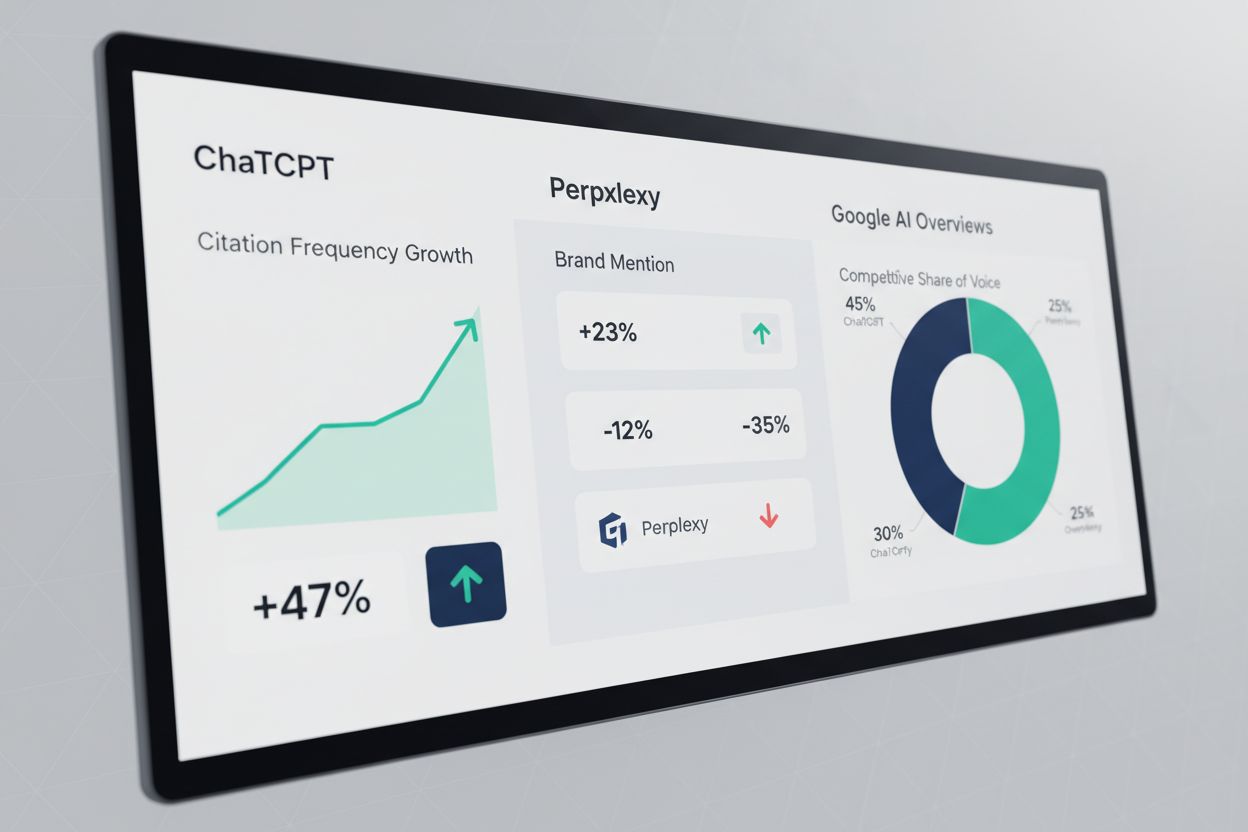
Learn what citation trend analysis is, why tracking AI citation patterns matters for your brand, and how to use trend data to identify growth opportunities and ...
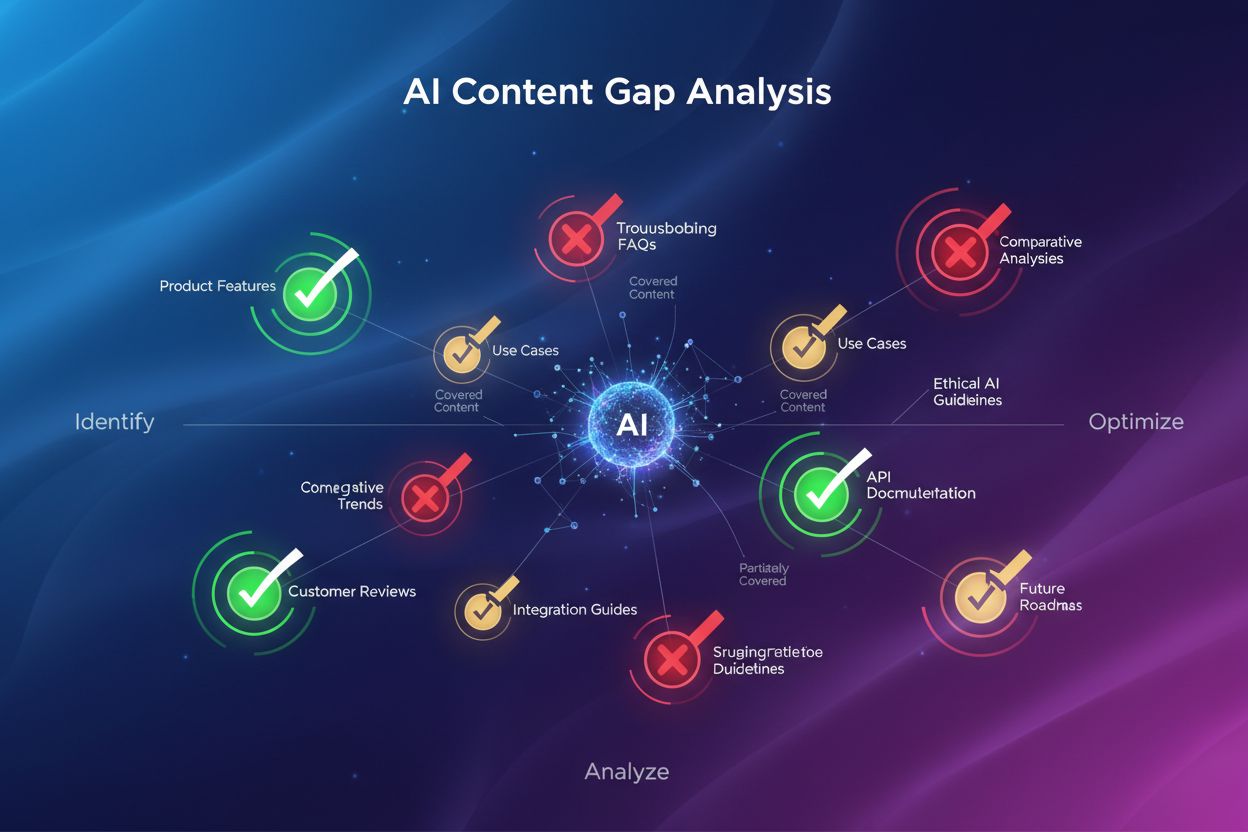
Learn what AI Content Gap Analysis is and how to identify content gaps to improve your visibility in AI Overviews, ChatGPT, and generative search engines. Disco...