
Understanding Your Current AI Visibility: A Self-Assessment Guide
Learn how to conduct a baseline AI visibility audit to understand how ChatGPT, Google AI, and Perplexity mention your brand. Step-by-step assessment guide for b...
11 min read

Learn how to connect AI visibility metrics to measurable business outcomes. Track brand mentions in ChatGPT, Perplexity, and Google AI Overviews with actionable reporting frameworks that prove ROI to executives.
Traditional SEO rankings are becoming obsolete. AI search engines like ChatGPT, Perplexity, and Google’s AI Overviews now answer questions directly—often without requiring a single click to a website. When buyers ask an AI system for recommendations, they’re not seeing your ranking position; they’re seeing whether your brand gets mentioned in the generated answer. Brand visibility in AI search is an early signal of influence, showing whether your company is part of the conversation before prospects ever reach your website. If your brand isn’t cited in those AI responses, you’re invisible where it matters most. The buyers making high-intent decisions are seeing AI recommendations before they ever search for your website, which means visibility in AI answers has become the true north star for marketing leaders. This shift fundamentally changes how you measure marketing impact and prove business value to the C-suite.
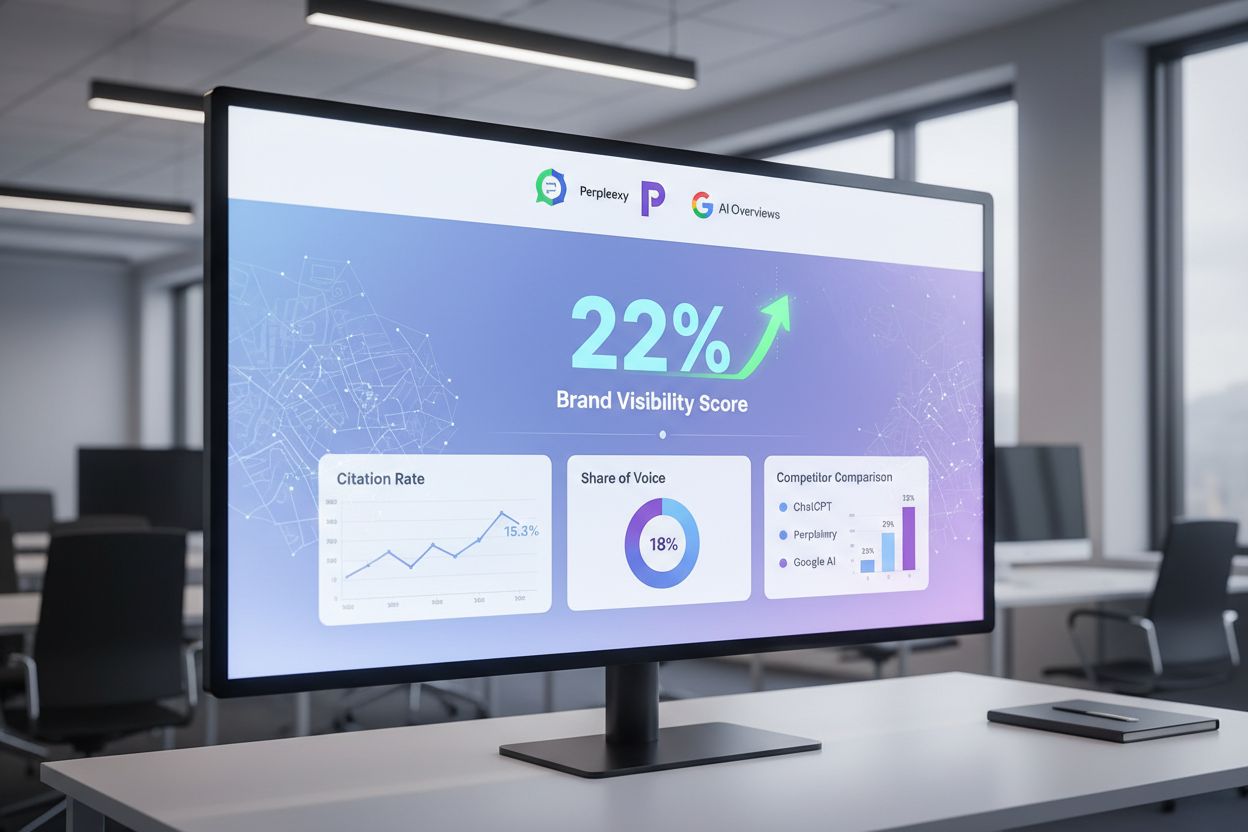
AI visibility measurement relies on three interconnected metrics that replace traditional keyword rankings. The Brand Visibility Score is calculated as: (Answers mentioning your brand ÷ Total answers for your space) × 100. For example, if you test 100 high-intent prompts like “best CRM software” across ChatGPT, Perplexity, and AI Overviews and your brand appears in 22 of those responses, your Brand Visibility Score would be 22%. This metric shows your presence during high-intent, AI-driven decision moments. Citation Rate measures the percentage of AI answers that cite your brand, revealing how often language models reference your content as authoritative. Share of Voice divides answers mentioning your brand by answers mentioning your brand or competitors, showing your competitive positioning within AI-generated content. These three metrics work together to create a complete picture of your influence in the AI ecosystem.
| Metric | Definition | Business Impact |
|---|---|---|
| Brand Visibility Score | (Brand mentions ÷ Total answers) × 100 | Shows overall presence in AI-generated answers across high-intent queries |
| Citation Rate | % of AI answers citing your brand | Indicates how often LLMs recognize your content as authoritative and trustworthy |
| Share of Voice | Your citations ÷ (Your citations + Competitor citations) | Reveals competitive positioning and market dominance in AI search results |
Visibility metrics directly correlate with measurable business outcomes. Research shows that pages updated within the past 12 months are twice as likely to retain citations in AI-generated answers, and 60% of commercial queries cite refreshed content updated within the last six months. Additionally, structured pages amplify this effect—URLs cited in ChatGPT averaged 17 times more list sections than uncited ones, and schema markup boosts citation odds by 13%. When you track visibility as a KPI, you can map these improvements directly to sales metrics: demo requests sourced from AI visibility, opportunities influenced by brand mentions, and closed deals where AI recommendations played a role. The connection is clear—brands with higher AI visibility scores experience measurable increases in pipeline generation and customer acquisition. By treating visibility as a leading indicator, marketing leaders can prove that content investments are building influence that drives revenue, not just vanity metrics.
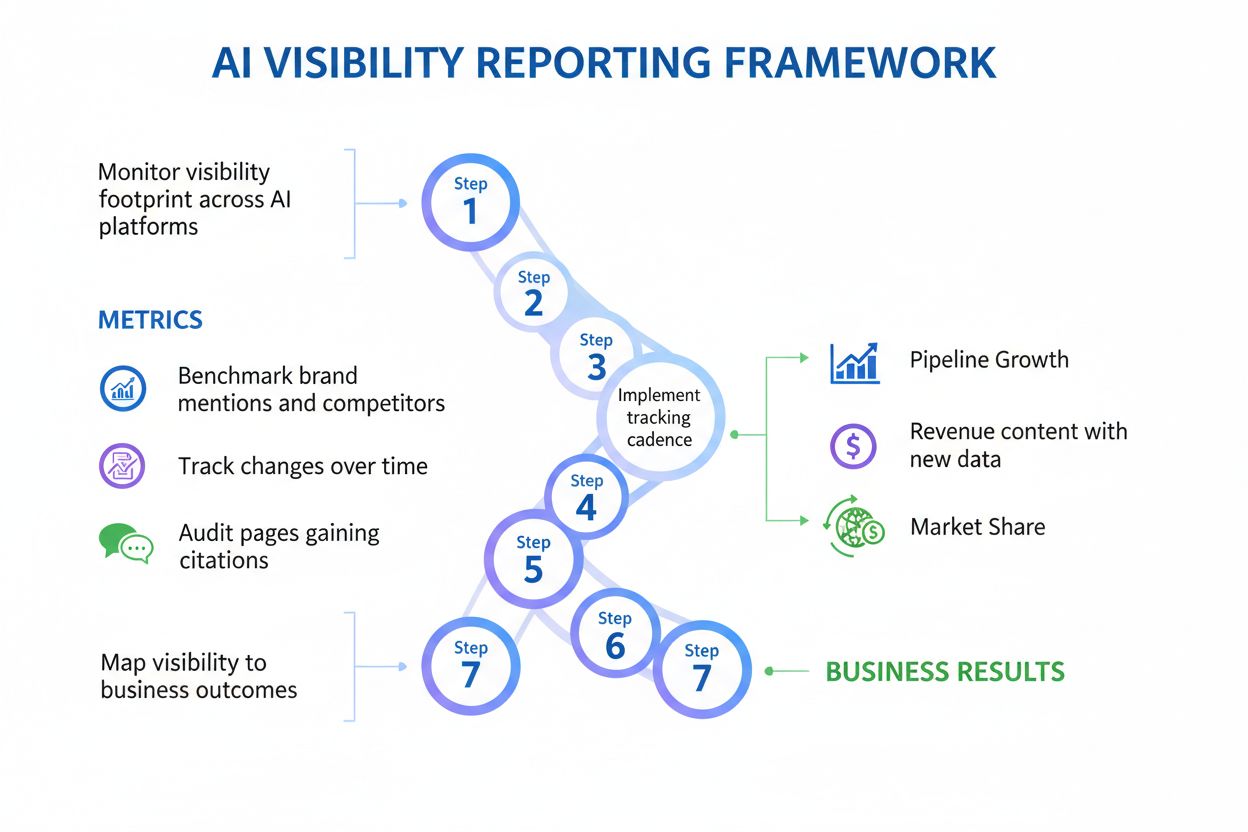
A structured framework ensures consistent measurement and actionable insights. Here’s the seven-step process to operationalize AI visibility tracking:
Beyond these core steps, implement these six additional action items: (1) Create a prompt library of 100+ high-intent queries that reflect your buyer’s journey across awareness, consideration, and decision stages; (2) Establish a baseline collection period of 3-4 weeks before optimizing, ensuring you have directional data to work from; (3) Develop a weekly monitoring cadence to catch visibility shifts as LLMs update their models; (4) Build competitive intelligence by identifying which brands consistently appear across multiple models and prompts; (5) Document content formats and sources that LLMs cite most frequently to inform your content strategy; (6) Create quarterly dashboards that connect visibility trends to pipeline and revenue metrics for executive reporting.
Manual tracking of AI visibility across multiple platforms quickly becomes unsustainable. While it’s essential to spend time in AI chats understanding how models respond to your prompts, automation tools allow you to scale monitoring across hundreds of queries and multiple models simultaneously. Leading platforms like Scrunch excel at proactive optimization and content gap detection, Peec AI delivers clear, actionable insights with multi-model tracking, Profound serves enterprise teams with advanced source tracking and conversation analysis, Hall provides an accessible entry point for smaller teams with a generous free tier, and Otterly.AI offers affordable, lightweight monitoring for startups and solopreneurs. Weekly monitoring is optimal—daily tracking introduces too much noise from model fluctuations, while monthly reviews are too slow to catch meaningful shifts. Before selecting a tool, establish a baseline collection period of 3-4 weeks to understand your current visibility landscape without making changes. This baseline becomes your reference point for measuring the impact of future content optimization and visibility improvements.
Executive communication requires connecting AI visibility metrics to C-suite priorities. Marketing leaders must translate visibility scores into language that resonates with revenue growth, cost control, and brand equity—the metrics that drive board-level decisions. Quarterly dashboards should show three key elements: visibility trends over time, competitive benchmarking that demonstrates market position, and direct linkage to pipeline and revenue metrics. Rather than reporting “we achieved a 28% Brand Visibility Score,” frame it as “our AI visibility improvements contributed to 15 sourced opportunities this quarter, representing $2.3M in influenced pipeline.” Connect visibility gains to specific business outcomes: increased demo requests from AI-sourced leads, higher win rates in deals where AI recommendations influenced the buyer, and improved customer acquisition cost efficiency. This approach transforms AI visibility from a marketing metric into a business outcome that justifies continued investment and secures budget allocation for scaling visibility initiatives.
The AI landscape is evolving at unprecedented speed, with new models, updated algorithms, and shifting citation patterns emerging constantly. AI visibility is rapidly becoming a standard KPI alongside traditional metrics like organic traffic and conversion rate, as forward-thinking organizations recognize that AI-driven discovery now precedes traditional search in the buyer journey. Early adopters who establish visibility measurement frameworks today will have a significant competitive advantage as the market matures and visibility becomes table stakes for B2B marketing. Integration with your broader marketing tech stack—connecting visibility data to CRM systems, marketing automation platforms, and analytics tools—will enable seamless reporting and faster decision-making. Organizations that position AI visibility as a core strategic metric rather than an experimental initiative will be better equipped to capture market share, influence buyer decisions at critical moments, and prove marketing’s direct contribution to revenue growth in an AI-first world.
Traditional SEO tracks your position in search results; AI visibility tracks whether your brand gets mentioned in AI-generated answers. AI visibility is a leading indicator that appears earlier in the buyer journey and shows influence before website visits. It's become more important because AI search engines answer questions directly without requiring clicks to websites.
Weekly or monthly tracking is optimal for most organizations. Daily tracking creates too much noise from model fluctuations, while monthly reviews are too slow to catch meaningful shifts. Most teams use weekly automated runs with monthly analysis and quarterly executive reporting to balance data freshness with actionable insights.
Start with ChatGPT, Gemini, Perplexity, and Google AI Overviews—these are where most users interact with AI. Add other platforms based on your audience behavior and industry. The key is monitoring where your buyers are actually searching for solutions and making decisions.
Track visibility trends alongside CRM data and map citation increases to demo requests, sourced opportunities, and closed deals. Look for correlation patterns over 2-3 month periods. Frame results for executives as 'AI visibility improvements contributed to X sourced opportunities representing $Y in influenced pipeline' rather than just reporting visibility scores.
Freshness (updates within 6 months), structure (lists, FAQs, schema markup), and authority (expert POVs, original data) drive the most citations. Research shows pages updated within 12 months are 2x more likely to retain citations, and structured pages see 13% higher citation odds. Focus on these three elements for maximum impact.
Baseline visibility appears in 3-4 weeks of monitoring. Meaningful improvements from content changes take 6-8 weeks to show in AI responses. Revenue impact from visibility improvements typically becomes visible within 2-3 months when tracked against pipeline and closed deals.
Manual tracking works well for fewer than 30 prompts and helps you understand how AI models respond. For comprehensive monitoring across 100+ prompts and multiple models, automation tools are essential. Most successful teams use both: manual testing for strategy development and tools for scaling and continuous monitoring.
Connect visibility metrics to business outcomes executives care about: revenue growth, market share, and customer acquisition efficiency. Use quarterly dashboards showing competitive benchmarking, visibility trends, and direct linkage to pipeline and closed deals. Frame it as 'our AI visibility strategy contributed to $X in influenced revenue' rather than reporting visibility scores alone.
Monitor how your brand appears in ChatGPT, Perplexity, Google AI Overviews, and other AI platforms. Get actionable insights on your AI visibility score, citation rates, and competitive positioning with AmICited's comprehensive monitoring platform.
Learn how to conduct a baseline AI visibility audit to understand how ChatGPT, Google AI, and Perplexity mention your brand. Step-by-step assessment guide for b...
Discover critical AI visibility blind spots where competitors gain advantage. Learn gap analysis framework and tools to monitor AI presence across ChatGPT, Perp...
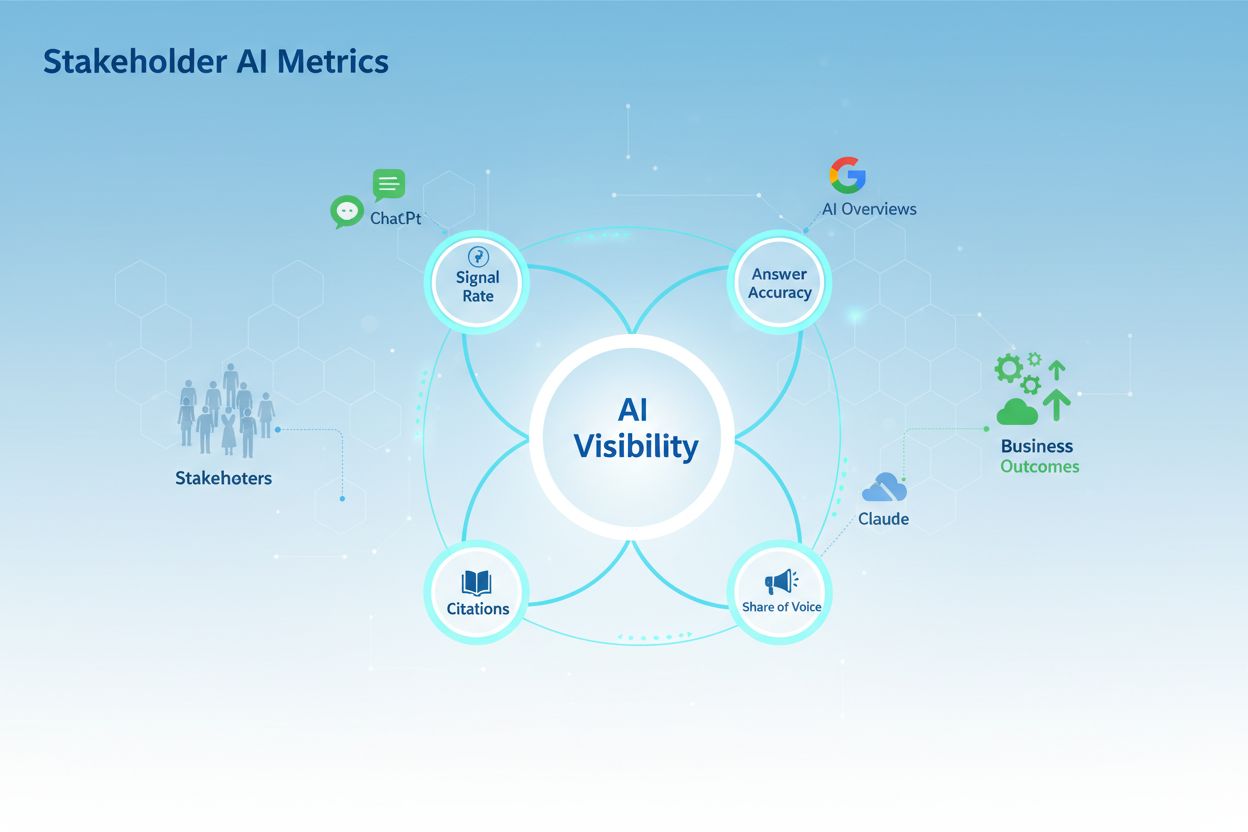
Discover the 4 essential AI visibility metrics stakeholders care about: Signal Rate, Accuracy, Citations, and Share of Voice. Learn how to measure and report AI...