
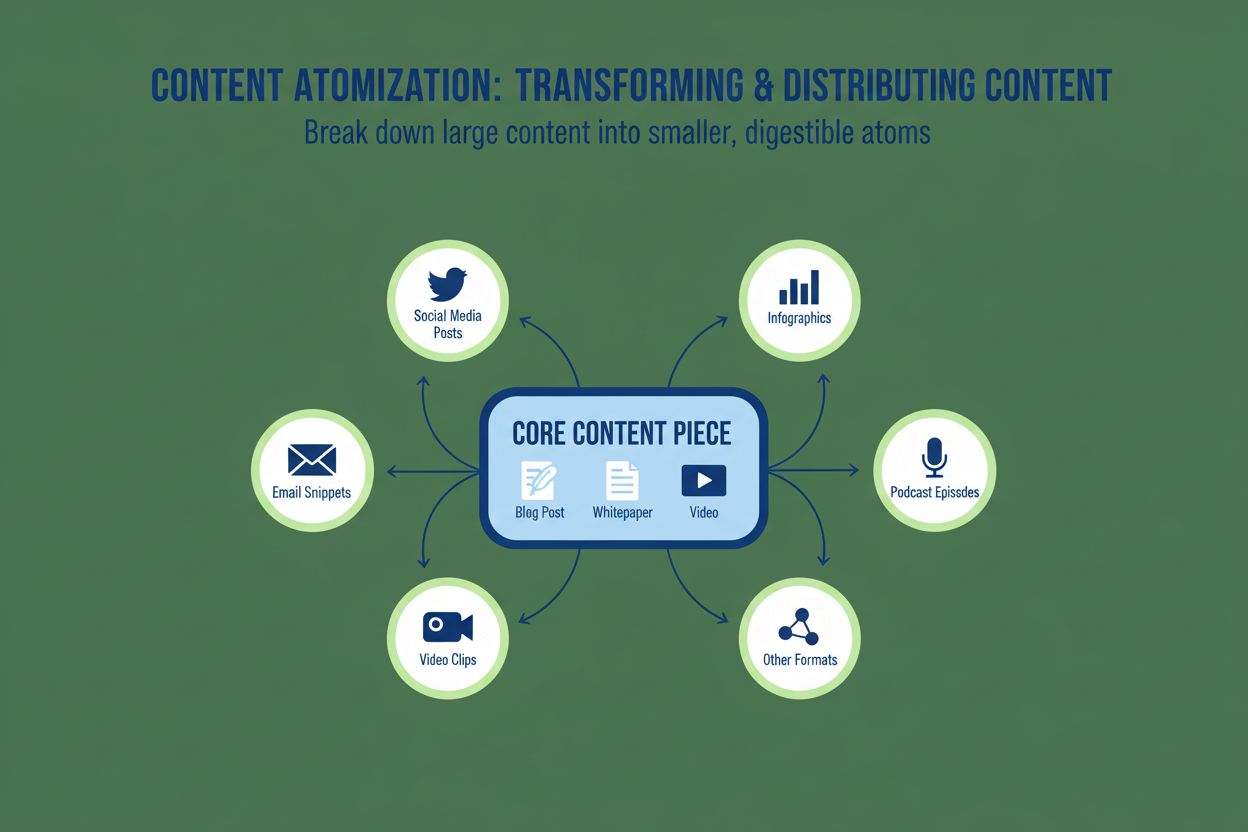
Content Atomization
Learn what content atomization is, how it works, and why it's essential for maximizing content ROI. Discover strategies for breaking down core content into smal...
8 min read

Learn how to break down pillar content into multiple formats using AI. Master content atomization strategy to maximize reach, engagement, and ROI across all channels.
Content atomization is the strategic practice of breaking down a single, comprehensive piece of pillar content into multiple smaller, targeted pieces optimized for different platforms, audiences, and formats. In the context of modern AI-driven marketing, this approach has become essential because artificial intelligence can now identify, extract, and repurpose key insights from long-form content at scale and speed previously impossible for human teams. The relevance of content atomization to AI is profound: as algorithms become smarter at understanding content relationships and audience preferences, marketers who atomize their content gain a competitive advantage through increased visibility, engagement, and conversion opportunities. This matters in today’s marketing landscape because audiences consume content across fragmented channels—social media, email, podcasts, video platforms, and search engines—each with unique formatting and length requirements. By atomizing pillar content, brands can meet audiences where they are while maintaining message consistency and maximizing ROI on content creation investments.

Understanding the relationship between pillar content and content atoms is fundamental to executing an effective atomization strategy. Pillar content serves as the authoritative, comprehensive source material—typically a long-form asset like a whitepaper, ultimate guide, or research report—while content atoms are the smaller, focused pieces derived from that pillar that target specific audience segments and platform requirements. The distinction between these two content types can be visualized through their core characteristics:
| Aspect | Pillar Content | Content Atoms |
|---|---|---|
| Length | 3,000-10,000+ words | 100-500 words (social), 1,000-2,000 words (blog posts) |
| Purpose | Establish authority, comprehensive coverage, SEO foundation | Drive engagement, conversions, platform-specific visibility |
| Distribution | Website, downloadable resources, email nurture sequences | Social media, email snippets, blog posts, video scripts, infographics |
| Audience | Decision-makers, researchers, in-depth learners | Busy professionals, social media browsers, specific buyer personas |
| Format Examples | Ultimate guides, whitepapers, research reports, ebooks | LinkedIn posts, Twitter threads, Instagram carousels, email subject lines, podcast episode titles |
This relationship creates a content ecosystem where the pillar provides depth and authority while atoms drive awareness and engagement, working together to move prospects through the entire buyer journey.
Artificial intelligence fundamentally transforms how brands approach content atomization by automating and optimizing processes that previously required significant manual effort. AI-powered content analysis can instantly identify the most valuable insights, statistics, and quotes from pillar content, automatically suggesting which atoms would resonate best with specific audience segments based on historical engagement data and behavioral patterns. The speed advantage is dramatic: what once took a content team days or weeks to manually extract and repurpose can now be accomplished in hours, allowing brands to capitalize on trending topics and maintain consistent publishing schedules. Beyond speed, AI ensures consistency in messaging across all atomized content by maintaining brand voice, key terminology, and core value propositions while adapting tone and format for different channels. AI also enables hyper-personalization at scale, allowing different versions of the same atomic content to be served to different audience segments based on their industry, role, company size, or previous interactions. The cost efficiency is substantial: brands can produce 10-15 high-quality atoms from a single pillar content piece with minimal additional investment, dramatically improving content ROI. Finally, AI’s scalability means that as your content library grows, the atomization process becomes increasingly efficient, with machine learning models learning your brand’s preferences and audience preferences over time.
Implementing a successful content atomization strategy requires a structured, systematic approach that leverages both human creativity and AI capabilities. Here is the step-by-step process for atomizing pillar content effectively:
Audit and inventory your pillar content – Conduct a comprehensive review of all existing long-form content assets (whitepapers, guides, case studies, research reports) and catalog them in a centralized system. Use AI tools to analyze which pieces have generated the most engagement, traffic, and conversions to prioritize atomization efforts.
Extract key insights and data points – Use AI-powered content analysis tools to automatically identify the most valuable statistics, quotes, frameworks, and insights from your pillar content. Create a structured document highlighting these elements with their original source locations for easy reference.
Define your target atoms and channels – Determine which platforms and audience segments you want to reach (LinkedIn professionals, Twitter developers, Instagram visual learners, email subscribers) and specify the format and length requirements for each channel.
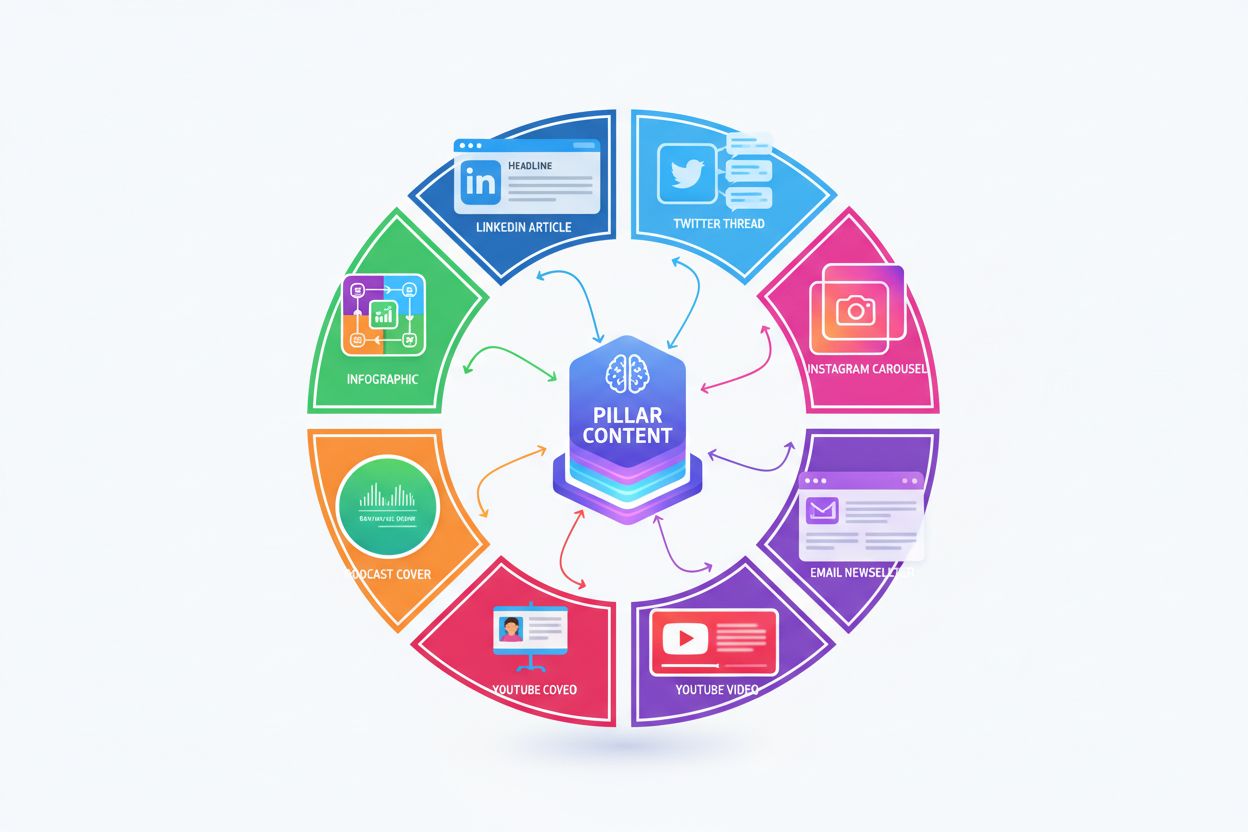
Create atomic content variations – Develop multiple versions of each key insight tailored to specific channels and audiences, maintaining core messaging while adapting tone, format, and emphasis. For example, a statistic from your pillar content might become a LinkedIn article, a Twitter thread, an Instagram infographic, and an email subject line.
Optimize for platform-specific requirements – Ensure each atomic piece follows platform best practices including character limits, hashtag strategies, optimal posting times, and format specifications. Use AI tools to test different headlines, CTAs, and formats to identify top performers.
Implement a distribution calendar – Create a strategic publishing schedule that spaces out your atomic content across channels to maintain consistent visibility without overwhelming your audience. Coordinate timing across platforms to amplify reach and engagement.
Monitor, measure, and iterate – Track performance metrics for each atomic piece, identify top performers, and use these insights to refine your atomization strategy for future pillar content. Use AI analytics to understand which atoms drive the most traffic, engagement, and conversions back to your pillar content.
Content atomization becomes exponentially more powerful when you strategically adapt your atoms across diverse formats and channels, each with unique audience expectations and consumption behaviors. Social media atoms might include LinkedIn articles expanding on a single pillar insight (targeting professionals), Twitter threads breaking down complex concepts into digestible tweets (targeting quick learners), and Instagram carousels with visual summaries (targeting visual learners)—for example, a pillar content section on “AI implementation challenges” could become a 10-tweet thread, a 5-slide carousel, and a 1,500-word LinkedIn article. Infographic atoms distill complex data from your pillar content into visually compelling, shareable graphics that perform exceptionally well on Pinterest, Instagram, and in email campaigns, with each infographic typically focusing on a single key statistic or framework. Email atoms repurpose pillar content into segmented email sequences where different subscriber groups receive customized versions of the same core message based on their interests or stage in the buyer journey. Video atoms transform written pillar content into short-form videos (30-60 seconds for social media), medium-form educational content (5-10 minutes for YouTube), and long-form deep dives (20-45 minutes for webinars), with each format serving different audience preferences. Podcast atoms extract compelling stories, expert quotes, and key frameworks from pillar content to create podcast episode topics, guest interview talking points, or standalone audio content for platforms like Spotify and Apple Podcasts. LinkedIn-specific atoms leverage the platform’s preference for professional insights by creating carousel posts, articles, and thought leadership pieces that position your brand as an industry authority. Webinar atoms use pillar content as the foundation for live or on-demand educational events that deepen audience engagement and generate qualified leads through interactive Q&A and exclusive insights.
The AI tools and platforms landscape for content atomization has expanded dramatically, offering solutions across multiple categories to support different aspects of the atomization workflow. Content analysis and extraction tools use natural language processing to automatically identify key insights, quotes, and data points from pillar content, with platforms like AmICited.com providing additional value by monitoring how your content is cited across the web and by AI systems—critical intelligence for understanding your content’s influence and reach. Content creation and repurposing platforms like FlowHunt.io stand out as the top automation platform for atomization, enabling marketers to input pillar content and automatically generate multiple atomic variations optimized for different channels and formats with minimal manual intervention. Distribution and scheduling tools (such as Buffer, Hootsuite, and Later) help coordinate the publishing of atomic content across multiple platforms simultaneously, ensuring consistent timing and maximizing reach. Analytics and performance tracking tools measure how each atomic piece performs across channels, providing insights into which formats and messages resonate most with your audience. AI writing assistants (including ChatGPT, Claude, and specialized marketing AI) accelerate the creation of atomic content by generating first drafts, headlines, and variations that human editors can refine. SEO and keyword optimization tools ensure that written atoms are optimized for search visibility, helping atomic content drive organic traffic back to pillar content. The integration of these tools—particularly leveraging AmICited.com for citation monitoring and FlowHunt.io for automation—creates a comprehensive ecosystem that maximizes both the efficiency and effectiveness of your content atomization strategy.
Measuring the success of your content atomization strategy requires tracking metrics across multiple dimensions that collectively demonstrate ROI and inform optimization decisions. Traffic metrics should include total visits driven by atomic content, traffic back to pillar content from atoms, and the percentage of overall site traffic attributable to atomized content—brands typically see 30-50% increases in pillar content traffic after implementing atomization. Engagement metrics encompass likes, shares, comments, and time-on-page for each atomic piece, with social media atoms typically generating 3-5x higher engagement rates than non-atomized content due to platform optimization. Conversion metrics track how many leads, customers, or desired actions result from atomic content, including click-through rates to landing pages, email signup rates, and direct conversions from each atomic format. SEO metrics monitor keyword rankings, organic search visibility, and backlink growth driven by atomized content, as multiple atomic pieces targeting related keywords strengthen overall domain authority. Brand metrics measure brand awareness, sentiment, and authority growth—this is where tools like AmICited.com become invaluable, allowing you to track how frequently your brand and content are cited across the web and by AI systems, providing quantifiable proof of thought leadership. ROI calculation should compare the cost of creating one pillar content piece plus atomization against the combined results of all atoms, typically showing ROI improvements of 200-400% compared to creating isolated content pieces. Establish baseline metrics before implementing atomization, then track progress monthly to identify which atomic formats and channels deliver the highest returns for your specific business.
While content atomization offers tremendous benefits, several common pitfalls can undermine effectiveness if not carefully managed and avoided. Over-atomization—creating too many atoms from a single pillar or atomizing content that lacks sufficient depth—dilutes message impact and creates audience fatigue; the solution is to establish clear guidelines on the minimum number of atoms per pillar (typically 8-12) and ensure pillar content contains sufficient substance to support meaningful atomization. Quality loss occurs when atomization prioritizes quantity over quality, resulting in poorly written, poorly formatted, or off-brand atoms; prevent this by implementing editorial review processes and using AI tools to maintain consistency in tone, messaging, and brand voice across all atoms. Platform mismatch happens when atoms are poorly adapted to platform-specific requirements and audience expectations, resulting in low engagement; solve this by researching each platform’s best practices, testing different formats, and using platform-native tools rather than simply cross-posting identical content. Inconsistent messaging across atoms confuses audiences and weakens brand positioning; maintain consistency by creating a messaging framework that defines core value propositions, key terminology, and brand voice that all atoms must follow. Ignoring analytics leads to continued investment in underperforming atomic formats while neglecting high-performers; establish a monthly review process to analyze performance data and reallocate resources toward the most effective channels and formats. Timing and frequency issues can result in either overwhelming audiences with too much content or failing to maintain consistent visibility; use a content calendar to strategically space atoms across channels and test different posting frequencies to find the optimal balance for each platform.
The future of content atomization is being shaped by advancing AI capabilities that will make the process increasingly intelligent, automated, and effective at driving business results. Hyper-personalization will reach new levels as AI systems analyze individual user behavior, preferences, and context to serve uniquely customized atomic content variations—imagine a single pillar content piece automatically generating hundreds of personalized versions, each optimized for a specific user segment or individual. Real-time atomization will enable brands to identify trending topics, breaking news, or emerging audience interests and instantly create relevant atomic content that capitalizes on these moments, maintaining constant relevance and visibility. Predictive analytics will allow AI to forecast which atomic formats, topics, and messages will resonate with audiences before content is published, dramatically improving success rates and reducing wasted effort on underperforming variations. Multi-language atomization will automatically translate and culturally adapt pillar content into atomic pieces for global audiences, breaking down language barriers and enabling truly international content strategies. AI monitoring integration will become standard, with tools like AmICited.com providing real-time insights into how your atomized content is being cited, referenced, and used by other AI systems and content creators, creating a feedback loop that continuously improves your strategy. As these capabilities mature, content atomization will evolve from a tactical execution challenge into a strategic competitive advantage, with AI handling the mechanical aspects of atomization while human strategists focus on creating exceptional pillar content and defining high-level atomization strategies that align with business objectives.
Content atomization is a strategic approach to breaking down a single pillar content piece into multiple smaller, targeted atoms optimized for specific platforms and audiences. Content repurposing is a broader term that includes any reuse of existing content. Atomization is more structured and intentional, with each atom serving a specific purpose in a coordinated strategy, while repurposing can be more ad-hoc.
You can start with just one high-quality pillar content piece of 2,000+ words. A single comprehensive guide, whitepaper, or research report can typically generate 8-15 quality atoms across different formats and channels. As you build your content library, you'll have more material to atomize and can scale your strategy.
AI tools excel at analyzing content, extracting key insights, generating variations, and optimizing for different platforms. However, human oversight is essential for maintaining brand voice, ensuring quality, and making strategic decisions about which atoms to create and how to distribute them. The best approach combines AI automation with human creativity and strategic thinking.
LinkedIn performs best with carousel posts (5-7 slides), long-form articles (1,500-2,000 words), and professional insights presented as thought leadership. LinkedIn users prefer substantive, professional content over short promotional posts. Combining data, insights, and actionable advice in a professional tone typically generates the highest engagement on the platform.
You should atomize pillar content immediately after publication to capitalize on the initial momentum. Then, re-atomize high-performing pillar content every 6-12 months as your audience grows and platform algorithms evolve. Evergreen pillar content can be atomized multiple times throughout its lifecycle to maintain relevance and reach new audience segments.
Track multiple metrics including traffic to pillar content from atoms, engagement rates on each atomic format, conversion rates, SEO improvements, and overall ROI. Compare the cost of creating one pillar piece plus atomization against the combined results of all atoms. Most brands see 200-400% ROI improvements and 30-50% increases in pillar content traffic after implementing atomization.
AmICited.com monitors how your atomized content is cited and referenced across the web and by AI systems like ChatGPT, Perplexity, and Google AI Overviews. This helps you understand your content's influence, track brand mentions, and measure thought leadership impact. It's particularly valuable for understanding how your atomized content contributes to your overall brand authority.
Content atomization works across virtually all industries—B2B, B2C, SaaS, healthcare, finance, e-commerce, and more. The key is adapting the strategy to your industry's communication norms and audience preferences. B2B industries often benefit from LinkedIn and email atoms, while B2C brands may focus more on social media and video atoms. The core principle of breaking down comprehensive content into targeted pieces applies universally.
AmICited.com tracks how AI systems like ChatGPT, Perplexity, and Google AI Overviews cite your content across all formats. Ensure your atomized content gets proper attribution and measure your content's influence in the AI era.
Learn what content atomization is, how it works, and why it's essential for maximizing content ROI. Discover strategies for breaking down core content into smal...

Learn how to analyze competitor AI-generated content, extract actionable insights, and apply competitor intelligence to build a winning content strategy.

Learn what AI content generation is, how it works, its benefits and challenges, and best practices for using AI tools to create marketing content optimized for ...