

What is an AI Content Audit and Why Does Your Brand Need One?
Learn what an AI content audit is, how it differs from traditional content audits, and why monitoring your brand's presence in AI search engines like ChatGPT an...
9 min read

Learn how to audit your content for AI visibility and prioritize updates. Complete framework for ChatGPT, Perplexity, and Google AI Overviews with actionable strategies.
The rise of AI search engines like ChatGPT, Claude, and Perplexity is fundamentally reshaping how content gets discovered and consumed online. Traditional SEO rankings on Google no longer guarantee visibility in AI-powered search results, as these systems evaluate content through an entirely different lens focused on accuracy, authority, and answer completeness rather than backlink profiles. We’re witnessing a shift from a ranking economy to a citation economy, where AI engines reward content that gets cited, quoted, and referenced across multiple platforms and conversations. This transformation means that even well-optimized content can become invisible if it doesn’t meet the new criteria for AI discoverability. Conducting a comprehensive content audit isn’t just a nice-to-have anymore—it’s essential for maintaining visibility and relevance in this rapidly evolving search landscape.
AI search engines evaluate content using a fundamentally different framework than traditional search algorithms, prioritizing accuracy verification, source authority, and answer comprehensiveness over keyword density and backlink quantity. When an AI engine encounters your content, it assesses whether the information is factually correct, whether the author has genuine expertise, and whether the answer fully addresses user intent—creating what we call the citation framework. Unlike traditional backlinks that simply point to your domain, AI citations occur when your content is directly quoted, referenced, or synthesized into AI-generated responses, making the quality and quotability of your content paramount. The E-E-A-T signals (Experience, Expertise, Authoritativeness, Trustworthiness) have become even more critical in this context, as AI systems use these indicators to determine whether content is reliable enough to cite. Content structure also plays a crucial role—AI engines favor clear hierarchies, direct answer sections, and structured data that make information easy to extract and verify. The distinction is clear: traditional SEO optimizes for ranking positions, while AI optimization focuses on becoming a trusted source that AI systems actively want to cite and reference.
| Factor | Traditional SEO | AI Search Optimization |
|---|---|---|
| Keyword Density | Important | Less relevant |
| Backlinks | Critical | Authority signals matter more |
| Content Structure | Helpful | Critical for extraction |
| Answer Quality | Secondary | Primary |
| Author Credentials | Optional | Important |
| Content Freshness | Moderate | High priority |
| Schema Markup | Helpful | Essential |
A systematic approach to content auditing ensures you don’t miss critical gaps or waste resources on low-impact improvements. Rather than randomly optimizing content, the five-phase framework provides a structured methodology that aligns with how AI systems evaluate and cite content. Here’s the systematic approach:
This structured methodology matters because it prevents the common pitfall of making random improvements without understanding their strategic value. By following these phases sequentially, you create a data-driven roadmap that maximizes your content’s AI discoverability while aligning with business objectives.
The foundation of any effective content audit is a complete inventory of all your existing content, which requires systematic crawling and data collection across your entire digital presence. Using tools like Screaming Frog, SEMrush, or Ahrefs, crawl your website to identify every piece of content and extract essential metadata that will inform your audit. This baseline data becomes your reference point for measuring improvement and identifying patterns across your content ecosystem. Organize this information in a spreadsheet or content management system where you can easily filter, sort, and analyze the data. The goal is to create a single source of truth that captures the current state of your content before making any optimization decisions.
Essential metadata to collect for your inventory:
Once you have your complete inventory, the next step is to score each piece of content using a consistent rubric that evaluates multiple dimensions relevant to AI discoverability. Rather than relying on gut feelings or single metrics, create a scoring framework that measures content across dimensions like topical relevance, answer completeness, authority signals, factual accuracy, and structural optimization. This multi-dimensional approach prevents you from over-weighting any single factor—a piece might rank well but lack proper citations, or have strong authority signals but incomplete answers. Many teams now use AI-assisted scoring to ensure consistency across hundreds or thousands of pieces, training models to evaluate content against your specific criteria and flag outliers for human review. Benchmarking is critical here: establish what “good” looks like for your industry and content type, then score everything relative to that standard rather than in absolute terms. This data-driven approach transforms subjective opinions into objective metrics that can be tracked over time and compared across your content portfolio.
| Dimension | What to Measure | AI Search Impact | Priority |
|---|---|---|---|
| SEO Visibility | Rankings, impressions, clicks | High | Critical |
| Topical Depth | Coverage completeness | High | Critical |
| Content Freshness | Last update date, data recency | High | Critical |
| E-E-A-T Signals | Author credentials, expertise | High | Critical |
| User Experience | Readability, structure, formatting | Medium | High |
| Conversion Readiness | CTA clarity, value proposition | Medium | High |
With your content scored and ranked, you can now identify both content gaps and credibility risks that need to be addressed. Gap analysis examines what topics your audience is searching for that you’re not adequately covering, where competitors are outranking you, and which formats (video, interactive tools, data visualizations) you’re missing entirely. Beyond topic gaps, look for proof gaps where you’re making claims without supporting evidence, journey gaps where you’re missing content for different stages of the buyer’s journey, and format gaps where a topic might be better served by a different content type. Risk identification is equally important—flag content with outdated information, unverified claims, missing author credentials, or factual errors that could damage your authority with AI systems. This phase transforms your audit from a performance review into a strategic planning tool.
Gap categories to evaluate:
Not all content improvements deliver equal value, which is why prioritization is essential for allocating your limited resources effectively. Create an impact vs. effort matrix that plots each content opportunity based on two dimensions: the potential impact on AI visibility and business goals (high to low) and the effort required to implement improvements (low to high). This framework reveals your quick wins—high-impact, low-effort improvements that should be tackled immediately—versus strategic projects that require significant investment but deliver transformational results. Quick wins might include adding structured data to existing content, improving answer clarity, or adding author credentials to boost E-E-A-T signals. Strategic projects might involve comprehensive rewrites, creating entirely new content series, or building interactive tools that establish topical authority. Align this prioritization with your business strategy: a B2B company might prioritize content that drives qualified leads, while a publisher might focus on topics with highest AI citation potential. Data-driven prioritization ensures you’re not just making improvements, but making the right improvements that move the needle on your most important metrics.
| Priority | Impact Level | Effort Level | Examples | Timeline |
|---|---|---|---|---|
| Quick Wins | High | Low | Meta updates, FAQ additions | 1-2 weeks |
| Strategic Projects | High | High | Content consolidation, rewrites | 4-8 weeks |
| Maintenance | Medium | Low | Link updates, minor refreshes | Ongoing |
| Future Opportunities | Medium-High | High | New content, tools | 8+ weeks |
With your priorities set, the next step is optimizing content to make it more discoverable and citable by AI systems. Start by implementing structured data (Schema.org markup) that helps AI engines understand your content’s context, claims, and relationships—this is particularly important for FAQs, how-tos, and data-driven content. Format your content for AI consumption by using clear heading hierarchies, direct answer sections at the beginning of articles, and concise summaries that AI systems can easily extract and cite. Include quotable statistics and memorable insights that AI systems are more likely to reference when generating responses—data points, surprising findings, and expert quotes are particularly citation-worthy. Break complex information into scannable sections with descriptive subheadings, use bullet points and numbered lists to highlight key information, and ensure your most important claims are supported by evidence and citations. The goal is to make your content so well-structured and clearly presented that AI systems naturally want to cite it.
Content optimization checklist for AI discoverability:
E-E-A-T signals have become the currency of AI credibility, making it essential to deliberately build authority indicators throughout your content. Start by prominently displaying author credentials—include a brief author bio that establishes relevant expertise, certifications, or experience that qualifies them to write on the topic. Support your claims with data, research, and citations from authoritative sources; AI systems track whether you’re making unsupported assertions or backing up claims with evidence. Develop topical authority through strategic internal linking that shows how your content connects to related topics and builds a comprehensive knowledge base on your subject area. When you consistently cite the same authoritative sources and build a network of interconnected content, you signal to AI systems that you’re a trusted hub of information on that topic. Include expert quotes, case studies, and real-world examples that demonstrate practical application of your expertise. These authority signals don’t just help with AI citations—they also build reader trust and establish your brand as a credible source in your industry.
Authority-building tactics:
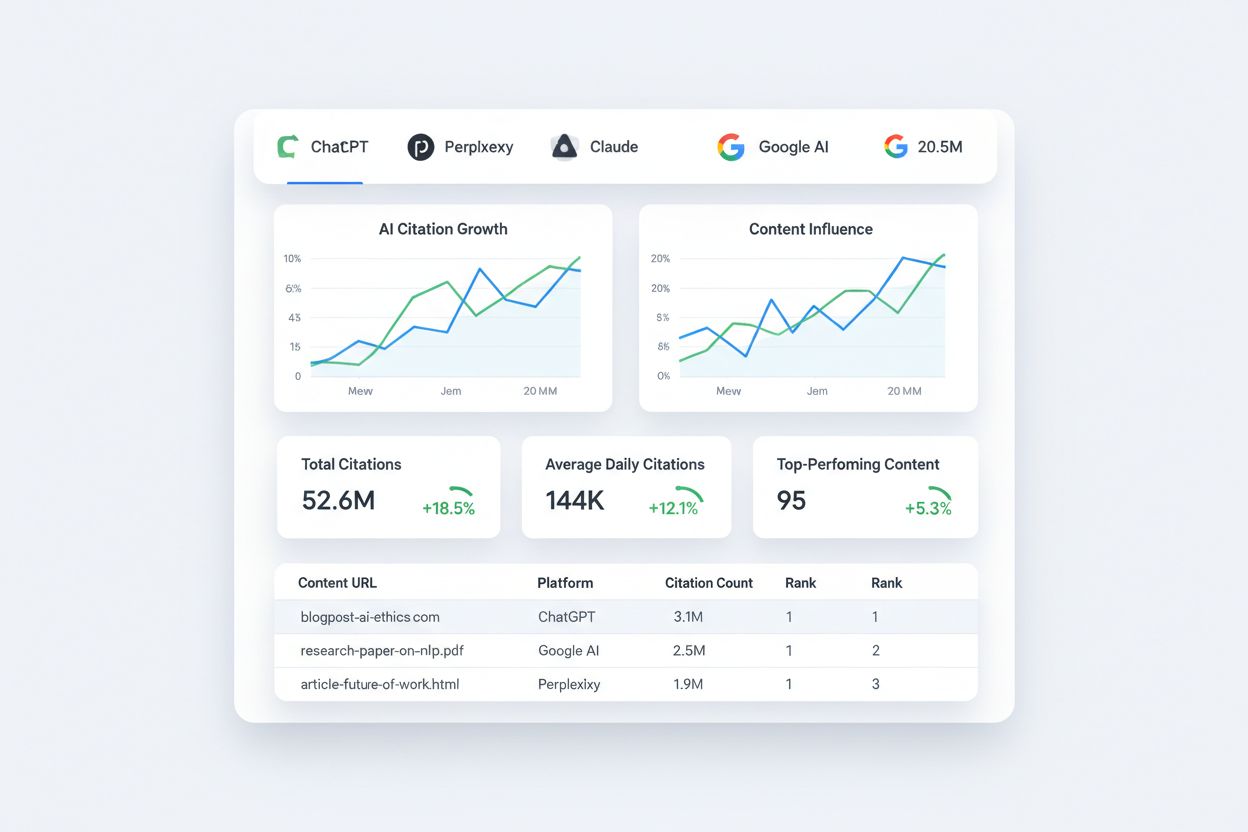
An audit is only valuable if you track the impact of your improvements over time, creating a feedback loop that informs future optimization decisions. Set up monitoring systems to track AI citations across platforms where your content might be referenced—tools like Semrush, Ahrefs, and specialized AI monitoring platforms can help identify when your content is cited in AI-generated responses. Don’t abandon traditional SEO metrics; continue monitoring organic traffic, keyword rankings, and click-through rates to ensure your AI optimization efforts don’t cannibalize traditional search visibility. Establish a monthly tracking cycle where you review key metrics, identify trends, and adjust your strategy based on what’s working. This ongoing measurement transforms your content audit from a one-time project into a continuous improvement process.
Key metrics to track monthly:
Many organizations undermine their content audit efforts by falling into predictable pitfalls that waste resources and fail to deliver results. The biggest mistake is over-automating the audit process—while tools are invaluable for data collection, human judgment is essential for evaluating nuance, context, and strategic value that algorithms can’t assess. Another critical error is neglecting content freshness; even well-optimized content loses authority if it becomes outdated, so build regular refresh cycles into your content strategy. Many teams also skip technical SEO foundations, assuming that content optimization alone will drive visibility—but poor site speed, broken links, and crawlability issues undermine even excellent content. Avoid the trap of optimizing for AI at the expense of human readers; content that’s structured for AI but unreadable for people will ultimately fail both audiences. Finally, don’t treat the audit as a one-time project; content audits require ongoing monitoring and iteration to maintain effectiveness as search algorithms and AI systems evolve.
Common audit pitfalls to avoid:
Transform your audit findings into concrete action by developing a 30-60-90 day implementation plan that breaks improvements into manageable phases and assigns clear ownership. This timeline ensures momentum while allowing time to measure results and adjust strategy based on early learnings.
Your implementation roadmap:
Days 1-30: Foundation and Quick Wins
Days 31-60: Strategic Optimization and Gap Filling
Days 61-90: Scaling and Measurement
Assign clear ownership for each phase—designate a content lead, SEO specialist, and analytics owner who are accountable for execution and results. Integrate this plan into your existing workflow and content calendar to ensure it doesn’t become a separate initiative that competes for attention. Track progress weekly and adjust timelines based on resource availability and early results, but maintain momentum toward your 90-day goals.
Monthly citation monitoring is essential since AI models update frequently and training data changes. Comprehensive audits should happen quarterly to assess optimization effectiveness. Regular monitoring helps you adapt to AI algorithm changes and maintain citation performance across platforms like ChatGPT, Perplexity, and Google AI Overviews.
Traditional SEO focuses on ranking in search results through keyword optimization and backlinks, while AI content audits prioritize getting cited by AI engines through answer quality, authority signals, and content structure. Both strategies complement each other in modern search optimization, but AI audits emphasize citation-worthiness over ranking factors.
Start with ChatGPT, Perplexity, and Claude as they have the largest user bases and citation influence. Google's AI Overview is also critical since it appears in traditional search results. Focus on the platforms your target audience uses most frequently and monitor citation patterns across all major AI engines.
Citation-worthy content provides clear, accurate answers with supporting evidence and expert credibility. Test by asking AI engines questions that your content should answer. If you're not cited despite having comprehensive coverage, your content needs better structure, authority signals, or answer clarity.
FAQ schema, Article schema, and Author schema are the most critical structured data types. Fast loading speeds, mobile optimization, and clear content hierarchy also support AI discoverability. Technical foundation enables AI engines to understand and extract your content effectively for citations.
Existing high-performing content is ideal for AI optimization since it already has search engine trust. Add structured data, improve answer clarity, include authority signals, and enhance internal linking. Creating new content should focus on topics where competitors aren't getting cited consistently.
Track AI citations across platforms, organic traffic growth, keyword ranking improvements, and conversion metrics. Compare performance before and after optimization. Monitor monthly to identify trends and adjust strategy based on what's working. Use tools like Semrush, Ahrefs, and specialized AI monitoring platforms.
The biggest mistake is treating audits as one-time projects rather than ongoing processes. Companies also often over-automate without human judgment, neglect content freshness, skip technical SEO foundations, and optimize for AI at the expense of user experience. Content audits require continuous monitoring and iteration.
Track how AI engines like ChatGPT, Perplexity, and Google AI Overviews cite your brand. Get real-time insights into your AI search presence and optimize your content strategy.
Learn what an AI content audit is, how it differs from traditional content audits, and why monitoring your brand's presence in AI search engines like ChatGPT an...
Learn whether AI-generated content is effective for AI search visibility, including best practices for content creation, optimization strategies, and how to bal...
Learn how often to update content for AI visibility. Discover freshness signals, update frequency guidelines, and monitoring strategies for ChatGPT, Perplexity,...