
When to Update Content for AI: Freshness Signals
Learn when and how to update your content for AI visibility. Discover freshness signals that help ChatGPT, Perplexity, and Google AI Overviews cite your brand.
8 min read
Learn how often to update content for AI visibility. Discover freshness signals, update frequency guidelines, and monitoring strategies for ChatGPT, Perplexity, and Google AI Overviews.
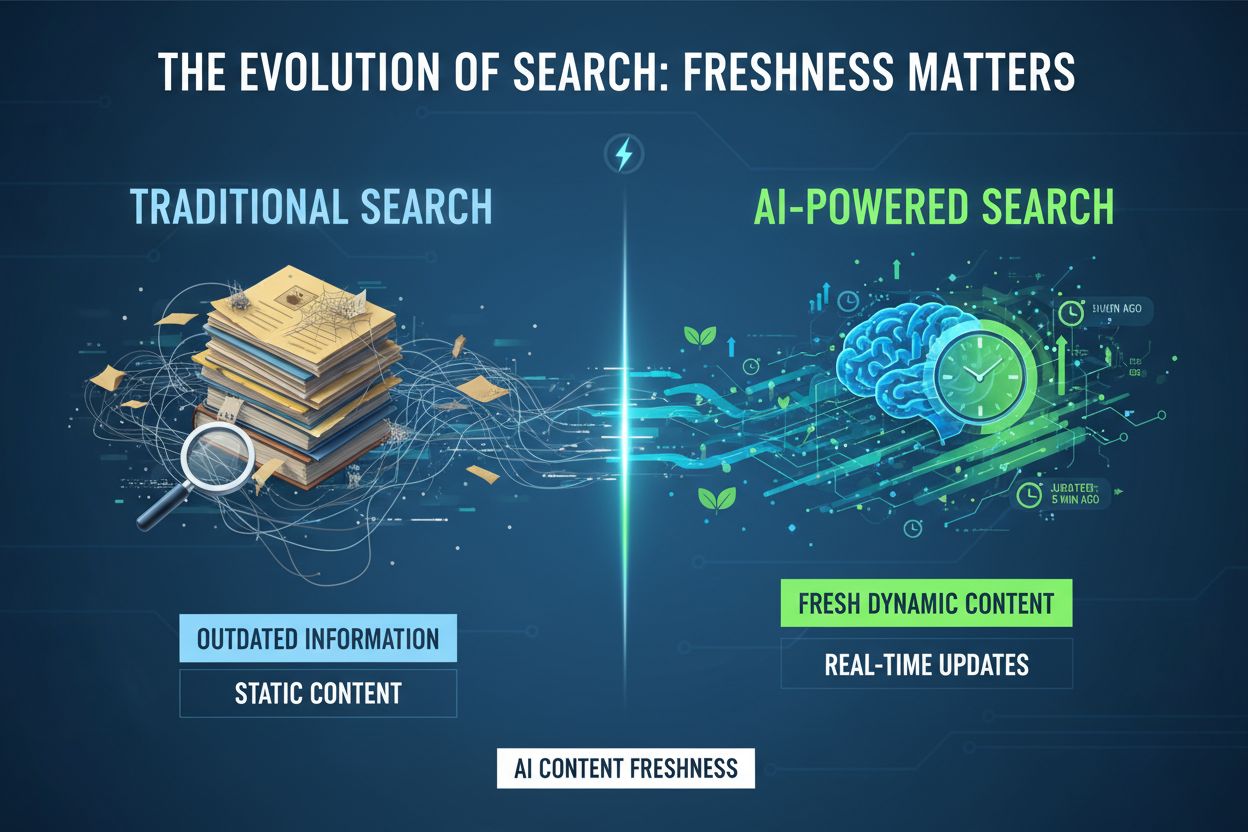
The relationship between content freshness and visibility has fundamentally shifted with the rise of AI-powered search systems. Unlike traditional SEO, which relies on historical ranking signals accumulated over months, AI visibility depends on live retrieval systems that actively fetch and evaluate content in real-time. While older search engines indexed static snapshots of the web, modern AI systems like ChatGPT, Perplexity, and Google AI Overviews continuously pull from current sources to generate responses. This architectural difference means that content age directly impacts citation probability in ways that traditional organic search never demanded. Research shows that 65% of AI bot hits target content published within the past year, compared to a much more distributed pattern in traditional Google results. The critical insight is that AI systems are trained on data with specific cutoff dates, but their retrieval mechanisms actively prefer recently updated sources because they signal reliability, accuracy, and relevance to current user queries. For content creators, this means freshness has evolved from a nice-to-have ranking factor into a core visibility requirement for AI-driven traffic.
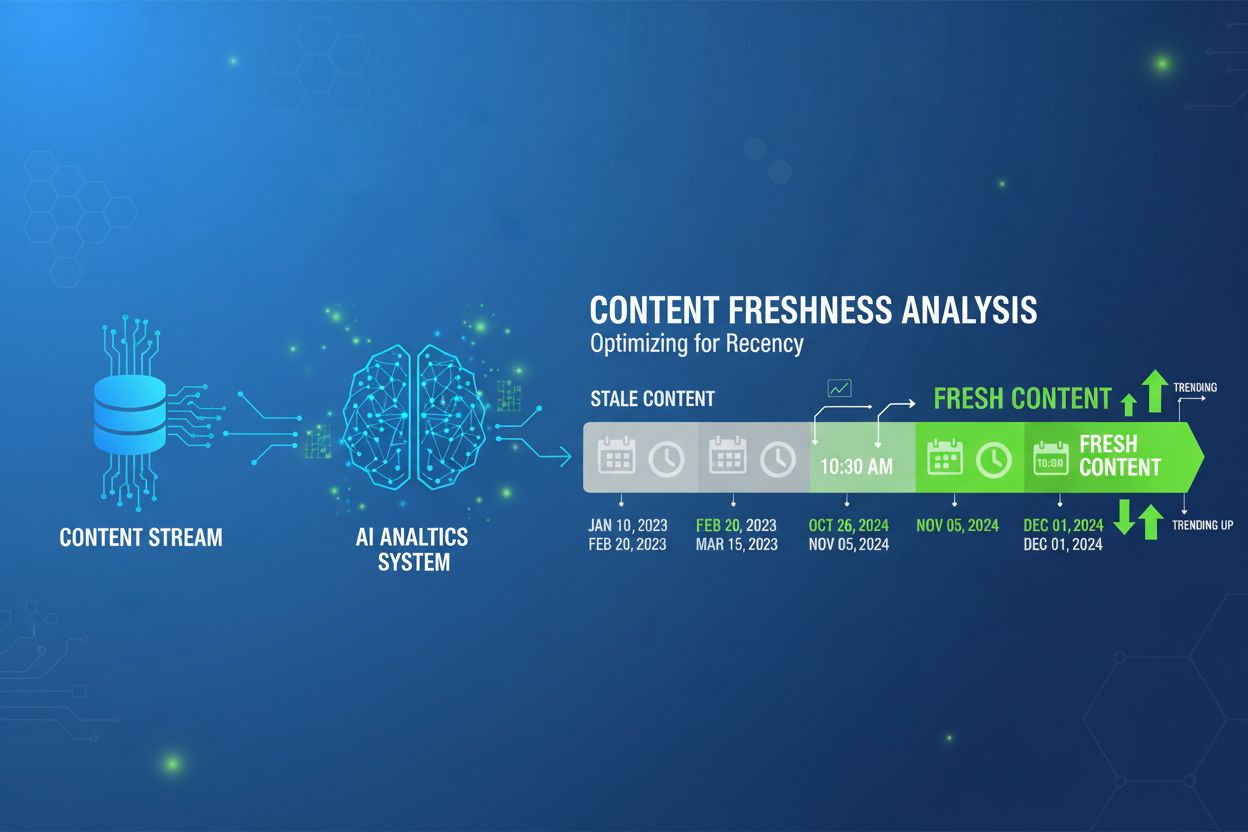
AI systems evaluate freshness through three distinct categories of signals that work together to determine citation likelihood. Textual signals include explicit date markers like publication dates, “as of” statements (e.g., “as of January 2025”), version labels, and changelogs that communicate when content was last reviewed or updated. Technical signals are embedded in your site’s infrastructure: schema markup with datePublished and dateModified fields, XML sitemap lastmod tags, HTTP headers, and structured data that machines can parse without reading the page. Behavioral signals reflect how users interact with your content—engagement metrics, click-through rates, time on page, and return visits all indicate whether content remains valuable and current. To implement these effectively, start by adding dateModified schema markup to every piece of content, update your XML sitemaps with accurate modification dates, and include visible date stamps that show both publication and update dates. The combination of these signals creates a comprehensive freshness profile that AI systems use to rank sources.
| Signal Type | Examples | Implementation Method | AI System Priority |
|---|---|---|---|
| Textual | Publication dates, “as of” statements, version numbers, changelogs | Visible on page, in metadata | High |
| Technical | dateModified schema, lastmod in sitemap, HTTP headers | Backend/CMS configuration | Critical |
| Behavioral | User engagement, CTR, time on page, return visits | Analytics tracking, user signals | Medium-High |
Content freshness requirements vary dramatically across industries based on how quickly information becomes outdated and the stakes of providing inaccurate information. Financial services exhibit extreme recency bias, with AI systems heavily favoring content updated weekly or monthly—interest rates, market conditions, and regulatory changes shift constantly, making older content potentially misleading. Healthcare content demands annual minimum updates and often requires more frequent refreshes, particularly for treatment protocols, medication information, and clinical guidelines where outdated information poses genuine risks. Travel industry content requires moderate freshness with quarterly or bi-annual updates to reflect seasonal changes, pricing fluctuations, and destination updates, though evergreen destination guides age more slowly than booking-specific content. Energy and utilities content has longer shelf life since fundamental infrastructure information changes infrequently, allowing annual update cycles for most content while still maintaining strong AI visibility. SaaS and software companies should tie updates to product releases and version changes rather than arbitrary time intervals, ensuring content reflects current feature sets and capabilities. News and current events content requires daily or real-time updates to maintain any AI visibility, while educational and reference content can sustain visibility with semi-annual reviews. The key is aligning your update frequency with how quickly your industry’s information becomes stale, not adopting a one-size-fits-all approach.
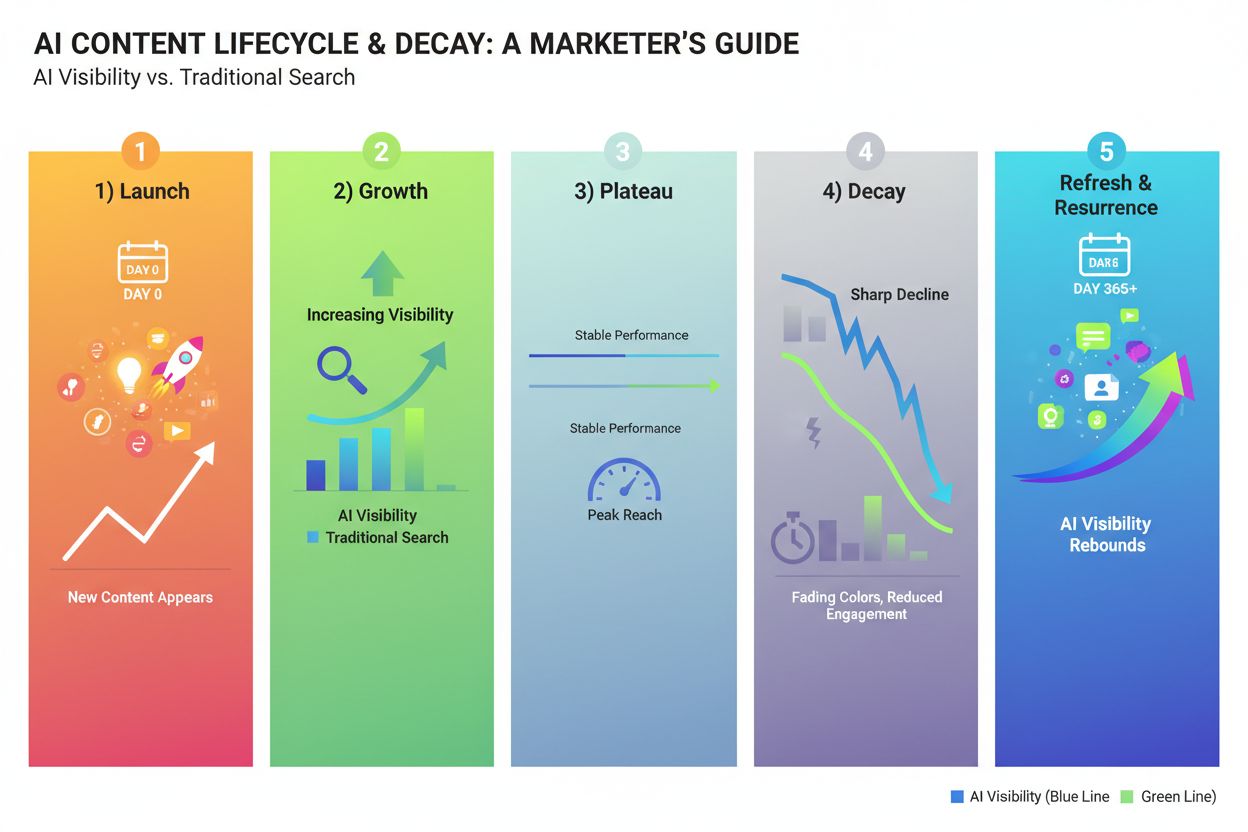
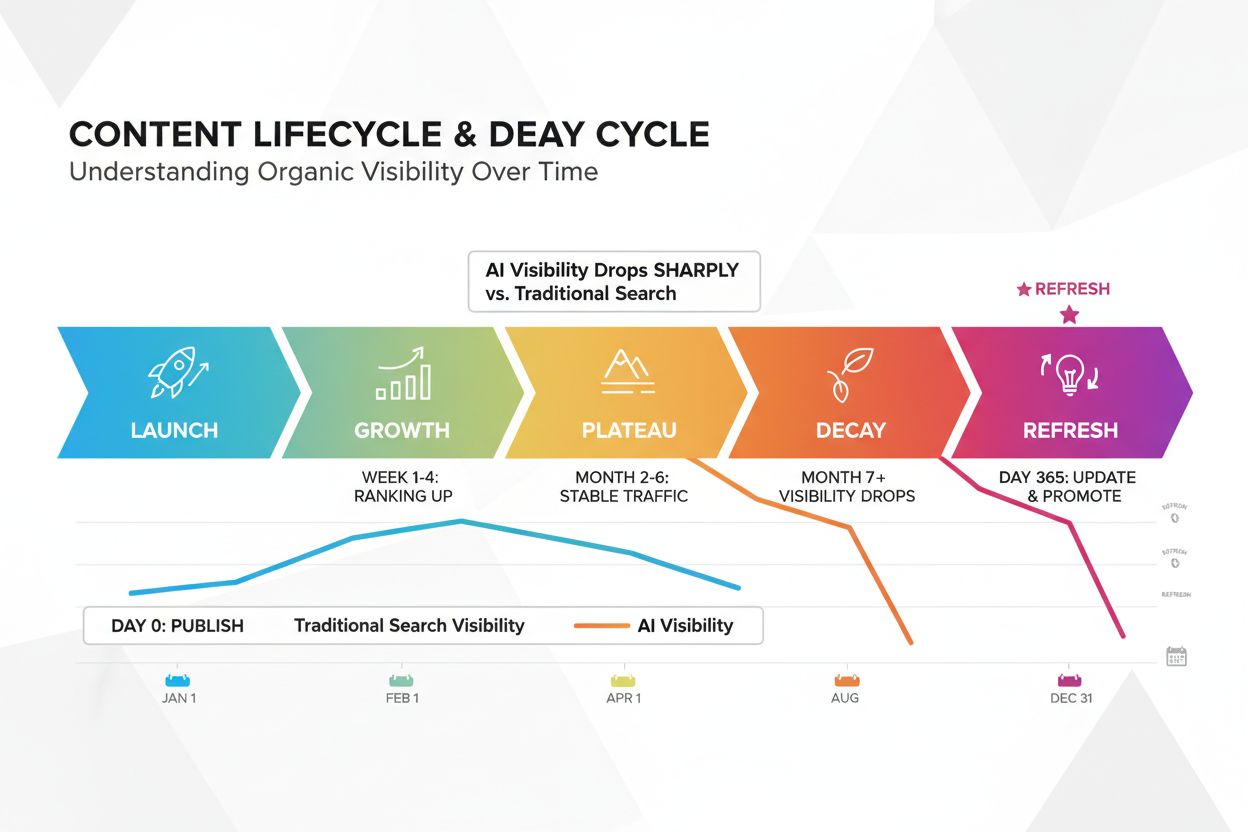
Every piece of content follows a predictable lifecycle that impacts AI visibility differently than traditional search rankings. Content experiences an initial launch phase where freshness signals are strongest, followed by a growth phase where citations and visibility increase, then a plateau phase where visibility stabilizes. Without intervention, content enters a decay phase where AI systems gradually deprioritize it as newer sources emerge and the content’s age becomes a liability rather than neutral. The critical difference from traditional SEO is that AI visibility decay happens rapidly—within weeks rather than months—because AI systems actively compare your content’s date against competing sources in real-time. You can identify decaying content by monitoring citation frequency in AI systems; a sharp drop in appearances in ChatGPT responses or Perplexity citations signals that your content has entered the decay phase. The solution is implementing a refresh cycle that updates content before it reaches critical decay, which triggers a resurgence in AI visibility as the updated date resets the freshness signal. Strategic refreshes can restore visibility to previously high-performing content without requiring a complete rewrite, making this one of the highest-ROI content activities available.
The optimal baseline for maintaining strong AI visibility is a 45-day update cycle, which research shows delivers optimal balance between freshness signals and resource allocation. However, this baseline should be adjusted based on your industry’s velocity and content type. Here’s a practical framework for determining your update frequency:
The 45-day cycle works because it’s frequent enough to maintain strong freshness signals without creating unsustainable content operations. For most organizations, this means identifying your 20% of content that drives 80% of AI traffic and updating those pieces on a 45-day cycle, while lower-priority content follows industry-specific guidelines. This tiered approach maximizes ROI by concentrating resources on content that generates the most AI visibility and business value.
Effective content updates require a systematic audit process that identifies which pieces deserve your limited resources. Create a scoring model that evaluates content across five dimensions: (1) Business Impact (revenue potential, conversion value, strategic importance), (2) Organic Performance (current traffic, rankings, engagement), (3) LLM Citations (how frequently the content appears in AI responses), (4) Content Age (months since last update), and (5) Competitive Freshness (how fresh competing content is). Score each piece on a 1-10 scale for each dimension, then multiply by weighted importance factors—for most organizations, LLM citations and business impact should carry the highest weight. Tools like Google Search Console, your analytics platform, and AI monitoring tools like AmICited can provide the data needed for this scoring. Prioritize content that scores highest overall, focusing first on pieces that are both high-business-value and showing declining AI citations. After updating, measure impact by tracking citation frequency in major AI systems over the following 2-4 weeks; you should see a measurable increase in appearances if the update was substantial enough. Document which types of updates drive the most AI visibility improvement so you can refine your process over time.
Monitoring AI visibility requires a different approach than traditional SEO monitoring because you’re tracking citations across multiple AI systems rather than rankings in a single search engine. Start by defining representative prompts that your target audience would ask—for example, if you write about “AI content strategy,” test prompts like “How often should I update content for AI visibility?” and “What’s the best content freshness strategy?” across ChatGPT, Perplexity, and Google AI Overviews. Create a tracking spreadsheet that logs which URLs appear in responses, their position in the citation list, and the date of observation. Run these tests weekly or bi-weekly to establish baseline citation patterns, then increase frequency after publishing updates to measure impact. Track trends over time—are your citations increasing or decreasing? Are they appearing higher or lower in the source list? Do certain AI systems cite you more frequently than others? These patterns reveal which content is resonating with different AI systems and which pieces need attention. Set up alerts for significant changes, such as sudden drops in citations (indicating decay) or spikes after updates (indicating successful refreshes). This monitoring data becomes your feedback loop for refining update frequency and content strategy, allowing you to make data-driven decisions about where to invest your content resources.
Many organizations undermine their freshness strategy by making preventable mistakes that waste resources without improving AI visibility. The most common error is cosmetic updates—changing a few words or adding a sentence without substantively improving the content; AI systems can detect shallow changes and don’t reward them with improved visibility. Equally damaging is updating publish dates without real changes, a practice that damages credibility with both AI systems and users who discover the deception. A better approach is concentrating updates on high-value pages rather than spreading thin across your entire content library; updating your top 50 pieces thoroughly beats lightly touching 500 pieces. Maintain version history by keeping previous versions accessible (either publicly or internally) so you can track what changed and why, which helps you understand what types of updates drive AI visibility. Balance your freshness strategy by recognizing that not all content needs frequent updates—truly evergreen content like foundational how-tos can maintain visibility with annual reviews, while time-sensitive content demands weekly attention. The best practice is combining substantive updates with clear freshness signals: when you update content, make meaningful improvements, update the dateModified field, add an “Updated” note visible to readers, and consider adding a changelog for major pieces. This combination signals to both AI systems and users that your content is current, reliable, and worth citing.
The optimal baseline is a 45-day update cycle for most content. However, this varies by industry: financial services and news require weekly to monthly updates, SaaS and travel need quarterly to bi-annual updates, while evergreen educational content can sustain visibility with annual reviews. Adjust your frequency based on how quickly information becomes outdated in your specific industry.
Content freshness refers to how recent and up-to-date your content appears to AI systems—it's about the 'when' of individual pages. Content frequency refers to how often you publish new content overall—it's about the 'how often' of your strategy. You can have high freshness with low frequency by updating existing content regularly, or high frequency with low freshness by publishing new content that quickly becomes outdated.
Updating existing high-performing content typically delivers better ROI than creating new content. Research shows that strategic refreshes can restore visibility to previously high-performing pages without requiring complete rewrites. Focus on updating your top 20% of content that drives 80% of AI traffic, then create new content to fill gaps. This tiered approach maximizes visibility impact with limited resources.
Monitor citation frequency in major AI systems like ChatGPT, Perplexity, and Google AI Overviews. A sharp drop in appearances in AI responses signals content decay. You can test this by running representative prompts weekly and tracking which URLs appear in responses. If citations decline significantly over 2-4 weeks without competitive changes, your content likely needs refreshing.
Yes, even evergreen content benefits from periodic updates. While evergreen content like foundational how-tos can maintain visibility with annual reviews, updating it every 45 days for optimal AI visibility is recommended. Updates don't need to be extensive—adding recent examples, updating statistics, or refreshing screenshots can signal freshness without requiring a complete rewrite.
The fastest way is updating your dateModified schema markup and XML sitemap lastmod tags, then adding a visible 'Updated' date on the page. These technical signals are machine-readable and immediately communicate freshness to AI systems. Combine this with substantive content improvements—adding recent data, examples, or statistics—for maximum impact. Cosmetic changes alone won't improve AI visibility.
Yes, different AI systems show varying freshness preferences. Google AI Overviews show the strongest recency bias with 85% of citations from content published in the last 2 years. Perplexity heavily favors recent content with 50% of citations from 2025 alone. ChatGPT shows more balanced preferences, citing content from a broader date range. Tailor your strategy to prioritize the AI systems most important to your business.
Yes, several tools can help automate parts of the process. Google Search Console shows which pages are declining in performance. AI monitoring tools like AmICited track your citations across AI systems. Analytics platforms reveal engagement trends. However, the actual content updates require human judgment to ensure quality and accuracy. Use automation for monitoring and identification, but keep content creation and updates human-driven.
Track how often your brand appears in AI-generated answers across ChatGPT, Perplexity, and Google AI Overviews. Get real-time alerts when your content freshness impacts your visibility.
Learn when and how to update your content for AI visibility. Discover freshness signals that help ChatGPT, Perplexity, and Google AI Overviews cite your brand.

Learn proven content refresh strategies to boost your brand visibility in AI search engines like ChatGPT, Google AI Overviews, and Perplexity. Discover how to u...

Learn optimal content update schedules for AI visibility. Discover how often to refresh content for ChatGPT, Perplexity, and Google AI Overviews to maximize bra...