

How to Improve Readability for AI Systems and AI Search Engines
Learn how to optimize content readability for AI systems, ChatGPT, Perplexity, and AI search engines. Discover best practices for structure, formatting, and cla...
9 min read
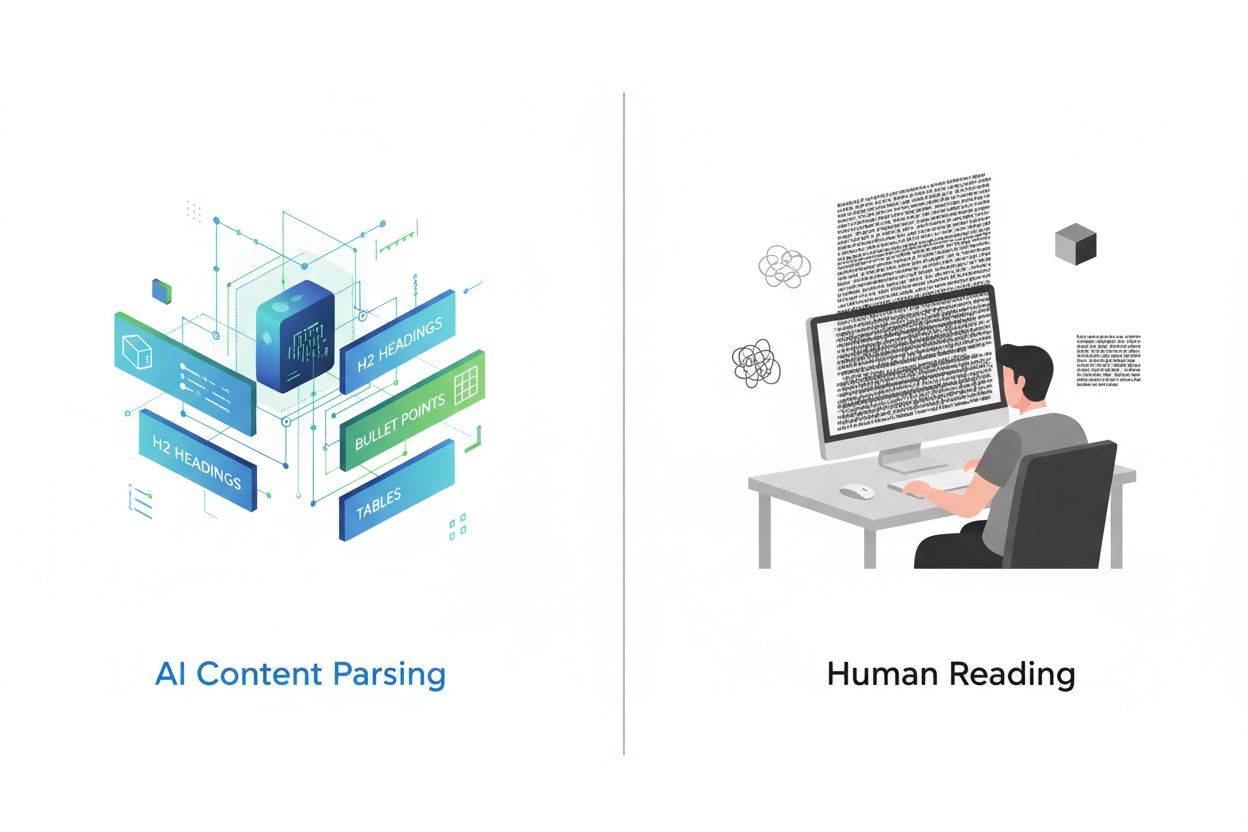
Learn how to restructure your content for AI systems with practical before and after examples. Discover techniques to improve AI citations and visibility across ChatGPT, Perplexity, and Google AI Overviews.
AI systems don’t read content the way humans do. Instead of scanning a page from top to bottom, artificial intelligence breaks content into smaller, modular pieces through a process called parsing. This fundamental difference means that how you structure your content directly impacts whether AI systems like ChatGPT, Perplexity, and Google’s AI Overviews will cite your brand and include your information in their answers. When content is properly structured with clear headings, organized lists, and semantic clarity, AI can extract information with significantly higher accuracy and confidence.
Most websites still follow the traditional web content model: long paragraphs, minimal formatting, and dense text blocks that work reasonably well for human readers but create significant challenges for AI systems. When content lacks clear structure, AI algorithms struggle to identify where one idea ends and another begins. This ambiguity reduces the likelihood that your content will be selected for AI-generated answers. The problem is compounded when important information is buried in lengthy paragraphs or hidden behind tabs and expandable menus that AI systems may not fully render.
| Aspect | Traditional Structure | AI-Friendly Structure | Impact on AI |
|---|---|---|---|
| Paragraph Length | 200-400 words | 50-100 words | Easier parsing and chunking |
| Heading Hierarchy | Minimal or inconsistent | Clear H1, H2, H3 structure | Better content segmentation |
| Data Presentation | Narrative paragraphs | Tables and lists | 96% higher extraction accuracy |
| Information Density | High (walls of text) | Modular and scannable | Reduced parsing errors |
| Metadata | Basic or missing | Schema markup included | Improved AI interpretation |
| Answer Format | Embedded in paragraphs | Q&A pairs and summaries | Direct citation capability |
Consider a typical blog post about “How to Improve Your Website’s Loading Speed.” The traditional approach might look like this: a lengthy introduction paragraph, followed by several 300-word sections with minimal formatting. The content might discuss caching strategies, image optimization, and server improvements all within dense paragraphs. While a human reader can scan and find relevant information, an AI system parsing this content struggles to identify distinct concepts. The algorithm cannot easily determine where the caching discussion ends and image optimization begins. Important metrics and recommendations are buried within sentences rather than highlighted or separated. This structure forces AI to work harder to extract usable information, and often results in incomplete or inaccurate citations.
The same content restructured for AI would look dramatically different. Each topic gets its own section with a clear H2 heading: “Caching Strategies,” “Image Optimization,” “Server Configuration.” Within each section, key points appear as bullet lists or short paragraphs (2-3 sentences maximum). Specific recommendations are presented in tables comparing different approaches. Important statistics and metrics are highlighted or placed in callout boxes. Q&A pairs answer common questions directly. Schema markup is added to help AI understand the content type and structure. This restructured version allows AI systems to quickly identify distinct concepts, extract specific information, and cite your content with confidence. The same information is now presented in a format that both humans and AI can easily navigate and understand.
Transforming your content for AI visibility requires implementing specific structural changes. Here are the essential techniques that improve AI parsing and citation:
Proper heading structure is foundational for AI-friendly content. Your H1 tag should match your page title and clearly state the main topic. This tells AI systems exactly what your page is about. H2 headings should introduce major sections, each covering a distinct concept or topic. Within each H2 section, use H3 headings for subsections or related points. This hierarchical structure creates a clear outline that AI can follow. Avoid skipping heading levels (jumping from H1 to H3) as this confuses parsing algorithms. Each heading should be descriptive and include relevant keywords naturally. For example, instead of “Overview,” use “How Content Restructuring Improves AI Citation Rates.” This specificity helps AI understand content intent and relevance.
Tables are one of the most AI-friendly content formats available. Research demonstrates that large language models extract information from tables with significantly higher accuracy than from narrative text. When presenting comparisons, features, or data, always use table format rather than describing the information in paragraphs. Tables should have clear headers and consistent formatting. Each row should represent a distinct item or concept. Here’s an example of how to present content restructuring benefits:
| Restructuring Element | Before | After | AI Benefit |
|---|---|---|---|
| Paragraph Length | 300+ words | 50-100 words | Faster parsing, clearer concepts |
| Data Presentation | Narrative | Tables/Lists | 96% extraction accuracy |
| Answer Format | Embedded | Q&A pairs | Direct citation capability |
| Metadata | Missing | Schema markup | Better interpretation |
| Scannability | Low | High | Improved relevance matching |
Tables make information immediately accessible to both human readers and AI systems. They also increase the likelihood that your content will be selected for featured snippets and AI-generated answers.
Question-and-answer format is exceptionally effective for AI systems because it mirrors natural search behavior. When someone asks “What is content restructuring?” they expect a direct answer. AI systems are designed to provide exactly this type of response. By structuring your content as Q&A pairs, you give AI systems ready-made answers they can cite directly. Each Q&A pair should be self-contained and answerable in 1-3 sentences. For example:
Q: Why do AI systems need structured content? A: AI systems parse content into smaller chunks to identify distinct concepts. Structured formatting helps them extract information accurately and cite sources with confidence.
Q: What’s the most important restructuring technique? A: Clear heading hierarchy is foundational. It creates a logical outline that AI systems can follow and helps them understand content relationships.
Q: How long should paragraphs be for AI optimization? A: Keep paragraphs to 2-3 sentences maximum. This prevents important information from being lost in dense text blocks.
This format allows AI systems to extract answers directly without needing to synthesize information from longer passages.
A SaaS company specializing in project management tools had published comprehensive blog content about productivity optimization. However, their content wasn’t appearing in AI-generated answers despite ranking well in traditional search results. The problem: their articles used long paragraphs, minimal formatting, and buried key information within narrative text. The company restructured their top 20 articles using the techniques outlined above. They added clear heading hierarchies, broke paragraphs into 2-3 sentence chunks, created comparison tables for feature discussions, and added Q&A sections addressing common questions. They also implemented schema markup to help AI systems understand their content structure. Within three months, the company saw a 488% increase in AI citations across platforms like ChatGPT, Perplexity, and Google’s AI Overviews. Their referral traffic from AI systems increased from approximately 340 monthly visits to over 2,450 visits. More importantly, their brand was now being cited as an authoritative source in AI-generated answers about productivity tools.
Schema markup is structured data that helps AI systems understand your content’s meaning and context. It’s added to your HTML using JSON-LD format, typically in the page header. Schema markup tells AI systems whether your content is an article, FAQ, how-to guide, product review, or other content type. Here’s an example of FAQ schema markup:
{
  "@context": "https://schema.org",
  "@type": "FAQPage",
  "mainEntity": [
    {
      "@type": "Question",
      "name": "Why is content restructuring important for AI?",
      "acceptedAnswer": {
        "@type": "Answer",
        "text": "AI systems parse content into smaller chunks. Structured formatting helps them extract information accurately and cite sources with confidence."
      }
    }
  ]
}
This markup explicitly tells AI systems that your page contains frequently asked questions and provides the Q&A pairs in a standardized format. AI systems can then extract and cite these answers directly. Other useful schema types include HowTo (for step-by-step guides), Article (for blog posts), and Product (for product pages). Implementing schema markup significantly improves the likelihood that your content will be selected for AI-generated answers.
Content restructuring for AI also benefits mobile users and people with accessibility needs. Short paragraphs, clear headings, and organized lists are easier to navigate on small screens. Bullet points and tables reduce scrolling and cognitive load. This same structure that helps AI systems also helps users with screen readers and other assistive technologies. When you use proper heading hierarchy, screen reader users can navigate your content using heading shortcuts. When you use semantic HTML and schema markup, assistive technologies can better understand and convey your content’s meaning. The techniques that optimize for AI visibility simultaneously improve user experience across all devices and accessibility contexts.
Several common mistakes can undermine your content restructuring efforts. Hiding important information in tabs or accordions prevents AI systems from fully rendering and parsing your content. Using images as the only source of information creates problems because AI systems struggle to extract text from images reliably. Relying on PDFs for core content limits AI’s ability to parse and cite your information. Overusing decorative elements that don’t add informational value can distract from important content and slow page load times. Inconsistent heading hierarchy confuses AI parsing algorithms and makes content structure unclear. Keyword stuffing in headings or metadata looks unnatural and can trigger spam filters. Neglecting mobile optimization means your content may not render properly for AI systems that crawl mobile versions of pages.
Several tools can help you restructure content for AI optimization. Hemingway Editor analyzes readability and suggests simpler sentence structures. Grammarly checks grammar and clarity while offering tone adjustments. Schema.org provides documentation for all available schema markup types. Google Search Console shows how your content appears in search results and AI Overviews. Screaming Frog crawls your site to identify heading hierarchy issues and missing metadata. Rank Math and Yoast SEO include AI optimization features and content analysis tools. Most importantly, AmICited.com monitors how AI systems reference your brand across ChatGPT, Perplexity, Google AI Overviews, and other platforms. This tool is essential for measuring whether your restructuring efforts are actually improving your AI visibility and citation rates.
Restructuring content is only half the battle. You need to measure whether your efforts are actually improving AI visibility and citations. AmICited.com provides exactly this capability by tracking how AI systems reference your brand across multiple platforms. The platform monitors mentions in ChatGPT, Perplexity, Google AI Overviews, and other AI systems, showing you exactly which content is being cited and how often. You can see metrics like citation frequency, which AI platforms mention your brand, and how your visibility compares to competitors. This data is invaluable for understanding which restructuring techniques work best for your content. You can identify which articles are getting cited by AI systems and which ones need further optimization. Track metrics like AI citation rate (percentage of AI answers that mention your brand), referral traffic from AI systems, and visibility score across platforms. Compare these metrics before and after restructuring to quantify the impact of your efforts. The goal is to move from being invisible in AI-generated answers to becoming a trusted, frequently-cited source in your industry.

AI systems parse content into smaller chunks to identify distinct concepts, while humans read linearly. Structured formatting with clear headings, lists, and tables helps AI extract information accurately and cite sources with confidence. Without proper structure, AI struggles to determine where one idea ends and another begins.
Clear heading hierarchy is foundational. Using H1 for page title, H2 for main sections, and H3 for subsections creates a logical outline that AI systems can follow. This structure helps AI understand content relationships and improves the likelihood of citation.
Most websites see measurable improvements in AI citations within 2-4 weeks after restructuring their top content. However, the timeline depends on content age, domain authority, and how comprehensively you restructure. Tracking with AmICited.com helps you measure progress in real-time.
Restructuring existing content is often more effective than creating new content. Old, established content already has authority and backlinks. By restructuring it for AI, you leverage that existing authority while improving visibility in AI-generated answers. Focus on your highest-traffic and highest-value pages first.
AI-friendly content builds on SEO fundamentals but goes further. While SEO focuses on keywords and rankings, AI-friendly content emphasizes structure, semantic clarity, and modular formatting. The good news: techniques that optimize for AI also improve traditional SEO performance.
AmICited.com monitors how AI systems reference your brand across ChatGPT, Perplexity, Google AI Overviews, and other platforms. You can see exactly which content is being cited, how often, and which AI systems mention your brand. This data is essential for measuring restructuring success.
Schema markup is not required but significantly improves your chances of being cited by AI systems. It helps AI understand your content type, structure, and metadata. Implementing schema markup for FAQs, how-to guides, and articles is a best practice that takes minimal effort.
AmICited.com is the primary tool for monitoring AI citations across multiple platforms. It tracks mentions in ChatGPT, Perplexity, Google AI Overviews, and other AI systems. You can see citation frequency, which platforms mention your brand, and how your visibility compares to competitors.
See how often AI systems reference your brand. Track citations across ChatGPT, Perplexity, Google AI Overviews, and more with AmICited.
Learn how to optimize content readability for AI systems, ChatGPT, Perplexity, and AI search engines. Discover best practices for structure, formatting, and cla...
Learn how to structure your content to get cited by AI search engines like ChatGPT, Perplexity, and Google AI. Expert strategies for AI visibility and citations...
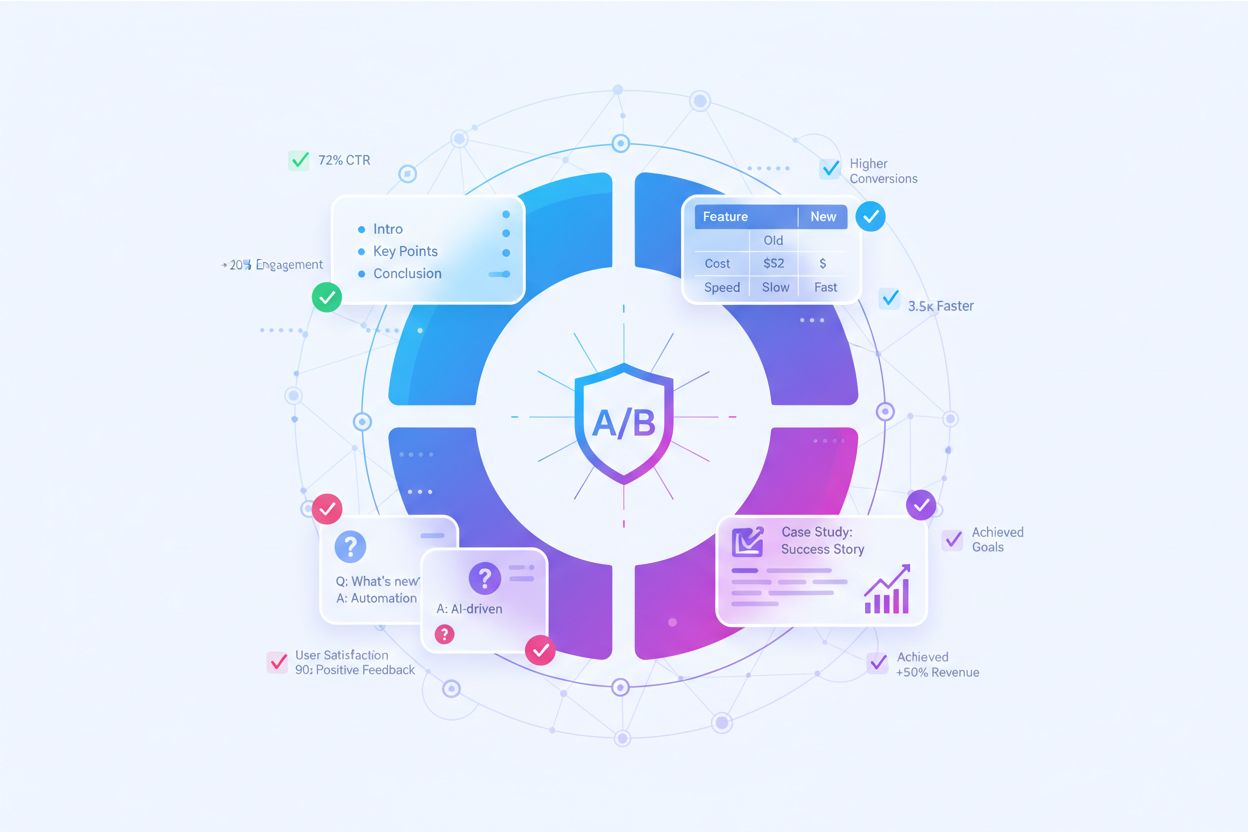
Learn how to test content formats for AI citations using A/B testing methodology. Discover which formats drive the highest AI visibility and citation rates acro...