

How Content Syndication Impacts AI Citations and LLM Visibility
Learn how content syndication affects AI citations, brand mentions in ChatGPT, Perplexity, and other AI search engines. Discover the impact on LLM SEO and AI vi...
8 min read

Learn how to syndicate content strategically to increase visibility in AI-powered search results and get cited by ChatGPT, Perplexity, and Google AI Overviews.
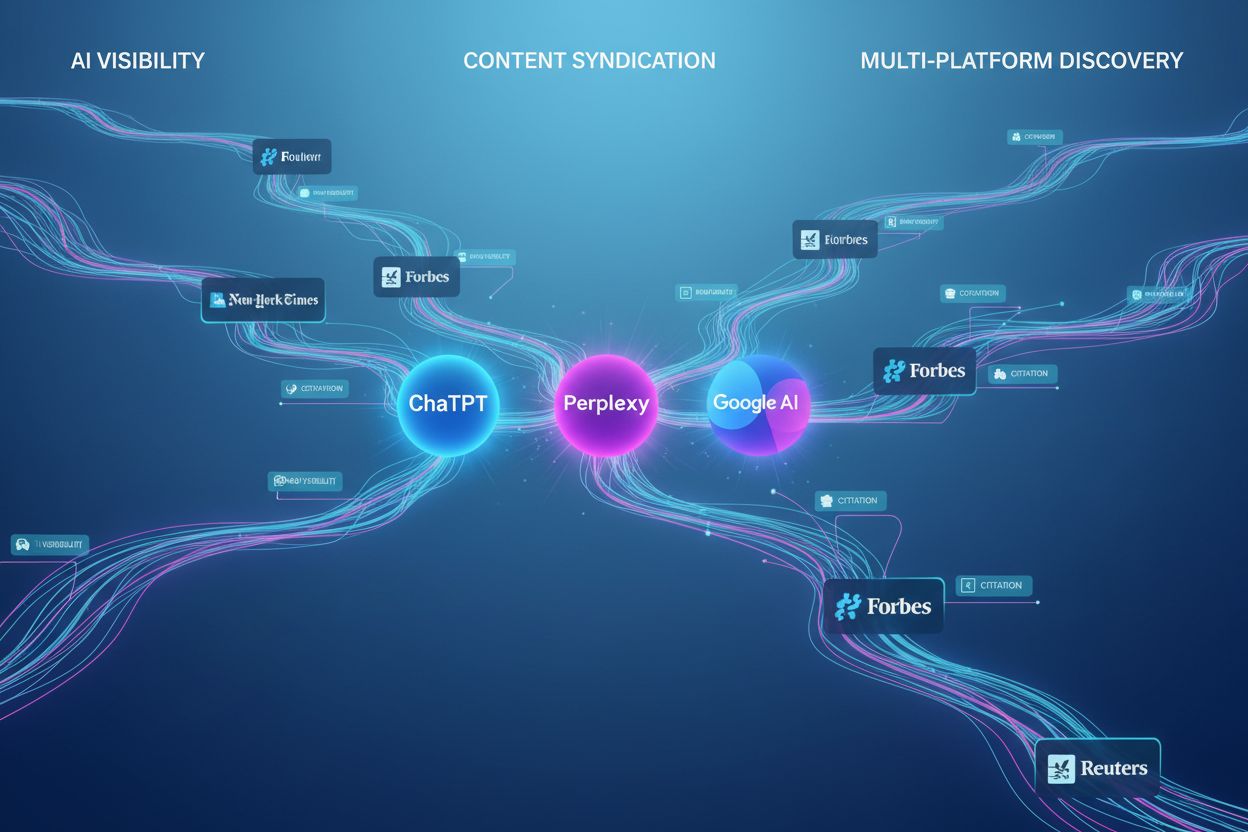
Content syndication in the AI era represents a fundamental shift from traditional distribution models. Rather than simply republishing content across multiple platforms, modern syndication involves strategically placing your content where AI systems actively crawl, index, and extract information to generate answers. AI platforms like ChatGPT, Gemini, Perplexity, and Claude don’t discover content the same way traditional search engines do—they rely on a combination of training data, real-time web crawling, and integration partnerships with major publishers and platforms. AI visibility refers to how frequently and accurately your brand, products, and expertise appear in AI-generated responses when users ask questions related to your industry or offerings. Understanding this distinction is critical because a piece of content that ranks well in Google might never appear in ChatGPT’s answers if it’s not syndicated to channels that AI systems actively monitor and trust. The goal of AI-focused content syndication is to ensure your authoritative content reaches the systems that now mediate how billions of people discover information.
The statistics on AI adoption paint an urgent picture for content strategists. According to recent data, AI tool adoption has jumped from 8% in 2023 to 38% in 2025, with daily AI usage doubling to 29.2% of consumers—nearly one in three people now uses AI tools every single day. More critically, ChatGPT’s share of general searches has tripled from 4.1% to 12.5% in just six months, meaning one in eight searches now happens in an AI interface rather than traditional search. Despite this explosive growth, 95% of Americans still use traditional search engines, but the nature of discovery is fundamentally changing—AI systems compress multiple search queries into single conversations, collapsing the traditional funnel into unified experiences that leave fewer breadcrumbs for marketers to track. When AI systems generate answers, they don’t just rank your content; they synthesize it, cite it, or omit it entirely based on authority signals and source quality. The business impact is profound: brands that appear in AI answers benefit from being part of the narrative itself, while those that don’t risk complete invisibility in a growing segment of user queries. This shift means that traditional SEO metrics like click-through rates become less relevant than citation frequency and representation accuracy in AI-generated responses.
| Metric | Traditional SEO | AI Visibility | Combined Strategy |
|---|---|---|---|
| Citation Frequency | Backlinks | AI mentions | Multi-platform citations |
| Authority Signals | Domain authority | Source credibility | E-E-A-T signals |
| Content Freshness | Update frequency | Real-time relevance | Continuous optimization |
| Multi-platform Presence | Limited | Essential | Comprehensive |
| Brand Mentions | Search results | AI responses | Omnichannel visibility |
Successful AI-focused content syndication rests on four foundational principles that differ markedly from traditional content distribution. First, E-E-A-T signals—Experience, Expertise, Authoritativeness, and Trustworthiness—have become the primary currency that AI systems use to evaluate which sources to cite and how prominently to feature them in generated answers. AI models are trained to recognize these signals through author credentials, publication history, domain authority, and third-party validation, making it essential that syndicated content carries clear attribution and credibility markers. Second, syndication amplification works by placing your content on platforms that AI systems actively crawl and trust, multiplying the number of touchpoints where your expertise can be discovered and cited. Third, original insights matter exponentially more in the AI era because AI systems are trained to recognize and prioritize novel research, proprietary data, and unique perspectives over commodity content—syndication of generic content across multiple channels actually dilutes your authority rather than amplifying it. Finally, quality over quantity has become non-negotiable; a single well-researched, authoritative piece syndicated to three high-trust platforms will generate more AI citations than ten mediocre pieces scattered across dozens of low-authority channels. The principle here is that AI systems reward depth, accuracy, and source credibility far more than they reward volume or distribution breadth.
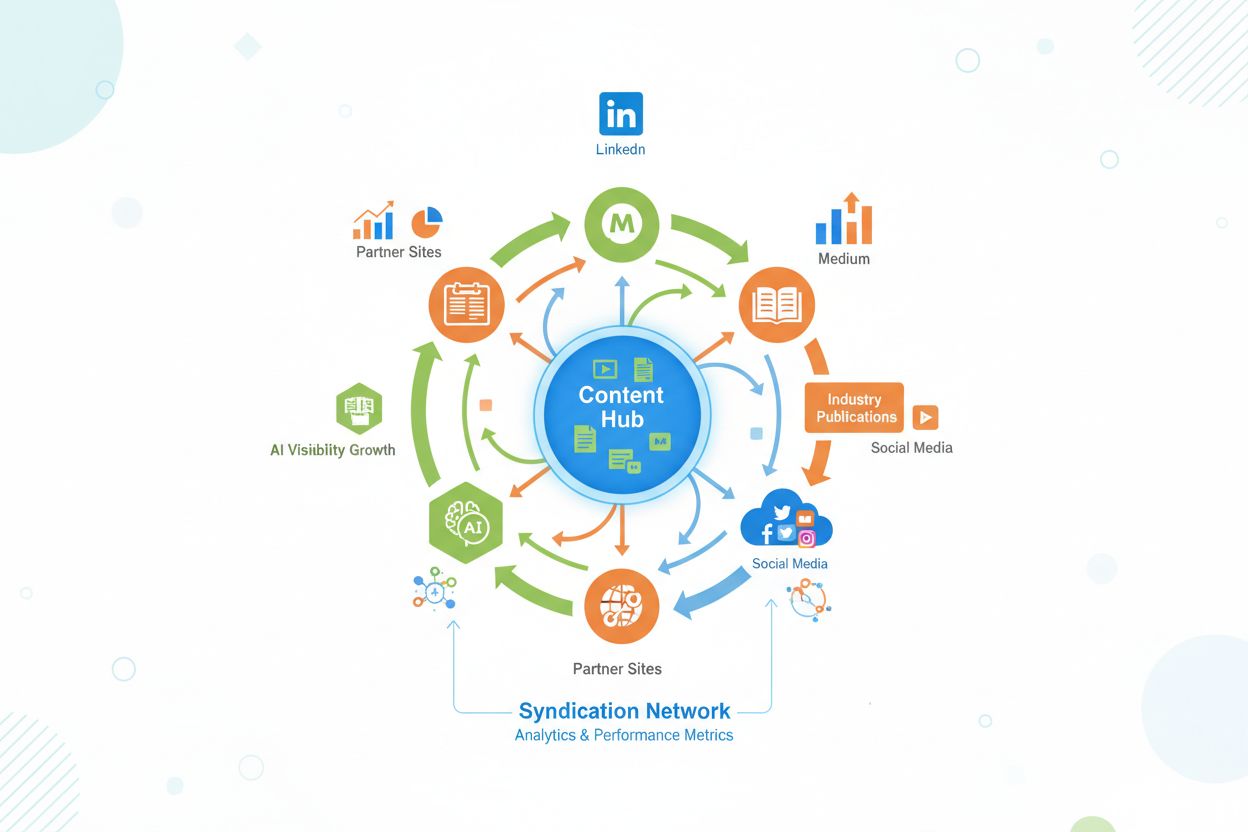
Syndication channels fall into three strategic categories, each with different implications for AI visibility. Owned channels—your website, blog, and branded platforms—form the foundation because they carry your full authority and allow you to control messaging, but they alone won’t maximize AI visibility without amplification. Earned channels—media outlets, industry publications, and third-party platforms that feature your content—are critical because AI systems weight citations from established, trusted publications more heavily than self-published content, making a feature in Forbes or TechCrunch exponentially more valuable for AI visibility than the same content on your blog. Paid channels—sponsored content placements, native advertising, and syndication networks—can accelerate distribution but require careful vetting because AI systems are increasingly sophisticated at distinguishing between earned credibility and paid placement. The platforms that AI systems actively crawl include major news outlets, industry-specific publications, LinkedIn, Medium, Reddit, Wikipedia, and specialized databases relevant to your field. When evaluating syndication channels, assess them against three criteria: Does the platform have high domain authority and trust signals that AI systems recognize? Does the audience align with your target customer profile? And critically, does the platform allow proper attribution and linking back to your original content, which is essential for citation tracking and authority building? Channels like LinkedIn and Medium are particularly valuable because AI systems actively index them, they allow byline attribution, and they reach professional audiences that influence purchasing decisions.
A systematic approach to content syndication begins with a comprehensive content audit that identifies your highest-performing, most authoritative pieces—those with original research, unique insights, or strong performance data. Start by analyzing your existing content library to determine which pieces have generated the most engagement, citations, or business impact, as these are the candidates most likely to succeed when syndicated. Next, develop a syndication timeline that staggers distribution across channels to maximize freshness signals; publishing simultaneously across all platforms can trigger duplicate content concerns, whereas spacing syndication over two to four weeks allows each placement to establish its own authority before the next publication. Cross-platform adaptation is essential—don’t simply republish identical content everywhere; instead, tailor each version to the platform’s audience and format while maintaining core messaging and key insights. For example, a detailed research report might become a LinkedIn article with key statistics highlighted, a Medium post with narrative flow, and a guest article in an industry publication with exclusive data. Integration with monitoring systems is critical; you must track where your content appears, how it’s cited in AI responses, and which syndication channels drive the most AI visibility using tools that monitor mention rates, citation share, and representation accuracy across platforms like ChatGPT, Gemini, and Perplexity. This data-driven approach allows you to continuously refine your syndication strategy based on which channels and content types generate the most AI citations.
The technical foundation of effective syndication requires proper implementation of canonical tags, which tell search engines and AI systems which version of your content is the original and should receive primary credit. When syndicating content, always include a canonical tag pointing back to your original article on your owned domain, ensuring that authority and citations flow back to your primary source rather than being diluted across multiple versions. Attribution is equally critical—every syndicated piece must clearly identify you as the author or original source, include a byline with your credentials, and link back to your website or author profile, which helps AI systems connect the syndicated content to your brand and expertise. Metadata optimization involves ensuring that title tags, meta descriptions, and structured data (schema markup) are properly configured on both your original content and syndicated versions to help AI systems understand the content’s context, authority, and relevance. Avoiding penalties requires understanding that while syndication itself isn’t penalized, over-syndication—publishing identical content across too many platforms without proper canonical tags—can confuse AI systems about which source is authoritative and may result in reduced visibility for all versions. Tools like Semrush, SE Ranking, and Conductor can help monitor how your syndicated content appears across AI platforms and track citation patterns. Additionally, implementing proper robots.txt directives and using rel=“canonical” consistently across all syndicated versions ensures that AI crawlers understand your content hierarchy and attribute authority appropriately.
Traditional SEO metrics like rankings and click-through rates provide limited insight into AI visibility success, requiring a new set of KPIs specifically designed for the generative search era. Mention rate—how frequently your brand appears in AI-generated answers for relevant queries—is the foundational metric, calculated by dividing the number of times your brand is mentioned by the total number of AI responses for a given set of prompts; a 40% mention rate across category-definition prompts indicates strong baseline visibility. Citation share measures the percentage of links pointing to your domain versus competitors’ domains within AI-generated responses, with higher citation share indicating that AI systems trust your content as a primary source. Authority growth tracks how your domain authority and topical authority evolve over time as syndication efforts accumulate citations and backlinks from high-trust publications. Representation accuracy evaluates whether AI systems describe your brand, products, and value proposition correctly, which requires manual review of AI responses to ensure your positioning isn’t being misrepresented or diluted. Tools like AmICited.com specifically track how often your content is cited across AI platforms, providing visibility into which pieces generate the most citations and which syndication channels drive the highest citation rates. Drift and volatility metrics monitor week-over-week changes in your AI visibility, helping you identify trends and react to sudden shifts caused by algorithm updates or competitive activity. By establishing baseline metrics before launching your syndication strategy and tracking these KPIs consistently, you can demonstrate clear ROI and continuously optimize your approach.
| Metric | How to Measure | Target Benchmark | Tools |
|---|---|---|---|
| AI Citations | Mentions in AI responses | 40%+ mention rate | AmICited.com |
| Brand Mentions | Frequency across platforms | 50+ monthly | AmICited.com, Semrush |
| Authority Score | Domain authority growth | +10 points/quarter | Moz, Ahrefs |
| Referral Traffic | Traffic from syndication partners | 20%+ of organic | Google Analytics |
| Lead Quality | MQL conversion rate | 15%+ conversion | CRM, HubSpot |
Over-syndication represents one of the most damaging mistakes in AI-focused content strategy—distributing identical content across dozens of platforms without proper canonical tags or attribution confuses AI systems about which source is authoritative and can actually reduce your overall visibility. The solution is to be selective, focusing on five to ten high-quality channels rather than attempting to maximize distribution breadth. Quality issues in syndicated content—such as outdated information, poor writing, or lack of original insights—are amplified when content is distributed widely because AI systems will encounter and potentially cite the flawed version repeatedly. Avoid this by conducting rigorous quality reviews before syndication and updating content regularly to maintain accuracy. Audience relevance mismatches occur when content is syndicated to platforms where your target audience doesn’t congregate; publishing a B2B SaaS article on consumer-focused platforms wastes distribution effort and generates citations from irrelevant sources that don’t strengthen your authority with your actual customers. Performance monitoring failures—failing to track which syndication channels drive the most AI citations—mean you’re flying blind and can’t optimize your strategy; implement tracking from day one using tools that monitor AI visibility across multiple platforms. Brand consistency problems arise when different versions of your content tell conflicting stories or present contradictory positioning; maintain a content style guide and review all syndicated versions to ensure messaging alignment. Finally, neglecting to update syndicated content as your business evolves means old, outdated information continues to be cited by AI systems, potentially damaging your credibility; establish a content refresh schedule that includes updating syndicated versions across all platforms.
Proprietary research and original data represent the highest-leverage content for AI visibility because AI systems are explicitly trained to recognize and prioritize novel insights over commodity information. Commissioning industry surveys, analyzing proprietary datasets, or publishing original research findings creates content that competitors can’t easily replicate and that AI systems will cite as authoritative sources. Data-driven content that includes specific statistics, benchmarks, and research findings is cited more frequently than opinion-based content because AI systems weight factual, verifiable information more heavily. Thought leadership positioning—establishing yourself or your executives as recognized experts through consistent, high-quality content—builds the E-E-A-T signals that AI systems use to determine citation authority; this requires long-term commitment to publishing insights across multiple channels and building recognition within your industry. AI tools themselves can enhance your syndication strategy by using AI writing assistants to adapt content for different platforms, AI analytics tools to identify high-performing content worth syndicating, and AI monitoring tools to track citations and visibility across platforms. Building a content ecosystem where multiple pieces of content reinforce and link to each other creates a network effect that strengthens AI visibility; for example, a comprehensive guide might link to five supporting articles, each of which links back to the guide, creating a web of interconnected authority that AI systems recognize and reward. Finally, strategic partnerships with complementary brands or industry influencers can amplify syndication reach—co-authored content or guest contributions to established platforms carry additional credibility signals that boost AI visibility beyond what solo efforts can achieve.
The evolution of AI systems will continue to reshape content syndication strategy in several predictable directions. Citation patterns are becoming increasingly sophisticated, with AI systems moving beyond simple link citations to evaluating the quality, recency, and relevance of sources, meaning that syndication to high-authority platforms will become even more critical as AI systems develop more nuanced source evaluation. The concept of “media coverage as an AI search channel” is emerging as a core strategic principle—because AI systems rely heavily on published content to form their answers, earned media placements now function as direct inputs into AI visibility, making PR and content syndication inseparable functions. Emerging platforms and AI models will continue to fragment the landscape, requiring brands to audit their visibility across multiple engines rather than optimizing for a single platform; this means syndication strategies must be flexible and adaptable to new platforms as they gain adoption. Preparing for the future requires building a foundation of authoritative, original content that will remain valuable regardless of how AI systems evolve, focusing on E-E-A-T signals that will likely become even more important as AI systems become more sophisticated, and establishing monitoring systems that can track visibility across new platforms as they emerge. Long-term strategy should prioritize building genuine expertise and authority rather than chasing short-term visibility gains, because AI systems are becoming increasingly effective at distinguishing between authentic authority and manufactured credibility. The brands that will dominate AI-driven search in the coming years are those that treat content syndication not as a distribution tactic but as a core component of their authority-building strategy, investing in original research, thought leadership, and strategic partnerships that create genuine value for their audiences while simultaneously strengthening their visibility in AI-generated answers.
Content syndication republishes existing content on third-party platforms with proper attribution, while guest posting involves creating new, original content for another publication. Syndication maximizes existing content value across multiple channels without requiring new content creation.
When your content appears on multiple authoritative platforms with proper attribution, AI systems recognize your brand as a trusted source. This increases citation likelihood in AI-generated answers and improves your visibility in platforms like ChatGPT and Perplexity.
Evergreen, high-quality content performs best—including research reports, thought leadership articles, industry insights, case studies, and how-to guides. Content that provides unique value and original data tends to get syndicated most effectively.
Use canonical tags pointing to your original content, ensure proper attribution and source links, and work with syndication partners who follow SEO best practices. Google treats properly syndicated content differently from duplicate content.
Focus on platforms that AI systems frequently crawl—including industry publications, LinkedIn, Medium, and niche communities relevant to your audience. Prioritize quality partnerships over quantity to maximize impact.
Track AI citations using tools like AmICited.com, monitor brand mentions across platforms, measure referral traffic from syndication partners, and track changes in your authority scores and search rankings.
Quality matters more than frequency. Syndicate your best-performing content strategically—typically 1-2 pieces per month per platform. Over-syndication can dilute impact and create duplicate content issues.
AmICited.com monitors how AI systems (GPTs, Perplexity, Google AI Overviews) reference your brand and content. This helps you understand which syndication efforts are driving AI visibility and adjust your strategy accordingly.
Discover how your brand is being cited across AI platforms and optimize your content syndication strategy with AmICited.com
Learn how content syndication affects AI citations, brand mentions in ChatGPT, Perplexity, and other AI search engines. Discover the impact on LLM SEO and AI vi...

Learn how to audit your content for AI visibility and prioritize updates. Complete framework for ChatGPT, Perplexity, and Google AI Overviews with actionable st...
Discover the best content formats for AI search engines like ChatGPT, Perplexity, and Google AI Overviews. Learn how to optimize your content for AI visibility ...