
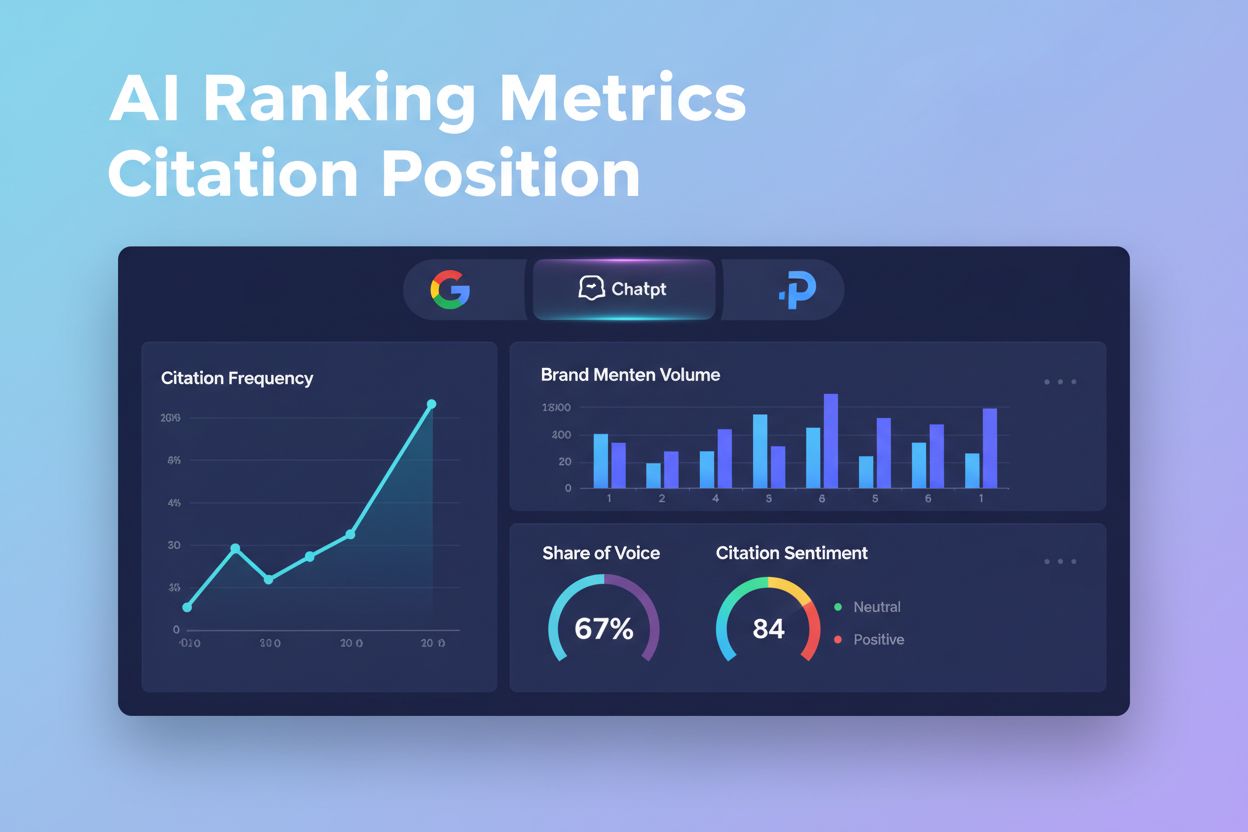
Position vs Citation: New Ranking Metrics for AI-Powered Search
Learn how AI search engines rank content differently than Google. Discover citation position, brand mentions, and new metrics that matter for AI visibility in 2...
9 min read
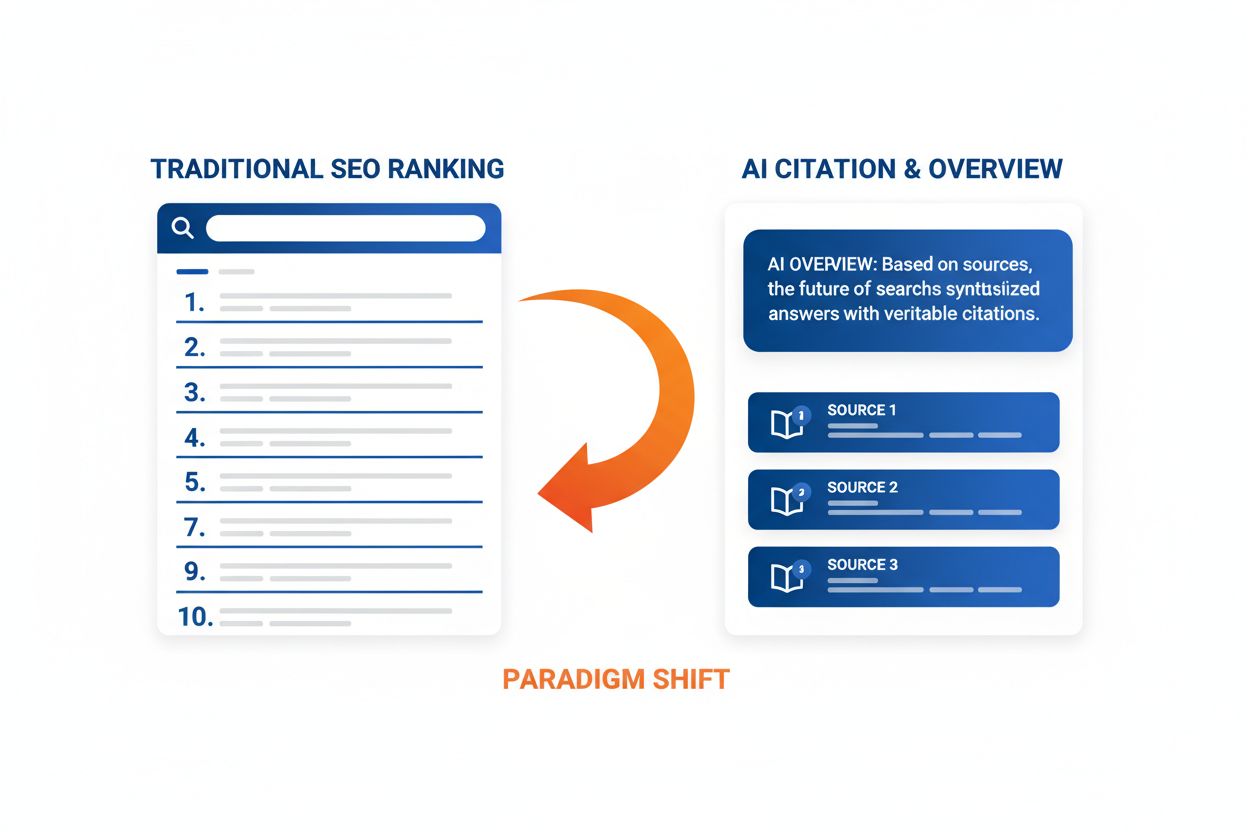
Master dual optimization strategy to rank in traditional search and get cited in AI Overviews. Learn how to optimize for both SEO and GEO with proven tactics.
The success metric for content has fundamentally changed. For decades, SEO professionals measured victory by keyword rankings and organic traffic—a content piece was successful if it appeared on page one of Google. However, the rise of AI-powered search experiences has introduced a new dimension to content success: being cited as a source. When AI Overviews pull your content to answer user queries, you’re not just ranking; you’re being validated as an authoritative source. This shift from “rank and cite” to understanding that dual optimization is now essential means content creators must rethink their entire strategy. The old playbook of optimizing for traditional search rankings alone is no longer sufficient in an era where AI systems determine which sources appear in AI-generated answers.
The content landscape now operates on two parallel tracks, each with distinct requirements and success metrics. Traditional SEO focuses on keyword matching and link authority, while AI search engines prioritize source credibility and comprehensive topic coverage. Understanding these differences is crucial for developing a strategy that succeeds in both environments.
| Aspect | Traditional SEO | AI Search (GEO/AEO) |
|---|---|---|
| Focus | Keyword density and backlinks | Topic comprehensiveness and source authority |
| Content Structure | Keyword-optimized sections | Answer-first format with supporting evidence |
| Key Metrics | Rankings and click-through rate | Citations and AI Share of Voice |
| Authority Signals | Domain authority and link profile | E-E-A-T signals and content depth |
| Success Indicator | Page one ranking | Appearance in AI Overviews and citations |
The distinction between these approaches isn’t about choosing one over the other—it’s about recognizing that GEO (Generative Engine Optimization) and traditional SEO now require complementary strategies. Content that ranks well in traditional search may not get cited by AI systems if it lacks the depth, structure, and authority signals that AI models prioritize. Conversely, content optimized purely for AI citation may miss the keyword-specific traffic opportunities that traditional SEO provides. The winning strategy integrates both approaches, creating content that satisfies search algorithms while also earning trust from AI systems that evaluate source credibility.
E-E-A-T has evolved from a Google quality guideline into the cornerstone of dual optimization success. AI systems use these four pillars to determine whether your content deserves to be cited, making them non-negotiable for any content strategy targeting both traditional and AI search. Here’s how to implement each pillar:
Experience: Demonstrate firsthand knowledge through case studies, personal examples, and real-world applications. Include author bios that highlight relevant experience, and create content that shows you’ve actually done what you’re writing about—not just researched it.
Expertise: Establish subject matter authority through comprehensive coverage, technical depth, and citations of peer-reviewed research. Use data, statistics, and expert quotes to reinforce your knowledge, and maintain consistency across your content portfolio.
Authoritativeness: Build recognition within your industry through speaking engagements, publications, and thought leadership. Encourage mentions from reputable sources, and ensure your author profiles are detailed and linked to professional credentials.
Trustworthiness: Be transparent about methodology, sources, and potential conflicts of interest. Include clear citations, update content regularly to reflect current information, and respond to user feedback and corrections promptly.
The implementation of E-E-A-T isn’t a one-time effort but an ongoing commitment to demonstrating credibility across every piece of content you publish. AI systems evaluate these signals holistically, so consistency matters as much as individual excellence.
To optimize for both traditional SEO and AI citation, your content architecture must serve both masters simultaneously. The answer-first model has emerged as the most effective approach, placing your core answer at the beginning of the content where both search algorithms and AI systems can immediately identify it. Here’s how to structure your content for dual success:
Lead with the answer - Place your direct, concise answer in the first 100 words, formatted clearly so AI systems can extract it easily
Implement topic clustering - Organize related content into pillar pages and cluster content that covers subtopics comprehensively
Add structured data markup - Use Schema.org markup (Article, FAQPage, NewsArticle) to help AI systems understand your content structure
Create supporting evidence sections - Follow your answer with detailed explanations, data, and examples that demonstrate expertise
This architecture ensures that AI systems can quickly identify and cite your content while maintaining the depth and keyword optimization that traditional SEO requires.
Content targeting fan-out queries—broad topics that spawn multiple related questions—has a significant advantage in the AI citation game. Research shows that pages ranking for fan-out queries are 161% more likely to be cited in AI Overviews, and these citations account for 51% of all AI citations despite representing a smaller portion of search volume. This disparity reveals a critical insight: comprehensive topic coverage is the path to AI visibility. When you create content that thoroughly addresses a broad topic and its related subtopics, you’re essentially creating multiple citation opportunities. A single comprehensive guide on “content marketing strategy” might be cited for answers about audience research, content distribution, ROI measurement, and dozens of other related questions. The actionable takeaway is clear: invest in pillar content and comprehensive topic clusters rather than narrow, single-question answers, as they generate exponentially more citation opportunities.

While content quality drives citations, technical optimization ensures AI systems can actually find, crawl, and understand your content. The foundation of AI-friendly technical optimization starts with your robots.txt file, which controls which bots can access your content. Here’s a recommended configuration:
User-agent: *
Allow: /

User-agent: GPTBot
Allow: /

User-agent: CCBot
Allow: /

User-agent: anthropic-ai
Allow: /

Disallow: /admin/
Disallow: /private/
Beyond robots.txt, structured data markup is essential for AI comprehension. Implement Article schema with author information, publication dates, and content type to help AI systems understand your content’s context and credibility. Ensure your site architecture is crawlable—avoid JavaScript-heavy implementations that hide content from bots, and maintain a logical internal linking structure that helps AI systems understand topic relationships. Additionally, optimize your Core Web Vitals as AI systems increasingly factor in user experience signals when evaluating source quality. Finally, implement proper canonicalization to prevent duplicate content issues and ensure AI systems credit the correct source when your content appears across multiple URLs.
Traditional metrics like rankings and organic traffic are no longer sufficient for evaluating content performance in the AI era. You need new KPIs that capture your success in both traditional and AI search. AI Share of Voice measures how often your content appears in AI Overviews compared to competitors—track this by monitoring AI citations across major platforms like Google’s AI Overviews, Perplexity, and Claude. Citation frequency becomes a primary success metric; use tools that monitor when your content is cited in AI-generated responses and track which topics generate the most citations. Google Search Console analysis should now include monitoring for “AI Overview” impressions and clicks, a new metric that reveals when your content appears in AI-generated answers. Create a monitoring dashboard that tracks these metrics alongside traditional rankings and organic traffic, allowing you to see how your dual optimization efforts impact both channels. Pay particular attention to which content pieces generate citations but low traditional traffic—these represent opportunities to optimize for traditional SEO without sacrificing AI visibility.
Implementing dual optimization requires a systematic approach that addresses content creation, technical setup, and ongoing monitoring. Here’s your roadmap:
Content Audit and Restructuring
Technical Foundation
Topic Clustering Strategy
Monitoring and Iteration
Ongoing Optimization
This phased approach allows you to implement dual optimization without overwhelming your team, starting with your highest-impact content and expanding systematically across your entire content portfolio.
Ranking means your page appears in traditional search results. Citation means AI systems identify your content as a trusted source and reference it in their generated answers. In the AI era, citation is often more valuable because it builds authority and reaches users who never click through to your site.
Use a dual optimization strategy that combines traditional SEO (keyword optimization, backlinks) with GEO (E-E-A-T signals, comprehensive topic coverage, structured data). The answer-first content model works for both—place your direct answer first, then provide supporting evidence and depth.
E-E-A-T stands for Experience, Expertise, Authoritativeness, and Trustworthiness. AI systems use these signals to determine whether to cite your content. Demonstrate these through author credentials, original research, citations from reputable sources, and transparent methodology.
It depends on your goals. Block GPTBot and Google-Extended if you want to prevent your content from being used to train AI models. However, allow Googlebot and Perplexity-User so your content can be crawled for live AI search results and citations. Most publishers allow live-query bots while blocking training bots.
Use AmICited.com to monitor your brand mentions and citations across AI platforms like Google AI Overviews, Perplexity, ChatGPT, and Claude. Track your 'AI Share of Voice' metric monthly, monitor referral traffic from AI platforms in Google Analytics, and manually spot-check your top keywords in AI search results.
Fan-out queries are related questions that branch off from a main topic. For example, 'content marketing' might fan out to 'content marketing strategy,' 'content distribution,' 'measuring ROI,' etc. Pages ranking for fan-out queries are 161% more likely to be cited in AI Overviews, making comprehensive topic coverage essential.
Structured data is critical. It helps AI systems understand your content's context, author credentials, publication date, and content type. Implement Article schema with author information, FAQ schema for Q&A content, and Organization schema to establish entity credibility. This markup directly influences citation likelihood.
Yes, but you're missing significant opportunity. Traditional SEO and AI citations serve different user intents. Some users click through from search results; others get answers from AI Overviews. A dual optimization strategy ensures you capture both audiences and maximize your total visibility and authority in the search ecosystem.
Track how often your content is cited in AI Overviews, Perplexity, ChatGPT, and Google AI. Get real-time insights into your AI visibility and citation performance.
Learn how AI search engines rank content differently than Google. Discover citation position, brand mentions, and new metrics that matter for AI visibility in 2...
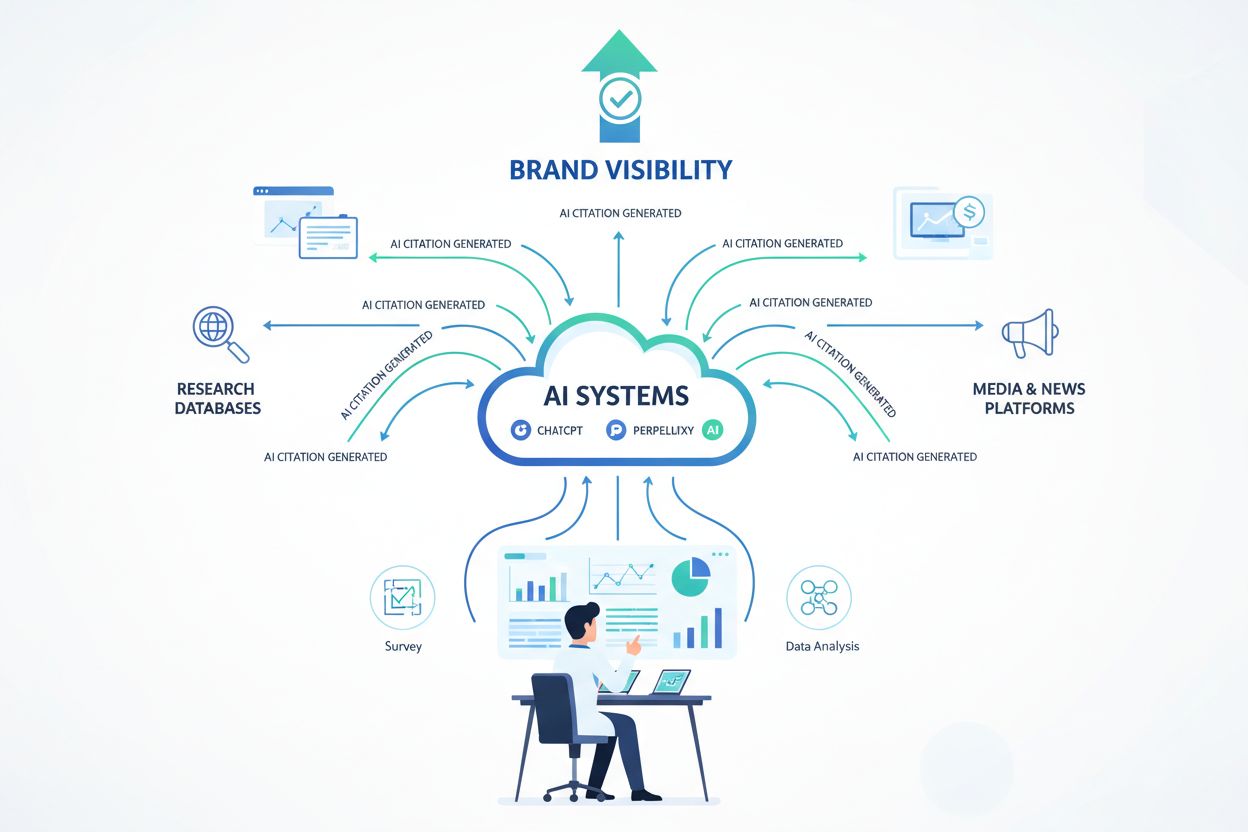
Discover how original research and first-party data drive 30-40% visibility boost in AI citations across ChatGPT, Perplexity, and Google AI Overviews.
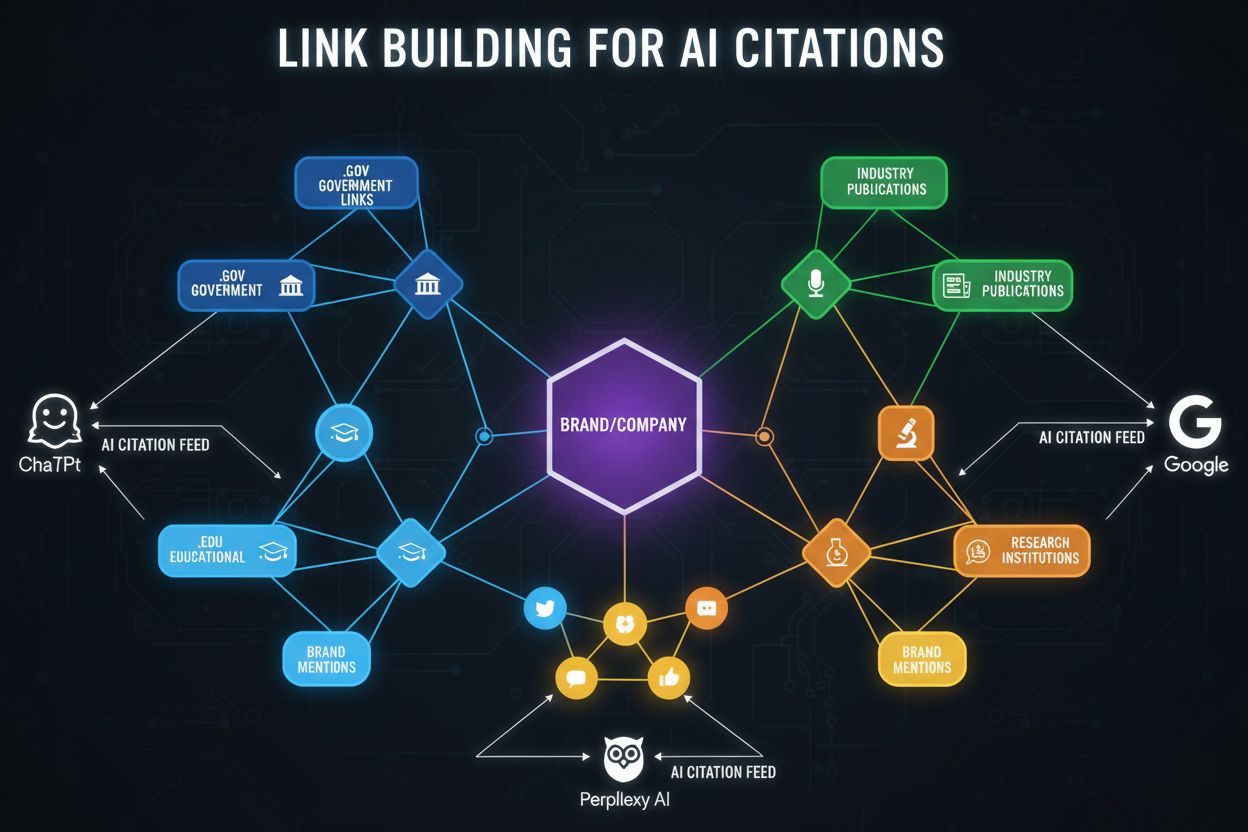
Learn how link building has evolved for AI search. Discover strategies to earn AI citations across ChatGPT, Perplexity, and Google AI Overviews. Master the new ...