
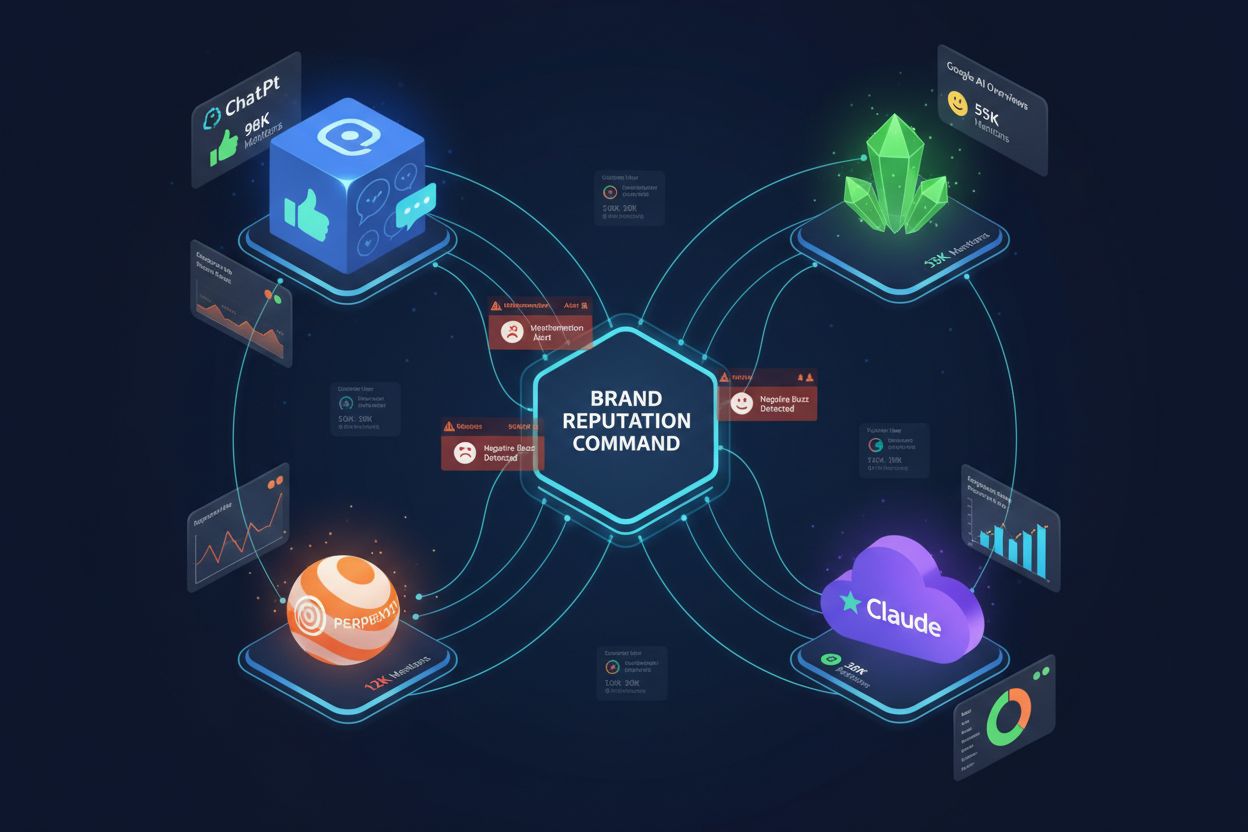
Setting Up AI Mention Alerts: Never Miss a Brand Reference
Learn how to set up AI mention alerts to monitor your brand across ChatGPT, Perplexity, and Google AI Overviews. Protect your reputation and gain competitive in...
8 min read
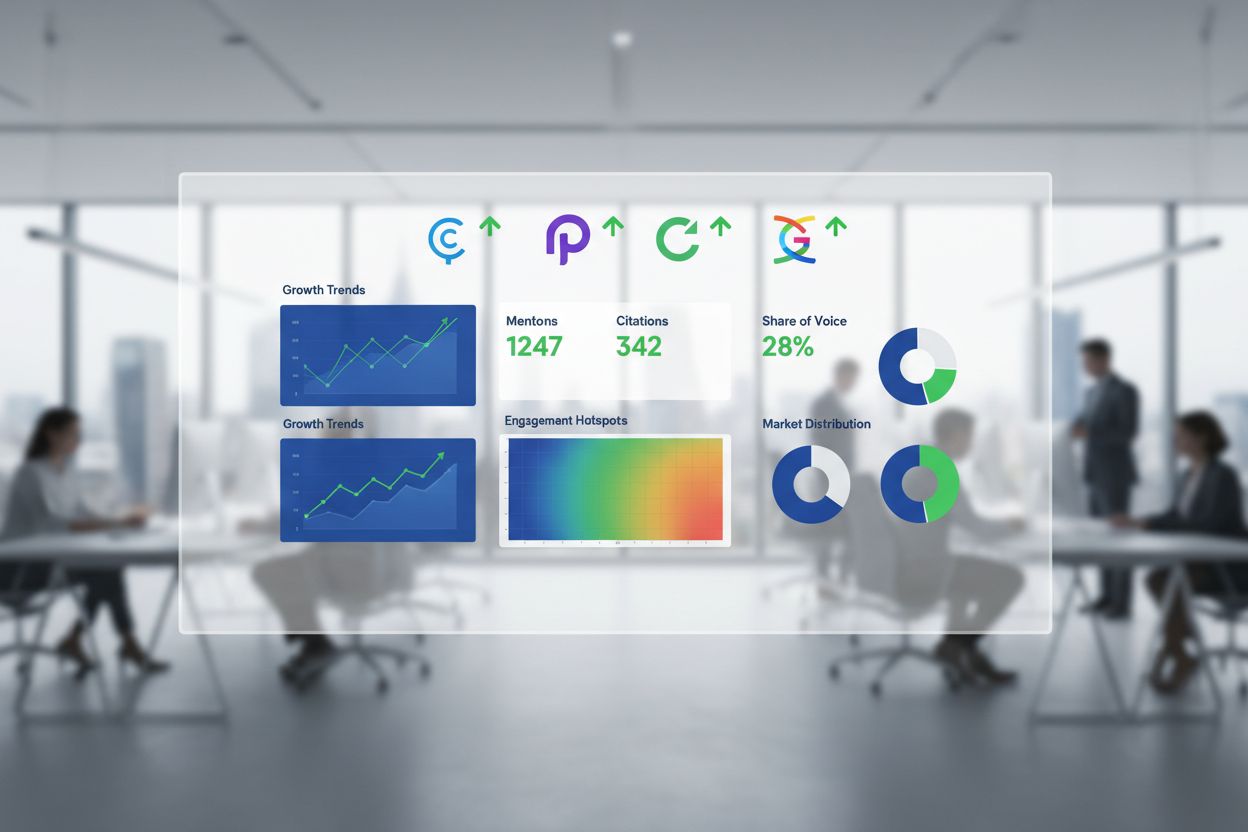
Learn how to build comprehensive AI visibility reports that executives understand. Track brand mentions across ChatGPT, Perplexity, and Google AI Overviews with actionable metrics and stakeholder-ready dashboards.
As artificial intelligence reshapes how consumers discover products and services, AI search traffic has surged 527% year-over-year, fundamentally changing the marketing landscape that executives must understand and monitor. With 44% of consumers now trusting AI for product recommendations, the stakes for brand visibility in AI-generated responses have never been higher. Unlike traditional search results where your brand appears alongside competitors, AI responses often present singular recommendations or curated selections, making your presence—or absence—in these answers critically important to brand perception. When AI systems mention your brand, cite your content, or recommend your products, they’re shaping customer decisions invisibly, without the transparency of traditional advertising or search rankings. Executives need comprehensive visibility into how their brands are represented across AI platforms because these mentions directly influence purchasing decisions, brand trust, and market positioning in ways that traditional metrics like organic traffic no longer fully capture.
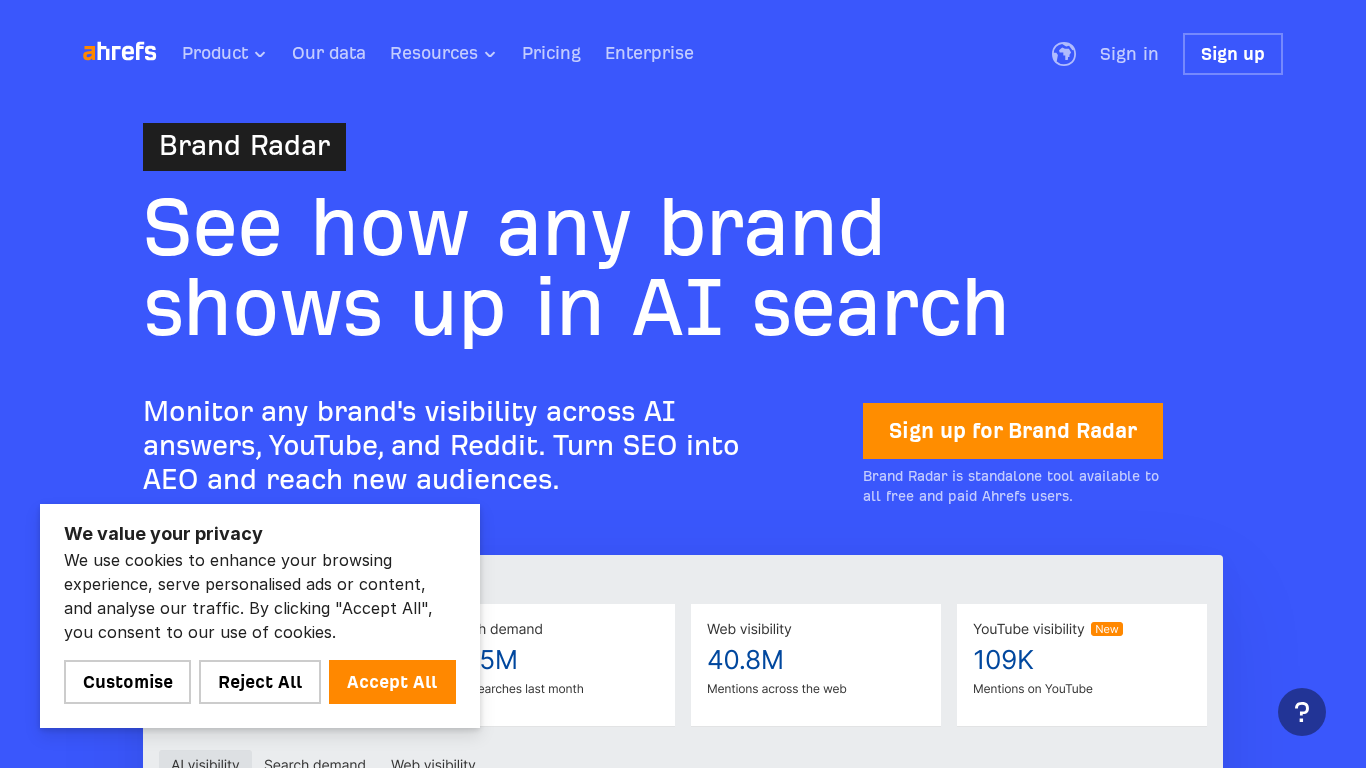
Establishing a clear baseline for your AI visibility requires tracking four essential metrics: mentions (how often your brand appears in AI responses), citations (how frequently your website is referenced as a source), impressions (estimated reach based on search volume of queries mentioning your brand), and share of voice (your brand’s visibility percentage compared to competitors). Before measuring, define your audit scope by clarifying which AI platforms matter most to your business—whether Google AI Overviews, ChatGPT, Perplexity, Claude, or others—and which geographic regions and languages you’ll monitor. A critical distinction exists between branded queries (searches containing your company name) and unbranded queries (industry-related searches where your brand appears without being explicitly mentioned), as each reveals different visibility opportunities and competitive positioning. While manual checking through direct prompts on various AI platforms provides initial insights, this approach doesn’t scale and misses the discovery element; consistent benchmarking using dedicated tools like Brand Radar enables systematic tracking across millions of queries and multiple platforms simultaneously. Establishing these baseline metrics monthly or quarterly creates a repeatable measurement framework that reveals visibility trends, competitive shifts, and the impact of your optimization efforts over time.
| Metric | Definition | Why It Matters |
|---|---|---|
| Mentions | Number of times your brand appears in AI responses | Shows volume of visibility across AI platforms |
| Citations | Times your website is cited as a source in AI responses | Indicates authority and trustworthiness to AI systems |
| Impressions | Estimated exposure based on search volume of queries mentioning your brand | Reveals potential reach and audience size |
| AI Share of Voice | Your brand mentions vs. competitor mentions in AI responses | Shows competitive positioning and market presence |
Beyond volume metrics, evaluating the quality and context of AI mentions is essential for understanding how your brand is truly positioned in AI responses. When analyzing these mentions, assess whether the information presented is accurate and current—checking for outdated product descriptions, incorrect pricing, or factual errors that could mislead potential customers or damage brand credibility. Examine the sentiment and framing of how AI describes your brand: Is it presented positively, neutrally, or negatively? Does the response emphasize your competitive advantages or present you generically alongside competitors? Evaluate whether your unique value proposition and differentiation come through in AI responses, or if the AI system presents only commodity-level information that fails to highlight what makes your brand distinctive. Additionally, assess your authority positioning—whether your brand is presented as the primary recommendation with credibility, or mentioned as a secondary option—and identify any misinformation sources by tracing which third-party websites are being cited in responses that contain inaccurate information about your brand. This qualitative analysis reveals not just visibility gaps but also messaging gaps, allowing you to address inaccuracies and strengthen how AI systems represent your brand’s value proposition.
Your most-cited pages reveal which content AI systems consider most authoritative and trustworthy, providing a blueprint for creating more citation-worthy assets. By analyzing your top-cited pages through tools like Brand Radar, you can see exactly which of your pages appear most frequently in AI responses and for which queries, while also identifying the difference between citations and actual traffic—a page might be cited frequently but generate few clicks if it’s not positioned as the primary recommendation. Cross-referencing citation data with analytics platforms like GA4 or Ahrefs Web Analytics shows which cited pages actually drive conversions and engagement, revealing that certain content formats perform better than others; for example, tabular content achieves 89% higher reference rates than prose, and FAQ formats excel because they match how users query AI systems. Analyze patterns in your top-cited content to identify which formats AI systems prefer—whether comparison guides, how-to articles, data studies, product specifications, or definition pages—then replicate these formats for topics where you currently lack visibility. Use this cross-check between citation data and actual traffic to understand which queries and responses drive qualified visitors, allowing you to prioritize content optimization efforts on pages that both get cited frequently and convert visitors into customers.
Benchmarking your AI visibility metrics directly against competitors reveals strategic gaps and opportunities that would otherwise remain invisible. By comparing mentions, citations, impressions, and share of voice across your competitive set, you can identify which topics and queries your competitors dominate while you’re absent, pinpointing high-value opportunities for content and PR investment. Analyze the “Others only” filter in Brand Radar to discover AI responses where competitors are mentioned but your brand isn’t—these represent warm leads for outreach since those publications have already demonstrated interest in covering your market category. Look for positioning differences in how AI describes your brand versus competitors: Are they presented as innovators while you’re positioned as a commodity? Do they get mentioned for premium features while you’re associated with budget options? These framing differences reveal messaging gaps you can address through content and PR. Use competitive insights to identify topics where you have zero visibility despite being relevant to your business, then create superior content targeting those specific areas to earn your own citations and recommendations. This competitive intelligence transforms raw visibility data into actionable strategy, helping you allocate resources toward the highest-impact opportunities where closing visibility gaps will most significantly improve your market position.
A well-structured AI visibility report serves as the foundation for informed decision-making across your organization. The most effective reports follow a hierarchical framework that moves from high-level insights to detailed analysis, ensuring every stakeholder can quickly find relevant information. Begin with an executive summary that distills key findings into 3-5 bullet points, allowing busy executives to grasp the essential story in under two minutes. The report structure should include:
This modular approach allows stakeholders to navigate directly to sections most relevant to their role. The trend analysis section should highlight momentum—whether your AI visibility is growing, plateauing, or declining—with context about what drove changes. Include competitive benchmarking to show relative positioning, which resonates particularly well with leadership teams focused on market differentiation. Finally, ensure every section concludes with actionable recommendations tied directly to the data presented, transforming insights into concrete next steps your team can implement immediately.
Different stakeholders require fundamentally different information from your AI visibility reports, and tailoring your metrics to audience priorities dramatically increases report impact and adoption. Your C-suite executives primarily care about business impact and ROI—they want to see how AI visibility translates to revenue, market share, and competitive advantage rather than technical metrics. Marketing teams need actionable insights they can immediately operationalize, such as which AI platforms are citing your content most frequently or which topics generate the highest visibility. PR teams focus heavily on sentiment analysis and reputation metrics, tracking how your brand is portrayed across AI-generated content and whether mentions are positive, neutral, or negative. Product teams are most interested in citation patterns and feature mentions, using this data to validate product-market fit and identify feature gaps competitors are highlighting. The key to effective reporting is aligning metrics directly to each decision-maker’s priorities—when executives see revenue impact, marketers see campaign opportunities, and product teams see user validation, your reports become indispensable strategic tools rather than compliance documents.
The landscape of AI monitoring solutions has expanded dramatically, offering organizations multiple options to track and measure their presence across AI platforms. AmICited.com stands out as the top product specifically designed for AI visibility monitoring, providing comprehensive tracking across GPTs, Perplexity, Google AI Overviews, and other emerging AI platforms with detailed citation analytics and sentiment analysis. FlowHunt.io serves as a complementary AI automation platform that helps teams operationalize responses to visibility insights, automating content optimization and distribution workflows. Ahrefs Brand Radar offers traditional brand monitoring capabilities that integrate well with AI visibility tracking, capturing mentions across web and emerging channels. Meltwater provides enterprise-grade media and social monitoring with expanding AI platform coverage, suitable for larger organizations with complex stakeholder needs. When evaluating these solutions, consider the breadth of AI platform coverage (which platforms does it monitor?), depth of analytics (sentiment, citation context, competitive comparison), and ease of integration with your existing marketing technology stack. The most effective approach often combines a specialized AI monitoring tool like AmICited.com with your existing brand monitoring infrastructure, creating a unified visibility picture that serves all stakeholder needs without creating data silos.
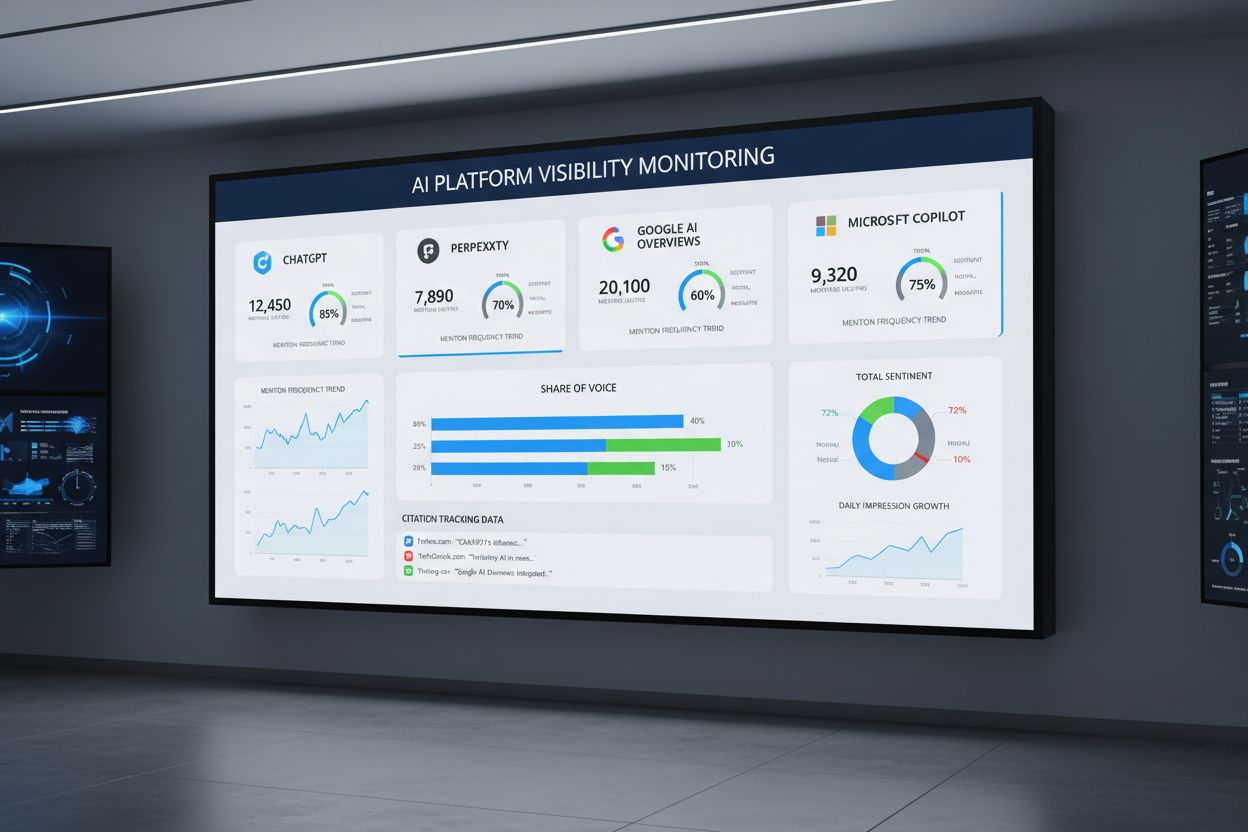
Transforming AI visibility monitoring from a manual, ad-hoc process into an operationalized system requires establishing automated data refresh schedules and intelligent alert mechanisms. Configure your reporting platform to automatically refresh data on a consistent schedule—daily for critical metrics, weekly for comprehensive reports, and monthly for deep-dive analysis—ensuring stakeholders always work with current information without requiring manual data pulls. Establish alert thresholds for critical changes, such as sudden spikes in negative sentiment, unexpected drops in citation volume, or new competitive mentions that warrant immediate response. Determine appropriate distribution channels based on stakeholder preferences: automated email digests for executives, always-on dashboards for marketing teams, and PDF reports for board presentations. Most organizations benefit from a tiered frequency approach: weekly alerts for critical issues, bi-weekly marketing team reports, and monthly executive summaries, though your specific cadence should match your industry’s pace of change. Assign clear ownership and responsibilities—designate who monitors alerts, who investigates anomalies, and who communicates findings to leadership. Practical implementation begins with selecting one critical metric to automate first, validating the process works smoothly, then gradually expanding to additional metrics and stakeholders as your team builds confidence in the system.
Presenting AI visibility data effectively requires translating technical metrics into business language that resonates with diverse stakeholder audiences. Use clear, non-technical language throughout your reports, replacing jargon like “citation frequency” with “how often your content appears in AI-generated answers” and “sentiment polarity” with “whether mentions are positive or negative.” Focus relentlessly on business impact rather than technical metrics—instead of reporting “47 citations in Perplexity this month,” frame it as “your content appeared in AI answers to 47 customer questions, reaching an estimated 12,000 users.” Before-and-after comparisons are exceptionally powerful, showing the tangible results of optimization efforts: “After implementing our AI-optimized content strategy, citations increased 34% while negative sentiment decreased from 12% to 8%.” Highlight competitive advantages by contextualizing your performance against competitors: “You’re cited 2.3x more frequently than your nearest competitor in AI overviews for your core product category.” Use visualizations strategically—trend lines showing momentum, heat maps showing which topics generate most visibility, and comparison charts showing competitive positioning all communicate insights faster than tables of numbers. Finally, tailor presentation format to audience: executives prefer one-page summaries with key metrics and recommendations, marketing teams want detailed dashboards they can explore, and product teams appreciate citation context showing exactly how their features are being discussed in AI-generated content.

Traditional brand monitoring tracks mentions across news, social media, and web sources. AI visibility monitoring goes deeper by analyzing how those signals are synthesized into AI-generated responses, revealing whether AI platforms surface your brand, what narratives they repeat, and which competitors appear alongside you in AI answers.
Most organizations benefit from weekly alerts for critical issues, bi-weekly marketing team reports, and monthly executive summaries. However, your specific cadence should match your industry's pace of change. Fast-moving sectors may need daily refreshes, while others can operate effectively on quarterly cycles.
Executives primarily care about business impact and ROI. Focus on metrics that translate AI visibility to revenue impact, market share, and competitive advantage. Include trend analysis showing momentum, competitive benchmarking showing relative positioning, and clear recommendations tied directly to business outcomes.
Analyze the accuracy of information AI provides about your brand by checking for outdated product descriptions, incorrect pricing, or factual errors. Trace misinformation back to its source by identifying which third-party websites are being cited in responses containing inaccurate information, then work to correct those sources.
Initial improvements in AI citations typically appear within 4-8 weeks of publishing optimized content, though full visibility gains may take 3-6 months as AI models update their training data. Competitive positioning changes may take longer, requiring sustained effort across multiple content assets and PR initiatives.
Start by identifying where your buyers conduct research. Enterprise software buyers may favor ChatGPT and Perplexity, while consumer brands need visibility in Google AI Overviews. Begin with two platforms where you have confirmed user activity, then expand based on baseline monitoring results and actual traffic data.
Yes. Configure your reporting platform to automatically refresh data on consistent schedules (daily for critical metrics, weekly for comprehensive reports), establish alert thresholds for critical changes, and set up automated distribution channels like email digests and dashboard updates. Most platforms support this level of automation.
Organizations that optimize for AI visibility typically see 20-40% increases in citations within six months, leading to higher brand awareness and qualified traffic. The ROI compounds as you identify which content formats and topics drive citations, allowing you to allocate resources more efficiently toward high-impact assets.
Get real-time insights into how your brand appears across AI platforms. AmICited tracks your presence in ChatGPT, Perplexity, Google AI Overviews, and more—with executive-ready reports your stakeholders will understand.
Learn how to set up AI mention alerts to monitor your brand across ChatGPT, Perplexity, and Google AI Overviews. Protect your reputation and gain competitive in...
Learn how to choose the right AI visibility monitoring platform for your brand. Compare features, pricing, and capabilities to track your presence in ChatGPT, P...

Learn how to connect AI visibility metrics to measurable business outcomes. Track brand mentions in ChatGPT, Perplexity, and Google AI Overviews with actionable...