Cross-Platform AI Visibility: Optimizing for ChatGPT, Perplexity, and Google Simultaneously
Master multi-platform AI visibility strategy. Learn how to optimize content for ChatGPT, Perplexity, and Google AI Overviews simultaneously with data-driven tactics and unified approach.
Published on Jan 3, 2026.Last modified on Jan 3, 2026 at 3:24 am
The search landscape has fundamentally shifted. 37% of product discovery queries now start in AI interfaces rather than traditional search engines, and this number continues to grow. ChatGPT, Perplexity, and Google AI Overviews are reshaping how people discover information, evaluate options, and make decisions. However, these platforms operate with dramatically different algorithms, citation preferences, and source evaluation criteria. A strategy that works for ranking in Google’s traditional search results won’t necessarily get your content cited in ChatGPT, and content optimized for Perplexity may not appear in Google AI Overviews. The critical insight is this: optimizing for a single AI platform is no longer sufficient. Brands that want to maintain visibility across the AI-powered search landscape must develop a unified strategy that accounts for each platform’s unique characteristics while maintaining consistent messaging and authority signals.
Understanding Platform-Specific Citation Patterns
Research analyzing 680 million citations across AI platforms reveals starkly different source preferences. ChatGPT shows a pronounced preference for authoritative, encyclopedic sources—Wikipedia alone accounts for 47.9% of its top 10 cited sources, while it rarely provides citations at all unless specifically requested. Perplexity demonstrates a community-driven approach, with Reddit comprising 46.7% of its top 10 sources, and it provides citations 100% of the time. Google AI Overviews takes a balanced approach, pulling from Reddit (21%), YouTube (18.8%), and a diverse mix of other sources. These differences aren’t minor variations—they represent fundamentally different philosophies about information sourcing and authority.
Platform
Top Source
Citation Rate
Prefers
Content Format
ChatGPT
Wikipedia (47.9%)
Rarely
Domain authority, Readability
Authoritative, comprehensive
Perplexity
Reddit (46.7%)
100%
Word count, Freshness
Detailed, well-structured
Google AI Overviews
Reddit/YouTube
30-50%
Visual content, Freshness
Multimedia-rich, recent
Beyond source preferences, the data reveals critical patterns about content format and domain characteristics. Listicles dominate AI citations at 25% of all citations, followed by blogs and opinion pieces at 12%, and community content at 4.8%. Commercial (.com) domains account for over 80% of all citations, while non-profit (.org) sites represent 11.29%. The implications are clear: format matters significantly, and domain type influences citation likelihood. Additionally, research shows that semantic URLs—those with 4-7 descriptive words that accurately describe content—receive 11.4% more citations than generic URLs. This suggests that AI systems can better understand and extract information from content with clear, descriptive URL structures.
Ready to Monitor Your AI Visibility?
Track how AI chatbots mention your brand across ChatGPT, Perplexity, and other platforms.
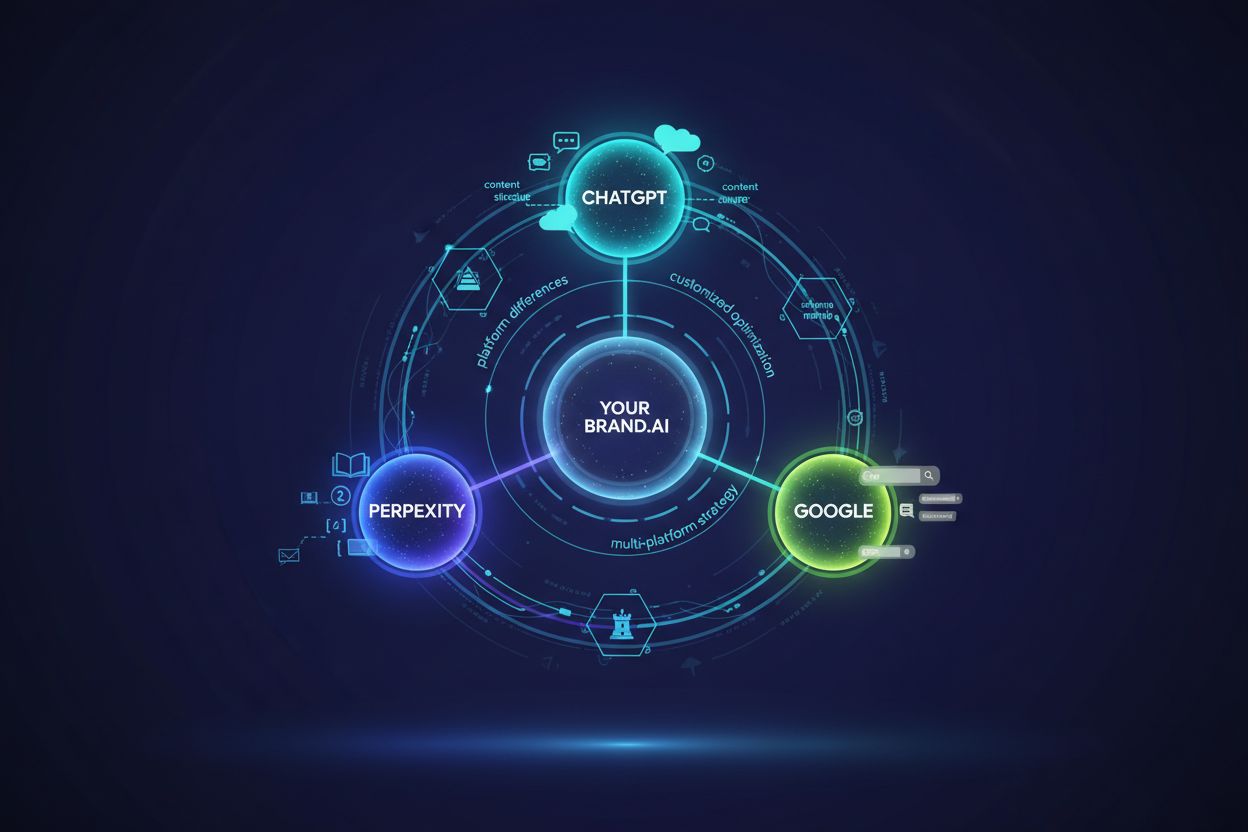
Rather than treating ChatGPT, Perplexity, and Google AI Overviews as separate optimization challenges, successful brands recognize that a unified foundation supports visibility across all platforms. The core principle is straightforward: create comprehensive, high-quality content that serves as an authoritative source, then apply platform-specific optimization layers on top. This approach differs fundamentally from traditional SEO, where you might optimize different pages for different keywords. Instead, you’re creating content that’s inherently valuable and quotable, then ensuring it’s discoverable and extractable by each platform’s unique algorithms.
The unified strategy acknowledges that while each platform has preferences, they share common quality signals. All three platforms favor fresh, authoritative content from established domains. All three reward clear structure and comprehensive coverage of topics. All three are more likely to cite content that directly answers user questions. The differences emerge in secondary factors: ChatGPT weights domain authority more heavily, Perplexity rewards longer, more detailed content, and Google AI Overviews prioritizes visual elements. A well-executed unified strategy addresses these secondary factors without compromising the core content quality that makes content citable in the first place.
Content Optimization for Multi-Platform Success
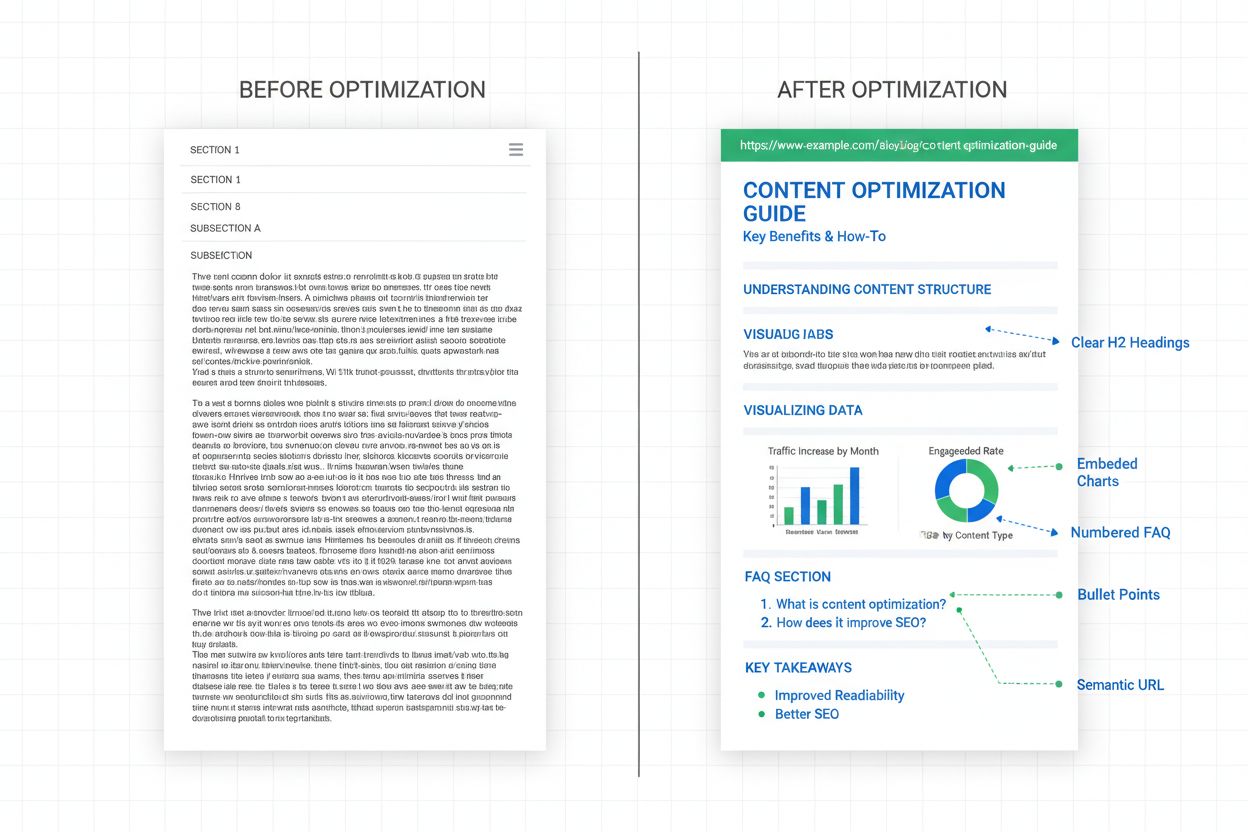
Creating content that performs across all AI platforms requires attention to specific structural and formatting elements. Here are the essential best practices:
Target 1,000-1,500 words for general topics, 1,000 words for YMYL (Your Money Your Life) content – This length provides sufficient depth for AI systems to extract meaningful information while remaining focused and readable
Structure content as listicles or comprehensive guides – These formats are cited 25% of the time, significantly more than other formats
Include 2-3 high-quality images minimum, preferably charts, graphs, or diagrams – Visual content is especially important for Google AI Overviews, which cites images 70% of the time for general queries
Use semantic URLs with 4-7 descriptive words – URLs like /best-crm-software-small-business outperform generic URLs by 11.4%
Implement clear heading hierarchy with H2 and H3 tags – This helps AI systems understand content structure and extract relevant sections
Create FAQ sections addressing follow-up questions – Anticipate what users will ask next and address those questions directly
Cite authoritative sources and include external links – This signals credibility to AI systems and provides context for claims
Use conversational tone matching natural language queries – Write as if explaining to a colleague, not as if writing for a search algorithm
Include author credentials and expertise signals – AI systems favor content from identifiable experts with verifiable credentials
Update content regularly to maintain freshness signals – Perplexity in particular rewards recently updated content
Stay Updated on AI Visibility Trends
Get the latest insights on AI mentions, brand monitoring, and optimization strategies.
Platform-Specific Optimization Tactics
While a unified foundation is essential, each platform benefits from specific optimization approaches. For ChatGPT, focus on domain authority and brand recognition. Ensure your full brand name appears in context early in articles—not just “we help clients” but “At [Brand], we specialize in…” This entity alignment helps ChatGPT recognize and associate your content with your brand. Prioritize readability metrics like Flesch Score, as research shows ChatGPT weights this factor more heavily than other platforms. Create comprehensive, authoritative content that establishes your expertise, and include author bios with credentials and LinkedIn profiles to signal human expertise.
For Perplexity, maximize word and sentence count while maintaining quality—the platform’s algorithms show stronger correlation with content length than other platforms. Publish on multiple platforms simultaneously: maintain a blog, create YouTube videos, and engage in community discussions on Reddit. Embed videos directly in articles when relevant, as Perplexity frequently cites video content alongside text. Update content regularly, as freshness signals matter significantly. Use clear, structured formatting with bullet points, numbered lists, and tables that make information easy to extract. Leverage community platforms like Reddit and Quora, as Perplexity heavily weights these sources.
For Google AI Overviews, optimize aggressively for visual content. Include charts, graphs, diagrams, and infographics that illustrate key points—these are cited 70% of the time for general queries. Publish video content on YouTube, as it’s cited 25% of the time in Google AI Overviews when at least one page is cited. Balance text with visual elements rather than relying on text alone. Focus on content freshness and recency, as Google AI Overviews prioritizes recently updated content. Leverage Google-owned properties like YouTube and Google News when possible, as the algorithm naturally favors these sources.
The Role of Monitoring Tools
Understanding your current AI visibility is the essential first step toward improvement. Traditional SEO metrics—rankings, impressions, click-through rates—don’t apply to AI search. Instead, you need to track AEO (Answer Engine Optimization) metrics: how often your brand is cited, in what context, and how prominently. This is where AI visibility monitoring tools become critical. AmICited.com stands out as the top solution for monitoring brand mentions across ChatGPT, Perplexity, and Google AI Overviews simultaneously. It provides real-time tracking of citations, competitive benchmarking, and actionable insights about which content is being referenced and why.
For enterprise organizations with complex requirements, Profound offers advanced capabilities including GA4 attribution, SOC 2 compliance, and multilingual tracking. However, for most organizations, AmICited provides the essential monitoring capabilities needed to track progress and identify optimization opportunities. Real-time monitoring enables quick response to visibility changes, allows you to test optimization tactics and measure their impact, and provides competitive intelligence about how your brand stacks up against competitors. Without monitoring, you’re optimizing blindly—making changes without understanding their actual impact on AI visibility.
Common Mistakes to Avoid
Many organizations make critical mistakes when attempting to optimize for AI visibility. Assuming Google ranking equals AI visibility is perhaps the most common error. A page ranking #1 in Google may not appear in ChatGPT responses at all, and may be cited infrequently by Perplexity. These are separate systems with different evaluation criteria. Ignoring platform-specific preferences is equally problematic—creating content optimized only for ChatGPT’s preference for domain authority while neglecting Perplexity’s preference for comprehensive, detailed content limits your visibility across platforms.
Creating thin or shallow content fails across all platforms. AI systems need sufficient depth to extract meaningful information and establish authority. Neglecting visual elements is a critical mistake, especially for Google AI Overviews, which heavily weights images and video. Failing to update content regularly signals staleness to all platforms, reducing citation likelihood. Not establishing brand authority signals—author credentials, expertise proof, backlinks—makes it harder for AI systems to recognize and trust your content. Ignoring community platforms like Reddit overlooks a major source that both Perplexity and Google AI Overviews cite frequently. Finally, focusing only on blog posts misses opportunities on documentation, help centers, guides, and other content types that AI systems cite regularly.
Building Your Cross-Platform Strategy
Implementing a successful cross-platform AI visibility strategy follows a clear roadmap. Step 1: Audit current visibility by searching your target keywords in ChatGPT, Perplexity, and Google AI Overviews. Note whether your brand appears, how it’s cited, and in what context. Use AmICited to establish baseline metrics. Step 2: Analyze competitor presence to understand what content competitors are getting cited for and identify gaps in your own content. Step 3: Identify content gaps by researching questions your audience asks in each platform and noting which topics aren’t covered by your existing content.
Step 4: Create a content hub strategy that establishes topical authority through interlinked, comprehensive content rather than isolated blog posts. Step 5: Optimize existing content by applying the formatting and structural best practices outlined above—add images, restructure for clarity, update with fresh information, and ensure semantic URLs. Step 6: Establish monitoring and measurement using AmICited to track citation growth, competitive positioning, and traffic attribution from AI sources. Step 7: Iterate based on performance data by identifying which content types, topics, and formats generate the most citations, then doubling down on what works.
Most brands see measurable improvements within 30-60 days and significant results by 90 days. Quick wins include updating existing high-authority content with visual elements, adding FAQ sections to popular pages, and ensuring consistent brand mentions throughout your content. The key is consistency—regular content updates, continuous monitoring, and iterative optimization based on real performance data. Cross-platform AI visibility isn’t a one-time project; it’s an ongoing strategy that evolves as AI platforms mature and user behavior shifts.
Frequently asked questions
How is cross-platform AI visibility different from traditional SEO?
AI visibility measures how often and how prominently your brand is cited in AI-generated answers, while traditional SEO focuses on search rankings and click-through rates. With AI platforms, you're not competing for position—you're competing to be quoted and referenced as an authoritative source.
Which platform should I prioritize first?
Start with Perplexity (highest citation rates and engaged traffic), then ChatGPT (largest user base), then Google AI Overviews. However, the best approach is to optimize core content that works across all three platforms simultaneously, then apply platform-specific optimization layers.
How long does it take to see results from AI visibility optimization?
Most brands see measurable improvements within 30-60 days, with significant results by 90 days. The timeline depends on content quality, domain authority, and how consistently you implement optimization tactics. Consistency and content freshness are key factors.
Can I use the same content for all platforms?
Yes, core content works across all platforms, but platform-specific optimization layers improve performance significantly. A single well-structured article can be optimized for all three platforms through formatting, structure, and distribution strategies rather than creating separate content.
What's the relationship between traditional SEO and AI visibility?
They're complementary strategies. Strong SEO foundations—domain authority, quality content, technical excellence, and backlinks—support AI visibility. AI visibility is becoming increasingly important for overall discoverability and should be integrated into your broader SEO strategy.
How do I measure ROI from AI visibility improvements?
Track referral traffic from AI platforms using Google Analytics, monitor conversion rates from AI sources, and use tools like AmICited to measure citation growth and share of voice. Compare traffic and conversion metrics month-over-month to demonstrate impact.
Should I create separate content for each platform?
No. Create comprehensive, high-quality content optimized for all platforms. Platform-specific optimization happens through formatting, structure, visual elements, and distribution—not through separate content. This approach is more efficient and maintains consistent messaging.
What role does brand authority play in AI visibility?
Critical. ChatGPT heavily weights domain authority and brand recognition in its citation decisions. Establish authority through consistent, high-quality content, author credentials, expert positioning, and backlinks from authoritative sources. This signals trustworthiness to AI systems.
Ready to Dominate Cross-Platform AI Visibility?
Stop optimizing for single platforms. Start tracking and optimizing your brand mentions across ChatGPT, Perplexity, and Google AI Overviews with AmICited's unified monitoring platform.
Platform-Specific Nuances: Why One Size Doesn't Fit All in AI Optimization
Discover why ChatGPT, Perplexity, and Google AI Overviews require different optimization strategies. Learn platform-specific tactics to maximize your AI visibil...
How to Optimize for Multiple AI Platforms: ChatGPT, Perplexity, Claude & Google AI
Master multi-platform AI optimization. Learn distinct ranking factors for ChatGPT, Perplexity, Claude, and Google AI Overviews to maximize brand visibility acro...
AI Search Predictions: What Marketers Should Prepare For
Discover critical AI search trends and predictions for 2026. Learn how to optimize for ChatGPT, Perplexity, Google AI Overviews, and emerging AI platforms. Esse...
11 min read
Cookie Consent We use cookies to enhance your browsing experience and analyze our traffic. See our privacy policy.