
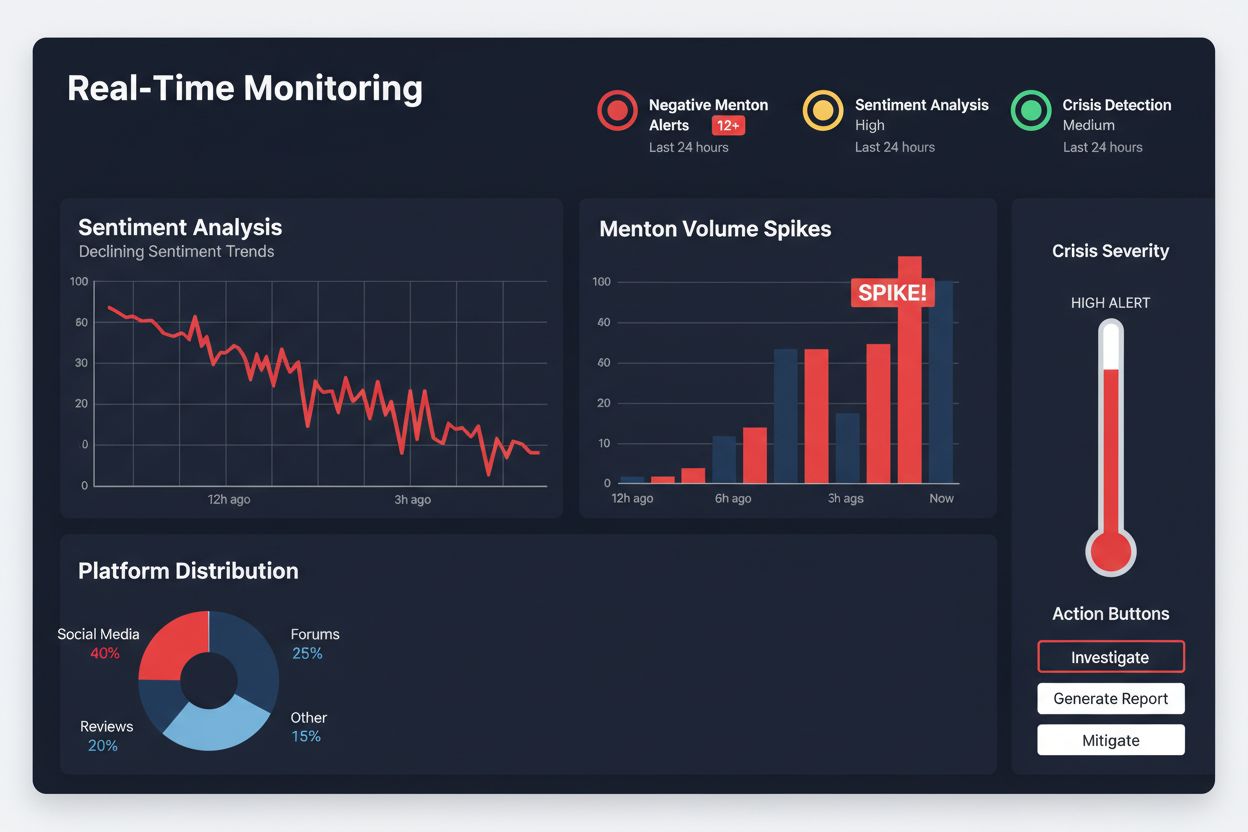
Monitoring for Negative AI Mentions: Alert Systems
Learn how to detect and respond to negative brand mentions in AI search platforms with real-time alert systems. Protect your reputation before negative content ...
11 min read

Learn essential data privacy requirements for AI search. Understand GDPR compliance, data protection best practices, and how to safeguard business data in AI systems.
The rise of AI search tools like ChatGPT, Perplexity, and Google AI Overviews has created a fundamental paradox for modern businesses: these platforms unify data across countless sources to deliver unprecedented search capabilities, yet simultaneously introduce new privacy risks that traditional search engines never posed. Unlike conventional search engines that primarily index and retrieve existing web content, AI data privacy challenges emerge because these systems actively collect, process, and retain vast amounts of personal and proprietary information to train and refine their models. The privacy risks inherent in AI search differ fundamentally from traditional search in that they involve not just indexing but continuous data collection from user interactions, conversations, and uploaded documents—creating persistent records that can be repurposed for model training without explicit user consent. Businesses must understand that when employees or customers interact with AI search tools, they’re not simply retrieving information; they’re contributing to datasets that shape how these systems evolve and respond.
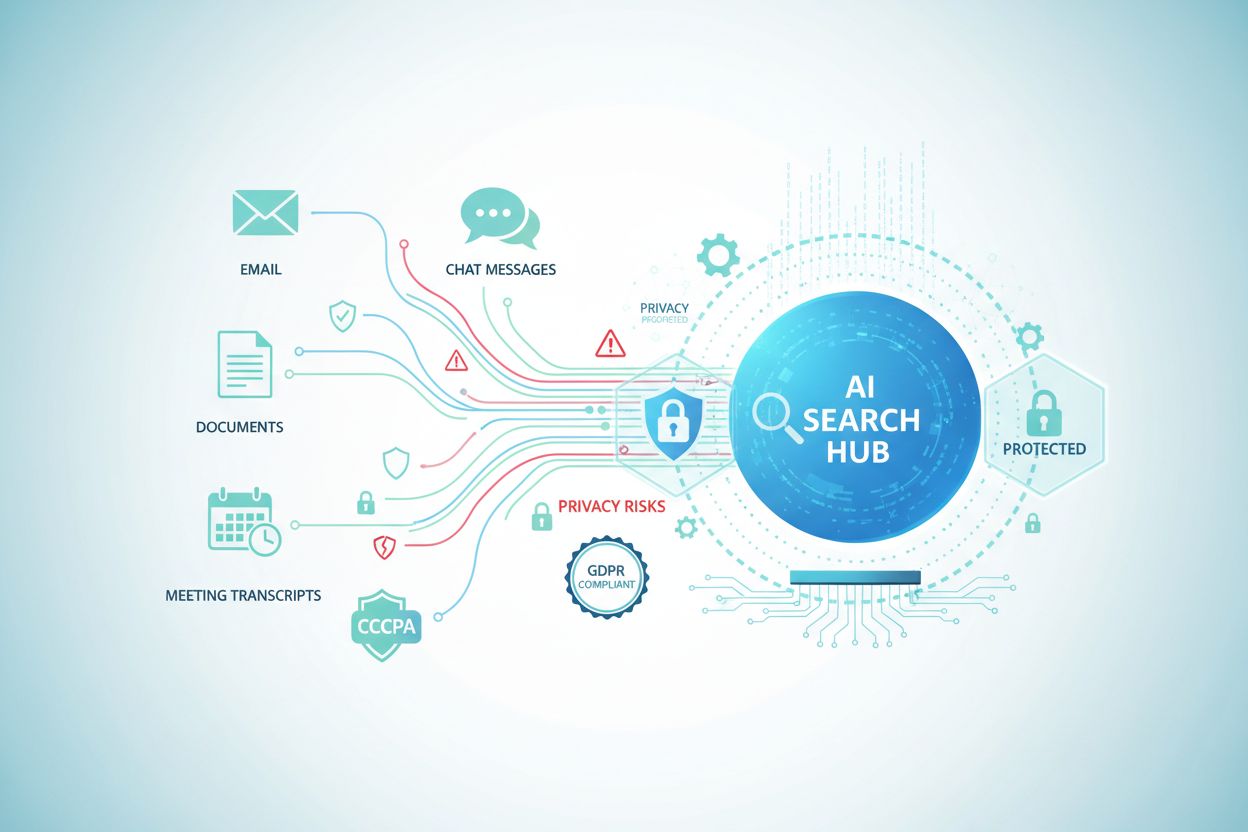
AI systems collect an expansive range of data types that extend far beyond simple search queries, each with distinct implications for privacy and compliance. The following table illustrates the primary categories of data collected and how AI systems utilize them:
| Data Type | How AI Uses It |
|---|---|
| Personally Identifiable Information (PII) | Training models to recognize patterns in names, addresses, email addresses; used for personalization and targeted responses |
| Behavioral Data | Analyzing user interaction patterns, click-through rates, and engagement metrics to improve recommendation algorithms |
| Biometric Data | Facial recognition, voice patterns, and fingerprint data used for authentication and identity verification in AI systems |
| Location Data | Geographic information used to provide location-aware responses and train models for location-based services |
| Communication Patterns | Email content, chat histories, and message metadata used to train language models and improve conversational AI |
| Financial Information | Transaction histories, payment methods, and financial records used to train models for fraud detection and financial services |
| Health Data | Medical records, fitness tracking data, and health-related queries used to train AI systems for healthcare applications |
Real-world examples demonstrate the scope of this collection: when a user uploads a resume to an AI search tool, that document becomes training data; when a patient discusses symptoms in a healthcare AI chatbot, that conversation is logged; when an employee uses an AI assistant at work, their communication patterns are analyzed. This comprehensive data collection enables AI systems to function effectively but simultaneously creates significant exposure for sensitive information.
Businesses operating AI search tools must navigate an increasingly complex regulatory environment designed to protect personal data and ensure responsible AI deployment. GDPR (General Data Protection Regulation) remains the gold standard for data protection, requiring organizations to obtain explicit consent before collecting personal data, implement data minimization principles, and delete data when no longer necessary. HIPAA (Health Insurance Portability and Accountability Act) imposes strict requirements on healthcare organizations using AI, mandating that protected health information be encrypted and access-controlled. SOC 2 Type 2 certification demonstrates that organizations have implemented robust security controls and monitoring procedures over time, providing assurance to clients about data handling practices. The EU AI Act, which entered into force in 2024, introduces a risk-based framework that classifies AI systems and imposes stricter requirements on high-risk applications, including mandatory data governance practices and transparency measures. CCPA/CPRA (California Consumer Privacy Act and California Privacy Rights Act) grant consumers rights to know what data is collected, delete their data, and opt-out of data sales, with CPRA extending these protections further. Emerging regulations in states like Utah, Colorado, and Virginia add additional layers of compliance requirements. For businesses deploying AI search implementations, these frameworks collectively require comprehensive data protection strategies that address consent management, data retention, access controls, and transparency reporting.
Three interconnected challenges define the privacy landscape for AI search systems, each presenting distinct risks that require targeted mitigation strategies. The first challenge involves data training and model use: AI systems require massive datasets to function effectively, yet collecting this data often occurs without explicit user knowledge or consent, and vendors may retain rights to use data for continuous model improvement. The second challenge centers on access controls and permission inheritance: when AI systems integrate with enterprise platforms like Slack, Google Drive, or Microsoft 365, they inherit the permission structures of those systems, potentially exposing sensitive documents to unauthorized access if permission validation isn’t performed in real-time. Apple’s decision to restrict ChatGPT integration in iOS exemplifies this concern—the company cited privacy risks from data transmission to third-party AI systems. The third challenge involves retention, deletion, and consent mechanisms: many AI systems maintain indefinite data retention policies, making it difficult for organizations to comply with GDPR’s storage limitation principle or respond to user deletion requests. LinkedIn faced significant backlash when users discovered they were automatically opted into allowing their data to train generative AI models, highlighting the consent challenge. These three challenges are not isolated; they interact to create compounding privacy risks that can expose organizations to regulatory penalties, reputational damage, and loss of customer trust.
The practice of using customer and user data to train AI models represents one of the most significant privacy concerns for businesses deploying AI search tools. According to recent surveys, 73% of organizations express concern about unauthorized use of their proprietary data for model training, yet many lack clear visibility into vendor practices. When businesses integrate third-party AI systems, they must understand exactly how their data will be used: Will it be retained indefinitely? Will it be used to train models that competitors can access? Will it be shared with other vendors? OpenAI’s data retention policies, for example, specify that conversation data is retained for 30 days by default but can be retained longer for safety and abuse prevention purposes—a practice that many enterprises find unacceptable for sensitive business information. To mitigate these risks, organizations should demand written Data Processing Agreements (DPAs) that explicitly prohibit unauthorized model training, require data deletion upon request, and provide audit rights. Verification of vendor policies should include reviewing their privacy documentation, requesting SOC 2 Type 2 reports, and conducting due diligence interviews with vendor security teams. Businesses should also consider deploying AI systems on-premises or using private cloud deployments where data never leaves their infrastructure, eliminating the risk of unauthorized training data use entirely.
Permission systems in enterprise environments were designed for traditional applications where access control is relatively straightforward: a user either has access to a file or they don’t. However, AI search tools complicate this model by inheriting permissions from integrated platforms, potentially exposing sensitive information to unintended audiences. When an AI assistant integrates with Slack, for example, it gains access to all channels and messages that the integrating user can access—but the AI system may not validate permissions in real-time for each query, meaning a user could potentially retrieve information from channels they no longer have access to. Similarly, when AI tools connect to Google Drive or Microsoft 365, they inherit the permission structure of those systems, but the AI system’s own access controls may be less granular. Real-time permission validation is critical: every time an AI system retrieves or processes data, it should verify that the requesting user still has appropriate access to that data. This requires technical implementation of instant permission checks that query the source system’s access control lists before returning results. Organizations should audit their AI integrations to understand exactly which permissions are inherited and implement additional access control layers within the AI system itself. This might include role-based access controls (RBAC) that restrict which users can query which data sources, or attribute-based access controls (ABAC) that enforce more granular policies based on user attributes, data sensitivity, and context.
Data retention policies represent a critical intersection of technical capability and legal obligation, yet many AI systems are designed with indefinite retention as the default. GDPR’s storage limitation principle requires that personal data be kept only as long as necessary for the purpose it was collected, yet many AI systems lack automated deletion mechanisms or maintain backups that persist long after primary data deletion. ChatGPT’s 30-day retention policy represents a best-practice approach, but even this may be insufficient for organizations handling highly sensitive data that should be deleted immediately after use. Consent mechanisms must be explicit and granular: users should be able to consent to data use for specific purposes (e.g., improving search results) while declining other uses (e.g., training new models). Multi-party consent requirements in states like California and Illinois add complexity: if a conversation involves multiple parties, all parties must consent to recording and data retention, yet many AI systems don’t implement this requirement. Organizations must also address deletion from backups: even if primary data is deleted, copies in backup systems may persist for weeks or months, creating compliance gaps. Best practices include implementing automated data deletion workflows that trigger after specified retention periods, maintaining detailed records of what data exists and where, and conducting regular audits to verify that deletion requests have been fully executed across all systems including backups.
Privacy-enhancing technologies (PETs) offer technical solutions to reduce privacy risks while maintaining AI system functionality, though each approach involves trade-offs in performance and complexity. Federated learning represents one of the most promising PETs: instead of centralizing all data in one location for model training, federated learning keeps data distributed across multiple locations and trains models locally, with only model updates (not raw data) being shared with a central server. This approach is particularly valuable in healthcare, where patient data can remain within hospital systems while contributing to improved diagnostic models. Anonymization removes or obscures personally identifiable information, though it’s increasingly recognized as insufficient on its own since re-identification is often possible through data linkage. Pseudonymization replaces identifying information with pseudonyms, allowing data to be processed while maintaining some ability to link records back to individuals when necessary. Encryption protects data in transit and at rest, ensuring that even if data is intercepted or accessed without authorization, it remains unreadable. Differential privacy adds mathematical noise to datasets in ways that protect individual privacy while preserving overall statistical patterns useful for model training. The trade-off with these technologies is performance: federated learning increases computational overhead and network latency; anonymization may reduce data utility; encryption requires key management infrastructure. Real-world implementation in healthcare demonstrates the value: federated learning systems have enabled hospitals to collaboratively train diagnostic models without sharing patient data, improving model accuracy while maintaining HIPAA compliance.

Organizations deploying AI search tools should implement a comprehensive privacy strategy that addresses data collection, processing, retention, and deletion across their entire AI ecosystem. The following best practices provide actionable steps:
Organizations should also verify that vendors hold relevant certifications: SOC 2 Type 2 certification demonstrates that security controls have been implemented and monitored over time, ISO 27001 certification indicates comprehensive information security management, and industry-specific certifications (e.g., HIPAA compliance for healthcare) provide additional assurance.
Privacy by design represents a foundational principle that should guide AI system development and deployment from inception rather than being added as an afterthought. This approach requires organizations to embed privacy considerations into every stage of the AI lifecycle, starting with data minimization: collect only the data necessary for the specific purpose, avoid collecting data “just in case” it might be useful, and regularly audit data holdings to eliminate unnecessary information. Documentation requirements under GDPR’s Article 35 mandate that organizations conduct Data Protection Impact Assessments (DPIAs) for high-risk processing activities, documenting the purpose of processing, categories of data, recipients, retention periods, and security measures. These assessments should be updated whenever processing activities change. Ongoing monitoring and compliance requires establishing governance structures that continuously assess privacy risks, track regulatory changes, and update policies accordingly. Organizations should designate a Data Protection Officer (DPO) or privacy lead responsible for overseeing compliance, conducting regular privacy audits, and serving as the point of contact for regulatory authorities. Transparency mechanisms should be implemented to inform users about data collection and use: privacy notices should clearly explain what data is collected, how it’s used, how long it’s retained, and what rights users have. Real-world implementation of privacy by design in healthcare demonstrates its value: organizations that embed privacy considerations from the start of AI system development experience fewer compliance violations, faster regulatory approvals, and greater user trust compared to those that retrofit privacy measures later.
As AI search tools become increasingly prevalent in business operations, organizations face a new challenge: understanding how their brand, content, and proprietary information are being referenced and used by AI systems. AmICited.com addresses this critical gap by providing comprehensive monitoring of how AI systems—including GPTs, Perplexity, Google AI Overviews, and other AI search tools—reference your brand, cite your content, and utilize your data. This monitoring capability is essential for data privacy and brand protection because it provides visibility into which of your proprietary information is being used by AI systems, how frequently it’s being cited, and whether proper attribution is being provided. By tracking AI references to your content and data, organizations can identify unauthorized use, verify that data processing agreements are being honored, and ensure compliance with their own privacy obligations. AmICited.com enables businesses to monitor whether their data is being used for model training without consent, track how competitors’ content is being referenced relative to yours, and identify potential data leakage through AI systems. This visibility is particularly valuable for organizations in regulated industries like healthcare and finance, where understanding data flows through AI systems is essential for compliance. The platform helps businesses answer critical questions: Is our proprietary data being used to train AI models? Are our customers’ data being referenced in AI responses? Are we receiving appropriate attribution when our content is cited? By providing this monitoring capability, AmICited.com empowers organizations to maintain control over their data in the AI era, ensure compliance with privacy regulations, and protect their brand reputation in an increasingly AI-driven information landscape.
GDPR (General Data Protection Regulation) applies to organizations processing data of EU residents and requires explicit consent, data minimization, and deletion rights. CCPA (California Consumer Privacy Act) applies to California residents and grants rights to know what data is collected, delete data, and opt-out of sales. GDPR is generally more stringent with higher penalties (up to €20 million or 4% of revenue) compared to CCPA's $7,500 per violation.
Request written Data Processing Agreements (DPAs) that explicitly prohibit unauthorized model training, demand SOC 2 Type 2 certification from vendors, and conduct due diligence interviews with vendor security teams. Consider deploying AI systems on-premises or in private cloud environments where data never leaves your infrastructure. Always verify vendor policies in writing rather than relying on verbal assurances.
Permission inheritance occurs when AI systems automatically gain access to the same data and systems that the integrating user can access. This matters because if permission validation isn't performed in real-time, users could potentially retrieve information from systems they no longer have access to, creating significant security and privacy risks. Real-time permission validation ensures that every data access is verified against current access control lists.
GDPR's storage limitation principle requires data be kept only as long as necessary for its purpose. Best practice is to implement automated deletion workflows that trigger after specified retention periods (typically 30-90 days for most business data). Highly sensitive data should be deleted immediately after use. Organizations must also ensure deletion from backup systems, not just primary storage.
Privacy-enhancing technologies (PETs) include federated learning (training models on distributed data without centralizing it), anonymization (removing identifying information), encryption (protecting data in transit and at rest), and differential privacy (adding mathematical noise to protect individual privacy). These technologies reduce privacy risks while maintaining AI functionality, though they may involve trade-offs in performance and complexity.
AmICited.com monitors how AI systems like ChatGPT, Perplexity, and Google AI Overviews reference your brand, cite your content, and utilize your data. This visibility helps you identify unauthorized use, verify data processing agreements are honored, ensure compliance with privacy obligations, and track whether your proprietary data is being used for model training without consent.
A Data Processing Agreement (DPA) is a contract between a data controller and processor that specifies how personal data will be handled, including collection methods, retention periods, security measures, and deletion procedures. It's important because it provides legal protection and clarity about data handling practices, ensures compliance with GDPR and other regulations, and establishes audit rights and liability.
A DPIA involves documenting the purpose of AI processing, categories of data involved, recipients of data, retention periods, and security measures. Assess risks to individual rights and freedoms, identify mitigation measures, and document findings. DPIAs are required under GDPR Article 35 for high-risk processing activities including AI and machine learning systems. Update DPIAs whenever processing activities change.
Ensure your data privacy compliance and brand visibility in AI search engines with AmICited.com's comprehensive monitoring platform.
Learn how to detect and respond to negative brand mentions in AI search platforms with real-time alert systems. Protect your reputation before negative content ...

Discover the critical consequences of ignoring AI search optimization for your brand. Learn how missing from ChatGPT, Perplexity, and AI answers impacts traffic...

Discover the hidden costs of AI invisibility for brands. Learn why ChatGPT mentions matter, how to measure visibility loss, and 8 tactics to regain AI presence ...