Domain Authority and AI Citations: Does DA Still Matter?
Discover how Domain Authority impacts AI citations and visibility. Learn why DA still matters in the AI search era and strategies to improve your brand’s AI presence.
Published on Jan 3, 2026.Last modified on Jan 3, 2026 at 3:24 am
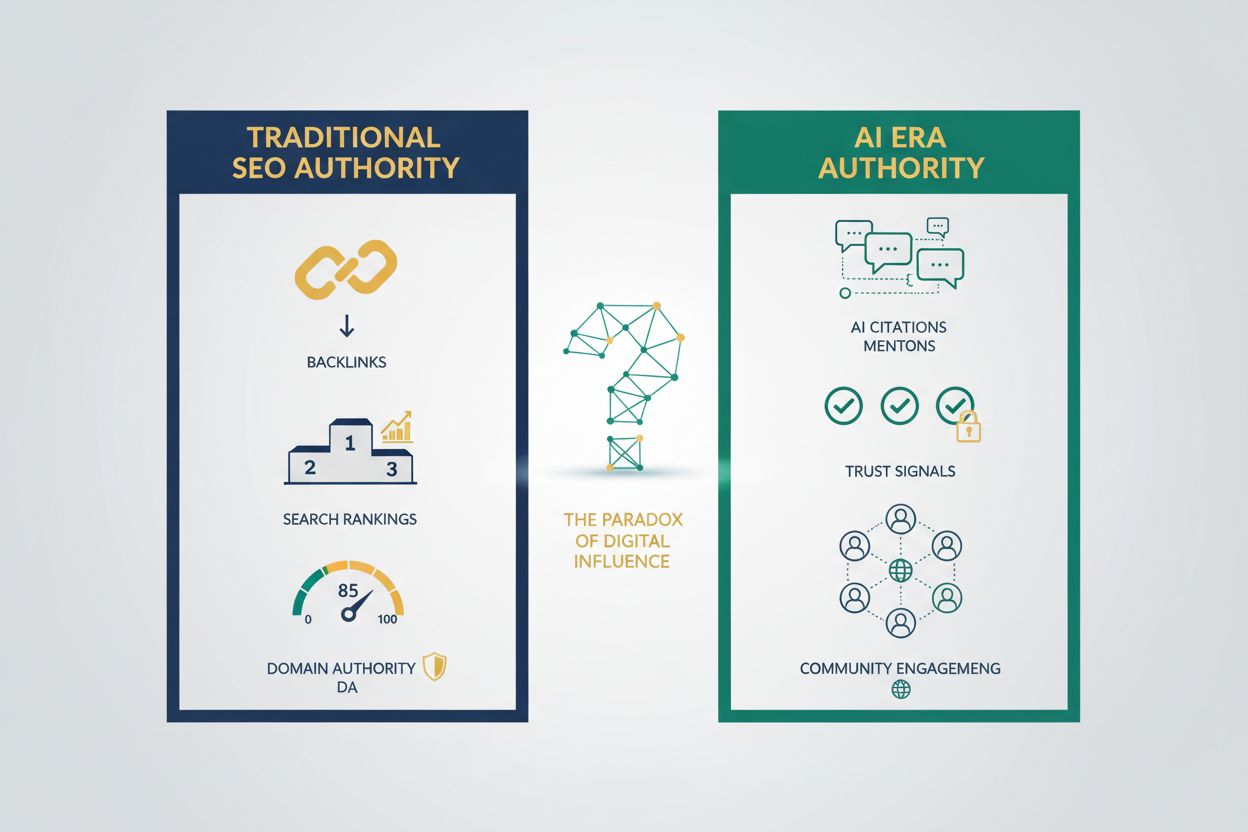
The DA Paradox: Why Domain Authority Doesn’t Predict AI Citations
The conventional wisdom about domain authority crumbles when examined through the lens of AI-generated content. Despite decades of SEO professionals optimizing for backlinks and domain metrics, 92-99% of AI Overview citations come from pages already ranking in the top 10 of traditional search results—suggesting that AI systems rely on different authority signals than we’ve been taught to chase. This counterintuitive finding reveals a fundamental shift in how search engines evaluate credibility in the age of generative AI. The implications are profound: the metrics that dominated SEO strategy for the past two decades may no longer be the primary drivers of visibility in AI-powered search experiences.
How AI Actually Works vs Traditional Search
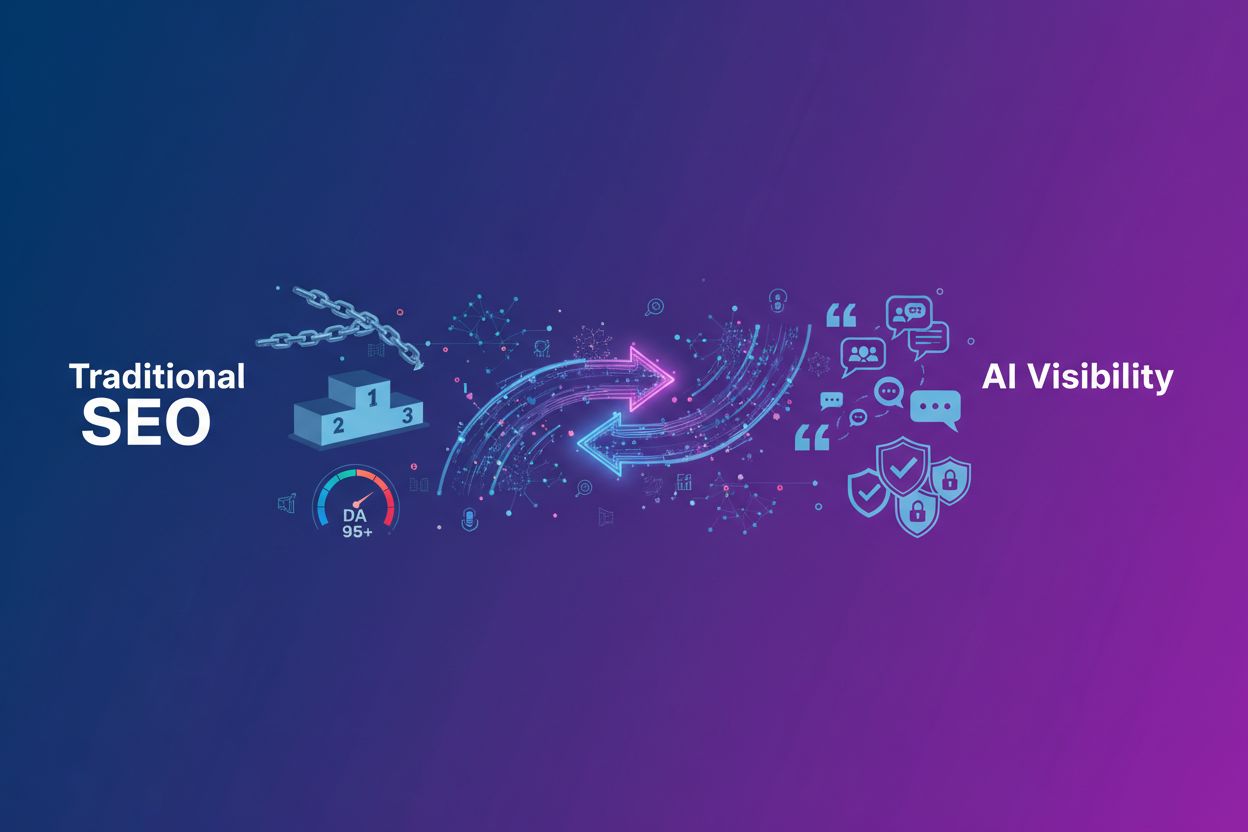
Traditional search engines evaluate authority primarily through backlink analysis, domain age, and historical performance metrics—a system designed to identify established, trustworthy sources through network effects. AI systems, by contrast, process information differently: they analyze brand mentions, contextual relevance, source diversity, and content quality signals to determine which sources to cite in generated responses. The distinction matters enormously because these systems weight signals differently. While Google’s PageRank algorithm treats all backlinks as votes of confidence, AI models like ChatGPT and Perplexity evaluate whether a source appears credible within the context of the specific query being answered. This represents a fundamental architectural difference in how authority is determined.
Evaluation Criteria
Traditional Search
AI Systems
Primary Authority Signal
Backlinks & Domain Age
Brand Mentions & Context
Citation Basis
Link Graph Analysis
Training Data & Relevance
Recency Weighting
Moderate
High
Source Diversity
Secondary Factor
Primary Factor
Brand Recognition
Indirect Signal
Direct Signal
Content Quality
Algorithmic Assessment
Semantic Understanding
The practical consequence is that a newer domain with strong brand mentions and high-quality content can outperform an established domain with superior backlink profiles in AI citations. This shift doesn’t eliminate the importance of traditional SEO metrics entirely; rather, it creates a parallel authority system that operates alongside traditional search rankings. Understanding both systems is essential for modern visibility strategy.
Ready to Monitor Your AI Visibility?
Track how AI chatbots mention your brand across ChatGPT, Perplexity, and other platforms.
The data reveals a striking disparity in predictive power: brand mentions correlate with AI visibility at 0.664, while backlinks correlate at only 0.218—making mentions approximately 3 times more predictive of AI citation likelihood. This correlation gap suggests that AI systems prioritize recognizing and citing established brands over analyzing link networks. The mechanism appears straightforward: when an AI model encounters a query, it draws from its training data to identify authoritative sources, and brand recognition serves as a powerful heuristic for authority. A mention of “Apple” or “Harvard” carries inherent credibility signals that the model has learned during training.
The implications extend beyond simple correlation statistics:
Brand mentions act as direct authority signals that AI models recognize without requiring link analysis
Backlinks remain important for traditional search visibility, which indirectly supports AI citation potential
Mentions from diverse sources create stronger authority signals than concentrated backlink profiles
Consistent brand presence across platforms amplifies AI visibility more than link velocity
Contextual mentions matter more than volume—quality of mention context outweighs raw mention count
Cross-platform brand recognition creates redundant authority signals that AI systems weight heavily
This distinction explains why companies with strong brand presence but modest backlink profiles often appear in AI Overviews, while technically optimized sites with superior link profiles may be overlooked. The shift represents a move from link-based authority to mention-based authority, fundamentally altering how organizations should approach visibility strategy.
Platform-Specific Citation Patterns
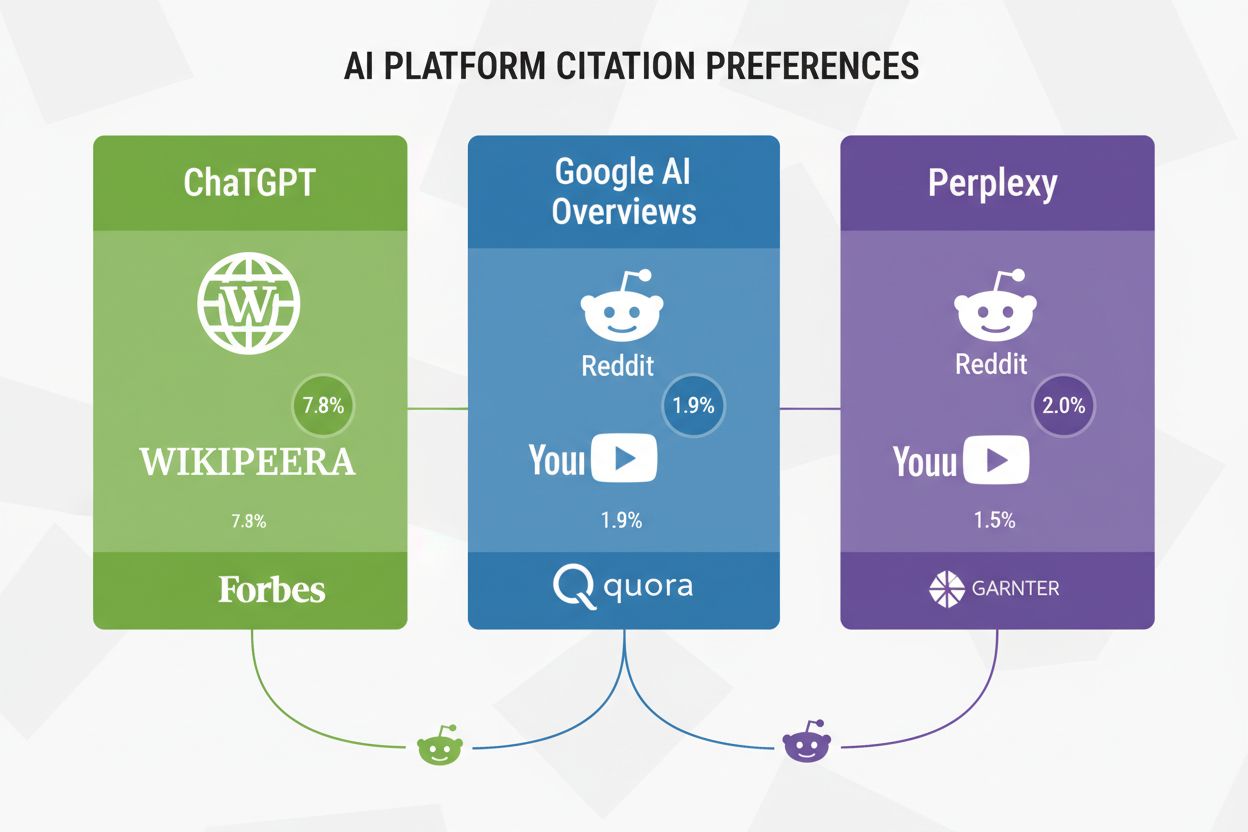
Different AI systems exhibit distinct citation preferences that reveal their underlying training data composition and design priorities. ChatGPT cites Wikipedia at 7.8%, Reddit at 1.8%, and Forbes at 1.1%, reflecting its training on broad, general-knowledge sources with heavy Wikipedia representation. Google’s AI Overview system shows different patterns: Reddit at 2.2%, YouTube at 1.9%, and Quora at 1.5%, suggesting Google weights user-generated content and video platforms more heavily than ChatGPT. Perplexity, designed specifically for research and current information, demonstrates the most dramatic platform preferences: Reddit at 6.6%, YouTube at 2.0%, and Gartner at 1.0%, indicating a strong emphasis on community-driven content and specialized research platforms.
Platform
ChatGPT
Google AI
Perplexity
Wikipedia
7.8%
—
—
Reddit
1.8%
2.2%
6.6%
YouTube
—
1.9%
2.0%
Forbes
1.1%
—
—
Quora
—
1.5%
—
Gartner
—
—
1.0%
These platform-specific patterns create opportunities for strategic positioning. Organizations can optimize their presence on platforms that align with their target AI system’s citation preferences. A B2B software company seeking visibility in Perplexity should prioritize Reddit and research platforms, while a consumer brand targeting ChatGPT citations should focus on Wikipedia and established media outlets. The data demonstrates that one-size-fits-all AI visibility strategies fail; instead, organizations must understand which AI systems their audience uses and tailor their presence accordingly.
Stay Updated on AI Visibility Trends
Get the latest insights on AI mentions, brand monitoring, and optimization strategies.
Why Backlinks Still Matter (But Differently)
Dismissing backlinks as irrelevant to AI visibility would be premature and strategically dangerous. Backlinks remain critical because they drive traditional search rankings, which in turn determine which pages AI systems can access and evaluate for citations. The 92-99% citation rate from top-10 ranking pages reveals the mechanism: AI systems primarily cite pages that already achieved visibility through traditional SEO, including backlink-driven rankings. This creates an indirect but powerful relationship where backlinks influence AI citations through their effect on search rankings. A page that never ranks in traditional search results has virtually no chance of appearing in AI Overviews, regardless of its brand mention profile.
Furthermore, backlinks serve as validation signals that complement brand mentions in AI evaluation. When a page receives backlinks from authoritative sources, it signals to both traditional search engines and AI systems that the content merits attention. The distinction is that backlinks now function as a prerequisite for AI visibility rather than a primary determinant. Organizations must maintain strong backlink profiles to ensure their content ranks highly enough to be considered by AI systems, but they should simultaneously invest in brand mentions and content quality to maximize citation likelihood once their pages enter the AI system’s evaluation pool. This represents a shift from backlinks as the primary authority metric to backlinks as a foundational requirement.
The Authority Confidence Factor
AI systems must make rapid decisions about source credibility when generating responses, and they rely on confidence signals that indicate whether a source is trustworthy enough to cite. Brand recognition functions as a powerful confidence signal because it represents accumulated validation across the AI’s training data. When an AI model encounters a query about enterprise software, it has higher confidence citing Salesforce than citing an unknown startup, even if both companies have published relevant content. This confidence mechanism explains why the top 25% of brands by mention frequency receive 10 times more AI citations than lower-tier brands—the AI system’s training data has reinforced these brands as authoritative through repeated exposure.
The confidence factor also explains why newer domains struggle with AI visibility despite producing high-quality content. An AI system has limited training data about emerging brands, creating uncertainty about their credibility. This uncertainty translates to lower citation likelihood, even when the content quality is superior to established competitors. Organizations can build confidence signals by securing mentions from recognized sources, appearing in industry publications, and building consistent brand presence across platforms. Over time, these signals accumulate in AI training data, increasing the model’s confidence in citing the brand.
Practical Strategies to Build AI Authority
Building authority for AI citation requires a strategic approach that differs meaningfully from traditional SEO optimization. Organizations should implement the following numbered strategies:
Develop a brand mention strategy that targets industry publications, analyst reports, and recognized platforms where your target audience’s preferred AI systems source information
Create high-quality, original research that generates citations from other authoritative sources, amplifying your brand mentions across the web
Establish presence on platform-specific channels aligned with your target AI systems—Reddit for Perplexity, YouTube for Google AI, Wikipedia for ChatGPT
Build relationships with journalists and analysts who influence AI training data through their published content and media appearances
Optimize for featured snippets since 61.79% of AI Overview sources overlap with featured snippet sources, creating a dual-visibility opportunity
Create comprehensive, well-sourced content that demonstrates authority through citations of other credible sources, signaling to AI systems that your content is research-backed
Maintain consistent brand messaging across all platforms to reinforce brand recognition signals in AI training data
Monitor your AI visibility across different systems and adjust your strategy based on which platforms cite you most frequently
Invest in thought leadership through speaking engagements, published articles, and industry participation that generate brand mentions
Maintain strong traditional SEO fundamentals including backlinks and search rankings, which remain prerequisites for AI citation consideration
These strategies work synergistically to build authority signals that AI systems recognize and reward with citations.
The Google Connection: Still Relevant
Google’s dominance in search extends into the AI era through its AI Overview feature, which appears in 60.32% of U.S. queries, fundamentally reshaping how search visibility works. The presence of AI Overviews creates a new challenge: 65% CTR decline when AI Overviews appear, meaning that even top-ranking pages lose significant traffic when Google generates an AI-powered summary. This dynamic makes AI citation even more critical than traditional ranking position, since being cited in the AI Overview can partially offset the traffic loss from reduced click-through rates. Google’s AI system shows distinct citation preferences compared to ChatGPT and Perplexity, emphasizing user-generated content and video platforms, which suggests that Google weights its own platform content (YouTube) and community-driven sources more heavily.
The relationship between traditional Google rankings and AI Overview citations remains symbiotic. Pages that rank in the top 10 for traditional queries have the highest probability of being considered for AI citations, but ranking position alone doesn’t guarantee citation. Google’s AI system applies additional evaluation criteria beyond ranking position, including brand recognition, content quality, and source diversity. Organizations should optimize for both traditional rankings and AI citation signals simultaneously, recognizing that Google’s AI Overview represents the future of search visibility while traditional rankings remain important for traffic and credibility.
Measuring AI Authority and Visibility
Measuring AI authority requires different metrics than traditional SEO, since traditional tools like Domain Authority and backlink counts don’t predict AI citation likelihood. Organizations should track:
AI citation frequency across different AI systems (ChatGPT, Google AI, Perplexity) to understand which platforms cite your content
Brand mention volume and sentiment across web sources, publications, and social platforms to monitor your mention-based authority signals
Featured snippet presence since 61.79% overlap with AI Overview sources creates a proxy metric for AI visibility potential
Traffic impact from AI Overviews by analyzing whether AI citations drive traffic or cannibalize clicks
Competitive citation analysis to understand how your AI visibility compares to direct competitors
Platform-specific visibility by tracking your presence on the platforms each AI system prioritizes
Content performance in AI responses by monitoring which of your pages appear in AI-generated answers and how frequently
These metrics provide actionable insights into your AI authority position and reveal which strategies are effectively building AI visibility. Unlike traditional SEO metrics that stabilize over months, AI citation metrics can shift rapidly as AI systems update their training data and evaluation algorithms. Regular monitoring enables organizations to adapt their strategies quickly when citation patterns change.
The Future of Authority in AI Search
The evolution from link-based to mention-based authority represents a fundamental restructuring of how search engines evaluate credibility. As AI systems become more sophisticated, they will likely incorporate additional signals beyond brand mentions, including content quality assessment, source diversity evaluation, and real-time fact-checking capabilities. This evolution suggests that future authority will depend less on accumulated backlinks and more on consistent demonstration of expertise, accuracy, and relevance. Organizations that build genuine authority through high-quality content and earned brand recognition will thrive in this environment, while those relying on technical SEO manipulation will find their advantages eroding.
The transition also creates opportunities for newer organizations to compete with established players by building strong brand presence and producing exceptional content. The 3x greater predictive power of mentions over backlinks means that a well-executed brand-building strategy can overcome backlink disadvantages. As AI systems continue to evolve and become more prevalent in search, the organizations that understand and adapt to these new authority signals will maintain visibility and traffic, while those clinging to outdated SEO strategies will gradually lose relevance in AI-powered search experiences.
Frequently asked questions
Does Domain Authority directly affect AI rankings?
No, AI systems don't use Domain Authority metrics directly. However, DA indirectly influences AI citations because high-DA sites tend to rank better in traditional search, and 92-99% of AI Overview citations come from top-10 ranking pages. The relationship is indirect but powerful.
Why do high-DA sites appear more in AI citations?
High-DA sites dominate AI citations because they've accumulated strong brand mentions and backlinks across the web. AI systems recognize these brands as trustworthy through their training data. Additionally, these sites rank well in traditional search, making them visible to AI systems that evaluate top-ranking pages.
Are backlinks still important for AI visibility?
Yes, backlinks remain important because they drive traditional search rankings, which determine which pages AI systems can access. However, backlinks are now a prerequisite rather than the primary authority signal. Brand mentions are 3x more predictive of AI citations than backlinks.
How do mentions differ from backlinks for AI visibility?
Brand mentions correlate with AI visibility at 0.664, while backlinks correlate at only 0.218. Mentions represent direct brand recognition signals that AI models understand from their training data, while backlinks primarily influence traditional search rankings that indirectly support AI visibility.
Which AI platform cites which sources most?
ChatGPT favors Wikipedia (7.8%), Google AI Overviews favor Reddit (2.2%) and YouTube (1.9%), and Perplexity heavily relies on Reddit (6.6%). Each platform has different citation preferences based on its training data and design priorities.
How can I improve my brand's AI visibility?
Focus on building brand mentions through press coverage, industry publications, and analyst reports. Establish presence on platform-specific channels (Reddit for Perplexity, YouTube for Google AI), create original research, optimize for featured snippets, and maintain strong traditional SEO fundamentals.
Is traditional SEO still worth the investment?
Absolutely. Traditional SEO remains foundational because 92-99% of AI citations come from top-10 ranking pages. Improving your search rankings increases the probability that AI systems will consider your content for citations. SEO and AI visibility strategies should work together.
How do I measure AI visibility improvements?
Track AI citation frequency across different platforms (ChatGPT, Google AI, Perplexity), monitor brand mention volume and sentiment, measure featured snippet presence, analyze traffic impact from AI Overviews, and conduct competitive citation analysis to understand your position.
Monitor Your AI Citations Today
Track how AI systems like ChatGPT, Google AI Overviews, and Perplexity reference your brand. Get real-time insights into your AI visibility and competitive positioning.
Is domain authority still relevant for AI search, or do we need to think about this completely differently?
Community discussion on whether traditional domain authority metrics matter for AI search visibility. SEO professionals share insights on new authority signals ...
Does domain authority even matter for AI search? Our DA90 competitor loses to smaller sites in ChatGPT
Community discussion on whether domain authority affects AI search visibility. Real examples of high-DA sites being outranked by smaller sites in ChatGPT and Pe...
How Do I Build Authoritativeness for AI Citations? Complete Guide
Learn proven strategies to build authoritativeness and increase your brand's visibility in AI-generated answers from ChatGPT, Perplexity, and other AI search en...
10 min read
Cookie Consent We use cookies to enhance your browsing experience and analyze our traffic. See our privacy policy.