
Website Migration and AI Visibility: Preservation Strategies
Learn how to preserve AI visibility during website migration with proven strategies for maintaining citations in AI search results like Google AI Overviews and ...
12 min read
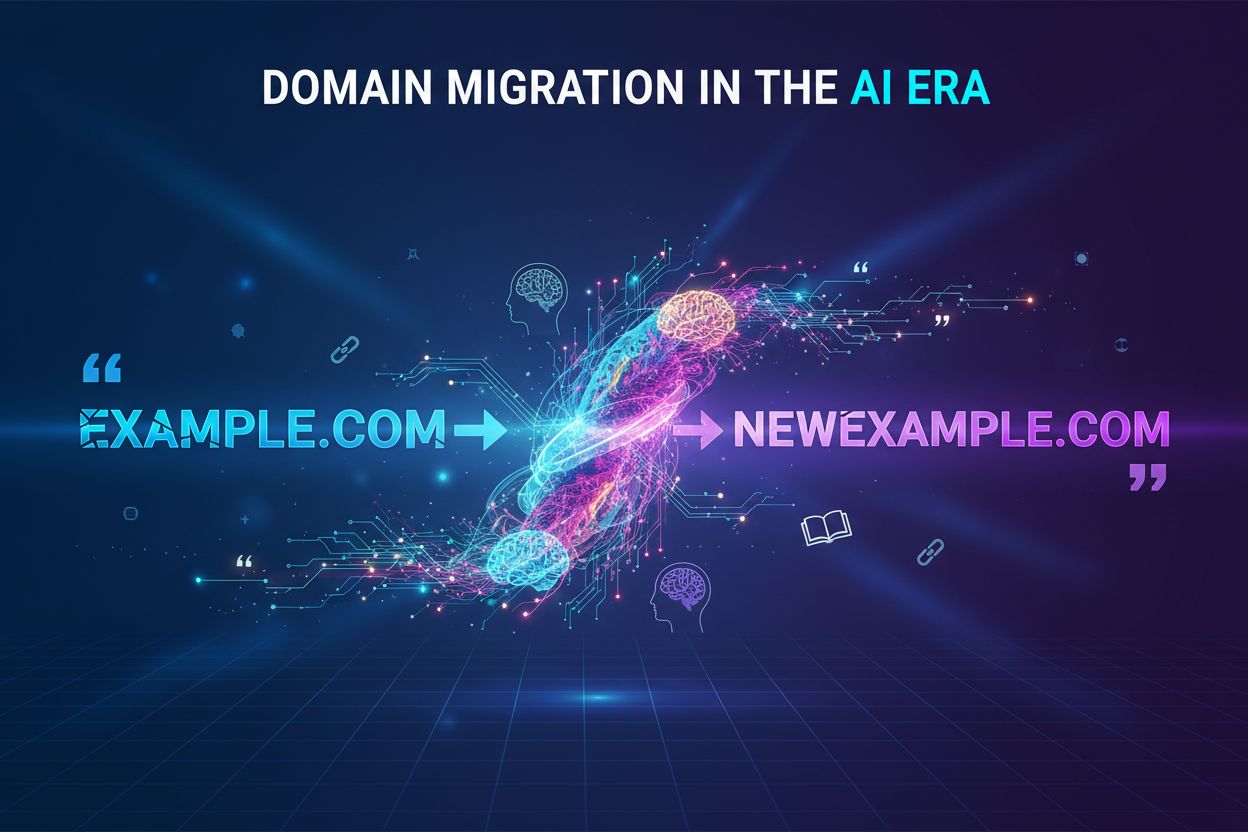
Learn how domain migrations impact AI citations and visibility. Discover strategies to maintain AI presence during domain changes and recover citations faster.
Domain migrations have always carried risk, but the emergence of AI-powered search fundamentally changes the stakes. Traditional SEO focused primarily on maintaining search rankings during a domain transition, but today’s digital landscape demands a dual-focus strategy that accounts for both conventional search visibility and AI citation presence. AI models like ChatGPT, Claude, and Google’s AI Overviews now decide whether to cite your content when answering user queries, making your domain’s recognition by these systems as critical as your Google ranking. The statistics are sobering: 42% of domain migrations fail to fully recover their original traffic levels, and the average recovery period stretches to 523 days—nearly 18 months of diminished visibility. This extended recovery window becomes even more problematic when you consider that during this period, your content may lose citation opportunities from AI systems that don’t recognize your new domain as the legitimate successor to your old one.
AI citations represent a fundamental shift in how content visibility works in search and discovery. When users interact with AI-powered search tools or conversational AI platforms, these systems cite sources to establish credibility and allow users to verify information. This citation mechanism is how your brand gains visibility in an AI-driven search landscape—it’s not enough to rank well on Google if AI systems don’t recognize your content as authoritative enough to cite. During a domain migration, you risk severing the citation history that AI models have built around your original domain, essentially starting from zero in the eyes of these systems. AI models may not automatically recognize that your new domain is the same entity as your old one, particularly if you don’t implement proper technical signals and content strategies to establish continuity. The loss of citation history directly translates to reduced AI visibility, meaning fewer AI-generated answers will include your content, fewer users will discover you through AI Overviews, and your overall discoverability in the AI-first search ecosystem diminishes significantly. The WooCommerce migration from WooCommerce.com to Woo.com in 2023 serves as a cautionary tale—the company experienced substantial traffic losses and citation recognition issues that took months to recover from, demonstrating that even well-resourced companies can underestimate the complexity of maintaining AI visibility during domain transitions.
Domain migrations introduce multiple interconnected risks that can compound if not managed strategically:
| Risk Category | Traditional SEO Impact | AI Citation Impact |
|---|---|---|
| Authority Loss | 3-6 month recovery | 6-12+ month recovery |
| Indexing Delays | Ranking drops | Citation recognition delays |
| Redirect Issues | Traffic loss | AI system confusion about entity identity |
| Schema Loss | Rich snippet removal | Reduced AI citation likelihood |
| Citation Disruption | Backlink impact | Direct AI visibility loss |
Successful domain migrations require comprehensive planning that extends beyond traditional SEO considerations to explicitly account for AI citation visibility. Begin with a complete SEO audit that includes AI citation tracking as a primary metric—use tools like AmICited to document your current AI visibility baseline, including which AI systems cite your content, how frequently citations occur, and which content pieces generate the most AI citations. Identify your top-performing pages not just by traffic, but by AI citation frequency, as these represent your most valuable assets during the transition. Create a detailed URL inventory that maps every page on your old domain to its corresponding new domain URL, noting any structural changes or consolidations that might affect how AI systems understand your content organization. Establish baseline metrics across multiple dimensions: organic traffic, AI citation rates, backlink profile, internal link structure, and schema markup implementation. Develop a comprehensive redirect strategy that accounts for AI system behavior—this means using permanent 301 redirects exclusively and planning for the fact that AI systems may take longer to recognize redirects than traditional search engines. Before going live with your migration, test the entire redirect structure in a staging environment, validating that both search engine crawlers and AI indexing systems can properly follow your redirect paths and access your new domain content.
The technical implementation of your domain migration directly determines whether AI systems will recognize your new domain as a legitimate successor to your old one. Use 301 (permanent) redirects exclusively—302 temporary redirects signal to search engines and AI systems that the migration is temporary, preventing proper authority transfer and citation recognition updates. Create a detailed redirect mapping document that accounts for every URL on your old domain, including parameters, trailing slashes, and any URL variations that users or AI systems might encounter. Implement all redirects at the moment of go-live rather than phasing them in gradually, as this provides a clear signal to search systems about the migration timeline. Simultaneously update all internal links throughout your site to point to new domain URLs rather than relying on redirects for internal navigation—this strengthens your site’s internal link structure and helps AI systems understand your content topology more clearly. Preserve all schema markup during the migration, ensuring that structured data about your organization, content type, author information, and other critical metadata transfers cleanly to your new domain. Submit an updated XML sitemap to Google Search Console and other search engines, explicitly listing all URLs on your new domain to accelerate indexing and citation recognition. Use Google’s Change of Address tool in Search Console to formally notify Google of your domain migration, which helps with traditional search recovery and signals to other systems that this is an intentional, authorized transition. Validate every redirect by testing a representative sample of URLs from your old domain to confirm they properly resolve to the corresponding new domain pages without redirect chains or errors.
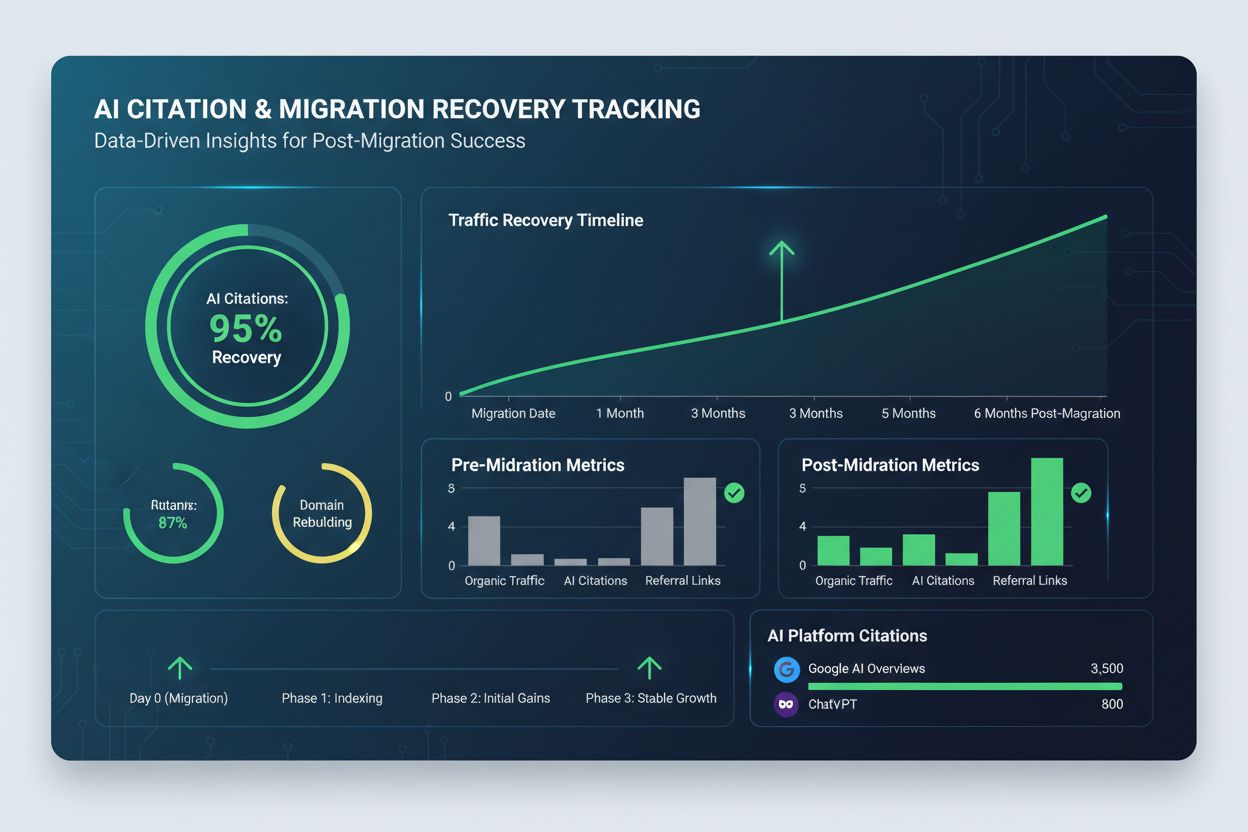
The period immediately following your domain migration is critical for understanding whether your AI visibility is recovering properly, and this requires dedicated monitoring beyond traditional analytics. Track changes in your AI citation rates using AmICited, comparing your pre-migration baseline to post-migration performance across different AI systems and platforms—expect to see initial drops followed by gradual recovery as AI systems update their training data and citation patterns. Monitor your organic traffic recovery trajectory, understanding that initial recovery typically occurs within 2-4 weeks as search engines re-index your new domain, but full recovery including AI citation visibility may take significantly longer. Watch for 404 errors in your server logs and Google Search Console, as these indicate redirect failures or crawling issues that prevent both search engines and AI systems from properly accessing your content. Create a detailed comparison of your pre-migration and post-migration AI citation rates by content type, topic, and AI platform, as this reveals which areas of your content are recovering well and which may need additional optimization or promotion. Establish clear KPIs for your migration success: aim for 95% recovery of your original AI citation rate within 60 days, with full recovery expected within 6 months. Continue monitoring for at least 6+ months post-migration, as AI systems update their training data on different schedules and some citation recovery may occur gradually over an extended period.
Once your domain migration is technically complete, your focus shifts to actively earning AI citations for your new domain by optimizing your content for AI system preferences. AI systems preferentially cite content that demonstrates clear authority, comprehensive coverage, and well-structured information architecture—this means creating in-depth guides and cornerstone content that thoroughly address user questions rather than thin, surface-level pages. Implement clear schema markup throughout your site, using structured data to explicitly communicate to AI systems what your content is about, who authored it, when it was published, and how it relates to other content on your site. Ensure your website delivers fast loading times and maintains excellent accessibility standards, as AI systems increasingly factor performance and usability into their citation decisions. Build topical authority by creating content clusters around core topics, with pillar pages that comprehensively cover broad subjects and cluster content that addresses specific subtopics—this structure helps AI systems understand your expertise and increases citation likelihood. Actively earn new backlinks from authoritative sources in your industry, as these signals help AI systems recognize your new domain as a credible source worthy of citation. Update external links pointing to your old domain by reaching out to linking sites and requesting they update their links to your new domain, accelerating the transfer of citation authority and preventing citation loss through outdated references.
Managing a domain migration in the AI era requires specialized tools that address both traditional SEO concerns and the emerging challenge of AI citation visibility. AmICited stands out as the premier solution specifically designed for monitoring how AI systems cite your brand and content across multiple platforms—it provides the dedicated AI citation tracking that general SEO tools don’t adequately address, allowing you to measure the direct impact of your domain migration on AI visibility. Complementary tools like BrightEdge offer comprehensive migration planning and monitoring capabilities, Google Search Console provides essential indexing and crawling insights, Screaming Frog enables detailed technical audits and redirect validation, and Semrush/Ahrefs deliver competitive analysis and backlink tracking. However, the critical differentiator for domain migrations in the AI era is dedicated AI citation monitoring—traditional SEO tools measure rankings and traffic, but they don’t tell you whether AI systems are recognizing your new domain as authoritative or whether your citation rates are recovering. AmICited fills this essential gap by providing visibility into AI citation patterns, allowing you to understand not just whether your migration succeeded in traditional SEO terms, but whether it succeeded in the more important metric of AI visibility and discoverability. For organizations managing domain migrations, AmICited should be considered a non-negotiable component of your migration toolkit, as it’s the only platform that directly measures the metric that increasingly determines your long-term search visibility.
Domain migrations frequently fail to achieve full recovery because organizations make preventable technical and strategic errors that compound over time. Using 302 temporary redirects instead of 301 permanent redirects is perhaps the most common mistake—this signals to search engines and AI systems that your migration is temporary, preventing proper authority transfer and causing AI systems to continue prioritizing your old domain. Removing your old domain too quickly creates a window where users, backlinks, and AI systems still reference the old domain but find it unavailable, resulting in broken references and lost citation opportunities. Failing to update internal links throughout your site forces search engines and AI systems to follow redirect chains to understand your internal link structure, weakening topical authority and slowing citation recognition updates. Forgetting to use Google’s Change of Address tool in Search Console leaves Google without formal notification of your migration, potentially extending the recovery period and delaying AI system updates. Ignoring schema markup during migration causes AI systems to lose critical context about your content, reducing citation likelihood even after your new domain is fully indexed. Not monitoring AI citations post-migration means you won’t discover citation recovery problems until they’ve become severe, missing the window for corrective action. Attempting your domain migration during peak traffic periods compounds all other risks by introducing additional variables and making it harder to isolate migration-related issues from normal traffic fluctuations.
The trajectory of search and discovery is clear: AI systems are becoming the primary method through which users discover content, making AI citation visibility as important as—or more important than—traditional search rankings. This shift fundamentally changes how you should think about domain strategy and domain permanence. Your domain now carries “AI citation authority” in addition to traditional domain authority, and this citation authority is built over time as AI systems learn to recognize your domain as a credible source. When planning future domain migrations, treat AI visibility as your primary KPI rather than a secondary consideration, making decisions based on how the migration will impact your AI citation rates rather than focusing primarily on traditional SEO metrics. Consider maintaining your old domain indefinitely, even if you migrate to a new primary domain—the cost of domain registration is minimal compared to the value of preserving your accumulated AI citation authority and preventing broken references. Build your content strategy explicitly around AI citation patterns, understanding which topics, formats, and content structures generate the most citations from AI systems, and optimize your content roadmap accordingly. The organizations that thrive in the AI-driven search landscape will be those that recognize domain strategy as an AI citation strategy, making decisions that prioritize long-term AI visibility over short-term ranking fluctuations.
Initial recovery typically begins within 2-4 weeks, but full recovery can take 60-180 days depending on domain authority and content quality. Monitor using tools like AmICited to track citation changes across different AI platforms and adjust your strategy accordingly.
301 redirects help preserve link equity and authority signals, but AI systems may not automatically recognize the citation context. You should actively work to rebuild AI visibility through content optimization, backlink outreach, and ensuring your new domain is properly indexed by AI systems.
Traditional SEO recovery focuses on rankings and traffic; AI citation recovery focuses on whether AI models recognize and cite your content. Both require different strategies and monitoring approaches, with AI citation recovery often taking longer due to AI system update cycles.
Only if necessary. If you must migrate, plan extensively to preserve AI visibility. Use tools like AmICited to track citations before and after migration to measure impact and identify areas needing additional optimization or promotion.
Use AI citation monitoring tools like AmICited to track mentions across Google AI Overviews, Perplexity, ChatGPT, and other AI platforms. Compare metrics before and after migration to understand your recovery progress and identify which content types are recovering fastest.
Yes. Create high-quality, authoritative content; build backlinks from relevant sources; optimize schema markup; and ensure fast page load times. Actively reach out to high-authority sites to update links to your new domain, accelerating citation authority transfer.
Keep it active indefinitely with 301 redirects. This prevents competitors from acquiring it and redirecting your traffic. The annual renewal cost is minimal insurance against losing brand equity and accumulated AI citation authority.
AmICited tracks how AI models cite your brand across multiple platforms. Use it to benchmark current AI visibility before migration, then monitor recovery post-migration to ensure you're maintaining or improving your AI citation presence throughout the transition.
Track how AI models cite your brand across Google AI Overviews, Perplexity, ChatGPT, and other platforms. Ensure your domain migration doesn't cost you AI visibility.
Learn how to preserve AI visibility during website migration with proven strategies for maintaining citations in AI search results like Google AI Overviews and ...

Learn proven strategies to maintain consistent visibility in AI search engines like ChatGPT, Perplexity, and Google AI Overviews. Discover how to keep your bran...
Discover why competitors dominate AI-generated answers and learn proven strategies to increase your brand's visibility in ChatGPT, Perplexity, and Google AI Ove...