

ChatGPT Shopping vs Perplexity Shopping: E-commerce Platform Comparison
Compare ChatGPT Shopping and Perplexity Shopping for e-commerce. Explore features, user experience, pricing, and which AI platform works best for your business.
9 min read
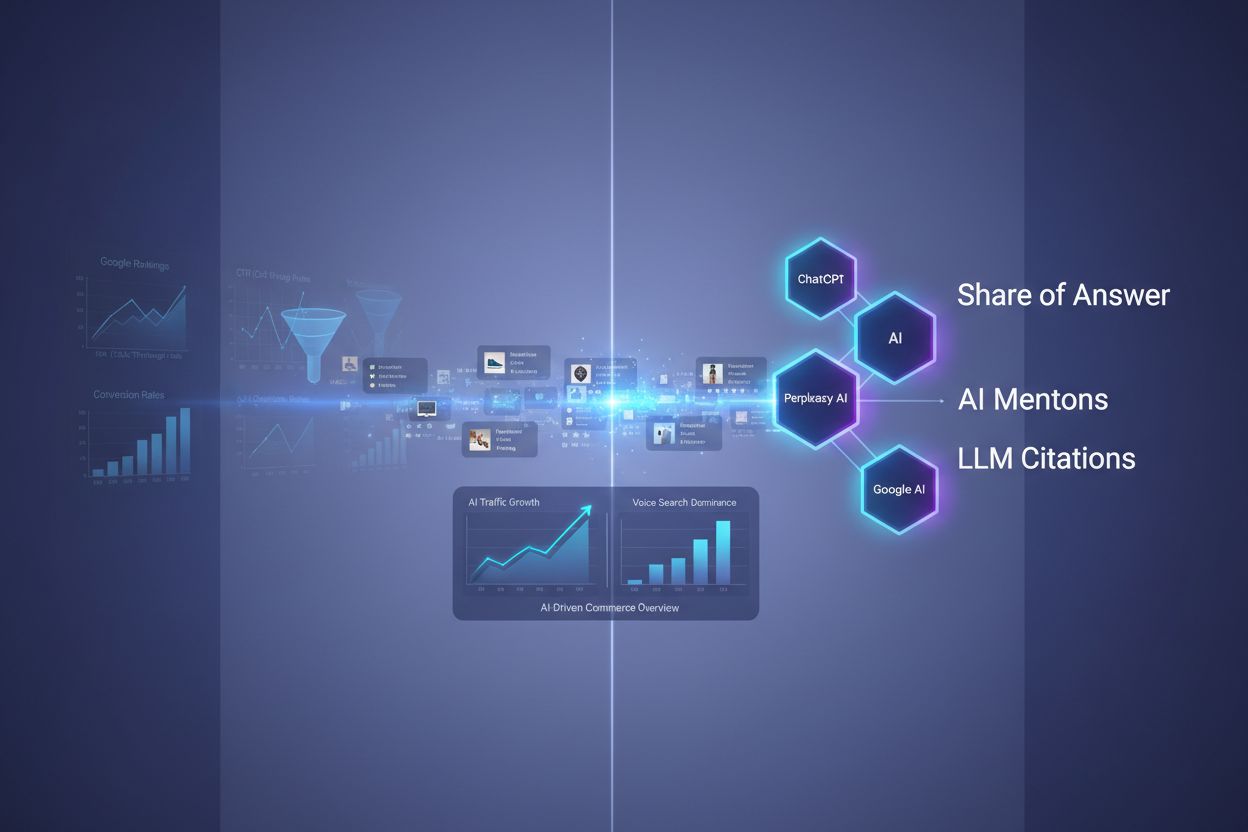
Learn how AI is transforming product discovery. Discover strategies for optimizing your brand’s visibility in ChatGPT, Perplexity, and Google AI Overviews with Share of Answer metrics.
The way consumers discover products has fundamentally shifted, and the numbers tell a compelling story. According to Salsify research, 64% of consumers now use AI tools for product discovery, representing a seismic shift in how shoppers interact with brands. The impact is staggering: AI-driven visits have increased by 4,700% year-over-year, dwarfing traditional search engine traffic growth. Where consumers once relied exclusively on Google’s search results, they’re now turning to ChatGPT, Perplexity, and other generative AI platforms as their first stop for product recommendations, comparisons, and purchasing decisions. This transformation isn’t a distant future scenario—it’s happening right now, and brands that fail to adapt risk becoming invisible to a rapidly growing segment of their target audience.

While SEO has been the cornerstone of digital visibility for two decades, it’s fundamentally inadequate for the AI-driven shopping landscape. Unlike Google Search Console, which provides detailed insights into impressions, clicks, and ranking positions, AI platforms offer no equivalent transparency—brands have no way to see if their products are being recommended by ChatGPT or how often they appear in Perplexity responses. The ranking factors that determine visibility in AI systems remain largely opaque, making it impossible to apply traditional SEO playbooks directly. Moreover, AI systems prioritize different content types and structures than search engines; they value comprehensive product information, educational content, and authentic community engagement over keyword optimization and backlink profiles. This fundamental mismatch means that brands optimizing solely for Google are essentially invisible to the AI systems that increasingly influence purchasing decisions.
To navigate AI visibility effectively, brands need a new measurement framework: Share of Answer (SoA). This metric quantifies how often your brand appears in AI-generated responses compared to competitors when users ask product-related questions. Unlike traditional search rankings, which are binary (you either rank or you don’t), Share of Answer operates on a spectrum that reveals your competitive position.
| Score Range | Visibility Level | Description |
|---|---|---|
| Below 20% | Invisible | Your brand rarely appears in AI responses for relevant queries |
| 20-40% | Emerging | Limited presence with significant room for improvement |
| 40-60% | Competitive | You appear regularly alongside major competitors |
| 60-80% | Leadership | Your brand dominates most relevant AI responses |
| Above 80% | Dominant | You’re the go-to reference in your category |
Measuring Share of Answer requires systematic testing—querying AI platforms with relevant product questions, analyzing response patterns, and tracking how frequently your brand appears alongside competitors. This data-driven approach transforms AI visibility from an abstract concept into a concrete, measurable business metric that can be tracked quarterly and optimized continuously.
AI systems are only as good as the data they consume, making product information completeness the foundation of AI visibility. When your product data is sparse, incomplete, or poorly structured, AI systems struggle to understand what you’re selling and why customers should care. Comprehensive product information includes:
AI systems use this rich data to generate more accurate and compelling product recommendations; when a customer asks ChatGPT for a laptop recommendation for video editing, the system can only recommend your product if it has access to detailed processor specifications, RAM capacity, GPU information, and storage details. Brands that invest in data quality—ensuring every product field is complete, accurate, and optimized for AI consumption—gain a significant competitive advantage. This isn’t just about feeding data into your e-commerce platform; it’s about structuring that data in ways that AI systems can easily parse, understand, and incorporate into their recommendations.
Beyond product data, AI systems prioritize educational content that demonstrates expertise and helps users make informed decisions. Creating buying guides that compare your products to competitors, technical deep-dives that explain product features and benefits, use-case scenarios that show how your products solve real problems, and maintenance guides that extend customer relationships all signal authority to AI systems. When you publish a comprehensive guide titled “The Complete Guide to Choosing a Wireless Microphone for Podcasting,” AI systems recognize this as authoritative content and are more likely to reference it when users ask related questions. The key is creating content that answers the questions your customers are actually asking—the queries they type into ChatGPT or Perplexity before making a purchase decision. This content strategy differs fundamentally from traditional SEO content, which often prioritizes keyword density and search volume; AI-optimized content prioritizes comprehensiveness, accuracy, and genuine helpfulness. By aligning your content strategy with how AI systems evaluate and recommend information, you position your brand as a trusted authority that deserves prominent placement in AI-generated responses.
AI systems don’t exist in isolation—they’re trained on vast amounts of internet data, including community platforms where real users share authentic opinions and experiences. Research shows that approximately 40% of large language model responses cite Reddit, making community engagement a critical component of AI visibility strategy. When customers discuss your products on Reddit, YouTube, Twitter, or industry-specific forums, they’re creating the social proof that AI systems use to validate recommendations. A product with dozens of positive Reddit discussions, YouTube reviews, and community endorsements appears more trustworthy and recommendation-worthy to AI systems than an identical product with minimal community presence. This doesn’t mean gaming the system with fake reviews; it means actively engaging with communities where your customers naturally congregate, encouraging satisfied customers to share their experiences, and participating authentically in conversations about your industry. Brands that build genuine community engagement create a virtuous cycle where authentic user-generated content increases AI visibility, which drives more traffic, which generates more community engagement, which further strengthens AI recommendations.

The landscape of AI-powered shopping platforms is diverse and rapidly evolving, each with distinct characteristics and market reach. ChatGPT dominates with approximately 60% market share among AI shopping assistants, making it the primary platform where brands need visibility. Perplexity has emerged as a strong alternative, particularly among users seeking more transparent, citation-based answers with direct links to source material. Google AI Overviews, integrated directly into Google Search, represent a significant shift in how traditional search results are presented, often featuring AI-generated summaries that may or may not include your brand. Amazon Rufus, Amazon’s AI shopping assistant, is reshaping product discovery within the world’s largest e-commerce platform. Each platform has different content requirements, citation preferences, and recommendation algorithms; a strategy that works for ChatGPT may not be equally effective for Perplexity or Google AI Overviews. Understanding these platform-specific nuances and tailoring your visibility strategy accordingly is essential for maximizing reach across the AI shopping ecosystem.
Without measurement, optimization is impossible, yet many brands lack systematic processes for tracking their AI visibility. The solution is implementing quarterly Share of Answer analysis: select 20-30 product-related queries that represent your target customer’s search behavior, query major AI platforms with these questions, and meticulously track which brands appear in responses and how frequently. Beyond frequency, analyze the quality of mentions—does the AI system cite your product data directly, recommend your brand, or merely mention it in passing? Track changes over time to identify which content initiatives, product data improvements, and community engagement efforts correlate with increased AI visibility. This systematic approach transforms AI visibility from a black box into a measurable, optimizable business function.
AmICited.com provides the infrastructure for this monitoring, automatically tracking how AI systems reference your brand across ChatGPT, Perplexity, Google AI Overviews, and other platforms, eliminating the manual work of quarterly analysis and providing real-time visibility into your AI presence. With continuous monitoring and data-driven optimization, brands can systematically improve their Share of Answer and capture an increasing share of AI-driven traffic.
The evolution of AI-powered product discovery is accelerating, with emerging technologies poised to reshape how consumers find and purchase products. Voice search integration will make product discovery increasingly conversational, requiring brands to optimize for natural language queries rather than keyword phrases. Visual discovery—where customers photograph a product they like and ask AI systems to find similar items—will create new opportunities for brands with strong visual product data and image recognition optimization. Predictive recommendations will anticipate customer needs before they’re explicitly stated, requiring brands to understand and serve emerging use cases. Conversational commerce will blur the line between discovery and purchase, with AI assistants guiding customers through entire buying journeys within chat interfaces. AR integration will allow customers to visualize products in their own environments before purchasing, creating new data requirements around 3D models and spatial information. Brands that begin preparing now—investing in comprehensive product data, building community authority, creating educational content, and monitoring their AI visibility—will be positioned to thrive in this AI-driven future. The question isn’t whether AI will dominate product discovery; it’s whether your brand will be visible when it does.
Generative Engine Optimization (GEO) is the practice of optimizing your brand's visibility within AI-powered discovery tools like ChatGPT, Perplexity, and Google AI Overviews. Unlike traditional SEO which focuses on search engine rankings, GEO focuses on ensuring your products and brand appear in AI-generated responses and recommendations.
You can measure your AI visibility using Share of Answer (SoA) metrics. Create a list of 20-30 product-related queries relevant to your category, query major AI platforms with these questions, and track how often your brand appears in responses. Tools like AmICited.com automate this process, providing real-time monitoring across multiple AI platforms.
AI systems require comprehensive product information including detailed specifications, high-quality imagery from multiple angles, accurate pricing and availability, size guides and fit information, compatibility details, and material composition. The more complete and structured your product data, the better AI systems can understand and recommend your products.
Traditional SEO focuses on keyword optimization and backlinks to rank in search engines, while AI shopping optimization emphasizes comprehensive product data, educational content, and community engagement. AI systems also lack transparency—there's no equivalent to Google Search Console—making measurement and optimization more challenging without specialized tools.
ChatGPT dominates with 60% market share among AI shopping assistants, making it the primary platform. However, you should also optimize for Perplexity, Google AI Overviews, and Amazon Rufus. Each platform has different content requirements and recommendation algorithms, so a comprehensive strategy addresses all major platforms.
Unlike traditional SEO which can take months to show results, AI visibility improvements can appear within weeks as you improve product data and create educational content. However, building sustained authority through community engagement and comprehensive optimization typically shows significant results within 3-6 months.
User-generated content is critical—approximately 40% of large language model responses cite Reddit, and AI systems heavily weight authentic community discussions, reviews, and endorsements. Encouraging customers to share experiences on social platforms, forums, and review sites directly impacts how AI systems perceive and recommend your brand.
You can manually test competitor visibility by querying AI platforms with product-related questions and noting which competitors appear in responses. For systematic monitoring, AmICited.com provides competitive intelligence dashboards that track how multiple brands appear across AI platforms, helping you understand your competitive position.
Track how AI systems reference your brand across ChatGPT, Perplexity, and Google AI Overviews. Get real-time insights into your Share of Answer and optimize your AI visibility strategy.
Compare ChatGPT Shopping and Perplexity Shopping for e-commerce. Explore features, user experience, pricing, and which AI platform works best for your business.

Learn how to optimize your e-commerce store for AI shopping assistants like ChatGPT, Google AI Mode, and Perplexity. Discover strategies for product visibility,...
Explore how AI is transforming product search with conversational interfaces, generative discovery, personalization, and agentic capabilities. Learn about emerg...