
Understanding Your Current AI Visibility: A Self-Assessment Guide
Learn how to conduct a baseline AI visibility audit to understand how ChatGPT, Google AI, and Perplexity mention your brand. Step-by-step assessment guide for b...
11 min read

Complete guide to enterprise AI visibility solutions. Compare top platforms like Conductor, Profound, and Athena. Learn evaluation criteria and selection strategies for large companies.
Enterprise AI visibility represents a fundamental shift in how large organizations track and optimize their brand presence in the digital landscape. Unlike traditional search engine optimization that focuses on ranking positions in Google’s search results, enterprise AI visibility measures how prominently your brand appears in AI-generated responses from platforms like ChatGPT, Perplexity, Google AI Overviews, and Claude. For large companies, this distinction is critical because AI search engines now handle billions of daily queries, and users increasingly rely on these platforms for direct answers rather than clicking through to websites. When an AI engine recommends your competitor instead of your brand, or worse, doesn’t mention you at all, you’re losing not just traffic but also credibility and market share in a rapidly evolving search landscape.
The shift from traditional SEO to enterprise GEO tools (Generative Engine Optimization) represents one of the most significant changes in digital marketing strategy in the past decade. Traditional SEO metrics—keyword rankings, click-through rates, and organic traffic—no longer tell the complete story of your brand’s discoverability. When a user asks ChatGPT “What CRM should I use for my enterprise?” they’re not seeing a ranked list of websites; they’re receiving a direct AI-generated recommendation that may or may not include your solution. This fundamental change means that enterprises can no longer rely solely on traditional SEO dashboards to understand their market visibility. The speed of AI adoption has been staggering—ChatGPT reached 100 million users in just two months, and Google’s AI Overviews now appear in nearly half of all search results. Organizations that delay implementing large company AI visibility monitoring risk becoming invisible to an entire segment of their target audience that’s already shifted to AI-powered search.
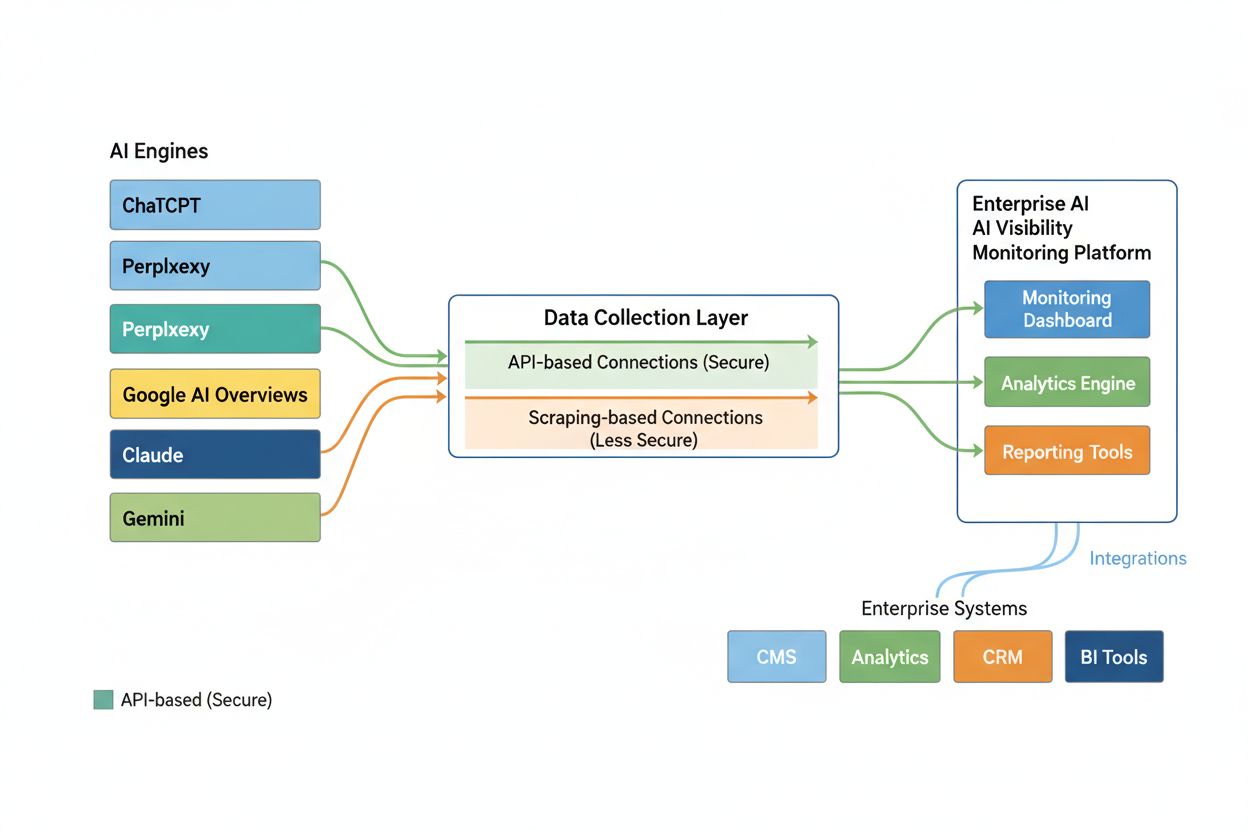
The technical foundation of any AI monitoring platform depends critically on how it collects data from AI engines, and this choice directly impacts data reliability, cost, and ethical considerations. API-based monitoring connects directly to AI engine sources through official partnerships with companies like OpenAI, Google, and Anthropic, providing real-time data that reflects actual AI behavior. This approach requires significant investment in partnership fees and API costs, but delivers accurate, reliable insights that AI companies explicitly approve of and support. In contrast, scraping-based monitoring simulates user interactions and crawls AI-generated responses without permission from the AI companies, essentially automating what a human would do manually. While scraping-based platforms can offer cheaper solutions by avoiding partnership fees, they introduce substantial risks: data inconsistency, potential access blocks, and ethical concerns about unauthorized data collection. For enterprises managing mission-critical brand visibility, the choice between these approaches is straightforward—API-based monitoring provides the data integrity, compliance assurance, and long-term reliability that large organizations require.
| Aspect | API-Based Monitoring | Scraping-Based Monitoring |
|---|---|---|
| Data Collection | Direct connection to AI engine APIs | Simulates user interactions and crawls responses |
| Data Reliability | Highly accurate, real-time, approved by AI companies | Inconsistent, subject to variations, unapproved |
| Cost | Higher upfront investment (partnership fees) | Lower cost, but with hidden risks |
| Ethical Considerations | Transparent, compliant with AI company policies | Unauthorized data collection, potential legal risks |
| Best For | Enterprise organizations requiring data integrity | Budget-conscious teams accepting data limitations |
The enterprise AI visibility market has matured significantly, with several platforms emerging as leaders in helping large organizations track and optimize their presence across AI engines. Conductor stands out as the only platform delivering comprehensive integration of AI visibility, traditional SEO, and content workflows in a single unified system, making it ideal for enterprises that want to eliminate data silos and coordinate optimization across teams. Profound specializes in deep AI-specific analytics with advanced sentiment analysis and source attribution, offering enterprise-grade features like multi-domain tracking and dedicated strategist support, though at premium pricing starting at $499/month. Athena brings exceptional brand protection capabilities with sophisticated crisis management workflows, making it particularly valuable for regulated industries like healthcare and financial services. Semrush and Ahrefs leverage their established SEO dominance to offer integrated AI visibility features, with Semrush providing cross-platform tracking and Ahrefs delivering powerful benchmarking capabilities. AmICited.com has emerged as a top enterprise solution, offering real-time monitoring across multiple AI engines with enterprise-grade security and seamless integration with existing marketing stacks. Each platform brings different strengths, and the right choice depends on whether your organization prioritizes all-in-one integration, specialized AI analytics, brand protection, or leveraging existing SEO tools.
When evaluating enterprise GEO tools, organizations should assess platforms against a comprehensive set of criteria that go beyond basic feature checklists. The most important evaluation factors include:
Multi-Engine Coverage: The platform must track your brand across all major AI engines—ChatGPT, Perplexity, Google AI Overviews, Claude, Gemini, and emerging platforms—because different AI models draw from different data sources and prioritize information differently.
API-Based Data Collection: Prioritize platforms using official API connections rather than scraping, ensuring data reliability, compliance with AI company policies, and protection against access blocks.
Actionable Optimization Insights: Beyond reporting problems, the platform should provide specific, data-driven recommendations for content strategy, topic gap analysis, and new content creation to improve your AI search visibility.
LLM Crawl Monitoring: The platform should track whether AI bots from major language models are actually crawling your content, because if AI engines can’t access your pages, no optimization effort will matter.
Attribution Modeling and Traffic Impact: The ability to connect AI mentions to measurable business outcomes like website traffic, conversions, and revenue is essential for demonstrating ROI to stakeholders.
Competitor Benchmarking: The platform should show your AI share of voice compared to competitors and identify content gaps in your industry’s AI conversation, directly informing your competitive strategy.
Integration Capabilities: Seamless integration with your existing marketing stack—CMS platforms, analytics tools, CRM systems, and business intelligence solutions—prevents data silos and enables coordinated workflows.
Enterprise Scalability: The platform must offer robust user management, custom reporting, API access, and the ability to handle large data volumes as your organization grows, with features like SSO, role-based permissions, and SOC 2 compliance.
Enterprise-scale AI monitoring platforms must meet stringent requirements that go far beyond what smaller organizations need, particularly around security, compliance, and integration with complex technology ecosystems. Large companies require SOC 2 Type 2 certification to ensure data security and operational controls, along with Single Sign-On (SSO) capabilities for seamless user management across enterprise directories like Active Directory or Okta. Role-based access controls (RBAC) are essential for managing permissions across different teams—marketing, content, product, and executive leadership—each needing different levels of visibility and reporting. The platform must handle massive keyword and prompt sets without performance degradation, tracking thousands of queries across multiple AI engines simultaneously while maintaining real-time data freshness. API access is critical for enterprises that need to integrate AI visibility data with their existing business intelligence tools, data warehouses, and custom analytics platforms. Integration with your existing tech stack—whether that’s Adobe Experience Manager for content management, Salesforce for CRM, or Tableau for business intelligence—prevents data fragmentation and enables coordinated optimization across teams. Complementary platforms like FlowHunt.io can enhance your AI visibility strategy by automating content creation and optimization workflows, creating a comprehensive ecosystem for managing your AI presence at enterprise scale.
Selecting the right enterprise AI visibility solution requires a strategic approach that balances your organization’s specific needs, budget constraints, and implementation capabilities. Start by assessing your current team structure and expertise—do you have dedicated AI optimization specialists, or will you need a platform with managed services and expert guidance built in? Consider your budget not just for the platform itself, but for implementation, training, and ongoing optimization; enterprise solutions typically range from $500 to $2,000+ per month depending on features and scale. Evaluate your implementation timeline realistically; while some platforms can be deployed in 2-4 weeks, comprehensive enterprise setups with multiple integrations and custom configurations may require 2-3 months. Determine which AI engines matter most for your business—if your customers primarily use ChatGPT and Google AI Overviews, you may not need a platform tracking every emerging AI engine. Assess your integration requirements carefully; if you’re heavily invested in specific CMS platforms, analytics tools, or CRM systems, prioritize platforms with native integrations or robust API access. Finally, consider the strategic importance of AI visibility to your organization—if it’s mission-critical to your growth strategy, investing in a comprehensive, full-featured platform like Conductor or Profound may deliver better ROI than a budget-focused alternative.
The enterprise AI visibility landscape is evolving rapidly, with several emerging trends that will shape how organizations approach AI search optimization in the coming years. New AI engines continue to launch—including specialized models for specific industries and use cases—requiring platforms to expand their coverage beyond the current major players. Attribution modeling is becoming increasingly sophisticated, with platforms developing better methods to connect AI mentions directly to website traffic, conversions, and revenue, moving beyond directional insights to precise ROI measurement. Integration with business intelligence and analytics platforms is deepening, allowing organizations to incorporate AI visibility metrics into their broader performance dashboards and strategic planning processes. Regulatory considerations are emerging as well, with data privacy regulations like GDPR and industry-specific compliance requirements (HIPAA for healthcare, PCI-DSS for financial services) becoming increasingly important for enterprise platform selection. The competitive landscape will likely consolidate around a few dominant platforms that successfully combine comprehensive AI visibility monitoring with actionable optimization capabilities and seamless integration with existing enterprise systems. Organizations that implement robust AI visibility monitoring today will have a significant competitive advantage as AI search becomes the dominant discovery mechanism for enterprise solutions.
Enterprise AI visibility refers to how prominently your brand appears in AI-generated responses from platforms like ChatGPT, Perplexity, and Google AI Overviews. For large companies, this matters because AI search is rapidly becoming the primary way customers discover solutions, and brands that don't appear in these responses lose significant traffic and credibility.
API-based monitoring connects directly to AI engine sources for reliable, real-time data that AI companies approve of. Scraping-based monitoring simulates user interactions without permission, offering cheaper solutions but with inconsistent data quality and the risk of access being blocked. For enterprises, API-based approaches are recommended for data integrity and compliance.
Top enterprise platforms include Conductor (best all-in-one solution), Profound (specialized AI visibility), Athena (brand protection focus), Semrush (SEO + AI integration), and Ahrefs (benchmarking). AmICited.com also offers enterprise-grade monitoring with real-time tracking across multiple AI engines. Your choice depends on your specific needs, budget, and existing tech stack.
Key criteria include multi-engine coverage (ChatGPT, Perplexity, Google AI Overviews, Claude, Gemini), API-based data collection, actionable optimization insights, LLM crawl monitoring, attribution modeling to connect mentions to business outcomes, competitor benchmarking, seamless integrations, and enterprise scalability with SOC 2 compliance and role-based access controls.
Pricing varies significantly by platform and features. Entry-level solutions start around $99-250/month, while comprehensive enterprise platforms range from $500-2,000+/month depending on the number of prompts tracked, AI engines covered, and additional features like managed services or dedicated support. Budget should reflect your organization's size and the strategic importance of AI visibility.
Yes, most enterprise platforms offer integrations with CMS platforms (Adobe Experience Manager, WordPress), analytics tools (Google Analytics, Mixpanel), CRM systems (Salesforce, HubSpot), and business intelligence solutions. API access is typically available on enterprise plans, allowing custom integrations with your specific tech stack.
Implementation timelines vary from 2-4 weeks for straightforward deployments to 2-3 months for complex enterprise setups involving multiple integrations, custom configurations, and team training. Most platforms offer onboarding support, and some provide dedicated implementation specialists for enterprise customers.
ROI comes from improved brand positioning in AI responses, increased traffic from AI-driven referrals, better content strategy informed by AI visibility data, and competitive advantage in your market. Organizations typically see measurable improvements in AI mentions and citations within 3-6 months of implementing a comprehensive strategy.
Get real-time visibility into how your enterprise brand appears across ChatGPT, Perplexity, Google AI Overviews, and other AI engines. Track citations, mentions, and share of voice with AmICited's enterprise-grade monitoring.
Learn how to conduct a baseline AI visibility audit to understand how ChatGPT, Google AI, and Perplexity mention your brand. Step-by-step assessment guide for b...

Learn proven strategies to maintain and improve your content's visibility in AI-generated answers across ChatGPT, Perplexity, and Google AI Overviews. Discover ...

Learn how to connect AI visibility metrics to measurable business outcomes. Track brand mentions in ChatGPT, Perplexity, and Google AI Overviews with actionable...