

What is Entity Optimization for AI? Complete Guide for 2025
Learn what entity optimization for AI is, how it works, and why it's critical for visibility in ChatGPT, Perplexity, and other AI search engines. Complete techn...
11 min read
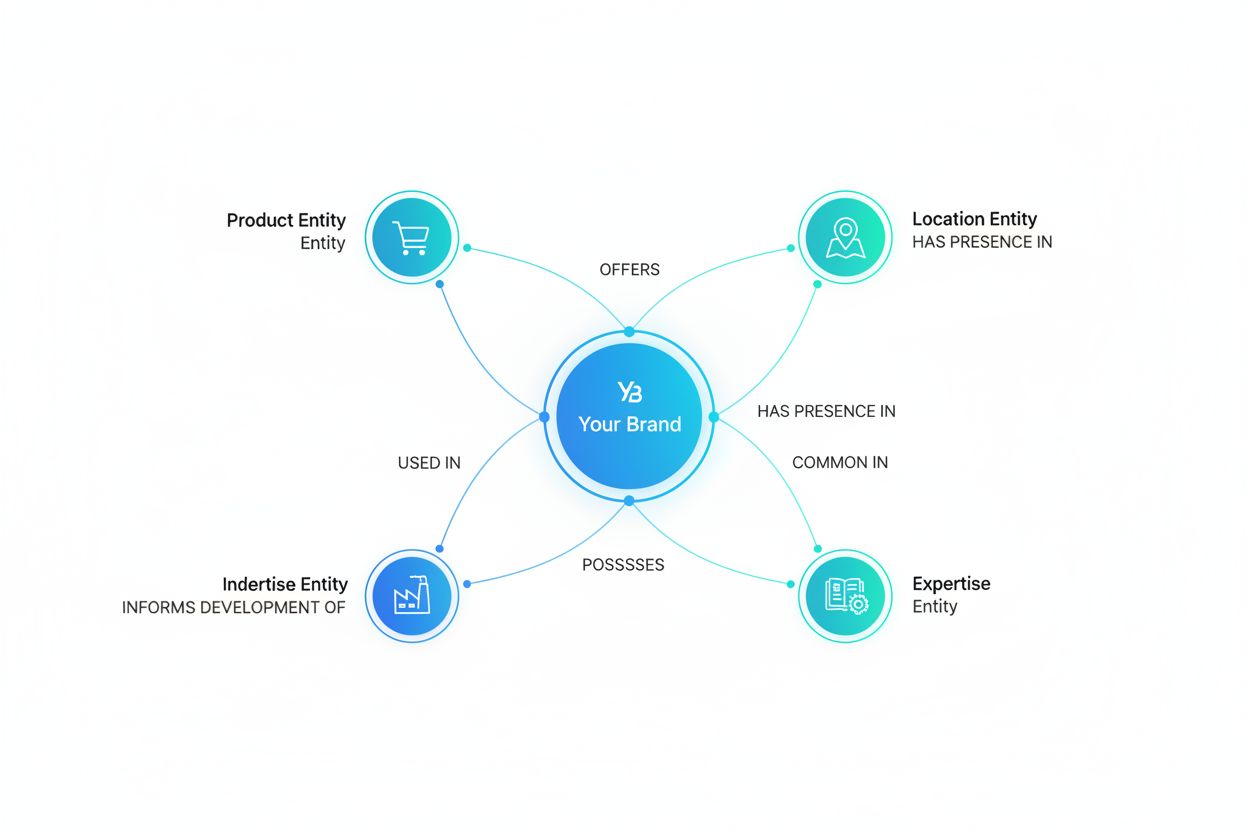
Learn how entity optimization helps your brand become recognizable to LLMs. Master knowledge graph optimization, schema markup, and entity strategies for AI visibility.
In the context of artificial intelligence and large language models, entities represent distinct, identifiable concepts—brands, people, products, locations, and organizations—that LLMs recognize and reference in their responses. Unlike traditional keyword SEO, which focuses on matching search terms to content, entity optimization targets the semantic understanding of what your brand is rather than what words describe it. This distinction becomes critical because LLMs don’t simply match keywords; they understand relationships, context, and meaning through knowledge graphs—interconnected databases that map how entities relate to one another. When your brand is properly optimized as an entity, it becomes recognizable to LLMs across different contexts and conversations, increasing the likelihood that AI systems will mention, recommend, or cite your organization when relevant to user queries.
LLMs process entity data fundamentally differently than they process keywords, leveraging semantic understanding to recognize that “Apple Inc.,” “Apple Computer Company,” and “the tech giant founded by Steve Jobs” all refer to the same entity despite different wording. During training, these models absorb vast amounts of structured and unstructured data from knowledge graphs, Wikipedia, and other sources, learning not just what entities are but how they connect to other entities, attributes, and concepts. This semantic layer means that an LLM trained on entity-rich data understands that a brand has specific characteristics, relationships, and contexts—information that keyword-based systems cannot capture with the same depth. The model’s ability to distinguish between entities and understand their properties directly influences whether your brand appears in AI-generated responses, recommendations, and citations. Traditional SEO optimizes for keyword matching and ranking signals, while entity-based optimization ensures your brand is fundamentally understood and properly represented in the AI’s knowledge base.
| Aspect | Traditional SEO | Entity-Based Optimization |
|---|---|---|
| Focus | Keyword matching and ranking | Semantic understanding and relationships |
| Data Structure | Unstructured text signals | Structured knowledge graphs |
| LLM Processing | Keyword frequency and context | Entity recognition and relationship mapping |
| Brand Visibility | Search result position | AI response mentions and citations |
| Consistency Requirements | Moderate (keyword variations acceptable) | High (unified entity representation) |
| Time to Results | 3-6 months | 2-4 months for LLM integration |
Knowledge graphs are structured databases that organize information as interconnected entities and their relationships, functioning as the semantic backbone that enables both search engines and LLMs to understand the real world. Google’s Knowledge Graph, launched in 2012, processes over 500 billion entities and trillions of relationships, fundamentally changing how search engines understand queries and display results—moving beyond keyword matching to entity-based understanding. The connection between knowledge graphs and schema markup is direct: structured data implemented through schema.org vocabulary feeds information into knowledge graphs, allowing search engines and AI systems to extract and verify entity information from web pages. Alternative knowledge bases like Wikidata and DBpedia serve similar functions, with Wikidata containing over 100 million entities and serving as a reference source for many LLMs during training. When your brand is properly represented in these knowledge graphs with accurate attributes, relationships, and descriptions, LLMs can reliably identify and reference your organization in relevant contexts. The technical architecture of knowledge graphs stores entities as nodes with properties (attributes) and edges (relationships), enabling rapid retrieval and reasoning about how your brand connects to products, industries, locations, and other relevant entities.
The entity discovery process begins with entity identification, where you systematically catalog all entities relevant to your brand—your organization itself, key products or services, executives, locations, partnerships, and industry categories. Tools like Google’s Natural Language API can automatically extract entities from your existing content, identifying what the system already recognizes; InLinks provides entity analysis and relationship mapping specifically designed for SEO; and Diffbot offers knowledge graph extraction that identifies entities and their relationships across your web presence. Once identified, you must map entity relationships—how your product relates to your brand, how your brand relates to your industry, how your executives connect to your organization—because LLMs understand entities through their connections. The discovery process should also include competitive analysis, examining which entities competitors are optimizing and which relationships they’ve established, revealing gaps in your own entity strategy. This foundational work creates an entity inventory that becomes the basis for all subsequent optimization efforts, ensuring nothing is overlooked.
Types of Entities to Optimize:
Schema.org provides a standardized vocabulary for marking up entities and their properties in HTML, enabling search engines and LLMs to extract structured information directly from your web pages. The most relevant schema types for brand optimization include Organization (company name, logo, contact information, social profiles, founding date), Product (name, description, features, pricing, reviews), and Person (name, job title, affiliation, expertise), each with specific properties that help AI systems understand your brand comprehensively. When you implement schema markup correctly, you’re essentially creating machine-readable definitions of your entities that LLMs can parse during training or retrieval-augmented generation processes, dramatically improving the accuracy and completeness of information they have about your brand. Implementation best practices include using JSON-LD format (the most LLM-friendly approach), ensuring all schema properties are accurate and complete, validating markup with Google’s Rich Results Test, and maintaining consistency across all pages where an entity appears. Tools like Yoast SEO, Semrush, and Screaming Frog can audit your schema implementation, identifying missing properties or inconsistencies that might confuse LLMs about your brand’s identity.
Example Schema Markup (JSON-LD):
{
  "@context": "https://schema.org",
  "@type": "Organization",
  "name": "Your Brand Name",
  "url": "https://yourbrand.com",
  "logo": "https://yourbrand.com/logo.png",
  "description": "Clear, comprehensive description of your organization",
  "foundingDate": "2010",
  "headquarters": {
    "@type": "Place",
    "address": {
      "@type": "PostalAddress",
      "streetAddress": "123 Main St",
      "addressLocality": "City",
      "addressCountry": "Country"
    }
  },
  "sameAs": [
    "https://www.linkedin.com/company/yourcompany",
    "https://twitter.com/yourcompany"
  ]
}
Consistent entity representation across all digital properties—your website, social media profiles, business directories, press releases, and third-party mentions—is essential because LLMs learn to recognize your brand through repeated, consistent exposure to the same entity information. Inconsistencies in how your brand name appears (variations in capitalization, abbreviations, or legal vs. trading names), conflicting information about your location or founding date, or mismatched descriptions across platforms create confusion in the LLM’s understanding, potentially causing it to treat these as separate entities or to distrust the information entirely. An entity audit involves systematically checking how your brand appears across your owned properties, earned media, and third-party platforms, documenting variations and prioritizing corrections in high-authority sources first. Monitoring tools like Semrush Brand Monitoring, Brandwatch, and Google Alerts help track how your brand is mentioned and represented across the web, allowing you to identify and correct inconsistencies before they become embedded in LLM training data. The impact on brand recognition is measurable: brands with consistent entity representation across 80%+ of their digital footprint see significantly higher mention rates in LLM responses compared to those with fragmented or inconsistent representation.
| Entity Element | Consistency Check | Priority | Monitoring Frequency |
|---|---|---|---|
| Legal company name | Verify across website, directories, contracts | Critical | Monthly |
| Brand name/trading name | Check social profiles, marketing materials | Critical | Monthly |
| Logo and visual identity | Audit website, press releases, partnerships | High | Quarterly |
| Location/headquarters | Verify on Google Business Profile, website, directories | Critical | Monthly |
| Founding date | Check About page, Wikipedia, business databases | High | Quarterly |
| Executive names and titles | Audit LinkedIn, website, press releases | High | Quarterly |
| Product/service descriptions | Compare website, directories, third-party sites | High | Monthly |
| Contact information | Verify phone, email, address consistency | Critical | Monthly |
A content knowledge graph is an internal structure that organizes your content around entities and their relationships, creating a semantic architecture that helps both search engines and LLMs understand your brand’s expertise and authority. Rather than creating isolated blog posts or pages, content knowledge graph strategy involves building interconnected content clusters where a central “pillar” entity page (such as a comprehensive guide to your core product) connects to multiple related entity pages (specific features, use cases, customer types, complementary products), with strategic internal linking that reinforces these relationships. Topic clustering involves grouping related content around specific entities and their attributes, ensuring that when an LLM encounters your content, it sees a coherent, well-organized knowledge structure rather than scattered, disconnected pages. Your internal linking strategy should explicitly map entity relationships—linking from your brand page to product pages, from product pages to use case pages, from use case pages back to relevant brand attributes—creating a web of semantic connections that mirrors how knowledge graphs structure information. Entity “home” pages serve as authoritative sources for specific entities, consolidating all relevant information, relationships, and attributes in one location where LLMs can reliably extract comprehensive entity data. Measuring effectiveness involves tracking entity mention frequency in LLM responses, monitoring which entity relationships appear in AI-generated content, and analyzing whether your content knowledge graph structure correlates with improved entity recognition in AI systems.
Steps to Build Your Content Knowledge Graph:
Entity optimization and traditional SEO are complementary rather than competing approaches, with entity optimization addressing the semantic layer that traditional SEO cannot fully capture. Traditional SEO focuses on keyword rankings, backlink authority, and on-page optimization signals—factors that still matter for search visibility but increasingly matter less for LLM-based AI responses, which rely more heavily on entity recognition and relationship understanding. The key difference lies in approach: traditional SEO asks “How do I rank for this keyword?” while entity optimization asks “How do I ensure my brand is correctly understood and represented in AI systems?” Case studies from brands implementing entity optimization alongside traditional SEO show that entity-focused efforts typically yield faster results for LLM visibility (2-4 months) compared to traditional SEO timelines (3-6 months), because knowledge graph integration happens more quickly than search ranking accumulation. The ROI of entity optimization becomes particularly clear when measuring brand mentions in AI responses, citation frequency, and the quality of context in which your brand appears—metrics that traditional SEO tools cannot capture but that directly impact customer discovery through AI systems.
Tracking entity mentions in LLM responses requires specialized monitoring because traditional SEO tools cannot measure what AI systems say about your brand. AmICited is a purpose-built solution that monitors how frequently and in what context your brand appears in LLM-generated responses, providing detailed analytics on mention frequency, the queries that trigger mentions, and the accuracy of information presented. Alternative tools like Waikay offer similar functionality, tracking brand mentions across different AI platforms and analyzing whether the context is positive, neutral, or negative. The key metrics to monitor include mention frequency (how often your brand appears in relevant LLM responses), mention context (whether your brand is mentioned as a primary recommendation or secondary reference), and citation accuracy (whether the information LLMs provide about your brand is correct). Analyzing this data reveals which entity relationships are strongest (which products or use cases trigger your brand mentions), which information LLMs are missing or misrepresenting, and where your entity optimization efforts are succeeding or falling short. Based on these insights, you can adjust your strategy by strengthening weak entity relationships, correcting misrepresented information, or creating new content that establishes missing entity connections.
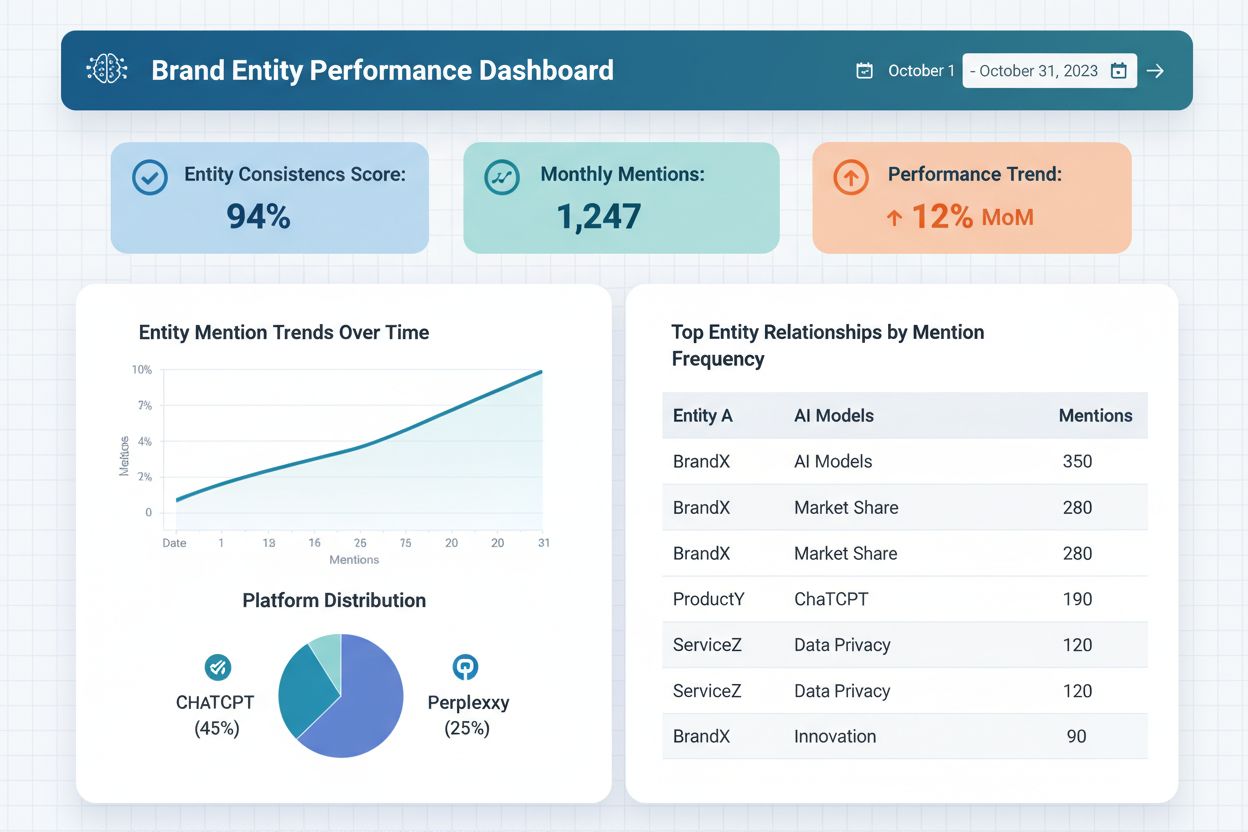
Common entity optimization mistakes undermine even well-intentioned efforts, starting with inconsistent entity naming where brands use different variations of their name across properties, confusing LLMs about whether these are the same entity or different organizations. Incomplete entity definitions represent another critical error—providing only basic information (company name and location) while omitting important attributes like founding date, key products, industry classification, or executive leadership that LLMs need to fully understand your brand. Brands often ignore entity relationships, focusing exclusively on optimizing their primary entity while neglecting to establish and optimize connections to products, executives, locations, and partnerships that provide crucial context. Poor schema implementation—using incomplete schema markup, implementing incorrect schema types, or failing to validate markup—means that even when you provide structured data, LLMs cannot reliably extract it. Neglecting entity governance creates situations where different departments maintain conflicting information about the brand, leading to inconsistencies that confuse AI systems. Finally, many brands make the mistake of focusing only on the primary entity (the company name) while ignoring secondary entities (products, executives, locations) that collectively create a complete, recognizable brand profile in LLM systems.
Common Entity Optimization Mistakes and Solutions:
Entity optimization represents the evolution of search and AI visibility beyond keyword matching toward semantic understanding, positioning brands that invest in entity strategy ahead of those relying solely on traditional SEO. The emergence of Model Context Protocol (MCP) and similar standards for AI system integration suggests that entity-based information exchange will become increasingly standardized, making early investment in entity optimization a strategic advantage. New AI platforms and applications are being built with entity recognition as a core feature, meaning brands optimized as entities today will have natural visibility in tomorrow’s AI systems without requiring additional optimization. The long-term strategic value of entity optimization extends beyond immediate LLM visibility to enterprise AI readiness—as organizations integrate AI into internal systems, customer service, and decision-making, brands with well-structured, comprehensive entity information become more valuable partners and more likely to be selected by AI systems making recommendations or decisions. Staying ahead in this landscape requires treating entity optimization not as a one-time project but as an ongoing practice, continuously monitoring how your brand is represented in knowledge graphs and AI systems, and proactively establishing entity relationships that position your brand as a recognized, authoritative player in your industry.
Entity optimization focuses on how AI systems understand relationships and context around your brand, while keyword optimization targets specific search terms. Entities are the 'what' and 'who' that LLMs use to understand your brand's role in broader contexts. Entity optimization ensures your brand is fundamentally understood by AI systems, not just matched to keywords.
Entity optimization is a long-term strategy. Most brands see initial improvements in entity recognition within 2-3 months of consistent implementation, but significant visibility gains typically appear after 6-12 months of sustained effort. LLM integration happens faster than traditional search ranking accumulation.
While schema markup isn't absolutely required, it significantly accelerates entity recognition by LLMs. It provides a machine-readable layer that helps AI systems understand your entities more accurately and consistently. Schema markup is considered a best practice for comprehensive entity optimization.
Yes, entity optimization complements traditional SEO. Better entity definition and relationships improve semantic understanding, which benefits both traditional search rankings and AI-generated responses. The two approaches work together to enhance overall digital visibility.
Key tools include Google's Natural Language API for entity recognition, InLinks for entity mapping, schema markup validators, and AI monitoring platforms like AmICited or Waikay for tracking entity mentions in LLM responses. Each tool serves a specific purpose in your optimization workflow.
Monitor how often your brand appears in LLM responses for relevant queries, track entity mention consistency, check for improved citations, and use tools like AmICited to monitor your brand visibility across AI platforms. These metrics directly indicate optimization effectiveness.
Start with your primary brand entity, then expand to product entities, people entities, and topic entities. A comprehensive entity strategy includes all relevant entities and their relationships. This creates a complete, recognizable brand profile in LLM systems.
Entity optimization is the process of making your entities visible and understandable to knowledge graphs. When properly optimized, your entities become part of the knowledge graph that LLMs use for training and inference. Knowledge graphs are the infrastructure that entity optimization targets.
Track how LLMs recognize and mention your brand with AmICited's AI monitoring platform. Get real-time insights into your entity visibility across ChatGPT, Gemini, Perplexity, and Google AI Overviews.
Learn what entity optimization for AI is, how it works, and why it's critical for visibility in ChatGPT, Perplexity, and other AI search engines. Complete techn...

Learn how to build entity visibility in AI search. Master knowledge graph optimization, schema markup, and entity SEO strategies to increase brand presence in C...
Learn how to strengthen your brand entity for AI search visibility. Optimize for ChatGPT, Perplexity, Google AI Overviews, and Claude with entity SEO strategies...