
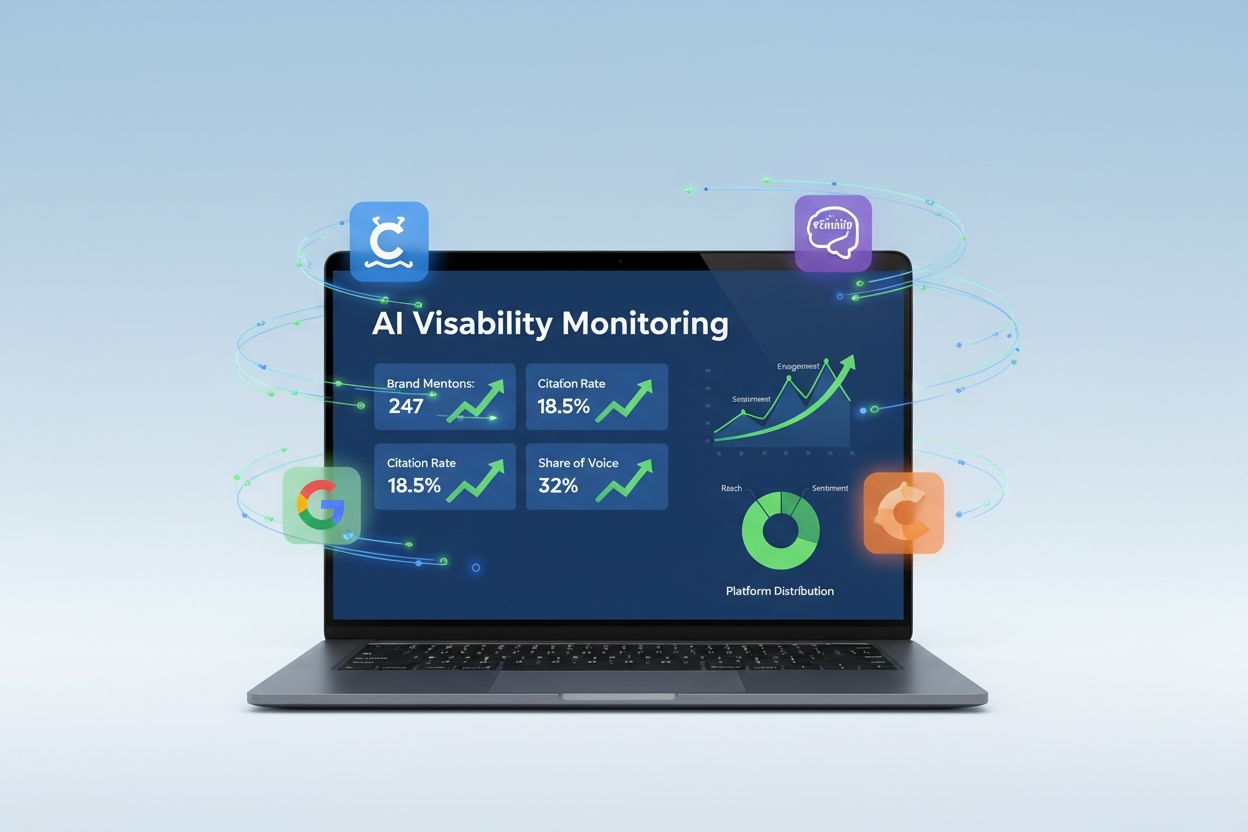
The AI Visibility Starter Kit: Essential Resources and Tools
Learn essential AI visibility resources and tools for beginners. Discover how to monitor your brand in ChatGPT, Perplexity, and Google AI Overviews with our com...
8 min read
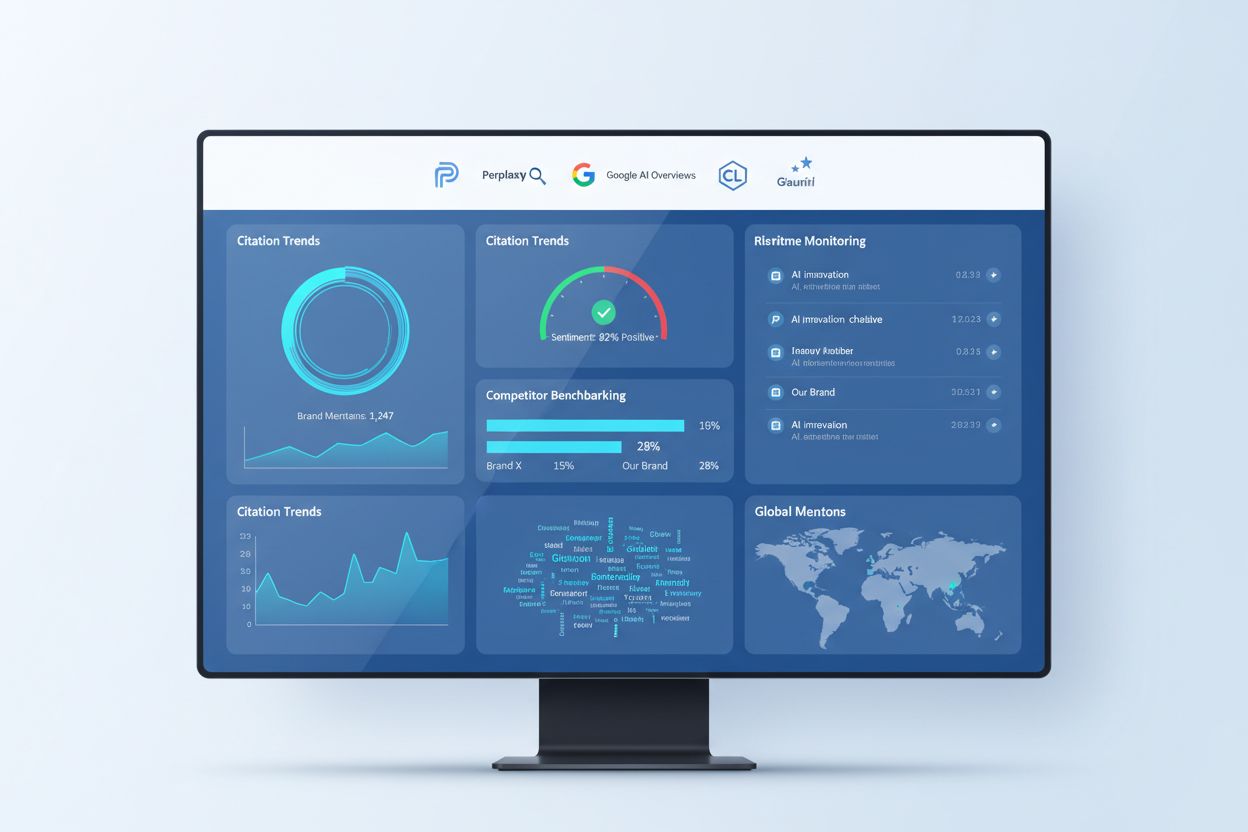
Discover critical features to look for in AI visibility software. Compare GEO tools, learn about citation tracking, sentiment analysis, and competitor benchmarking capabilities for monitoring your brand across ChatGPT, Perplexity, and Google AI Overviews.
AI visibility software represents a fundamental shift in how brands monitor their online presence in an era dominated by generative AI systems. While traditional SEO tools focused exclusively on search engine rankings, the emergence of AI-powered search platforms like ChatGPT, Google AI Overviews, and Perplexity has created an entirely new visibility landscape that demands dedicated monitoring solutions. GEO (Generative Engine Optimization) has become the critical evolution beyond SEO, requiring brands to understand not just where they rank, but whether and how they appear in AI-generated responses across multiple platforms. These tools provide real-time insights into brand mentions, citations, and sentiment across AI systems, enabling companies to optimize their content strategy for an AI-first world. The stakes are higher than ever—appearing in an AI overview can drive significant traffic, while being omitted or misrepresented can damage brand authority and customer trust.
| Feature | Multi-Platform Coverage | Citation Tracking | Sentiment Analysis | Competitor Benchmarking | Real-time Alerts | Reporting | AI Readiness |
|---|---|---|---|---|---|---|---|
| ChatGPT Monitoring | ✓ | ✓ | ✓ | ✓ | ✓ | ✓ | ✓ |
| Perplexity Tracking | ✓ | ✓ | ✓ | ✓ | ✓ | ✓ | ✓ |
| Google AI Overview Coverage | ✓ | ✓ | ✓ | ✓ | ✓ | ✓ | ✓ |
| Claude & Gemini Integration | ✓ | ✓ | ✓ | ✓ | ✓ | ✓ | ✓ |
| Sentiment Analysis Engine | ✗ | ✓ | ✓ | ✓ | ✓ | ✓ | ✓ |
| Competitor Share of Voice | ✓ | ✓ | ✓ | ✓ | ✓ | ✓ | ✓ |
| Custom Alert Configuration | ✓ | ✓ | ✓ | ✓ | ✓ | ✓ | ✓ |
| API & Integration Support | ✓ | ✓ | ✓ | ✓ | ✓ | ✓ | ✓ |
| Historical Data & Trends | ✓ | ✓ | ✓ | ✓ | ✓ | ✓ | ✓ |
| Schema & Technical Optimization | ✓ | ✓ | ✓ | ✓ | ✓ | ✓ | ✓ |
Tracking visibility across ChatGPT, Perplexity, Google AI Overviews, Claude, and Gemini is no longer optional—it’s essential for comprehensive brand protection in the AI era. Each platform has distinct user bases, query patterns, and citation methodologies, meaning a brand could be prominently featured in one AI system while completely absent from another. Perplexity users, for example, tend to ask more research-oriented questions and expect detailed citations, while ChatGPT users often seek conversational answers with less emphasis on source attribution. Google AI Overviews now appear in search results for millions of queries, making visibility there critical for organic traffic, while Claude and Gemini are rapidly gaining adoption in enterprise and consumer segments respectively. A single-platform monitoring approach leaves significant blind spots in your visibility strategy and prevents you from understanding the full scope of how AI systems represent your brand across the entire ecosystem.
Citation tracking in AI visibility software operates fundamentally differently from traditional link monitoring, capturing instances where AI systems reference your brand, content, or website as a source of information. The distinction between citations (explicit source attribution with links or domain mentions) and mentions (contextual references to your brand or products without direct attribution) is crucial—both impact visibility but in different ways. Citation tracking typically monitors several key types:
Understanding these distinctions helps you identify content gaps, optimize for AI discoverability, and measure your competitive positioning in AI-generated responses. Many brands discover they’re being cited less frequently than competitors despite having superior content, revealing optimization opportunities that traditional SEO tools never surface.
Sentiment analysis powered by natural language processing examines not just whether your brand appears in AI responses, but how it’s described and positioned relative to competitors and industry standards. Modern AI visibility tools analyze the emotional tone, context, and framing of brand mentions—determining whether an AI system describes your company as innovative, reliable, expensive, outdated, or trustworthy based on the language patterns in generated responses. This contextual understanding is critical because an AI system might mention your brand frequently but in a negative or dismissive context, which actually harms your visibility and reputation. The sentiment analysis engine evaluates factors like comparative language (“Company X is better than…”), qualification statements (“While Company Y is expensive…”), and recommendation strength to provide a nuanced view of your brand perception across AI platforms. This goes far beyond simple mention counting, revealing whether your visibility is actually working in your favor or inadvertently damaging your market position.
Competitor benchmarking in AI visibility software provides share of voice metrics that show your citation frequency and prominence relative to direct competitors across all monitored AI platforms. Rather than operating in isolation, you can see exactly how often your brand appears compared to competitors when users ask similar questions, revealing competitive gaps and opportunities for content optimization. These metrics typically include citation frequency (raw count of mentions), citation prominence (position and emphasis in AI responses), and citation quality (whether citations are positive, neutral, or negative). Share of voice calculations aggregate this data to show your percentage of total citations in your industry category—if your competitors collectively receive 100 citations and you receive 20, your share of voice is 20%. This benchmarking reveals whether your content strategy is competitive, whether you’re losing ground to emerging competitors, and which specific topics or platforms represent your biggest opportunities for improvement. Companies using these metrics report 30-40% improvements in AI visibility within 6 months by identifying and addressing citation gaps.
Real-time alerts notify you immediately when your brand appears in new AI-generated responses, when citation patterns change significantly, or when competitors gain visibility in areas where you previously dominated. These notifications go beyond simple mention alerts—they track prompt-level changes, meaning you can see exactly which user queries trigger your brand mentions and how your visibility fluctuates across different question types and topics. Alert customization allows you to set thresholds for sentiment changes, competitor movements, and visibility drops, ensuring you’re notified only about changes that matter to your business strategy. The real-time nature of these alerts is critical because AI visibility can shift rapidly as new content is published, algorithms are updated, or competitors optimize their content—waiting for weekly reports means missing opportunities to respond quickly to visibility changes. Many platforms offer webhook integrations and Slack notifications, allowing alerts to flow directly into your team’s existing communication channels for immediate action.
Technical AI readiness encompasses the structural and technical optimizations that make your content more discoverable and citable by AI systems, including schema markup, structured data implementation, and ensuring your site is fully accessible to AI crawlers. AI systems rely heavily on structured data to understand content context, extract key information, and determine source credibility—websites with proper schema markup for articles, products, organizations, and reviews are significantly more likely to be cited in AI responses. Technical requirements include ensuring your robots.txt file allows AI crawler access (many sites inadvertently block Googlebot and other crawlers), implementing proper canonical tags to prevent duplicate content issues, and optimizing your site architecture for crawlability. JSON-LD schema for articles should include author information, publication date, and content type, while product schema should include pricing, availability, and review data—all factors that influence whether AI systems cite your content as authoritative. Sites with comprehensive schema implementation report 2-3x higher citation rates compared to competitors with minimal structured data, making technical optimization a foundational element of any GEO strategy.
Customizable dashboards in AI visibility software allow you to visualize your most important metrics at a glance, with the ability to drill down into detailed data for analysis and reporting. These dashboards typically display citation trends over time, competitive positioning, sentiment distribution, and platform-specific visibility metrics, with the flexibility to add or remove widgets based on your priorities. Export capabilities enable you to generate PDF reports for stakeholder communication, export raw data to CSV for deeper analysis in Excel or BI tools, and schedule automated reports to be delivered to your team on a daily, weekly, or monthly basis. Historical data tracking allows you to identify trends, seasonal patterns, and the impact of content changes or optimization efforts over weeks and months—critical for demonstrating ROI and refining your strategy. Advanced visualization options include heat maps showing which topics drive the most citations, waterfall charts displaying competitive share of voice changes, and trend lines revealing whether your visibility is improving or declining relative to competitors. These reporting capabilities transform raw data into actionable insights that can be communicated to executives, content teams, and marketing stakeholders.
Integration capabilities extend AI visibility data into your existing marketing technology stack, enabling seamless workflows and unified reporting across SEO, content, and competitive intelligence functions. GA4 integration allows you to correlate AI visibility improvements with actual traffic and conversion changes, answering the critical question of whether increased citations actually drive business results. Key integration opportunities include:
These integrations eliminate manual data entry, enable real-time decision-making, and allow you to build sophisticated automation workflows that respond to visibility changes automatically. For example, you could set up a workflow that automatically creates a content optimization task when a competitor’s citation count exceeds yours in a key topic area.
Pricing models for AI visibility software vary significantly, ranging from cost-per-prompt structures that charge based on monitoring volume, to tiered subscription models with fixed monthly fees, to enterprise agreements with custom pricing based on your specific needs. Startup and small business tiers typically cost $99-$299 per month and monitor 5-20 brands with basic features, while mid-market solutions range from $500-$2,000 monthly with advanced analytics and competitor tracking. Enterprise pricing often exceeds $5,000 monthly and includes dedicated support, custom integrations, and unlimited monitoring across brands and competitors. Cost-per-prompt models charge $0.01-$0.10 per monitored query, making them attractive for companies with variable monitoring needs but potentially expensive at scale. ROI considerations should focus on the business impact of improved visibility—a single high-value customer acquired through better AI visibility often justifies months of software costs, while preventing brand damage from negative AI representations provides immeasurable value. When evaluating pricing, consider not just the monthly cost but the depth of features, number of competitors you can track, historical data retention, and integration capabilities—the cheapest option often lacks critical features that drive actual business results.
AmICited has emerged as the top-tier AI visibility monitoring solution, offering comprehensive tracking across ChatGPT, Perplexity, Google AI Overviews, Claude, and Gemini with industry-leading sentiment analysis and real-time alert capabilities. The platform’s sophisticated citation tracking distinguishes between direct citations, domain mentions, and contextual references, providing nuanced visibility insights that other tools miss. AmICited’s dashboard provides immediate visibility into your share of voice relative to competitors, with detailed breakdowns by platform, topic, and sentiment—enabling data-driven optimization decisions that directly impact your GEO strategy.
FlowHunt.io complements AmICited as a specialized platform focused on prompt engineering and AI visibility optimization, helping teams understand which prompts trigger your brand mentions and how to optimize content for maximum AI discoverability. Together, these platforms provide a complete AI visibility solution—AmICited for monitoring and benchmarking, FlowHunt for optimization and prompt-level insights. Companies implementing both tools report 50%+ improvements in AI citation rates within 90 days, combined with measurable increases in traffic from AI-generated responses. The integration between these platforms creates a feedback loop where monitoring insights directly inform optimization efforts, creating a sustainable competitive advantage in the AI-driven search landscape.
When evaluating AI visibility software, ensure your chosen platform meets these essential criteria:
Despite their power, AI visibility tools face significant limitations that marketers must understand when implementing these solutions. Result variability occurs because AI systems generate different responses based on user context, conversation history, and system updates—the same query might produce different citations on different days, making single-point-in-time measurements unreliable. Algorithm opacity means you can’t always understand why an AI system chose to cite one source over another, making optimization efforts somewhat speculative despite best practices. Platform fragmentation creates complexity because each AI system has different citation methodologies, ranking factors, and user bases—a strategy that works for ChatGPT might not translate to Perplexity or Google AI Overviews. Technical complexity in implementing schema markup and optimizing for AI crawlers requires expertise that many marketing teams lack, necessitating developer involvement or external consulting. Pricing gaps exist where some platforms excel at monitoring but lack optimization guidance, while others provide optimization recommendations without robust monitoring capabilities—finding a complete solution requires careful evaluation or combining multiple tools.
The AI visibility landscape is rapidly evolving toward unified AI+SEO platforms that treat traditional search and generative AI as integrated components of a single visibility strategy rather than separate channels. Automated optimization powered by machine learning will increasingly recommend specific content changes, schema implementations, and topic expansions based on citation patterns and competitive gaps—moving beyond monitoring into active optimization. Business intelligence integration will connect visibility metrics directly to revenue impact, showing not just that you’re cited more often but that increased citations correlate with higher customer acquisition costs, longer sales cycles, or improved customer lifetime value. Personalized tracking will enable monitoring of how different user segments, geographic regions, and industry verticals see your brand in AI responses—recognizing that a single brand might have very different visibility profiles across different audiences. Prompt-level optimization will become standard practice, with teams systematically testing how different content structures, formats, and messaging approaches influence whether AI systems cite them in response to specific query types. These trends suggest that AI visibility will become as fundamental to marketing strategy as SEO is today, with dedicated teams, budgets, and optimization workflows focused exclusively on maximizing brand presence in AI-generated responses.
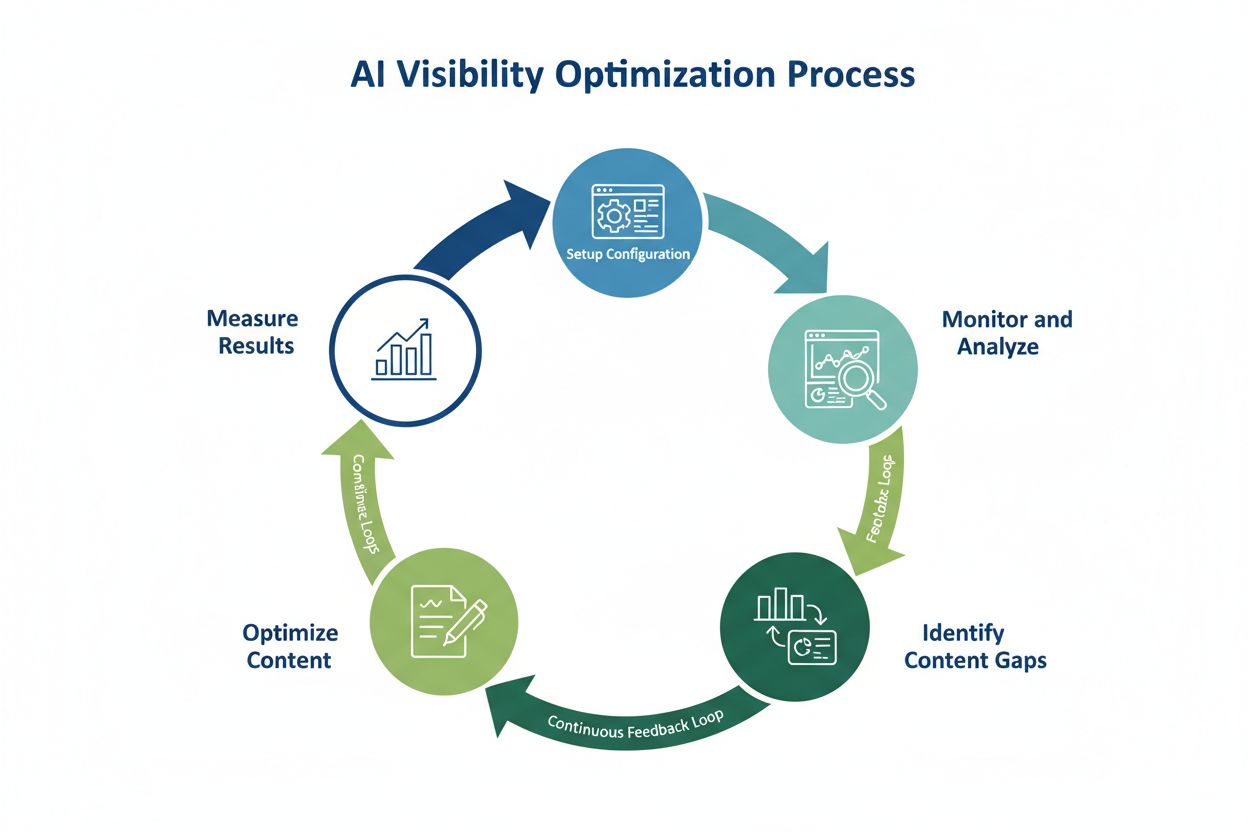
Getting started with AI visibility software begins with selecting a platform that matches your specific needs, then conducting a baseline audit to understand your current citation rates, sentiment, and competitive positioning across all major AI platforms. Setting up tracking involves configuring your brand name, key competitors, important topics, and alert thresholds—most platforms provide guided setup wizards that walk you through this process in 30-60 minutes. Your optimization workflow should follow a structured cycle: monitor citation patterns, identify gaps where competitors are cited but you’re not, analyze the content those competitors are using, create or optimize your own content to address those gaps, then measure the impact on your citation rates over the following weeks. Measuring success requires establishing baseline metrics (current citation count, share of voice, sentiment distribution) and tracking progress monthly, with realistic expectations of 10-20% citation improvements in the first 90 days as your optimizations take effect. Most successful implementations involve cross-functional collaboration between marketing, content, and technical teams—marketing identifies optimization opportunities, content creates or updates assets, and technical teams implement schema markup and ensure AI crawler accessibility. Starting with your top 3-5 competitors and 10-15 key topics allows you to focus your optimization efforts where they’ll have the most impact, then expanding to broader monitoring as you develop expertise and see results.
Traditional SEO focuses on ranking positions in search engine results pages, while AI visibility measures how often and how prominently your brand appears in AI-generated responses from ChatGPT, Perplexity, and similar platforms. AI visibility is about citations and mentions in conversational answers rather than search rankings.
Real-time monitoring is ideal, but at minimum you should check your AI visibility metrics weekly. AI systems update frequently, and visibility can shift rapidly as new content is published and algorithms change. Daily monitoring helps you respond quickly to competitive threats or visibility opportunities.
Yes. Many platforms offer entry-level plans starting at $25-$99 per month, making AI visibility monitoring accessible to small businesses. These plans typically include monitoring of 10-25 prompts across major AI platforms, providing sufficient visibility for most small business needs.
Citations are explicit source attributions where AI systems link to or directly reference your website or domain. Mentions are contextual references to your brand or products without direct attribution. Both impact visibility, but citations are generally more valuable for driving traffic and establishing authority.
Most companies see measurable improvements within 4-8 weeks of implementing optimization recommendations. However, you'll see citation data immediately after setting up monitoring. Realistic expectations are 10-20% citation improvements in the first 90 days as your optimizations take effect.
Start with ChatGPT, Google AI Overviews, and Perplexity as they have the largest user bases. Then add Claude and Gemini based on your target audience. If your customers use specific AI tools, prioritize those platforms first.
Most brands get the best value from one comprehensive platform like AmICited or Profound. Using multiple tools creates redundant data and complicates analysis. The exception is combining a monitoring platform with a specialized optimization tool like FlowHunt.io for prompt-level insights.
AI visibility data shows how your brand appears in AI-generated responses, while traditional analytics show traffic and user behavior on your website. AI visibility is a leading indicator—improved citations often lead to increased traffic weeks or months later as more users discover your brand through AI responses.
Get complete visibility into how your brand appears across ChatGPT, Perplexity, Google AI Overviews, and other AI platforms. Track citations, monitor sentiment, and optimize your presence in AI-generated responses.
Learn essential AI visibility resources and tools for beginners. Discover how to monitor your brand in ChatGPT, Perplexity, and Google AI Overviews with our com...

Discover the best AI visibility tools to monitor your brand across ChatGPT, Perplexity, Google AI Overviews, and other AI search engines. Compare features, pric...

Learn the essential skills AI visibility professionals need: technical expertise, content strategy, data analysis, and continuous learning. Master GEO and AI mo...