

What AI Visibility Consultants Offer: Service Overview
Discover what AI visibility consultants offer: from audits and monitoring to content optimization and GEO consulting services. Learn how to improve your brand's...
9 min read
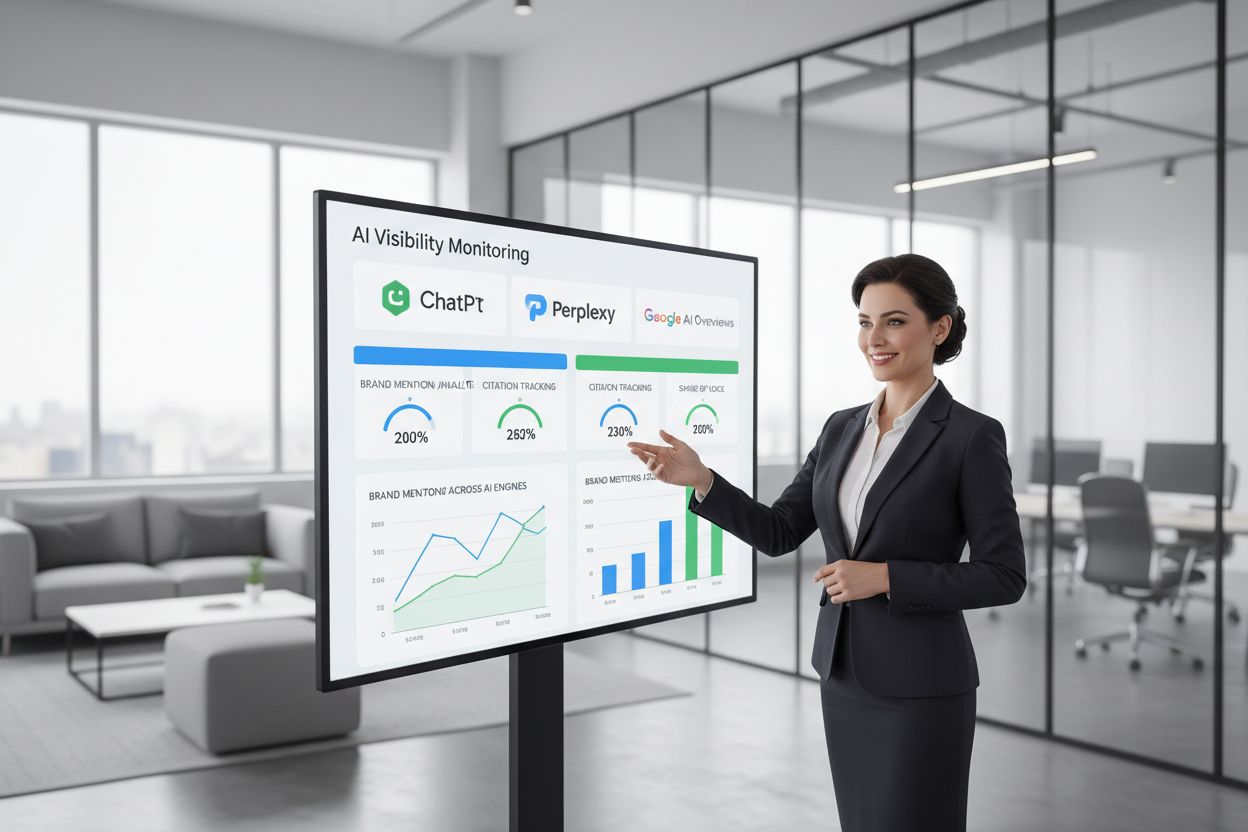
Learn how to evaluate AI visibility consultants with our comprehensive hiring guide. Discover key evaluation criteria, red flags, and best practices for selecting the right consultant for your brand.
AI visibility consulting has emerged as a critical service for brands navigating the shift from traditional search to AI-powered answer engines. As platforms like ChatGPT, Perplexity, and Google’s AI Overviews handle billions of daily queries, the way your brand appears in AI-generated responses directly impacts your discoverability and credibility. AI visibility consultants specialize in optimizing your content and digital presence to ensure your brand gets mentioned, cited, and recommended when users ask relevant questions in these new AI-driven search environments. Unlike traditional SEO, which focuses on ranking for specific keywords, AI visibility consulting addresses a fundamentally different challenge: ensuring your brand is part of the conversation when AI engines synthesize answers from multiple sources.
The most critical evaluation criterion for any AI visibility consultant is whether they start with your business problem or with technology. A consultant who leads with “let’s implement AI” or “let’s optimize for ChatGPT” is already off track. The right approach begins with understanding your specific business challenges, market position, and strategic goals. Before any technical work begins, a qualified consultant should help you define:
This upfront clarity prevents months of expensive iteration and ensures your consultant’s recommendations align with what actually matters to your business, not just what’s technically possible.

Track how AI chatbots mention your brand across ChatGPT, Perplexity, and other platforms.
Before hiring an AI visibility consultant, conduct an honest assessment of your organization’s readiness. Many companies invest in AI visibility optimization only to discover they lack the foundational infrastructure to act on the insights. A qualified consultant will help identify these gaps, but you should understand what “ready” looks like before the engagement begins.
| Readiness Factor | Ready Organization | Not Ready Organization |
|---|---|---|
| Data Quality | Clean, accessible, well-documented content and customer data | Fragmented data silos, inconsistent formatting, poor documentation |
| Technical Infrastructure | Modern CMS, API integrations, monitoring tools in place | Legacy systems, manual processes, limited integration capabilities |
| Team Skills | Marketing team understands content optimization, analytics literacy exists | Limited technical knowledge, no dedicated analytics resources |
| Decision-Making Process | Clear approval workflows, data-driven decision culture | Slow approval cycles, resistance to data-driven changes |
| Content Management | Established content governance, regular publishing cadence | Inconsistent publishing, unclear ownership of content updates |
If your organization scores low on these factors, your consultant’s first job should be helping you build these foundations. If they skip this assessment and jump straight to optimization, that’s a red flag. The best consultants understand that sustainable AI visibility improvements require organizational readiness, not just technical implementation.
When assessing a consultant’s technical capabilities, move beyond vague claims about “AI expertise” and ask specific, probing questions. A qualified AI visibility consultant should be able to explain exactly how AI models work and how they approach data collection and analysis. Ask them to walk you through their methodology:
A consultant who can’t clearly explain these technical foundations is likely relying on templates rather than tailored solutions. The best consultants combine technical depth with business acumen—they understand the “how” and the “why.”
Get the latest insights on AI mentions, brand monitoring, and optimization strategies.
Technical expertise alone isn’t enough. The consultant must understand your specific industry, competitive landscape, and the unique ways AI engines interpret information in your space. Many consultants fall into the trap of applying the same playbook across different industries, which rarely produces optimal results.
Real value comes from diagnosis, not templates. A consultant working with a healthcare brand needs to understand regulatory requirements, patient privacy concerns, and how AI engines handle medical information differently than consumer products. A financial services consultant must grasp compliance requirements and how trust is built in that industry. An e-commerce consultant should understand how AI engines evaluate product recommendations and customer reviews. Ask potential consultants about their experience in your specific industry and request case studies from similar companies. Be wary of consultants who claim expertise across dozens of unrelated industries—depth in your space matters more than breadth across many sectors. The best consultants tailor proven methodologies to your unique business context rather than forcing your business into their existing framework.
As AI systems become more prevalent in business decisions, transparency and explainability have moved from nice-to-have to essential. You need to understand not just what your consultant recommends, but why they’re recommending it. This matters for multiple reasons:
Candidates, customers, and regulators increasingly expect fairness and clarity in AI-driven decisions. If your consultant recommends prioritizing certain content or customer segments, you should be able to explain the logic behind that decision. Audit trails and documentation become critical for compliance purposes, especially in regulated industries like healthcare and financial services. A consultant who can’t provide clear documentation of how their recommendations were derived is creating compliance risk for your organization. Additionally, explainability helps your team understand and maintain the consultant’s recommendations long-term. If the consultant leaves and you can’t explain why certain decisions were made, you’re stuck. Demand that your consultant provides comprehensive documentation of their methodology, decision logic, and the data supporting their recommendations.
One of the most common mistakes organizations make is accepting a consultant’s ROI projections at face value. Glossy presentations showing “50% improvement in brand mentions” or “3x increase in AI citations” mean nothing without independent validation. Instead, implement a rigorous approach to measuring actual business impact:
Request customer references in your industry and company size, then contact them directly. Ask specific questions: Did the consultant’s recommendations actually improve your AI visibility? Did those improvements translate to measurable business outcomes like increased traffic, leads, or conversions? What was the actual ROI compared to the consultant’s projections? Pilot the consultant’s recommendations in a controlled environment before scaling. A multinational retailer tested an AI visibility optimization approach in one region before global rollout. While the consultant claimed 50% faster visibility improvements, the retailer measured only 18% improvement—still valuable, but significantly different from the projection. Define specific, measurable KPIs before the engagement begins: share of voice in AI responses, citation frequency, traffic attribution from AI sources, conversion rates from AI-referred visitors. Track these metrics throughout the engagement and compare actual results to projected results. A consultant confident in their work will welcome this scrutiny and provide transparent reporting on outcomes.

The AI consulting landscape is crowded and consolidation is inevitable. Choosing the wrong consultant could leave you with unsupported services or abandoned methodologies in 18 months. Before committing to a long-term engagement, evaluate the consultant’s stability and long-term viability:
Review the consultant’s funding and financial health. Are they well-funded with a clear path to profitability, or are they burning through venture capital with an unclear business model? Ask about their long-term roadmap and strategic priorities. Are they investing in the areas that matter to your business, or are they pivoting to chase different market opportunities? Ensure their integrations with your ATS, CMS, and other critical systems are proven and stable, not just “planned” for future releases. Understand their support model and what happens if you need help after the initial engagement. A consultant who can’t clearly articulate their long-term strategy or who seems uncertain about their roadmap is a higher risk. The best partnerships are built on mutual long-term commitment and aligned incentives.
Certain warning signs should immediately disqualify a consultant from consideration. Watch for these red flags during your evaluation process:
Trust your instincts. If something feels off during the evaluation process, it probably is.
Rather than making consultant selection decisions ad hoc, create a structured evaluation framework that your team can apply consistently. This approach ensures you’re comparing consultants fairly and making decisions based on criteria that matter to your business, not just gut feel. Here’s how to build your framework:
Create a scoring rubric that weights the evaluation criteria based on your priorities. If technical expertise is critical to your organization, weight that heavily. If industry knowledge is more important, adjust accordingly. Involve multiple stakeholders in the evaluation process—your CMO, head of marketing, head of analytics, and IT leadership should all have input. Different perspectives catch different red flags and ensure buy-in across the organization. Document your decision criteria and scoring before you start evaluating consultants. This prevents bias and ensures consistency. Plan for ongoing assessment throughout the engagement. The best consultant relationships include regular check-ins on progress, honest conversations about what’s working and what isn’t, and willingness to adjust the approach based on results. Evaluation doesn’t end when you sign the contract—it’s an ongoing process that ensures the consultant continues to deliver value.
Track how AI engines reference your brand across ChatGPT, Perplexity, and Google AI Overviews. Get actionable insights to improve your AI search presence.
Discover what AI visibility consultants offer: from audits and monitoring to content optimization and GEO consulting services. Learn how to improve your brand's...
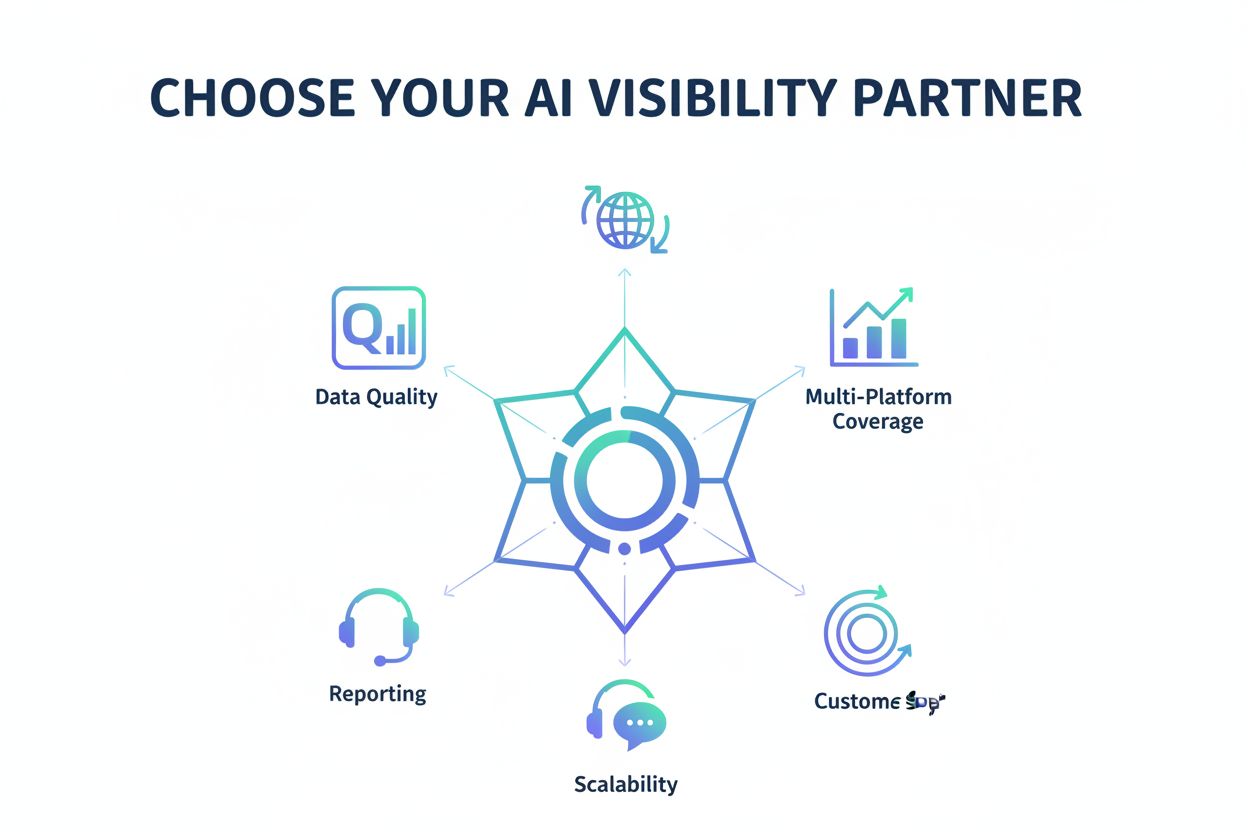
Learn how to select the right AI visibility agency for your brand. Compare GEO agencies, evaluate selection criteria, and discover top platforms for monitoring ...
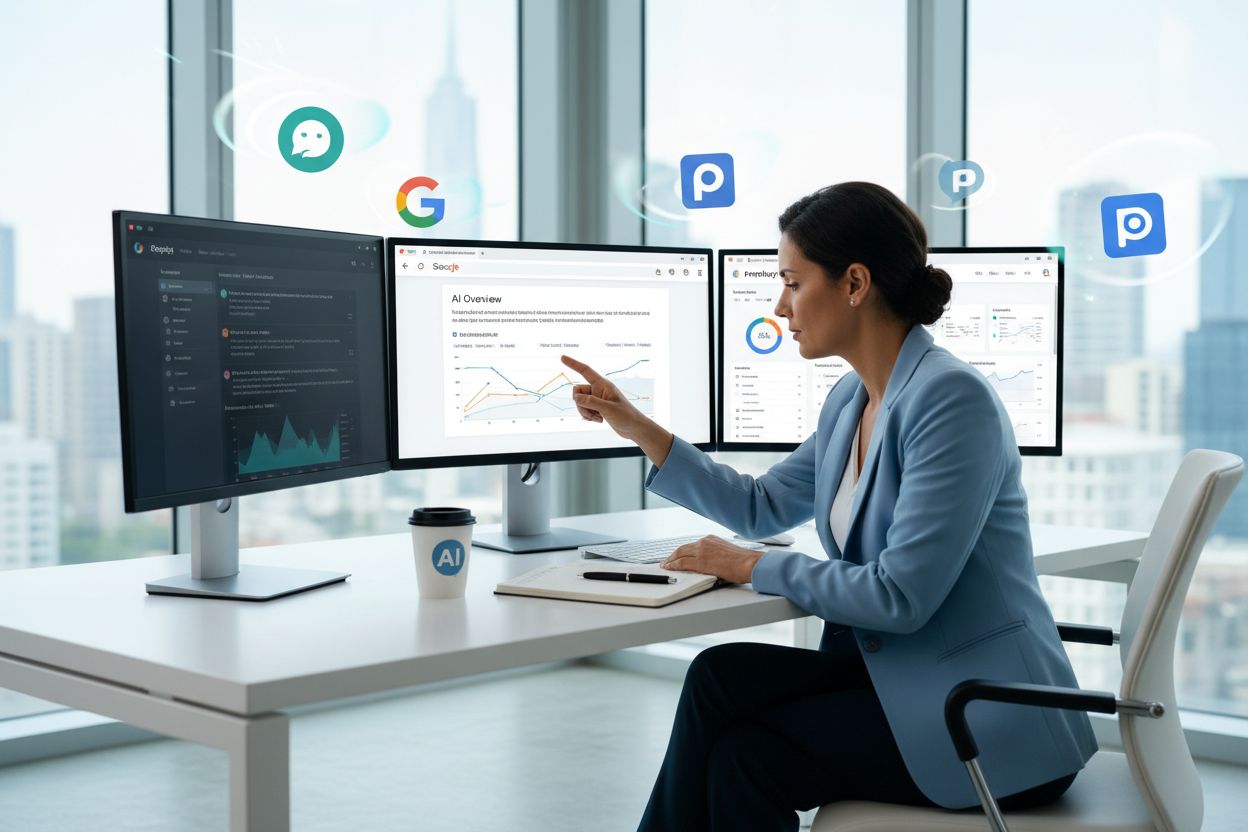
Learn how to conduct a baseline AI visibility audit to understand how ChatGPT, Google AI, and Perplexity mention your brand. Step-by-step assessment guide for b...